What if your company never had to write a massive check for a server refresh or a fleet of new laptops again? You’re likely used to the cycle of equipment slowing down, followed by a stressful capital expenditure that drains your cash flow. It’s a common frustration for business leaders who want to stay competitive without the constant burden of owning depreciating assets. This is exactly why more organizations are moving toward hardware as a service (HaaS). In a year defined by higher interest rates and rapid AI advancements, shifting from heavy upfront costs to a predictable monthly model is the smartest way to keep your operation lean and modern.
We know that managing hardware lifecycles and complex disposal regulations can feel like a full time job you didn’t sign up for. You need your technology to be a silent, efficient partner that supports your goals without the headaches. This guide will show you how hardware as a service (HaaS) eliminates technical debt and ensures your team always has current, high performing tools. We’ll explore how you can secure automatic hardware refreshes and expert support within one stable price. You’ll learn how to move away from reactive fixes and toward a strategy that prioritizes operational serenity and long term growth.
Key Takeaways
- Learn how to swap heavy upfront IT costs for a flexible subscription that covers everything from procurement to ongoing maintenance.
- Understand how shifting from CapEx to OpEx frees up vital capital for your business growth rather than tying it up in depreciating assets.
- Discover how hardware as a service (HaaS) keeps your staff productive with automatic technology refreshes every three to four years.
- Find out how Service Level Agreements (SLAs) act as your safety net, ensuring expert support is always included in your monthly cost.
- See why businesses across Ontario and Canada are using this model to simplify hybrid work and stay compliant with evolving data disposal laws.
What is Hardware as a Service (HaaS) and How Does It Work?
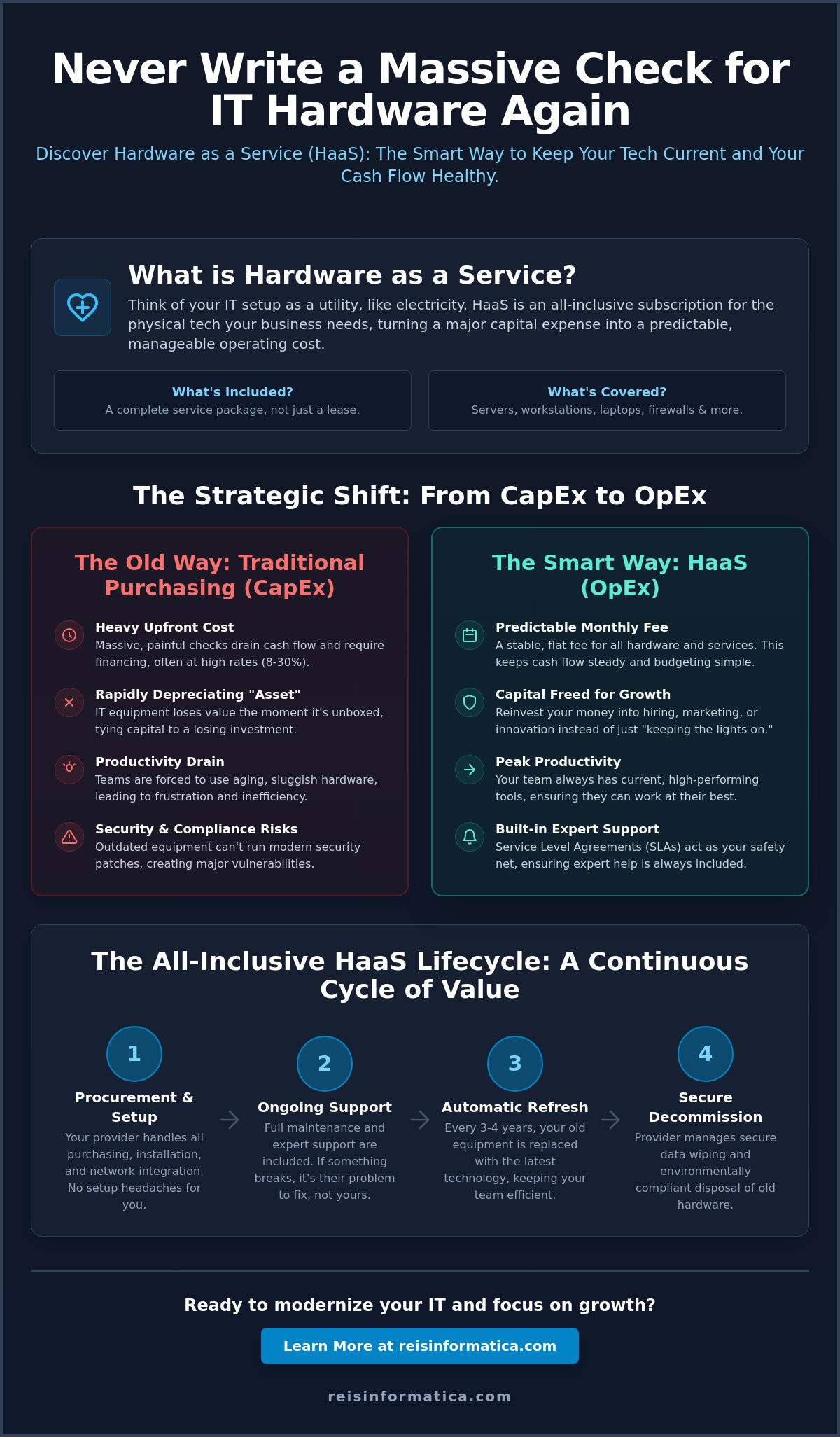
Imagine your IT setup as a utility, much like electricity or water. You don’t buy the power plant; you pay for the light it provides. That is the core of hardware as a service (HaaS). It’s a subscription based model where you pay a monthly fee for the physical equipment your business needs to thrive. Unlike a traditional lease, which is often just a financial arrangement to pay for gear over time, HaaS is a comprehensive service package. It includes everything from the initial procurement and installation to ongoing maintenance and expert support.
By understanding the ‘as a service’ model, you can see how this shift moves the burden of ownership to your provider. This means if a server fails or a workstation starts acting up, the responsibility for fixing or replacing it lies with your provider, not your internal team. Typical equipment covered under this model includes:
- High performance servers and storage solutions
- Employee workstations and laptops
- Networking gear like firewalls and switches
The HaaS Lifecycle: From Setup to Refresh
Your provider handles the heavy lifting from day one as part of their managed IT services. They don’t just drop boxes at your door. They manage the entire setup and integration into your existing network. One of the biggest wins for your team is the automatic refresh cycle. Every three or four years, your provider replaces your equipment with the latest technology. This prevents the productivity slump that happens when staff are forced to use aging, sluggish computers. At the end of the term, your provider manages the secure decommissioning of the old hardware, which is vital for meeting modern data privacy standards.
HaaS vs. Traditional Purchasing
Many leaders view buying hardware as building an “asset.” In reality, IT equipment is a rapidly depreciating one. The moment you unbox a new server, its value begins to drop. Traditional purchasing ties you to a “buy and hold” mentality. You’re often incentivized to squeeze every last second of life out of a machine, even if it’s costing you in downtime. HaaS shifts you to a “subscribe and evolve” model. You aren’t stuck with yesterday’s tech; you’re invested in a reliable outcome that grows with your business needs.
The Strategic Benefits: Moving from CapEx to OpEx
For most business owners, writing a five figure check for a server refresh is a painful experience. This is what we call Capital Expenditure (CapEx). It’s a large, upfront investment in an asset that immediately starts losing value. In 2026, with equipment financing rates often ranging from 8% to 30% depending on credit and business age, tying up your cash in hardware can be a costly mistake. Hardware as a service (HaaS) changes this dynamic by shifting your IT costs into Operating Expenses (OpEx).
As IBM explains in their overview of What is Hardware as a Service (HaaS), this model treats technology like a monthly utility. Instead of a massive one time hit to your bank account, you pay a predictable, flat fee. This keeps your cash flow steady. It allows you to reinvest that capital into your core business growth, like hiring new talent or launching a marketing campaign, rather than just “keeping the lights on.” This financial predictability is a cornerstone of effective managed IT services.
Cybersecurity and Compliance Advantages
Old hardware isn’t just slow; it’s a security risk. Outdated machines often lack the processing power needed for modern encryption or the latest security patches. By staying on a structured refresh cycle, you ensure your team is always using equipment capable of defending against modern threats. This physical layer of protection works alongside your “Human Firewall” to create a robust defense. You can learn more about how we protect your team through our cybersecurity services. Remember, Hardware as a Service ensures your physical security layers are never more than a few years behind the latest threats.
Scalability for Growing Teams
Scaling a business is rarely a perfectly straight line. You might hire five people this month and none the next. HaaS provides the flexibility to add or remove workstations as your team fluctuates. You won’t end up with a closet full of old laptops gathering dust. It’s a lean approach that ensures you only pay for what you’re actually using. If you’re looking to refine your technology roadmap, our team can help you build a custom IT strategy that balances performance with budget.
Overcoming Common Challenges: Implementation and Scalability
One of the biggest concerns we hear from business leaders is the fear of downtime. What happens if a critical server or a workstation fails in a hardware as a service (HaaS) model? When you own the equipment, a breakdown often leads to a frantic search for replacement parts or expensive emergency repairs. With HaaS, the burden shifts entirely to your partner. Your Service Level Agreement (SLA) acts as a legal guarantee, defining exactly how quickly your provider must respond and resolve the issue. It’s built in protection that ensures your team stays productive without unexpected repair bills.
Security is another major hurdle during any technology transition. By May 2026, updates to the HIPAA Security Rule will mandate even more rigorous processes for sanitizing retired devices. Whether you are in healthcare or finance, you need to know that your old data is being destroyed according to NIST approved standards. This level of care is a standard part of a resilient IT foundation. For a deeper look at the physical components that keep your business running, check out our Infrastructure Services guide.
Choosing the Right HaaS Partner
Not all contracts are created equal. When evaluating a provider, look closely at the refresh cycles. A standard three to four year window is ideal to stay ahead of the “old computer” slump. You also want a partner who understands the unique compliance needs of your industry, such as legal or medical regulations. Make sure the exit clauses are clear so you aren’t locked into a rigid agreement that no longer serves your growth.
Managing the Transition
Moving to a subscription model doesn’t have to happen overnight. Most businesses choose to phase out old equipment as it reaches the end of its life, replacing it with HaaS units one department at a time. This gradual rollout makes the accounting shift easier for your CFO or bookkeeper. They’ll appreciate moving from unpredictable capital spikes to a steady, manageable line item. If you’re ready to simplify your technology management, explore our IT service options to see how we can streamline your operations.
Why HaaS is the Future for Businesses in Kitchener, Waterloo, and Beyond
Kitchener, Waterloo, and the surrounding regions are unique. As a massive Canadian technology hub, our local businesses are often at the forefront of hybrid work and innovation. Hardware as a service (HaaS) is the perfect fit for this environment. It provides the physical backbone for modern operations without requiring you to manage a warehouse of equipment. When you combine high quality hardware with our cloud services, you essentially create an “IT in a box” solution. Your team can work from Mississauga, Calgary, or Halifax with the same level of performance and security as if they were in the office.
This model also prepares you for the future of work. We know that AI business solutions are top of mind for leaders in 2026. However, running advanced AI workloads requires significant processing power. HaaS ensures your team isn’t trying to run 2026 software on 2020 hardware. You get the speed you need to stay competitive while keeping your costs predictable. It’s a strategic way to ensure your technology facilitates growth instead of acting as a bottleneck.
Local Support vs. Global Call Centres
When a device fails, you don’t want to spend hours on the phone with a global call centre. The value of local support is that technicians can physically reach your office in London or Milton if a hands on fix is required. This proximity also ensures your hardware management aligns with Canadian data residency and compliance needs. We understand the local landscape and the specific regulatory pressures facing Canadian businesses today. It’s about having a partner who is accessible and accountable.
Conclusion: Peace of Mind for Leadership
Ultimately, hardware as a service (HaaS) is about reclaiming your time. As a leader, your focus should be on high level strategy and growth, not worrying about server fans or laptop lifecycles. By letting a specialist manage the technical complexity, you gain the serenity of knowing your operation is stable and secure. It’s time to move away from reactive IT and toward a proactive partnership that scales with your ambition. Contact Reis Informatica to see how HaaS can transform your business.
Modernize Your Business Strategy for 2026
Transitioning to hardware as a service (HaaS) isn’t just about getting new computers; it’s about reclaiming the mental energy you currently spend on technical debt. By shifting to a predictable operating expense model, your organization can stabilize cash flow while staying ahead of rapid technology cycles. You’ve seen how this approach removes the security risks of aging equipment and the headaches of secure data disposal. Instead, you gain a partner who manages the physical infrastructure so you can stay focused on your high level strategy and growth.
We’ve been serving local businesses across Canada since 1999, providing expert managed IT and cybersecurity integration. Our predictable models are built specifically for the needs of Canadian SMEs, ensuring you have the support you need when it matters most. If you’re ready to eliminate the burden of hardware ownership and build a more resilient, scalable workplace, we’re ready to help. Get a Custom HaaS Quote for Your Business today. Let’s make your technology a silent, powerful engine for your continued success.
Frequently Asked Questions
Is Hardware as a Service just a fancy name for leasing?
Not exactly; while they share some similarities, HaaS is a much more comprehensive solution. A lease is primarily a financial tool to help you pay for equipment over time. In contrast, hardware as a service (HaaS) is a complete management package that includes installation, ongoing maintenance, and expert support. You aren’t just paying for the box; you’re paying for the guaranteed uptime and performance of that equipment throughout its entire lifecycle.
What happens to my data when I return the hardware at the end of the term?
Your data is securely destroyed using industry recognized sanitization methods before the hardware is decommissioned. We follow strict standards, like those set by NIST, to ensure that sensitive information is completely unrecoverable. This process is essential for staying compliant with Canadian privacy laws and evolving 2026 regulations. We handle the documentation so you have proof that your old drives were wiped properly and safely.
Can I include specialized equipment like servers and firewalls in a HaaS agreement?
Yes, you can include almost any critical piece of IT infrastructure in your agreement. This model isn’t limited to just laptops or desktops. Many businesses use it for high performance servers, complex firewalls, and network switches. Including these specialized tools ensures that your entire network foundation stays current and supported under one predictable monthly cost. It’s a great way to manage your most complex assets without the risk of obsolescence.
How does HaaS help with my business taxes in Canada?
Hardware as a service (HaaS) typically allows you to categorize your IT costs as a fully deductible operating expense (OpEx) rather than a capital asset that must be depreciated over several years. This can simplify your accounting and potentially provide a more immediate tax benefit. Since you don’t own the equipment, you don’t have to track complex depreciation schedules for every laptop. It’s always best to consult with your accountant to see how this impacts your filing.
What if my business grows faster than expected—can I add more hardware easily?
Scalability is one of the biggest advantages of this model. If you hire new staff or open a new branch, you can simply add the necessary workstations or networking gear to your existing subscription. There’s no need to find a large chunk of capital for a sudden expansion. This flexibility allows you to respond to market opportunities quickly. You only pay for the equipment you need to support your current team size and operational goals.