
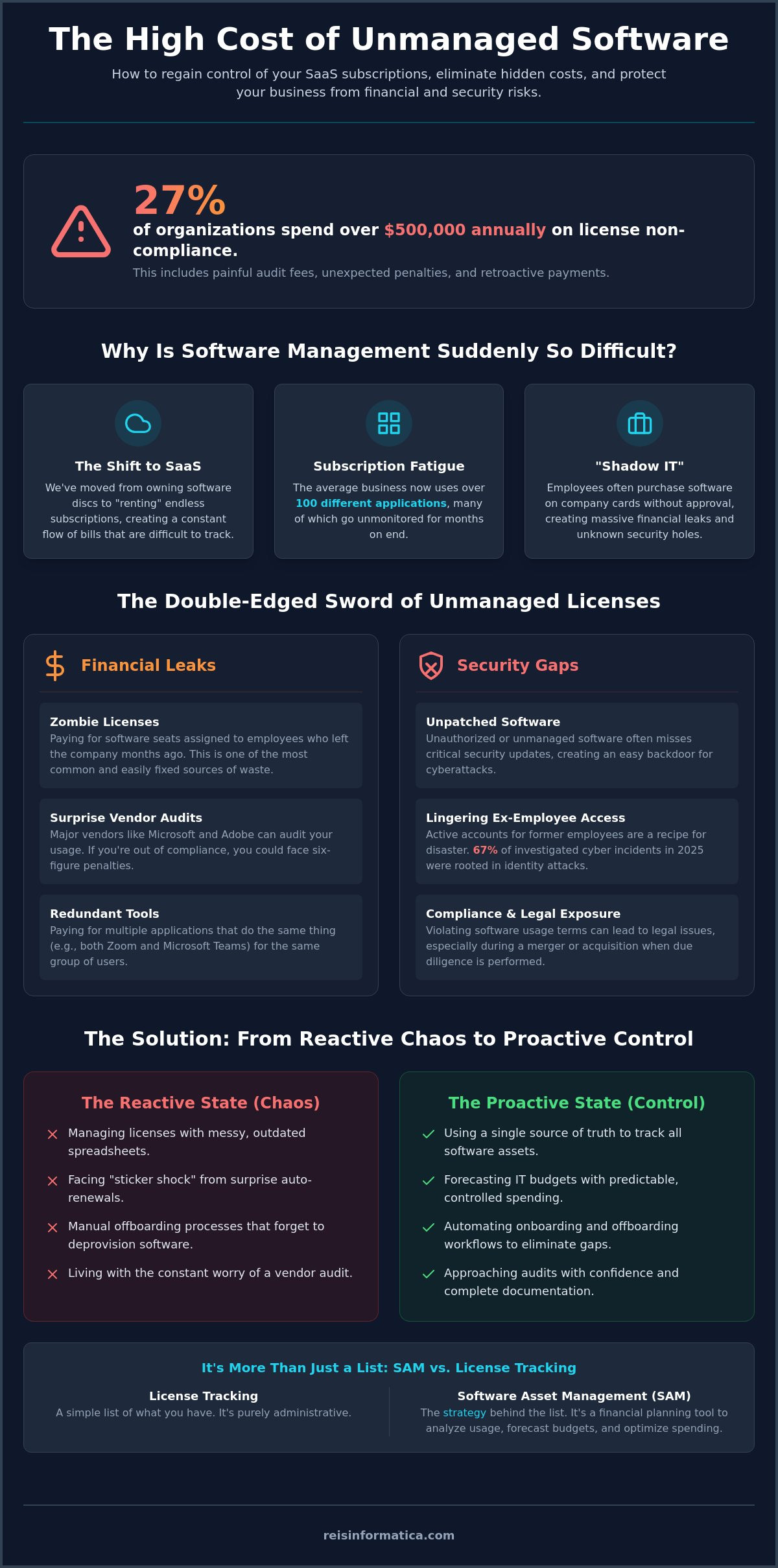
Did you know that 27% of organizations now spend over $500,000 every year just to cover the costs of license non-compliance, including those painful audit fees and unexpected penalties? For many Canadian business leaders, the rapid expansion of SaaS tools has turned a once-simple task into a complex financial drain. Effective software license management isn’t just a technical chore; it’s a vital safeguard for your company’s stability and bottom line. You likely feel the pressure of unpredictable monthly bills and the nagging worry that former employees might still have access to your sensitive data.
It’s completely understandable to feel overwhelmed by the sheer volume of subscriptions and the shifting legal landscape, especially with new regulations like Bill C-8 now in full effect. We’re here to help you move from a reactive state of putting out fires to a position of total control. This guide will show you how to eliminate wasted spending, ensure you’re fully compliant with Canadian standards, and secure your operations. You’ll learn the steps to achieve total visibility into your software assets and how to automate your onboarding and offboarding processes to keep your business running smoothly.
Key Takeaways
- Understand why the modern “subscription” model makes tracking your software more difficult and how to regain control of your monthly bills.
- Spot the hidden “zombie licenses” in your organization to ensure you aren’t paying for seats assigned to former team members.
- Protect your company from six-figure penalties by mastering proactive software license management before a vendor audit ever happens.
- Learn how to move from messy spreadsheets to a single source of truth that automates your onboarding and offboarding workflows.
- Discover the strategic advantage of using managed IT services to secure better pricing and expert guidance for your software portfolio.
What is Software License Management and Why Does It Matter in 2026?
At its core, software license management is the process of documenting and managing exactly where and how software is used within your company. It used to be simpler when you bought a disc and owned the software forever. Today, the shift from “buying” to “renting” through the SaaS model has made oversight far more complex but also more critical for your survival. You’re no longer just managing a few assets; you’re managing a constant flow of subscriptions that can easily spiral out of control.
Think of What is Software Asset Management (SAM) as the strategic foundation for your broader infrastructure services. It’s the professional practice that ensures your technology stack is resilient, secure, and cost-effective. For business leaders in Kitchener and Waterloo, prioritizing this oversight is a proven way to fuel lean growth while avoiding the operational bloat that often slows down competitors.
Software Asset Management (SAM) vs. License Tracking
Many people confuse license tracking with SAM. License tracking is just a list of what you have. SAM is the strategy behind that list. It involves analyzing usage data to forecast your IT budget for the next fiscal year. This proactive approach prevents the “sticker shock” that often happens when multiple high-cost subscriptions renew at the same time without warning. It turns a technical inventory into a powerful financial planning tool.
The 2026 Landscape: Subscription Fatigue
The current business landscape is defined by subscription fatigue. The average business now uses over 100 different apps; many of these go completely unmonitored for months. This leads to “shadow IT,” where employees purchase software on company credit cards without official approval. These unauthorized tools create massive financial leaks. They also open doors for security risks that your team might not even know exist, making software license management a key pillar of your overall risk mitigation strategy.
The Financial and Security Risks of Unmanaged Licenses
Unmanaged software creates a double-edged sword of risk that can wound both your bank account and your reputation. One of the most common issues we see is the “Zombie License” problem. This happens when you keep paying for software seats assigned to employees who left your company months ago. It’s essentially throwing money away on a monthly basis because your offboarding process isn’t synced with your billing.
Then there’s the looming threat of vendor audits. Major players like Microsoft or Adobe aren’t shy about checking the books. If your software license management is messy, you could face six-figure penalties. In fact, research shows that 27% of organizations spend over $500,000 annually on license non-compliance. These aren’t just small true-up fees; they’re major financial hits that can derail your quarterly goals and drain your reserves.
Beyond the money, there’s a massive security gap to consider. Unmanaged or unauthorized software often misses critical updates. This creates a backdoor for cyberattacks. Since 67% of investigated cyber incidents in 2025 were rooted in identity attacks, leaving old accounts active is a recipe for disaster. Integrating robust cybersecurity services helps close these gaps by ensuring every piece of software on your network is authorized and patched.
Financial Leakage: Beyond the Subscription Fee
Redundancy is a silent profit killer. We often find businesses paying for Zoom and Microsoft Teams simultaneously. While each tool has its merits, paying for both for the same group of users is redundant. In competitive business hubs like Mississauga, maintaining a lean operation is essential for staying ahead of the curve. Auto-renewals only make it worse. Without a watchful eye, you’ll find your cash flow tied up in tools you don’t actually need.
Compliance and Legal Exposure
Legal risks extend into the fine print of your contracts. Many leaders assume “unlimited” means they can do anything, but corporate agreements usually have strict usage limits. Proper documentation is your best defense. If you’re planning a merger or acquisition, having a clean record of your software assets makes the due diligence process much smoother. It proves to potential partners that your operation is tight and professional. If you aren’t sure where your current risks lie, a quick review of your managed IT services can provide the clarity you need.
5 Best Practices for Optimizing Your Software Portfolio
Optimizing your portfolio doesn’t have to be a Herculean task. It starts with moving away from disparate spreadsheets that are likely out of date the moment you save them. You need a single source of truth. Centralizing your inventory is the first step toward effective software license management. When everything is in one place, you can spot waste instantly and make informed decisions about your technology investments.
Next, you should automate your offboarding. The moment an employee leaves your company, their software access should be revoked. This stops those “zombie licenses” we discussed earlier from draining your budget. You also need a clear procurement policy. If anyone with a company credit card can buy software, your budget will always be a mess. Set rules on who can spend and what specific tools are allowed within your organization.
Regularly audit your usage too. We recommend a simple 30-day rule. If a tool hasn’t been logged into for 30 days, reassign that license or cancel it. There’s no reason to pay for a seat that’s gathering digital dust while your team focuses on other priorities.
Implementing Role-Based Access Control (RBAC)
RBAC is just a clear way of saying you give employees only the tools they need for their specific job title. It prevents “license creep,” where everyone has every app “just in case.” This strategy also significantly improves cybersecurity awareness by limiting the potential damage from a compromised account. When users only have access to what they need, your overall risk profile drops.
Standardizing Your Tech Stack
Reducing complexity is key to a smooth operation. Choosing “all-in-one” platforms like Microsoft 365 simplifies your ecosystem and makes training much easier for your team. A unified tech stack also streamlines your IT support. If you’re looking for a partner to help you implement these changes, explore how our managed IT services can take the technical weight off your shoulders so you can focus on growth.
How Managed IT Services Simplify Licensing for Canadian Businesses
While many software vendors promote their own tracking tools, a piece of software can’t replace a strategic partner. Tools give you data, but they don’t make decisions for you. This is where IT managed services bridge the gap. We provide the human element that interprets those alerts and acts on them before they become expensive problems. It’s the difference between having a smoke detector and having a full-time fire marshal on site.
One of the biggest advantages of this partnership is the cost savings. Most individual businesses pay retail prices for their subscriptions. Because Managed Service Providers (MSPs) manage thousands of licenses across many clients, they often have access to partner discounts and better pricing tiers that you simply can’t get on your own. It’s a direct way to lower your overhead while gaining expert oversight.
We focus on preventing waste rather than just fixing it. By the time you notice a financial leak, the money is already gone. A proactive partner monitors your environment constantly, moving your software license management from a reactive “firefighting” mode to a streamlined operation. This local expertise is especially valuable in cities like Calgary or London, Ontario, where on-site compliance checks and personalized service ensure your team stays fully aligned with both company policy and Canadian regulations.
Strategic Procurement and Lifecycle Management
Lifecycle management means your partner handles everything from the initial purchase to the final retirement of a license. We’re even starting to integrate AI business solutions to analyze usage patterns across your organization. These tools can actually predict when you’ll need more seats or when you should scale back, keeping your budget perfectly balanced as your company grows.
Peace of Mind for Leadership
For business leaders, the real win is peace of mind. You can focus on your core business goals while experts handle the technical and legal minutiae. With a predictable, flat-fee model that includes license oversight, you’ll never have to worry about a surprise bill or a failed audit. You get a secure, stable environment where technology serves as a silent, efficient facilitator for your success.
Securing Your Business Future Through Strategic Oversight
Regaining control over your technology stack is about more than just cutting costs; it’s about building a resilient foundation for your company’s growth. By eliminating hidden “zombie licenses” and centralizing your inventory, you protect your cash flow and shield your organization from the heavy penalties of vendor audits. Proactive software license management ensures that your tools are always working for you, not against you.
Since 1997, we’ve helped businesses across Kitchener, Calgary, and Halifax navigate the evolving digital landscape. Our team brings specialized expertise in Microsoft 365 and Enterprise Cloud solutions to provide you with the strategic IT leadership your business deserves. We handle the technical and legal minutiae so your leadership team can stay focused on the big picture.
Let Reis Informatica optimize your software licenses and secure your business today. You’ve built something great; let’s work together to ensure your technology supports that legacy every step of the way.
Frequently Asked Questions
How much can a business save with software license management?
A business can typically save between 20% and 30% of their total software spend by implementing diligent software license management. These savings come primarily from identifying and eliminating “zombie licenses” or unused seats that have been billing for months without providing any value. By reassigning these assets or canceling unnecessary subscriptions, you turn wasted IT overhead back into usable capital for your core business operations.
What is the most common mistake businesses make with software licenses?
The most common mistake is decentralized purchasing, where individual departments or employees buy their own tools without central oversight. This creates “shadow IT,” leading to redundant software and making it impossible to track your total legal and financial exposure. Establishing a clear procurement policy ensures that every tool in your stack is authorized, necessary, and integrated into your broader management strategy.
Is a spreadsheet enough for license management?
A spreadsheet is generally only sufficient for very small teams with a handful of applications. Larger organizations require automated tracking to avoid inevitable human error and data silos. Manual lists become outdated quickly as staff join or leave. Professional software license management tools provide a real-time source of truth, ensuring you never miss an auto-renewal or fail to revoke access for a former employee.
How does license management improve cybersecurity?
License management boosts cybersecurity by ensuring every piece of software on your network is legitimate and fully updated with the latest security patches. It also streamlines the offboarding process, which is critical since 67% of investigated cyber incidents in 2025 were rooted in identity attacks. By automatically revoking access the moment an employee exits, you close a major backdoor that hackers often exploit to reach sensitive data.
What happens if we fail a software audit in Canada?
Failing a software audit in Canada can lead to significant legal fees, mandatory back-pay for any unlicensed usage, and lasting damage to your professional reputation. Beyond the immediate financial sting, the audit process itself is time-consuming and disruptive to your daily operations. Maintaining a clean, documented record is the only way to ensure your leadership team stays protected from these legal and financial risks.