
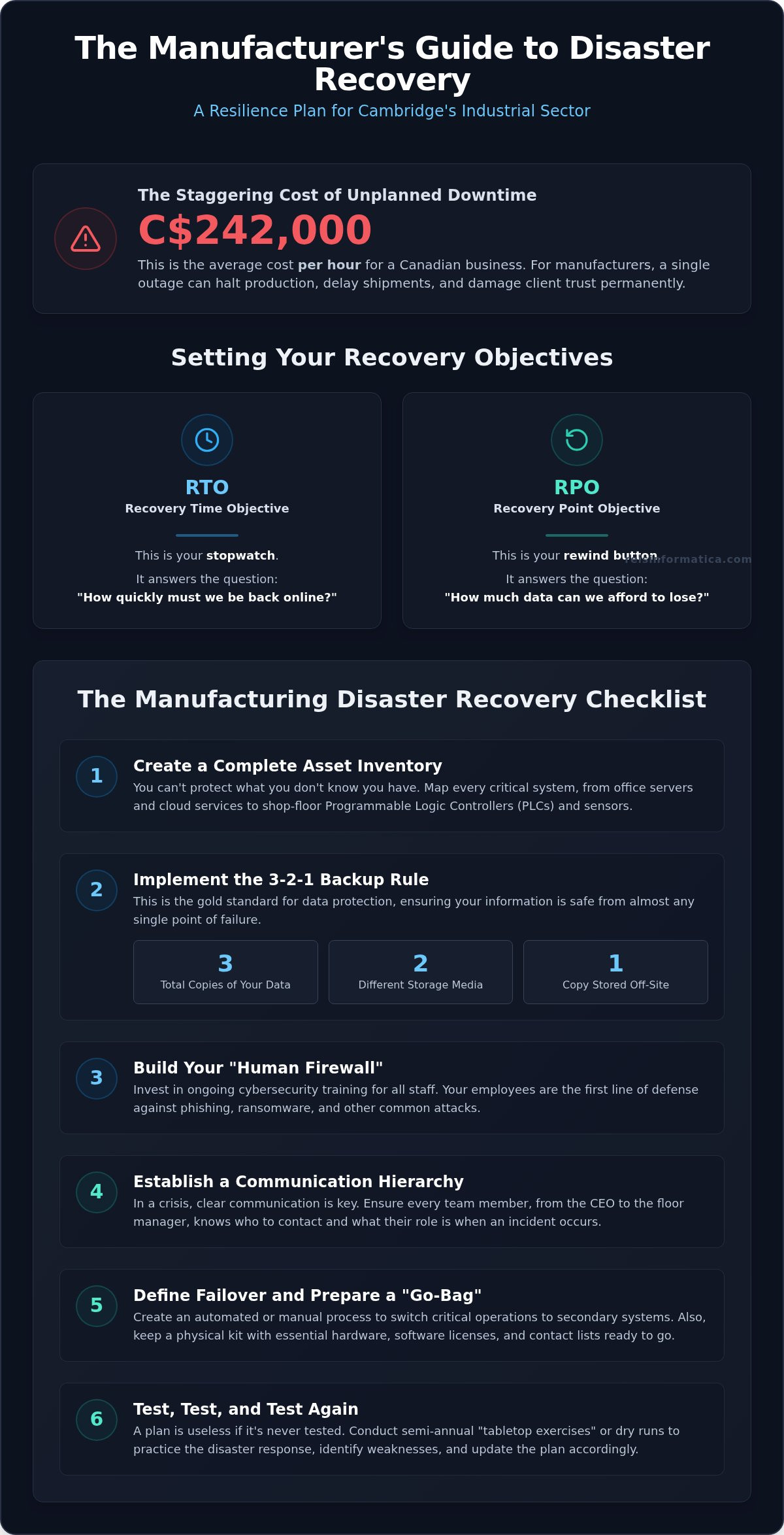
Did you know the average cost of unplanned downtime for a Canadian business is now approximately C$242,000 per hour? In the fast-paced industrial environment of the Waterloo Region, a sudden server crash or ransomware attack can halt your assembly line in seconds. You need a disaster recovery plan for manufacturing Cambridge ON that doesn’t just back up files but actually keeps your shop floor moving. Balancing complex industrial technology with office IT is a massive challenge, and the fear of a digital breach stalling production is a reality many local leaders face every day.
We understand that your priority is maintaining a steady output while protecting your data. This article provides a step-by-step checklist designed to help you build a resilient operation that can withstand IT failures or local disasters. You’ll learn how to minimize your recovery time objectives and ensure your facility stays compliant with Canadian data privacy standards like PIPEDA. By the end of this guide, you’ll have a clear roadmap to keep your facility operational and secure through 2026 and beyond.
Key Takeaways
- Learn why Cambridge’s unique location along the 401 corridor and southwestern Ontario’s power grid demands a specialized approach to IT resilience.
- Access a comprehensive disaster recovery plan for manufacturing Cambridge ON that maps out everything from office servers to shop-floor controllers (PLCs).
- Discover how to calculate your Recovery Time Objective (RTO) and Recovery Point Objective (RPO) to minimize production data loss and assembly line downtime.
- Understand the value of a local vCIO in moving your business from a reactive “set it and forget it” mindset to a proactive, resilient security posture.
Why Cambridge Manufacturers Need a Specific DRP in 2026
In Cambridge, your facility isn’t just a building; it’s a vital link in the 401 corridor supply chain. Local manufacturers often act as “just-in-time” suppliers for the automotive and aerospace sectors. If your systems fail, the trucks stop moving. This ripple effect hits partners across North America almost instantly. This is why a Disaster Recovery Plan (DRP) has evolved from a simple backup folder into a strategy for total operational resilience. By 2026, legislative shifts like Bill C-26 mean that having a formal plan is no longer just a best practice; it’s becoming a legal necessity for protecting Ontario’s critical infrastructure.
The True Cost of Downtime on the Shop Floor
When a server fails, you aren’t just losing access to emails. You’re losing labor hours as staff stand idle and missing critical shipping windows. Research shows that unplanned downtime can cost Canadian businesses an average of C$242,000 per hour. In a tight-margin industry, a four-hour outage doesn’t just hurt your bottom line. It can permanently damage your reputation with Tier-1 clients who rely on your punctuality. A generic plan won’t cover the complexity of syncing your office IT with your shop-floor production data.
Local Vulnerabilities in the Waterloo Region
Cambridge industrial parks face specific regional risks, from southwestern Ontario’s aging power grid to the infrastructure strain caused by rapid growth. A generic, remote-only IT provider might not understand the nuances of our local utilities. Choosing managed IT services from a partner who can be on-site quickly is vital. We focus on proactive resilience so that when the regional grid flickers, your assembly line doesn’t skip a beat. Having a local disaster recovery plan for manufacturing Cambridge ON ensures that your recovery is measured in minutes, not days.
The 2026 Manufacturing Disaster Recovery Checklist
A solid disaster recovery plan for manufacturing Cambridge ON starts with a clear inventory. You can’t protect what you haven’t mapped. In a factory setting, this means looking beyond your office servers to include Programmable Logic Controllers (PLCs) and shop-floor sensors. If a ransomware attack or hardware failure occurs, these controllers are often the first to go offline, bringing production to a standstill. Mapping these assets ensures your recovery efforts target the most critical parts of your operation first.
Following Canadian government guidelines, your strategy must include a clear communication hierarchy. Do your floor managers know exactly who to call when the network drops? Establishing a “failover” process where critical data shifts to secondary systems is essential for continuity. This level of preparation turns a potential catastrophe into a manageable technical hurdle.
Step 1-3: Infrastructure and Data Protection
Start by identifying which systems rely on cloud services versus local hardware. Use the 3-2-1 backup rule: keep three copies of your data on two different types of media, with one copy stored safely offsite. This ensures that even if a local event like a flood occurs, your manufacturing data remains secure. Don’t forget the human element. Investing in cybersecurity services that include staff training builds a “human firewall” that prevents many disasters before they start.
Step 4-7: Operations and Testing
Prepare an emergency “Go-Bag” containing backup hardware and essential software licenses. It’s also vital to schedule semi-annual tabletop exercises. These “dry runs” help your management team practice their roles during a crisis without the pressure of actual downtime. If you’re looking for a partner to guide this process, our team can help you build a resilient IT strategy tailored to your plant’s specific needs. For facilities that rely on wireless connectivity across large floor spaces, ensuring you have a proper business WiFi installation Milton professionals recommend can be a critical component of your operational continuity planning.
Setting Your Recovery Objectives: RTO vs. RPO
Every disaster recovery plan for manufacturing Cambridge ON revolves around two vital acronyms: RTO and RPO. Think of your Recovery Time Objective (RTO) as a stopwatch. It measures how long your assembly line can sit idle before the financial damage becomes critical. Your Recovery Point Objective (RPO) is like a rewind button. It defines how much data you can afford to lose, measured in time. If your system crashes at 3:00 PM and your RPO is one hour, you must be able to restore everything as it existed at 2:00 PM.
Finding the right balance between recovery speed and your budget is a core part of risk management for manufacturers in Ontario. While every owner wants instant recovery, the cost of “always-on” systems must align with your actual business needs. Our Managed IT Services help maintain these targets automatically. We ensure your technology supports your production schedule rather than creating a bottleneck during a crisis.
RTO for Manufacturers: Aiming for Near-Zero
A 15-minute outage in a law office might be a minor annoyance, but for a factory on the 401 corridor, it’s a logistics nightmare. Rapid hardware failover techniques allow your shop floor to switch to backup systems almost instantly. This prevents the “domino effect” where one stalled line stops your entire shipping department. We focus on building local redundancy so your controllers keep running even if the main network flickers.
RPO: Protecting Your Intellectual Property
Your RPO is especially critical for protecting proprietary “recipes” and CAD files. Losing even a few hours of design work or custom machine settings can set a project back days. Linking your RPO to robust Cybersecurity Services prevents ransomware from corrupting your historical data. If you’re ready to define your facility’s safety net, contact us for a custom IT strategy review today.
Implementing Your Plan with Local Cambridge Expertise
A disaster recovery plan for manufacturing Cambridge ON is never a static document you simply file away. In the 2026 threat landscape, a “set it and forget it” mentality is a dangerous gamble for any industrial facility. You need a vCIO who understands your specific production goals and translates them into technical safeguards. This strategic partnership ensures your IT budget isn’t just an expense; it becomes a calculated investment in your operational continuity. By aligning your technology with your business output, you build a foundation that survives the unexpected.
Modern resilience now leverages AI business solutions to move from reactive repairs to predictive prevention. These tools monitor your network for subtle anomalies, often identifying a failing server or a cyber threat before it can halt your assembly line. It’s about staying one step ahead of the risks inherent in southwestern Ontario’s industrial corridor. A resilient wireless network is equally important; understanding the standards for business WiFi installation Milton area businesses depend on can help you eliminate the dead zones and connectivity gaps that leave your shop-floor devices vulnerable during a recovery scenario.
Bridging the Gap Between IT and Leadership
When you present a DRP budget to stakeholders, focus on the return on investment. Every hour of downtime you prevent protects thousands of dollars in labor and shipping commitments. If you’re unsure where to start your search for a local expert, our Cambridge Small Business IT Support Guide offers a roadmap for choosing a partner who understands the unique needs of manufacturers. A good partner will help you turn complex technical requirements into clear business advantages.
Why Local Support Matters in a Crisis
If a critical network switch fails on your shop floor, you don’t have time to wait for a technician to battle traffic from Toronto. Having a local team means an expert can be on-site at your Cambridge facility within the hour. This proximity is vital for maintaining resilient infrastructure services. Your first step toward true security is conducting a local IT risk assessment to find the gaps in your current disaster recovery plan for manufacturing Cambridge ON.
Securing Your Future on the Shop Floor
Resilience in 2026 isn’t just about protecting digital files; it’s about ensuring your physical assembly line never skips a beat. By now, you understand how regional infrastructure risks and 401 corridor logistics make a specialized disaster recovery plan for manufacturing Cambridge ON a business necessity. You’ve learned how to balance your budget against recovery targets and seen why a proactive strategy is far superior to a reactive one. Protecting your proprietary data and shop-floor controllers is the foundation of long-term stability.
Our local Cambridge-Waterloo support team is here to help you stay 2026 compliance ready while providing specialized manufacturing IT expertise. We act as your strategic partner, taking the technical weight off your shoulders so you can focus on production. Don’t wait for a power failure or a cyber breach to test your defenses. Book Your Local Cambridge IT Risk Assessment Today and gain the peace of mind that comes with a truly resilient operation. You’ve built a great business; let’s work together to make sure it’s protected for the long haul.
Frequently Asked Questions
What is the most common cause of downtime for Cambridge manufacturers?
Hardware failure and human error are the most frequent causes of downtime for Cambridge manufacturers. While ransomware is a growing threat, a simple server malfunction or an accidental deletion often triggers the need for a disaster recovery plan for manufacturing Cambridge ON. These internal issues can be just as damaging as external attacks if your team isn’t prepared to switch to a secondary system immediately.
How often should we test our disaster recovery plan?
You should perform a full test of your recovery procedures at least twice a year. Scheduling semi-annual tabletop exercises ensures that your management team knows their roles and that your backup data is actually restorable. Regular testing identifies gaps in your strategy before a real crisis occurs. This allows you to refine your processes without the pressure of an active production halt.
Is cloud backup secure enough for sensitive manufacturing IP?
Modern cloud solutions are highly secure when they include end-to-end encryption and comply with Canadian standards like PIPEDA. Storing your proprietary “recipes” and CAD files in a secure cloud environment protects them from local physical disasters like fires or floods. Using private or hybrid cloud models allows you to maintain full control over who accesses your intellectual property at all times.
What is the difference between a Business Continuity Plan and a Disaster Recovery Plan?
A Business Continuity Plan (BCP) is the broad strategy for keeping your entire company running, while a Disaster Recovery Plan (DRP) focuses specifically on restoring your IT systems. Your BCP might cover where employees work if the building is inaccessible. In contrast, a disaster recovery plan for manufacturing Cambridge ON ensures your servers, shop-floor controllers, and production data are back online quickly.
Does insurance cover the costs of an IT-related production shutdown?
Standard business insurance often requires a specific cyber liability or business interruption rider to cover IT-related shutdowns. Many Canadian insurers now mandate that you have a formal, tested DRP in place before they will issue a policy or pay out a claim. It’s essential to review your policy details with your provider to ensure that lost production hours and data restoration costs are covered.