
Canadian data residency requirements do not impose one blanket rule requiring every business to keep all data in Canada. Under PIPEDA, personal information can generally be processed across borders, but organizations remain responsible for protecting it. Other rules may apply depending on the information, sector, province, and whether the organization is a public body.
It is reasonable to want a clear answer before choosing a cloud or IT provider: where information is stored can affect privacy, access, and compliance. But a Canadian data centre alone does not settle every question, because data residency and data sovereignty describe different risks.
This article explains when Canadian laws require data to stay in Canada, when cross-border transfers may be allowed, and how residency differs from sovereignty. It also covers why backups, support access, and data processing matter alongside the location of the main system, helping you assess the practical implications for your business.
Key Takeaways
- Identify whether your information is personal health data, public-sector data or ordinary business records, since the applicable location rules can differ.
- Assess cross-border access as well as transfers, including how consent requirements and statutory exceptions may affect handling.
- Separate where data is physically stored from which laws may govern access to it, then consider both when assessing risk.
- Compare provincial privacy rules and your organization’s obligations before settling on a storage arrangement or cloud configuration.
What is the difference between data residency and data sovereignty in Canada?
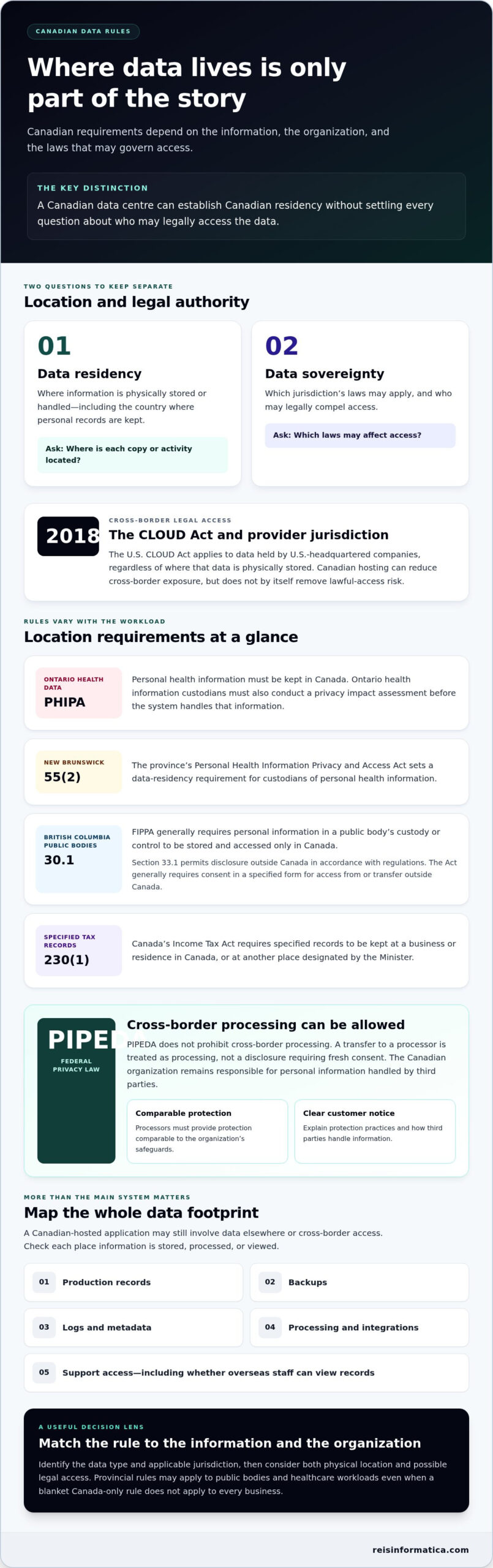
Data residency describes where information is physically stored or handled. For personal information, it means the country where records are stored. Data sovereignty concerns which jurisdiction’s laws may apply and who can legally compel access. A server in Canada can therefore provide Canadian residency while foreign laws may still affect access, depending on the provider and its legal obligations.
This distinction matters for government, healthcare, and financial workloads. A public body may face provincial storage rules that do not apply to an ordinary private business. Businesses handling health records must consider health privacy legislation, while financial records may have separate retention requirements. The appropriate location depends on the information, organization, and laws governing that work.
Ontario has a strict rule for personal health information. The Personal Health Information Protection Act (PHIPA), cited as SO 2004, c 3, Sch A, governs that information and requires it to be kept in Canada. Ontario health information custodians must also conduct a privacy impact assessment. That assessment helps identify privacy risks in a system before it handles personal health information. For example, a clinic reviewing a cloud system needs to assess the information and how the system handles it.
New Brunswick sets a specific residency rule for custodians of personal health information. Section 55(2) of the province’s Personal Health Information Privacy and Access Act imposes a data-residency requirement. The applicable provincial law can therefore change the storage obligations for a healthcare workload.
Financial records need their own analysis. Subsection 230(1) of Canada’s Income Tax Act requires specified tax records to be kept at a business or residence in Canada, or at another place designated by the Minister. In practice, identify each workload, its data, and its jurisdiction. Then map production records, backups, and processing locations. That gives decision-makers a clearer view of residency and legal access risks.
Is data ever transferred outside Canada?
Yes. Canadian rules can allow cross-border storage or processing, but obligations depend on the information and organization. Consent, notice, and the possibility of foreign legal access all affect the risk.
Foreign Legal Access to Transferred Data
Cross-border transfer can expose information to laws in the country where it is stored or processed. That matters because physical location is only part of the access picture. The U.S. CLOUD Act, passed in 2018, applies to data held by U.S.-headquartered companies regardless of where it is physically stored. Canadian storage can reduce cross-border exposure, but doesn’t by itself remove lawful-access risk.
PIPEDA and Cross-Border Processing
PIPEDA treats a transfer to a processor as processing, not a disclosure that needs fresh consent. The federal law doesn’t prohibit cross-border processing, but Canadian organizations remain responsible for personal information handled by third parties. Processors must provide comparable protection. For a U.S. transfer, organizations may generally proceed under PIPEDA when they secure the information and notify customers about their protection practices.
The Office of the Privacy Commissioner of Canada issued cross-border processing guidance in 2009 and reaffirmed it following a 2019 consultation. For a business, the practical point is accountability: moving information across borders doesn’t transfer responsibility to the processor. Notice should explain how the organization protects information and how third parties handle it.
British Columbia public bodies face a separate rule under FIPPA. Section 30.1 generally requires personal information in their custody or control to be stored and accessed only in Canada. Section 33.1 permits disclosure outside Canada in accordance with regulations. The Act also generally requires consent in a specified form for personal information to be accessed from or transferred outside Canada.
Map more than the primary storage location. Include backups, support access, processing, and third-party integrations. For example, a Canadian-hosted application may still involve cross-border access if overseas support staff can view records. A practical data map helps distinguish where information resides from where it may be accessed, and identify which rules govern each activity.
Data residency versus data sovereignty
Residency answers where information is stored; sovereignty asks which laws may govern it. A Canadian server gives data Canadian residency, but the provider’s location, ownership, and legal obligations can affect its jurisdiction. Consider both dimensions, because information may be subject to more than one legal system.
The Government of Canada’s Guideline on Service and Digital addresses how foreign laws applying to a cloud provider can affect Canadian data sovereignty. This distinction matters even when a provider stores information in Canadian regions. For example, a Canadian office may use a locally hosted service while the provider remains subject to laws elsewhere. Storage location alone does not determine who may have lawful authority over access.
Residency can involve more than the main production database. Backups, logs, metadata, and processing may occupy different regions or jurisdictions. A business might store customer records in Canada while sending diagnostic logs elsewhere. Each copy or activity can have its own location and legal context. Mapping these flows helps reveal where information is stored, processed, and potentially accessible.
Some organizations choose Canadian residency because of internal policy or contractual commitments, even without a specific legal localization rule. A customer agreement, procurement condition, or sector policy may require Canadian storage. These obligations can be stricter than the baseline rules for a private organization. Compare each commitment with the actual locations used by the service.
Neither residency nor sovereignty is the same as security. Canadian storage does not automatically provide strong access controls, audit trails, or sound data-handling practices. Conversely, strong technical safeguards do not change where information is stored or which laws may apply. For each workload, record the data type, storage and processing regions, access arrangements, and applicable commitments. This helps decision-makers distinguish location questions from legal control and protection questions.
Does Canadian law require my business data to stay in Canada?
Not as a blanket rule for every business record. Canadian data residency requirements depend on the information, organization, province, and applicable federal or provincial regulations.
Provincial and Territorial Privacy Restrictions
Provincial privacy rules can impose stricter location limits on public bodies and particular information. British Columbia’s FIPPA section 30.1 generally requires public bodies to keep personal information in Canada, while Nova Scotia’s section 5(1) sets a similar requirement. These rules matter when government infrastructure or a public-sector contract is involved.
Quebec’s Law 25 requires private-sector enterprises to conduct a privacy impact assessment before transferring personal information outside Quebec. The assessment must consider the information’s sensitivity, purpose, and protection measures. A transfer can proceed only when the assessment establishes adequate protection under the applicable legal framework.
Canadian Privacy and Regulatory Considerations
PIPEDA applies to personal information handled for commercial purposes and federally regulated businesses, including banks, airlines, and telecommunications companies. It permits cross-border processing while keeping the organization responsible for protecting the information. Separate record-keeping rules also matter: subsection 230(1) of the Income Tax Act addresses specified tax records, and section 98 of the Excise Tax Act contains a similar provision.
Violations can bring fines or other legal penalties, as well as reputational damage. Quebec Law 25 provides for penalties of up to C$25 million or 4% of worldwide turnover. The applicable response depends on the law and circumstances involved.
International Privacy and Localization Protections
Canada’s rules do not mirror the EU’s General Data Protection Regulation (GDPR). The GDPR can apply to data processed outside the EU when it concerns EU residents, but it does not universally require data localization. Canadian organizations handling such information may need to account for GDPR obligations alongside Canadian rules.
Canadian Laws on Residency and Localization
At the federal level, PIPEDA governs commercial personal information, while the Privacy Act covers federal public-sector information. Neither creates a universal rule requiring all business data to remain in Canada. Tax record requirements and provincial health or public-sector laws can create more specific location obligations.
For cloud infrastructure, map where production data, backups, logs, and metadata are stored or processed. Then match those locations against the rules for each data type. Explore cloud services as part of planning a suitable data arrangement.
Reisinformatica.com: Managed IT aservices
Reis Informatica helps businesses connect data-location decisions with their day-to-day IT environment. Its managed IT services support ongoing technology management, while its cybersecurity services help businesses consider protection controls alongside where information is stored.
When reviewing a cloud setup, Reis Informatica’s private and public cloud services and products can support planning around your organization’s workloads and data-handling needs. This is useful when teams need to account for production data, backups, access, and processing, rather than focusing only on a data centre’s location. AI Business Solutions can also support businesses assessing how information is used in AI workflows.
A clear discussion of your systems, data types, and operational needs can help shape the next steps when addressing Canadian data residency requirements. Visit Reis Informatica to discuss your business’s IT needs.
Make data-location decisions part of ongoing IT planning
Data arrangements can change as your business adopts new systems, adds integrations, or adjusts how teams work. Treat location and access decisions as part of operational planning, not a one-time procurement detail. A clear record of the information each system handles, where it flows, and who can access it gives decision-makers a practical basis for reviewing changes.
Use that record to connect Canadian data residency requirements with business priorities, contractual commitments, and the controls your organization expects. When considering a new application or AI workflow, include its data handling in the decision alongside its operational value. This helps leadership weigh flexibility against privacy and jurisdiction concerns without slowing every technology decision.
reisinformatica.com can help your team align IT planning with its data and security needs. Contact reisinformatica.com to discuss a practical next step for your organization.
Frequently Asked Questions
When does data residency actually matter legally?
A location requirement matters when an applicable law, contract, or procurement condition sets one for specific information. To assess a real system, identify who controls the records, why they are held, and which organization provides the service. Then compare those details with the obligations attached to the relevant program or agreement. This can reveal requirements that a general business-wide policy might miss.
Can my Calgary business store data in the United States?
Generally, yes, for commercial personal information handled under PIPEDA. Before choosing U.S. hosting, determine whether the dataset includes records governed by a separate provincial or sector-specific rule. Also account for the business purpose and any customer commitments tied to that information. This classification helps distinguish routine business records from information subject to more specific location restrictions.
How does any Canadian organization move its data to a truly sovereign cloud?
Plan the move around legal control as well as technical migration. Define which workloads need stronger jurisdictional safeguards, then set those requirements in the service agreement and operating model. Move a limited workload first, test how staff complete essential tasks, and confirm that recovery procedures still work. Expand only after the organization understands the operational impact and governance responsibilities.
Do PIPEDA or the Consumer Privacy Protection Act require personal data to be stored in Canada?
No blanket Canada-only storage rule applies under PIPEDA. The proposed Consumer Privacy Protection Act in Bill C-27 did not become law, so it doesn’t create a current storage obligation. For a specific project, separate enacted requirements from proposed legislation, then assess the laws and contracts that actually govern the organization’s records and activities.
What data residency rules apply to Canadian government and federal public-sector data?
The federal Privacy Act governs federal public-sector personal information, but it does not set a universal Canada-only location rule for every record. For a federal project, distinguish information held by the institution from a contractor’s separate business records. Review the program’s procurement documents and service agreement for additional hosting or access conditions, as those terms can shape the system’s operational requirements.
How do provincial privacy laws in Quebec, British Columbia, and Alberta regulate storage or access to personal data outside Canada?
The rules differ by province and by the organization holding the information. Quebec requires a privacy impact assessment before private-sector enterprises transfer personal information outside Quebec. British Columbia’s public-sector FIPPA restricts storage and access outside Canada, while Alberta’s health-information rules include assessment duties for relevant systems. For a multi-province operation, assign each dataset to the responsible entity and governing framework.