
In a 2023 survey of Canadian IT leaders, 52% cited system downtime as their primary obstacle to hitting annual revenue targets. You likely know the frustration of a sudden network crash that halts your team’s work just as a major deadline approaches. It’s exhausting to manage the constant debate between buying new hardware or moving to the cloud when you just want things to work. By leveraging professional infrastructure services, you can stop reacting to crises and start building a stable, invisible IT environment that supports your growth.
This guide shows you how a resilient foundation powers business growth and operational stability across the Canadian market. You’ll discover how to stabilize your IT budget and secure your local operations against modern threats. We’ll outline a clear path to building a foundation that scales through 2026 while keeping your operational costs predictable and your data safe. It’s time to move away from the stress of emergency repairs and toward a proactive strategy that puts you back in control.
Key Takeaways
- Learn how modern infrastructure services integrate hardware, software, and networks to create a stable foundation that scales with your business growth.
- Discover the four essential pillars of IT stability that prevent performance bottlenecks and keep your Canadian operations running smoothly.
- Understand the hidden financial impact of downtime in competitive markets like Toronto and why proactive monitoring is a smarter investment than reactive repairs.
- Master a five-step audit process to identify aging equipment and optimize your technology assets for maximum efficiency.
- Find out how to select a strategic partner who understands the local regulatory landscapes of Ontario and Alberta to ensure long-term compliance and security.
What Are Infrastructure Services and Why Do They Matter for Your Business?
Think of infrastructure services as the digital foundation of your entire company. It’s the strategic management of your hardware, software, networks, and the physical facilities that house them. In the past, this meant a dedicated “server room” humming with loud fans down the hall. Today, that’s changed. Most businesses now operate in hybrid environments where local hardware must communicate seamlessly with cloud platforms every second. To get a firm grasp on these basics, understanding What is IT infrastructure helps clarify how these physical and virtual components interact to support your daily operations.
Ignoring the health of your setup is a gamble. If your team is complaining about slowness, or if you’re seeing frequent system crashes, your foundation is cracking. Security gaps are another major warning sign that your current infrastructure services are failing. According to IBM’s 2023 report, the average cost of a data breach in Canada reached C$6.94 million. These aren’t just technical glitches; they’re direct threats to your profitability and reputation. You need a setup that works silently in the background so you can focus on growth.
The Evolution of IT Infrastructure in 2026
By 2026, we’ve moved far beyond simple cabling. Modern setups are integrated ecosystems. Everything is managed through “Infrastructure as Code,” which means we use software to automatically configure and update your hardware. This removes human error and keeps things consistent across your entire organization. Modern infrastructure is a dynamic, software-defined environment. It adapts to your needs in real-time, allowing your business to scale without the traditional growing pains of physical hardware upgrades.
Why Local Management is Critical in Ontario and Beyond
Having a partner who knows the streets of Toronto, Ottawa, or Kitchener makes a huge difference. If a physical server fails in Mississauga or Milton, you don’t want to wait for a technician to fly in from another province. Proximity equals speed. In the Waterloo Region tech corridor, businesses move fast and need immediate, on-site support to stay competitive. Local experts understand the specific connectivity challenges in Ontario, ensuring your infrastructure services are always optimized for the local grid. This local presence allows for proactive maintenance that remote-only providers simply can’t match. Businesses operating in southwestern Ontario, for example, are increasingly turning to managed network services London Ontario specialists to achieve the reliable connectivity and security that regional growth demands.
The 4 Core Pillars of a Modern IT Infrastructure
Think of your IT setup as the foundation of a high-rise in downtown Toronto. If the pilings are weak, the whole structure is at risk. In 2026, building a resilient business requires a deep understanding of how physical and digital components interact. These core infrastructure services provide the stability needed for growth. They aren’t just technical checkboxes; they’re the engine of your daily operations. A modern foundation consists of four distinct but interconnected pillars that must work in harmony to ensure your business stays online and productive.
Hardware and Physical Assets
Effective hardware procurement is much more than finding the lowest price on a laptop. It’s about total cost of ownership. A cheap device might save you C$200 today, but it could cost you C$2,000 in lost billable hours over its lifespan due to slow processing or frequent repairs. For servers, the three-to-five-year lifecycle remains a critical benchmark. Past year four, the probability of hardware failure increases significantly, often by nearly 25% according to industry performance data. Choosing when to replace versus repair is a financial decision that directly impacts your uptime. We streamline hardware and software procurement to ensure your team has reliable tools that don’t quit when you need them most.
Networking and Connectivity
Bandwidth needs vary significantly depending on your location and industry. An engineering firm in Calgary handling massive CAD files needs a different setup than a retail head office in Halifax. Routers and switches act as the traffic controllers for your data, making sure information reaches its destination without delays. Firewalls protect your perimeter, acting as a digital security guard for your entire office. Without professional network security services, your internet connectivity is a wide-open door for intruders. Modern infrastructure services ensure this door stays locked while allowing your data to flow freely between branches and remote workers. For organizations in southwestern Ontario, partnering with a provider that offers managed network services in London Ontario can deliver the proactive monitoring and local expertise needed to keep connectivity issues from disrupting your operations.
Cloud and Virtualized Environments
The hybrid model is now the standard for Canadian enterprises. By 2026, most businesses have moved away from maintaining massive, overheated server rooms. Instead, cloud services allow you to scale resources up or down as needed. It’s important to understand that the cloud isn’t a magical place; it’s just hardware that you access remotely. It still requires active management, software updates, and ERP integration to keep your business running smoothly. This virtual layer reduces physical clutter while increasing your resilience against local disasters like power outages or floods. Managed infrastructure services bridge the gap between your physical office and these remote resources, creating a seamless experience for your employees.
Proactive Management vs. Break-Fix: The Cost of Waiting
Waiting for your systems to fail before acting is a gamble that rarely pays off in the modern market. The traditional break-fix model, where you only call for help after a server crashes or the internet cuts out, creates a cycle of stress and unpredictable expenses. Modern infrastructure services move your business away from this reactive pattern, replacing it with 24/7 monitoring that identifies a failing hard drive or a suspicious login attempt before it halts your operations. Technology should be invisible; it works best when you don’t have to think about it at all.
Proactive server maintenance is your primary defense against catastrophic data loss. When hardware is monitored constantly, technicians can swap out aging components during scheduled downtime rather than scrambling during a crisis. This vigilance ensures that your data remains intact and your applications stay online, providing the stability your team needs to hit their targets. It’s about shifting the focus from “fixing problems” to “preventing interruptions.”
The True Cost of Downtime for Canadian Businesses
If you’re operating in high-pressure environments like Toronto or Ottawa, a single hour of disconnected servers can translate into thousands of dollars in lost productivity. To calculate your risk, use this simple framework: multiply the number of idle employees by their average hourly wage, then add your average hourly revenue loss. A 2023 IBM report found that the average cost of a data breach in Canada reached C$6.94 million, which includes the massive expense of system downtime and recovery.
Beyond the immediate financial hit, consider the reputational damage. A law firm in London or a logistics company in Kingston can’t afford the loss of trust that happens when client-facing systems fail at a critical moment. By 2026, maintaining 99.9% uptime isn’t a luxury for elite corporations; it’s a fundamental requirement for any business that wants to remain competitive and credible in a digital-first economy.
Security as an Infrastructure Component
Security isn’t an optional layer you wrap around your hardware after the fact. It must be baked into the very foundation of your setup. Effective cybersecurity services start at the infrastructure level, where every router, server, and endpoint is hardened against external threats. This architectural approach ensures that your defense is structural rather than superficial.
- Automated Patching: Infrastructure management ensures that security updates are applied the moment they’re released, closing backdoors before hackers can find them.
- Vulnerability Scanning: Constant checks of your network identify weak points in real-time, allowing for immediate remediation.
- Staff Awareness: We emphasize cybersecurity awareness for your team, because a well-trained employee is the best defense against phishing and social engineering.
By integrating these elements into your infrastructure services, you create a resilient environment that protects your assets and your reputation simultaneously. This proactive stance allows you to stop worrying about “what if” and start focusing on what’s next for your business.
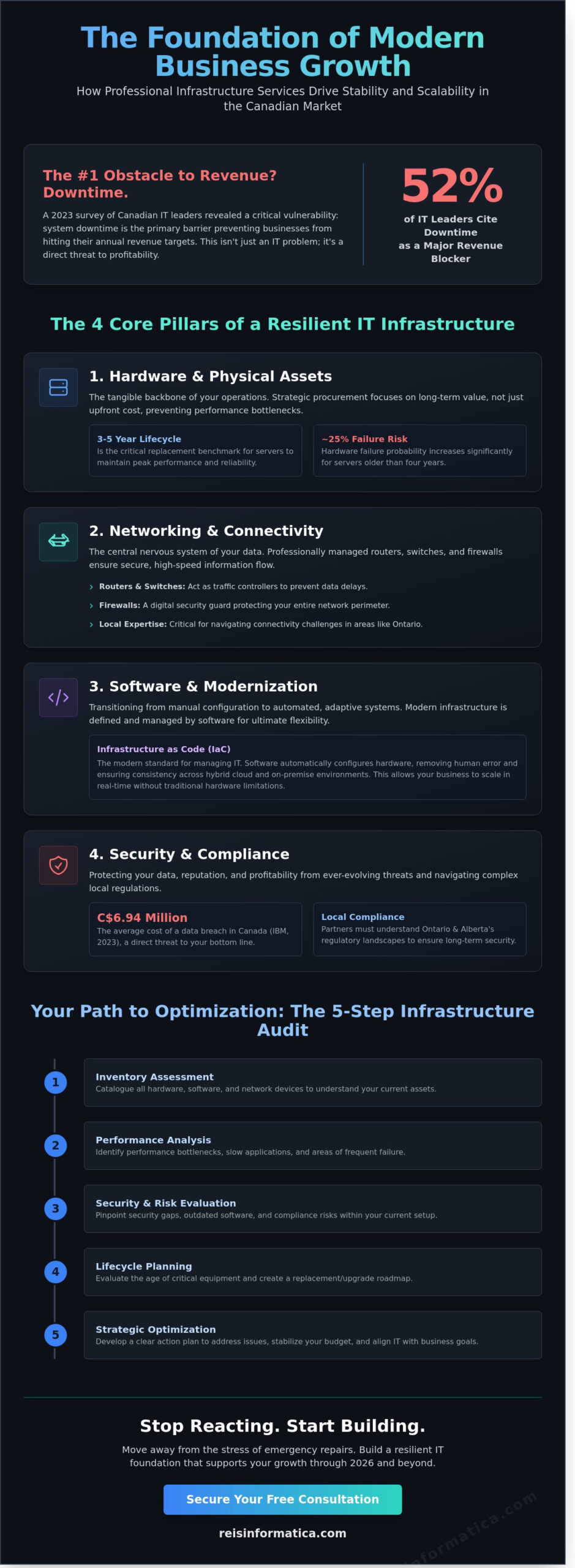
How to Audit and Optimize Your Infrastructure in 5 Steps
Building a resilient foundation starts with knowing exactly where you stand. An audit isn’t just a technical chore; it’s a strategic review that ensures your infrastructure services are actually working for your business. If you haven’t looked under the hood of your tech stack lately, you might be carrying risks that could stall your operations in 2026. Follow these five steps to clear the path for future success.
- Inventory every asset: Document every piece of hardware, software license, and cloud subscription. You can’t protect or optimize what you don’t know you have.
- Identify performance bottlenecks: Look for equipment that’s reached “end-of-life” status. Hardware over five years old often costs more to maintain than it’s worth.
- Evaluate security and compliance: Ensure your data handling meets PIPEDA standards. Canadian regulations are strict, and non-compliance is a risk you don’t want to take.
- Align with your growth plan: Compare your current tech capacity against your three-year business goals. Technology should lead your growth, not lag behind it.
- Consult a professional: Work with a managed service provider for a gap analysis. They’ll find the hidden vulnerabilities that internal teams might overlook.
Step-by-Step Infrastructure Audit
Start your audit by hunting for “shadow IT.” This happens when employees use unauthorized apps or personal cloud storage because the official tools are too slow. It creates massive security gaps and fragments your data. You also need to verify if your current network can handle AI business solutions. AI requires high bandwidth and low latency that older systems simply can’t provide. Finally, test your backup integrity. A backup is useless if the data is corrupted or the restore process takes three days. We recommend a full restore test at least once per quarter to ensure you’re truly protected.
Preparing for Future Growth
Think about where your business will be in 20 months. If you plan to add 50 new hires in Cambridge, you need to know if your servers and bandwidth can handle the load. Scalability is non-negotiable for 2026. Your infrastructure services must support remote and hybrid work without compromising security or speed. This is where a strong Managed IT pillar becomes essential. It provides the strategy to ensure your technology scales alongside your revenue. By moving to a proactive model, you stop reacting to crashes and start planning for expansion. It’s about turning your IT from a cost center into a reliable growth engine.
Ready to see where your technology stands? Book a professional infrastructure audit today to secure your business’s future.
Choosing a Strategic Infrastructure Partner in Canada
Selecting the right infrastructure services provider isn’t just about hiring a technician to manage hardware. It’s about finding a partner who understands that your technology should serve your bottom line. In Canada, where privacy laws like PIPEDA and provincial regulations such as Ontario’s PHIPA or Alberta’s PIPA dictate how data is handled, a purely technical approach often misses the mark. You need a consultant who speaks the language of business first and technology second.
A strategic partner helps you avoid the “break-fix” cycle that drains resources and kills momentum. Instead of waiting for a crash, a consultative provider builds a foundation that scales with your growth. This approach ensures your digital backbone is compliant with local standards while remaining flexible enough to adopt new tools. By aligning tech investments with your three-year or five-year business plan, you turn IT from a cost center into a competitive advantage.
The Reis Informatica Advantage
At Reis Informatica, we act as your internal IT arm, adopting the role of a “Parceiro Especialista” (Expert Partner). We don’t just manage servers; we manage your peace of mind. With active support teams in Mississauga, Toronto, and Calgary, we provide local expertise that understands the specific challenges of the Canadian business environment. We position ourselves as a vigilant guardian of your operational continuity, ensuring that every piece of tech serves a specific purpose.
Our commitment is to make your technology invisible. When your systems work perfectly in the background, your team can focus on their core tasks rather than troubleshooting. We bridge the gap between complex digital architecture and the tangible results you need to see on your balance sheet. By choosing a partner with a physical presence in key Canadian hubs, you get the benefit of rapid response times and a team that understands the local regulatory landscape in provinces like Ontario and Alberta.
Next Steps for Your Infrastructure
If your current IT environment feels messy or unpredictable, it’s time to transition to a managed model. The first step involves a comprehensive assessment to identify vulnerabilities and bottlenecks that could be costing you money. From there, we develop a technology roadmap for 2026 and beyond, ensuring your business stays ahead of the curve as AI and cloud integration become standard.
Don’t let outdated systems hold your business back from its full potential. You can explore our it services to see how we’ve helped other Canadian firms stabilize their growth and secure their data. A secure, efficient infrastructure is the backbone of your future success. Contact us today to schedule your infrastructure assessment and take the first step toward total operational confidence. We’ll help you build a roadmap that turns your technology into a silent, powerful engine for growth.
Secure Your Competitive Edge for 2026 and Beyond
Your business foundation shouldn’t be an afterthought. As we approach 2026, the shift from reactive “break-fix” repairs to proactive management is no longer optional for Canadian leaders. Building a resilient environment means prioritizing AI-ready systems and constant vigilance. By auditing your current setup and partnering with experts who understand the local landscape, you turn technology from a cost center into a growth engine.
Reis Informatica provides the stability you need to focus on your core operations while we handle the technical complexity. We deliver local support across 11+ Canadian cities, ensuring help is always nearby. Our team maintains your systems with proactive 24/7 monitoring and management to stop problems before they cause downtime. We specialize in designing AI-ready infrastructure services that scale with your ambitions. Don’t let outdated hardware or hidden vulnerabilities slow your progress.
Get a Professional Infrastructure Audit for Your Business
You’ve built a great business, and it deserves a foundation that’s just as strong.
Frequently Asked Questions
What is the difference between IT services and infrastructure services?
Infrastructure services focus on the physical and virtual foundation of your technology, while IT services cover the broader spectrum of support and software management. Think of infrastructure as the plumbing and wiring of your business, including servers, cabling, and network hardware. Our infrastructure services ensure this foundation is rock solid so your software and applications can run without interruption or lag.
How much do infrastructure services cost for a small business in Ontario?
Small businesses in Ontario typically invest between C$1,500 and C$5,000 per month for comprehensive managed infrastructure and support. These figures depend on your specific user count and the complexity of your network requirements. Choosing a managed model helps you avoid the C$250 per hour emergency fees often charged for reactive repairs in the Greater Toronto Area and Waterloo Region.
Can infrastructure services help my business move to the cloud?
Yes, infrastructure services are the primary vehicle for a successful and secure cloud migration. We manage the transition of your data and applications to platforms like Microsoft Azure or private clouds while maintaining your local network’s integrity. Proper planning prevents the common pitfalls of migration, which can lead to downtime costs exceeding C$8,000 per hour for mid sized Canadian firms.
Is it better to own my servers or use a managed infrastructure service?
Managed infrastructure services are the superior choice for 85% of modern businesses because they replace high capital expenses with predictable monthly costs. When you own hardware, you’re responsible for maintenance, cooling, and replacing expensive parts every 3 to 5 years. Managed services ensure you always have access to the latest technology and security updates without the burden of hardware ownership.
How often should a business perform an infrastructure audit?
You should schedule a professional infrastructure audit at least once every 12 months to maintain security and efficiency. With cyber threats increasing by 35% annually, a yearly check ensures your hardware and protocols can withstand new risks. These audits identify hidden bottlenecks and aging components before they cause a total system failure that halts your production.
Do you provide on-site support in cities like Kitchener and Waterloo?
We provide rapid on-site support to businesses across the Waterloo Region, including Kitchener, Waterloo, and Cambridge. While our team resolves 92% of technical issues through remote monitoring, we maintain local technicians who can arrive at your facility within 2 to 4 hours for critical hardware emergencies. This local presence gives you the peace of mind that help is always nearby when physical intervention is required.
How does infrastructure impact my company’s cybersecurity?
Your infrastructure services serve as the essential first line of defense by securing the entry points to your digital environment. Since 60% of small businesses that experience a major data breach fail within six months, a secure foundation isn’t optional. We implement robust firewalls, encrypted gateways, and secure access controls at the hardware level to stop intruders before they ever reach your sensitive data.
What happens to my infrastructure during a power outage or disaster?
A resilient infrastructure setup uses Uninterruptible Power Supplies (UPS) and automated off-site backups to protect your data during a power failure. If a physical disaster impacts your office, our disaster recovery protocols allow your team to resume operations from a remote location in under 4 hours. We focus on maintaining 99.9% uptime so your business stays functional even when the unexpected happens.