The most impressive AI tool isn’t necessarily the right one for your business. The value of ai-enabled business solutions comes from how well they address a real workflow, fit your existing technology, and protect the information your team relies on. To choose wisely, compare ready-made tools, custom development, and AI integrated with existing services against the same business needs.
It’s reasonable to feel cautious. A solution may look promising in a demo but still require more data preparation, staff effort, or security oversight than expected. Start with a business problem, not a model or feature list.
This guide compares AI approaches by business value, integration, and risk. You’ll learn how to identify a suitable use case, set clear measures of success, assess data and implementation needs, and pilot a solution before deciding whether to scale it.
Key Takeaways
- AI can support or automate business tasks, but its usefulness depends on the process, the information available, and the level of human oversight.
- Compare packaged tools, custom development, and AI integrated with existing services by fit, flexibility, integration effort, and ongoing management.
- Assess whether your data and workflow are ready, then use measures such as time, quality, or user adoption to review a pilot.
- Choose ai-enabled business solutions that fit your operations and wider technology priorities, with a clear path to decide whether to scale.
What AI-Enabled Business Solutions Can Actually Do for a Business
AI-enabled business solutions use artificial intelligence to assist with or automate business tasks. They might sort incoming information, draft a response for review, or highlight patterns that help a team make a decision. The technology is useful when it fits a real process, has suitable information to work with, and serves a clear business objective.
For businesses in Waterloo and nearby Kitchener and Cambridge, it helps to separate practical support from broad promises of company-wide transformation. An AI solution might assist with one recurring task without changing every department. The basics of artificial intelligence can help explain the underlying technology, but the business case comes down to how it works in your operation. Reis Informatica provides AI business solutions to help businesses consider AI in the context of their operations and technology priorities.
Which business processes may benefit from AI?
Start with a process pain point, not a technology trend. Repetitive information handling, such as sorting requests or summarizing documents, may be suitable for AI assistance. AI may also help prepare responses to common customer enquiries or organize information for decision support. A task involving exceptions, sensitive situations, or important relationships may still need a person to assess context and make the call. Map the process first: what comes in, what decisions are made, and where does work slow down?
What AI can and cannot promise
AI output depends on the information available and the way the solution is used. Missing, outdated, or unclear information can lead to responses that need correction. Set boundaries around what the system can handle, what requires review, and who is responsible for final decisions. Human oversight is especially important when an answer could affect a customer, employee, or business commitment.
A well-defined workflow turns AI from a broad idea into a use case you can measure against a specific business goal. Track a relevant measure, such as time spent on a task or the quality of reviewed outputs, rather than assuming savings or accuracy in advance. Leaders remain accountable for business decisions, even when AI helps inform them.
Compare AI-Enabled Business Solutions by Approach and Business Fit
There’s no single best route for every business. A ready-made tool may suit a common task, while a specialized process may call for more tailoring. Compare the work involved in fitting, connecting, and managing each option, not just its feature list.
Packaged tools, custom development, or integrated services?
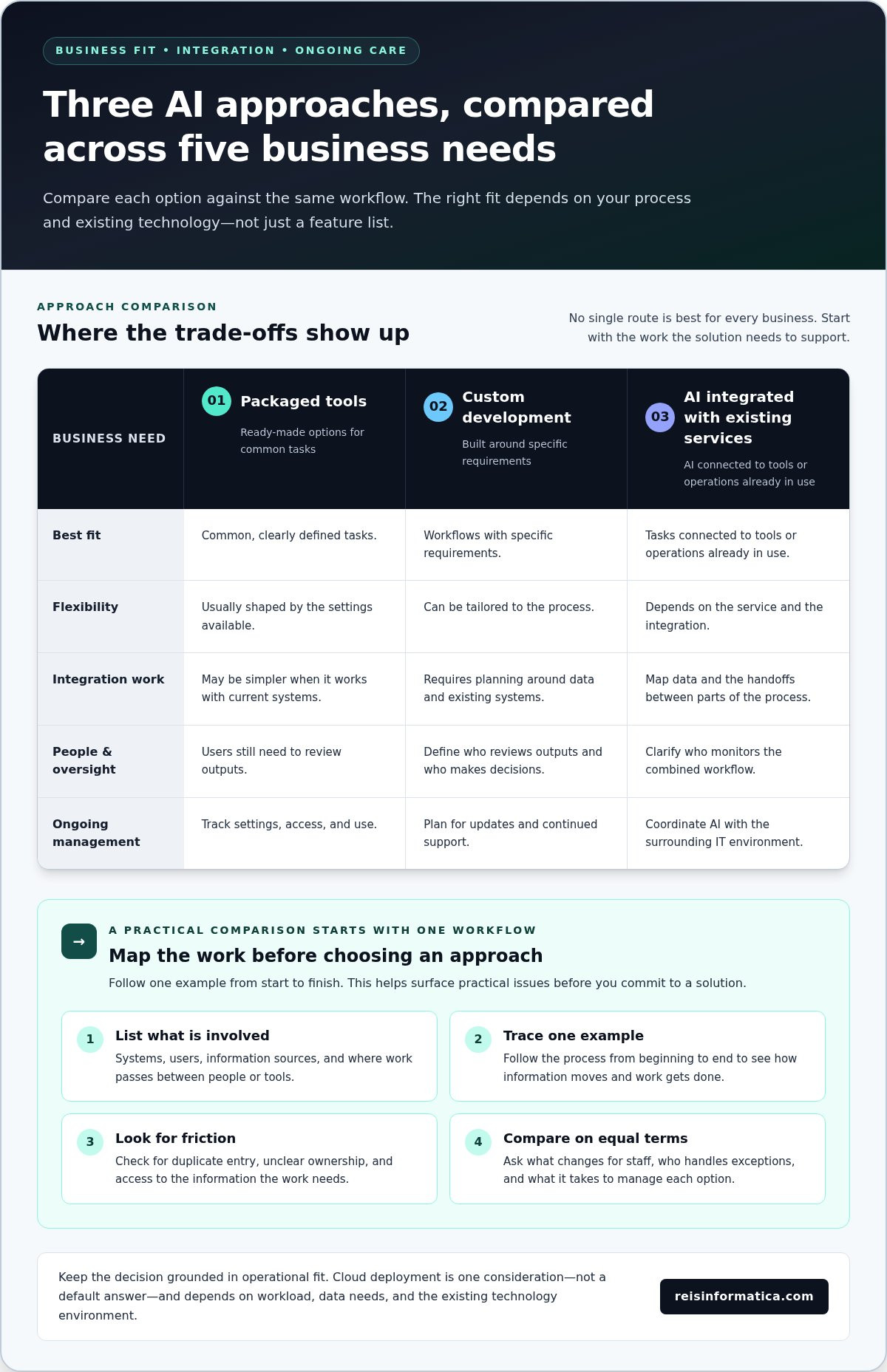
Use this comparison to frame the trade-offs. The right fit depends on the workflow and your existing technology environment.
Fit: Common, clearly defined tasks. Flexibility: Usually shaped by available settings. Integration: May be simpler when it works with current systems. Oversight: Users still need to review outputs. Ongoing management: Track settings, access, and use.
Fit: Workflows with specific requirements. Flexibility: Can be tailored to the process. Integration: Requires planning around data and existing systems. Oversight: Define review and decision responsibilities. Ongoing management: Plan for updates and continued support.
Fit: Tasks connected to tools or operations already in use. Flexibility: Depends on the service and integration. Integration: Map data and process handoffs. Oversight: Clarify who monitors the combined workflow. Ongoing management: Coordinate AI with the surrounding IT environment.
How should a business assess integration and flexibility?
Before comparing options, list the systems involved, who will use the solution, where its information comes from, and where work passes between people or tools. Then trace one example from start to finish. This can reveal practical issues such as duplicate entry, unclear ownership, or access to information before you commit to an approach. It also shows whether existing IT operations need to be part of the plan.
Cloud deployment is one consideration, not a default answer. The right choice depends on the workload, data needs, and existing technology environment. Cloud services may form part of that discussion, including how a solution fits with current systems and business priorities.
Compare the options against the same workflow and management needs. Ask what changes for staff, how information moves, and who handles exceptions. That keeps the decision grounded in operational fit rather than assumptions about which approach is automatically more flexible or easier to run.
Evaluate AI Business Solutions for Value, Security, and Readiness
A controlled pilot lets your team test how a solution fits before making a wider commitment. It doesn’t guarantee savings or better results, so decide in advance what evidence would support moving forward.
- Define the process. Describe the task, who performs it, and where delays or errors occur.
- Set a baseline. Record how the process works now, including time spent, quality checks, or other measures that match the problem.
- Assess the data. Identify what information the solution needs, where it comes from, whether it’s suitable, and who should be allowed to access it.
- Run a limited pilot. Use a defined workflow and keep people responsible for reviewing outputs, handling exceptions, and making decisions.
- Review the evidence. Compare results with the baseline and gather feedback from both users and process owners.
- Decide what comes next. Continue, adjust, or stop based on the results, remaining risks, and effort needed to manage the solution.
An AI pilot is useful only when defined measures and human review show whether it fits the work safely and effectively. For example, a team testing AI support for document handling could track time spent on the task and whether reviewers need to correct or complete the output. Choose measures that reflect the actual objective. Adoption matters too: a tool that people can’t use comfortably may not fit the process.
What security and governance questions belong in the evaluation?
Consider how sensitive the information is, who can access it, how outputs will be reviewed, and who is accountable when they’re incorrect or incomplete. Set clear boundaries for what the solution may handle and when a person must take over. Reis Informatica’s cybersecurity services can help place AI-related risks within the wider security picture.
Use the pilot findings to make a measured decision, not to assume the same result across every workflow. Reis Informatica’s AI business solutions can help connect your evaluation to your operations and technology environment.
Plan an AI-Enabled Business Solution That Fits Your Operations
A practical next step doesn’t require a company-wide AI plan. Choose one workflow, define what success would look like, check whether the information and systems are ready, then scope a measured pilot. A focused start gives your team a way to learn before deciding whether to adjust, expand, or stop.
What to prepare before moving from evaluation to action
Write down how the process works today, where it causes friction, and who feels the impact. Note the systems and information involved, who owns decisions, and what outcome would make a pilot worth continuing. For example, a team handling recurring requests can map its current steps, identify where staff would review AI-generated suggestions, and choose a measure that reflects the problem. Keep the first scope narrow enough to evaluate clearly, without assuming what the outcome will be.
How AI fits into a broader technology plan
AI doesn’t replace sound IT foundations or human judgment. The fit may depend on how the solution connects to current systems, where its information is stored, and how access and security are managed. IT strategy, cloud choices, and cybersecurity considerations can all shape the plan. These factors help ensure the proposed use supports business priorities rather than adding a disconnected tool or process.
Reis Informatica provides AI Business Solutions as part of the broader technology picture. Businesses in Waterloo and nearby Kitchener and Cambridge, as well as Mississauga, Milton, Calgary, Halifax, and London, can use the same decision path: define the workflow, identify a useful measure, assess readiness, and plan a pilot with clear review responsibilities.
To connect a business need with a practical next step, explore AI business solutions.
Make Your Next AI Decision With Confidence
The next step doesn’t need to be a sweeping transformation. Pick a business problem worth solving and give your team room to decide what role technology should play. A measured, business-led approach can help you make a confident choice without treating AI as a goal in itself.
As you consider ai-enabled business solutions, keep the focus on practical fit: how a solution supports your people, operations, and technology priorities. The right approach should help your business move forward while keeping human judgment and accountability in view.
Start with a focused conversation about your business goals. Explore AI business solutions and take the next step toward an approach that fits your operations.
Frequently Asked Questions
Is AI suitable for small and medium-sized businesses?
Yes, an SMB can use AI without building its own model or maintaining a dedicated AI team. The practical question is whether the business can support the tool’s ongoing costs, staff learning, and oversight. For example, a small office may find an existing feature in software it already uses more manageable than introducing a separate platform. Match the commitment to the team’s capacity.
Can AI-enabled business solutions work with existing business systems?
They can, but compatibility varies by tool and system. Some solutions connect directly; others may require manual steps or additional setup. Before relying on a connection, consider how updates, errors, and service interruptions could affect day-to-day work. Keep a workable fallback for essential tasks, such as processing a request manually, so an AI feature doesn’t become a single point of failure.
How should a business protect sensitive information when using AI?
Start by checking how the tool handles information entered by employees, including whether inputs may be retained or used to improve the service. Avoid sharing sensitive records until the business understands those terms. Classify information into practical categories, such as public, internal, and confidential, then give staff clear examples of what belongs in each category. Revisit the guidance as tools or business needs change.
How much do AI-enabled business solutions cost?
Costs vary with the tool and the work required to put it into use, so there’s no dependable single figure for every business. Look beyond the subscription or licence: account for usage charges, staff time, setup, training, and ongoing oversight. Compare the total with the value the business would need to see, and identify who will review expenses if usage grows or the solution’s scope changes.
What should a business measure in an AI pilot?
Alongside task-level results, look for effects elsewhere in the process. A faster first response may not help if it creates more follow-up work or customer escalations. Ask staff to note recurring exceptions and check whether work is shifting to another team. Before the pilot, agree on what would prompt a change in scope or a pause, so the review considers operational side effects as well as the intended benefit.