
Trying to budget for IT support in the US can feel like navigating a maze in the dark. You’re met with confusing quotes, vague service tiers, and the nagging fear of hidden fees lurking in the fine print. This ambiguity leaves business leaders asking a critical question: how much do managed IT services cost, really? The lack of clarity makes it nearly impossible to compare providers “apples to apples” or confidently justify the investment over hiring an in-house technician.
Your focus should be on growth, not deciphering complex IT proposals. That’s why we’ve created this definitive 2026 US pricing guide. Here, we provide a transparent breakdown of the common pricing models you’ll encounter, reveal the key factors that influence your final quote in USD, and equip you with the knowledge to calculate the true value of a strategic IT partnership. By the end, you’ll have the confidence to evaluate any proposal and secure a predictable, flat-fee IT budget that empowers your business to thrive.
Key Takeaways
- Expect to pay between C$100-C$250 per user, per month in Canada, but understand the four common pricing models to see which one aligns with your budget and operational needs.
- Learning how much do managed IT services cost involves more than a base price; your final quote is determined by factors like infrastructure complexity, security requirements, and the number of users.
- Discover why a low-priced plan often means reactive support, while a higher-priced plan delivers a proactive strategic partnership focused on preventing downtime and securing your business.
- Move the conversation from cost to investment by learning how to calculate the true ROI, factoring in the high price of downtime, security risks, and lost productivity versus an in-house team.
The 4 Common Managed IT Pricing Models Explained
TL;DR: For most Canadian businesses, you can expect to pay between C$100 to C$250 per user, per month for comprehensive managed IT services.
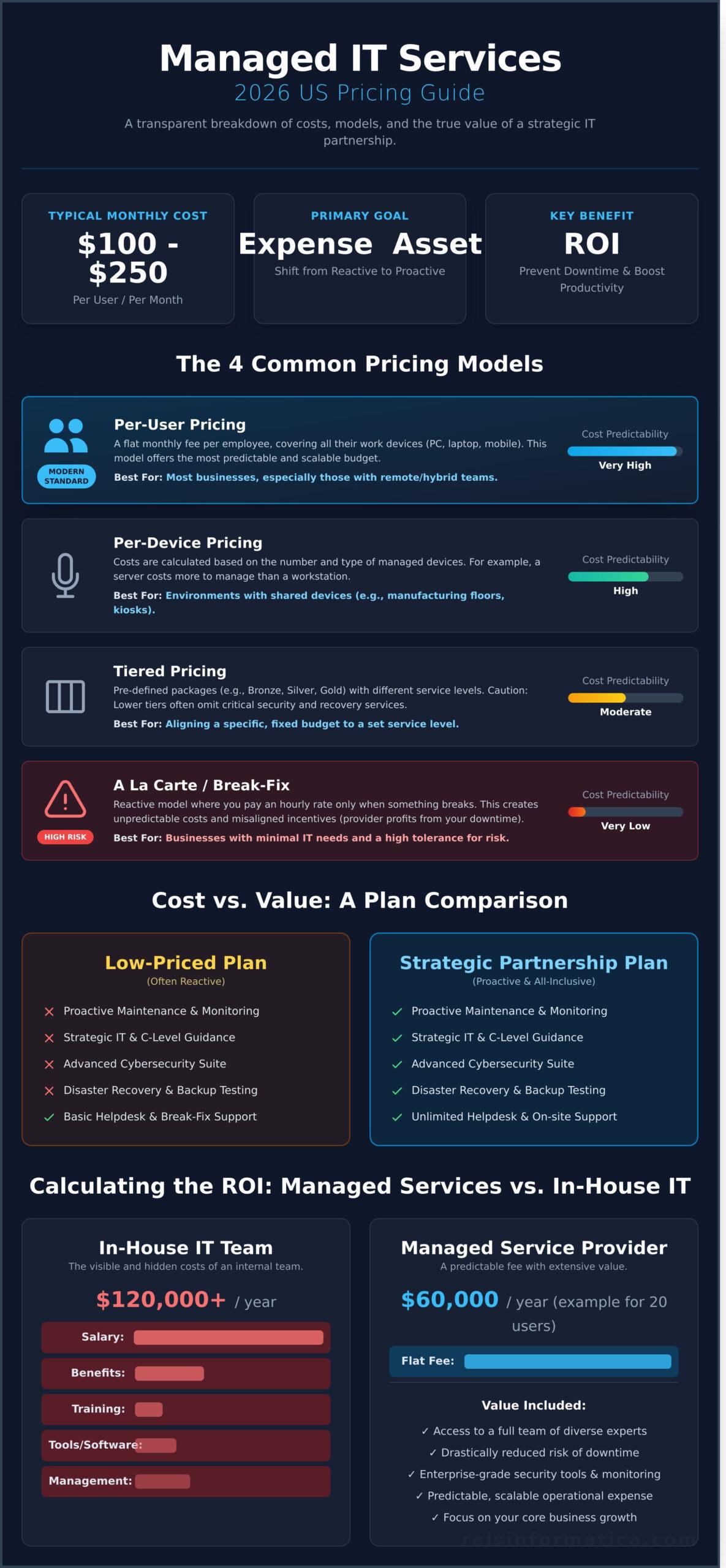
However, to truly understand how much do managed IT services cost, you must look beyond that average. The final investment depends entirely on the pricing model and the level of proactive support included in your agreement. The goal of a Managed Service Provider (MSP) is to shift your IT from a reactive expense to a predictable, strategic asset, a core concept behind what are managed IT services? Let’s break down the four models you will encounter.
| Pricing Model | Cost Structure | Best For |
|---|---|---|
| Per-User | Flat monthly fee per employee | Most modern businesses, especially with remote/hybrid teams |
| Per-Device | Flat monthly fee per managed device | Companies with shared devices (e.g., manufacturing, kiosks) |
| Tiered | Pre-defined packages (e.g., Bronze, Silver, Gold) | Businesses wanting to match a specific budget to a service level |
| A La Carte / Break-Fix | Hourly rate or per-project fee | Businesses with minimal IT needs and high risk tolerance |
Per-User Pricing: The All-Inclusive Standard
This is the modern standard for a reason. You pay a single, flat monthly fee for each employee, and that fee covers support for all the devices they use-workstation, laptop, mobile phone, and tablet. This model simplifies budgeting into a predictable operational expense. Its all-inclusive nature encourages your team to seek proactive support, preventing small issues from becoming costly problems. It’s the ideal fit for professional services firms and any company embracing a remote or hybrid work culture.
Per-Device Pricing: The Traditional Approach
With this model, costs are calculated based on the number and type of devices under management. For example, a server might cost C$200/month to manage, while a workstation is C$75/month and a firewall is C$50/month. This offers granular control over which assets are covered, which can be beneficial for environments where multiple users share a single device, such as on a manufacturing floor, in a computer lab, or at public-facing kiosks.
Tiered Pricing: The ‘Good, Better, Best’ Model
Many providers offer bundled packages-often labelled Bronze, Silver, and Gold-at different price points. This provides the flexibility to select a plan that aligns with your immediate budget. However, caution is advised. The lowest-cost tiers often serve as a foot in the door, omitting critical services like advanced cybersecurity monitoring or disaster recovery. This can create a false sense of security while leaving your business vulnerable to the most significant threats.
A La Carte & Break-Fix: The Reactive Model
This is the opposite of a true managed services partnership. In a break-fix model, you pay an hourly rate for support only when something breaks. While it appears to be the cheapest option upfront, it creates unpredictable costs and misaligned incentives. Your provider only profits when your technology fails, giving them no reason to proactively maintain your systems to prevent downtime. This reactive approach is a gamble that modern businesses cannot afford to take.
Key Factors That Influence Your Final Price
Understanding the common pricing models is the first step, but the final quote on your monthly invoice is shaped by your company’s unique operational DNA. A one-size-fits-all price is a red flag; a true IT partner begins with a comprehensive audit to understand your environment, goals, and risk tolerance. This discovery process ensures you only pay for what you need, aligning the IT investment directly with business outcomes. When asking “how much do managed IT services cost?”, the real answer lies in the following key factors.
Number of Users and Devices
The most direct factor influencing your monthly cost is the scale of your operation. This is the total count of every endpoint that requires management, monitoring, and support. This typically includes:
- Workstations (desktops and laptops)
- Servers (both on-premise and virtual)
- Mobile devices (smartphones and tablets)
- Network hardware (firewalls, switches, and access points)
While more users naturally increase the price, many MSPs offer economies of scale, potentially lowering the per-unit cost for larger Canadian businesses as the management overhead becomes more efficient.
Complexity of Your IT Environment
A single office with a straightforward local network has vastly different support needs than a multi-site enterprise running a sophisticated hybrid infrastructure. The complexity of your environment is a major cost determinant. Factors include the integration of specialized business applications (like ERP or CRM systems), managing legacy software that requires expert knowledge, and orchestrating various cloud services. The more moving parts, the more intensive the management required to ensure seamless, secure operation.
Required Service Level Agreement (SLA)
Your Service Level Agreement (SLA) is a contractual guarantee that defines the provider’s response and resolution times for IT issues. This is where your operational needs and risk tolerance directly impact the price. Do you require 24/7/365 support for a mission-critical operation, or is standard 9-5 business hour support sufficient? An SLA that includes guaranteed on-site support for hardware failures will also be priced differently than a purely remote helpdesk model.
Cybersecurity and Compliance Needs
In today’s threat landscape, cybersecurity is non-negotiable, but the level of protection you need varies significantly. Basic antivirus and firewall management are standard, but a comprehensive security stack-including Endpoint Detection and Response (EDR), Security Information and Event Management (SIEM), and vulnerability scanning-comes at a premium. Furthermore, Canadian businesses in regulated industries (e.g., healthcare, finance, or those handling sensitive data subject to PIPEDA) require robust compliance protocols and reporting. These advanced cybersecurity services are a critical investment, not a simple add-on, and significantly influence the final answer to how much do managed IT services cost.
What’s Actually Included? Comparing Low vs. High-Priced Plans
One of the most common points of confusion when asking “how much do managed IT services cost” is the significant price variance. Why does one Managed Service Provider (MSP) in Canada quote C$75 per user, while another proposes C$200? The difference isn’t just in the price tag; it’s a fundamental difference in philosophy: Reactive Support versus a Strategic Partnership.
A low-cost provider often operates on a reactive, break-fix model. Their profitability depends on problems being resolved with minimal effort. In contrast, a comprehensive partner invests heavily in proactive tools and expert staff to prevent those problems from ever happening. The lower price tag frequently hides the true cost of potential downtime, security breaches, and a lack of strategic direction.
What a Low-Cost Plan (C$75-C$125/User) Typically Includes
This tier represents the baseline for IT management. It’s designed to fix issues as they arise, functioning more like an on-call repair service than a dedicated technology partner. While it covers the essentials, it leaves your business vulnerable to advanced threats and operational inefficiencies.
- Basic Helpdesk: Support is often limited to standard business hours, leaving you unprotected overnight or on weekends.
- Essential Maintenance: Includes basic antivirus software and automated patch management to address known vulnerabilities.
- Reactive Problem-Solving: The focus is on responding to tickets and system failures after they have already impacted your team.
- No Strategic Guidance: This model does not include IT roadmapping, budget planning, or advice on leveraging technology for business growth.
What a Comprehensive Plan (C$150-C$250+/User) Includes
This model is an investment in stability, security, and growth. A true IT partner integrates with your business to ensure your technology infrastructure is a competitive advantage, not a liability. This proactive approach minimizes disruptions and aligns your IT with your long-term business objectives.
- Everything in the low-cost plan, plus:
- 24/7 Proactive Monitoring: Sophisticated tools monitor your network around the clock to detect and resolve issues before they cause downtime.
- Advanced Cybersecurity: A multi-layered security stack (including endpoint detection, email filtering, and more) combined with crucial employee security awareness training.
- Strategic IT Guidance: Access to a Virtual CIO (vCIO) who helps with technology budgeting, long-term planning, and ensuring compliance with Canadian regulations.
This comprehensive approach transforms IT from a recurring expense into a powerful business asset. Explore our full list of what modern IT services should cover to understand the complete scope of a true partnership.
Calculating the ROI: Managed Services vs. In-House IT
When business leaders first ask, “how much do managed IT services cost?”, they are often looking at it as a new line item on the budget. The more strategic approach, however, is to view it as an investment in efficiency, security, and growth. For a CFO or owner, justifying the expense comes down to a clear-eyed comparison between a predictable monthly fee and the often-underestimated total cost of managing IT internally.
While a large enterprise with a multi-person IT department may find in-house support effective, for most small and medium-sized businesses in Canada, the value proposition of an MSP is compelling.
The True Cost of an In-House IT Employee
A single, mid-level IT specialist in Canada commands a median salary of around C$75,000 per year. However, the “fully loaded” cost to your business is far higher. When you factor in benefits, payroll taxes (CPP/EI), vacation, training, and recruitment costs, that figure easily swells by 30% or more, pushing the real cost closer to C$100,000 annually. This doesn’t even include the thousands more needed for the essential monitoring, security, and ticketing software that an MSP provides as part of their service.
The Hidden Costs of NOT Having Proactive Support
An even greater financial risk lies in what you spend when your IT isn’t being proactively managed. These reactive costs are unpredictable and disruptive, directly impacting your bottom line:
- Cost of Downtime: Calculate your hourly operational cost. If a critical system goes down for even two hours, the lost revenue and wages can quickly surpass a month’s MSP fee.
- Cost of a Data Breach: For a Canadian small business, a significant security incident can cost well over C$150,000 in remediation, fines, and reputational damage.
- Cost of Lost Productivity: Slow systems, recurring glitches, and inefficient workflows create a constant drag on your team’s output, a “death by a thousand cuts” to your profitability.
The ‘Force Multiplier’ Effect of an MSP
Comparing an MSP to a single hire isn’t an apples-to-apples comparison. An MSP acts as a force multiplier for your entire organization. For less than the cost of one IT generalist, you gain access to a full team of specialists in cybersecurity, cloud computing, and network infrastructure. You benefit from enterprise-grade security tools that would be prohibitively expensive to license on your own. Most importantly, a strategic IT partner frees your leadership to focus on core business objectives, leveraging technology for growth-such as implementing powerful new AI business solutions-instead of constantly reacting to technical problems. The ultimate question evolves from how much do managed IT services cost to what value will they deliver to my business?
Making the Right IT Investment for Your Business
As we’ve explored, understanding how much do managed IT services cost in Canada is less about a single price tag and more about identifying true value. The key takeaway is that the right IT partner moves beyond simple break-fix support. They deliver a strategic advantage through proactive security, predictable budgeting, and operational efficiency that far outweighs the investment, especially when compared to the high costs and limitations of a traditional in-house team.
Instead of navigating complex pricing models alone, let our team provide the clarity you need. We offer transparent, predictable monthly pricing that gives you access to a full team of IT and cybersecurity experts. We provide the strategic guidance necessary to align your technology directly with your business goals, turning your IT from a cost centre into a growth engine.
Stop guessing. Get a clear, custom quote for your business today.
Let us handle the complexity of your technology, so you can focus on what you do best: growing your business.
Frequently Asked Questions About Managed IT Services Costs
Are there one-time setup or onboarding fees for managed IT services?
Yes, most managed service providers (MSPs) in Canada charge a one-time onboarding fee. This cost covers the essential initial work, including a comprehensive audit of your current IT infrastructure, deployment of monitoring and security software, and documenting your systems. This foundational step ensures a smooth transition and allows for effective proactive management. The fee is typically a flat rate, often ranging from C$1,500 to C$5,000, or equivalent to one month’s service cost.
What is typically NOT included in a standard managed IT services contract?
Standard contracts typically exclude large-scale projects, the cost of new hardware or software licenses, and specialized services. For example, an office move, a complete server overhaul, or custom application development would be quoted as a separate project. While the management of your cloud services is included, the consumption fees from providers like Azure or AWS are not. Always review the Service Level Agreement (SLA) to understand the precise scope and any potential additional costs.
Can managed IT services be cheaper than hiring an in-house IT person?
For most small and medium-sized businesses in Canada, yes. A single in-house IT specialist can cost over C$75,000 annually with salary, benefits, and training. Managed services provide access to an entire team of experts-in cybersecurity, cloud computing, and network engineering-for a predictable monthly fee that is often significantly less. This model eliminates recruitment overhead and provides a broader range of expertise, delivering a superior return on your technology investment.
How can I compare quotes from different managed IT service providers?
When comparing quotes to determine how much do managed IT services cost, look beyond the monthly price. Scrutinize the Service Level Agreements (SLAs) for guaranteed response and resolution times. Verify what is truly included-are proactive cybersecurity monitoring, data backup, and disaster recovery standard? Ask for references from Canadian companies in your sector. A lower price often reflects a reactive, break-fix approach rather than the strategic, proactive partnership needed for long-term business continuity.
Is there a minimum contract length for managed IT services?
Yes, the industry standard in Canada is to have a minimum contract term, typically ranging from 12 to 36 months. This commitment allows the provider to invest the necessary resources into onboarding and strategically aligning your technology with your business goals. A longer-term partnership ensures stability and allows for the development of a proactive IT roadmap. While some month-to-month options may exist, they often come at a higher price and offer less comprehensive strategic oversight.
Do prices change if my company grows and adds more employees?
Yes, your plan is designed to scale with your business. The answer to how much do managed IT services cost is directly tied to your company’s size, as most pricing is per-user or per-device. As you hire more employees, your monthly fee adjusts accordingly, ensuring you only pay for what you use. A reputable provider will clearly define this in your contract for transparent budgeting, ensuring every new team member is fully supported from day one.