
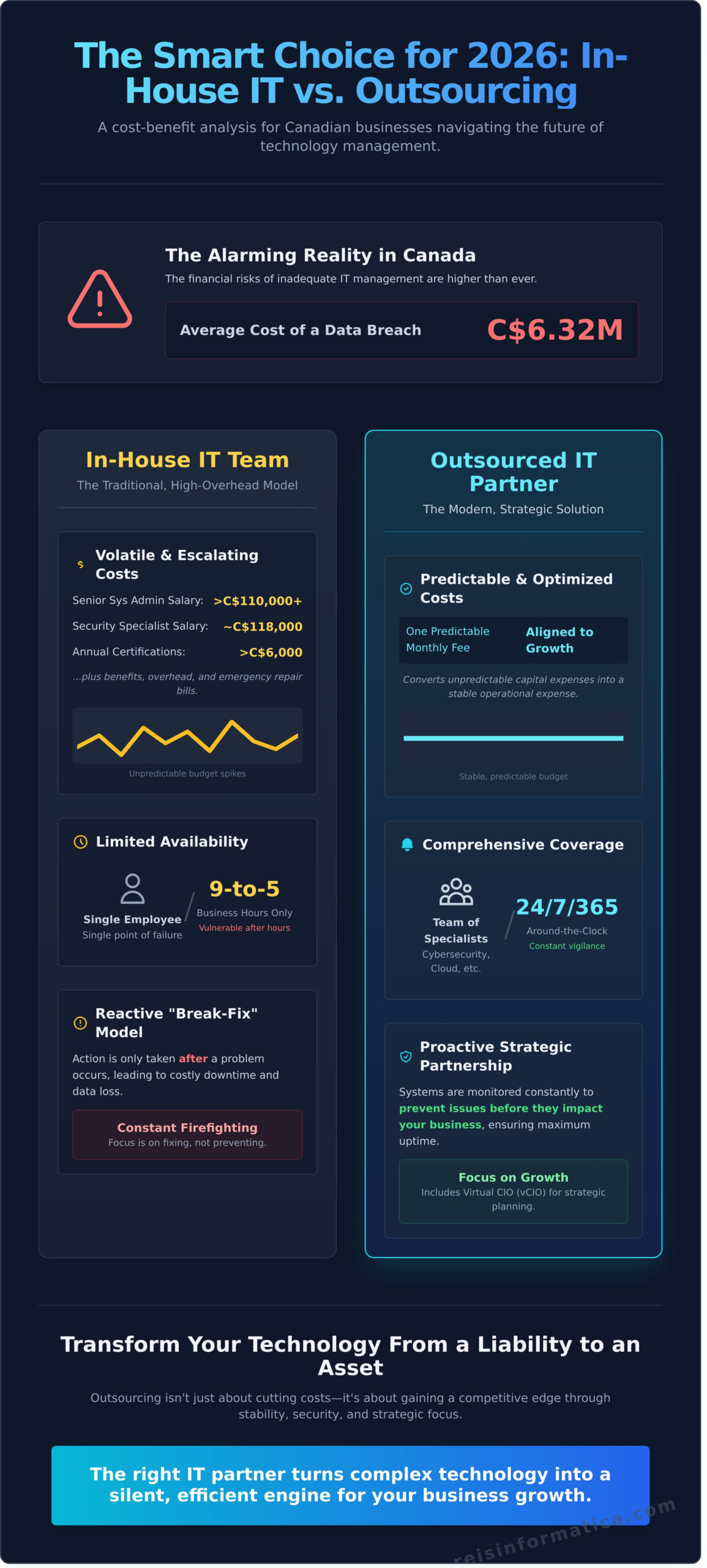
In 2024, the average cost of a data breach in Canada reached C$6.32 million per incident. This reality makes one thing clear: staying safe isn’t just a technical task; it’s a vital financial necessity. Most Canadian business owners recognize that hiring a full team of in-house specialists is becoming prohibitively expensive. In tech hubs like Toronto or Calgary, a single senior systems administrator often commands a salary over C$110,000 plus benefits. It’s frustrating to watch your budget disappear into overhead while you still struggle to scale your systems as the business grows. You want to focus on your clients, not on whether your server will hold up during a rush.
We understand that you want your technology to be an invisible asset that just works. This guide shows how IT infrastructure outsourcing provides a smarter way forward for 2026. You’ll learn how to secure 24/7 proactive protection and predictable monthly spending that aligns perfectly with your revenue goals. We’ll walk through a strategic framework that turns your technology from a constant source of stress into a silent, efficient engine for growth that stays ahead of every modern threat.
Key Takeaways
- Learn why moving from “break-fix” support to a proactive partnership is essential for staying competitive in the 2026 Canadian business landscape.
- Discover how to leverage cloud ecosystems and robust cybersecurity to protect your data while increasing your team’s operational agility.
- Understand the financial benefits of it infrastructure outsourcing, comparing predictable monthly C$ fees against the high price of unexpected downtime.
- See why a local presence in cities like Kitchener, Waterloo, and London is critical for aligning your technology with your specific regional business goals.
- Find out how a vigilant IT partner can handle your technical complexity, giving you the peace of mind to focus entirely on growing your company.
What is IT Infrastructure Outsourcing and Why Does Your Business Need It?
You shouldn’t have to be a systems engineer to run a successful manufacturing plant or law firm in Southwestern Ontario. At its core, it infrastructure outsourcing is the strategic practice of hiring an external specialist to manage your digital foundation. This includes everything from the physical servers in your closet to the complex security protocols protecting your client data. According to the historical development of Information technology outsourcing, this model has evolved from simple emergency repairs to a comprehensive partnership that drives business value.
The outdated “break-fix” model is a liability in the 2026 business environment. In this old way of thinking, you only called a technician when something stopped working. This led to unpredictable invoices and costly downtime. Today, a proactive partnership ensures that your systems are monitored 24/7. This shift allows businesses in Kitchener and Waterloo to maintain a competitive edge. With over 1,500 tech companies in the Waterloo Region alone, local SMBs are competing for the same talent as global giants. Outsourcing levels the playing field by providing enterprise-grade tools without the enterprise-grade payroll.
Every robust infrastructure consists of four primary pillars that require constant vigilance. First, your servers and storage must remain accessible and redundant. Second, your network connectivity needs to be fast and secure against intrusions. Third, your cloud environment must be optimized to prevent “cloud sprawl” and wasted spending. Finally, cibersecurity must be baked into every layer. When you outsource, you aren’t just buying a service; you’re securing a team that manages these components simultaneously to ensure 99.9% uptime for your operations.
The Evolution of IT Management for Non-Technical Owners
Managing technology should feel like using a utility. When you turn on a faucet, you expect clean water at the right pressure without needing to understand the municipal plumbing system. Modern it infrastructure outsourcing works the same way. It removes the daily burden of patch management, hardware lifecycles, and software updates from your plate. This allows you to focus entirely on your core mission. A vital part of this evolution is the Virtual CIO (vCIO). Your vCIO doesn’t just fix computers; they sit down with you quarterly to align your technology investments with your 3-year growth plan, ensuring you never overspend on “shiny” tech that doesn’t improve your bottom line.
The 2026 Landscape: Why In-House IT is Becoming Impossible
The financial reality for Ontario SMBs has changed drastically. Hiring a single qualified security specialist in Canada now carries an average base salary of C$118,000. Beyond the salary, the cost of maintaining specialized certifications like the CISSP or specialized cloud architecture designations can exceed C$6,000 per employee annually. A single in-house employee also cannot provide the 24/7 coverage required by modern global supply chains. If your server fails at 2:00 AM on a Sunday, a 9-to-5 employee won’t see it until Monday morning. By then, the financial damage is already done. Infrastructure outsourcing is a strategic business lever that converts technical complexity into a predictable operational advantage.
The Core Pillars of Modern IT Infrastructure in 2026
By 2026, technology shouldn’t be a source of stress. It needs to function so seamlessly that you barely notice it’s there. For many Ontario business owners, achieving this level of reliability requires a strategic shift toward it infrastructure outsourcing. This approach moves your focus from fixing broken equipment to driving growth through a stable, modern foundation. Your infrastructure is the engine of your company; it requires more than just occasional maintenance to keep pace with the Canadian market.
Modern infrastructure relies on four essential pillars. First, cloud ecosystems have evolved. They are no longer just places to store files; they provide the agility to launch new services in hours rather than weeks. Second, cybersecurity is now the bedrock of every technical decision. Third, AI and automation handle the heavy lifting of system monitoring. Finally, smart procurement ensures you aren’t overspending on tools that don’t talk to each other. When these pillars align, your business gains a competitive edge that is difficult to replicate.
Cloud and Hybrid Solutions for Canadian Scalability
Many businesses in Mississauga and Milton are moving away from traditional on-premise servers. A 2024 industry report indicated that 68% of Canadian SMBs now prefer hybrid models. This setup allows you to keep sensitive data on local hardware while using the cloud to scale your operations instantly. Ensuring data residency within Canadian borders is a legal necessity under PIPEDA and various provincial regulations. You can explore how cloud services enable remote work across Canada without compromising on speed or compliance. This flexibility is vital for attracting talent from across the Greater Toronto Area.
AI-Driven Monitoring and Proactive Maintenance
The days of waiting for a server to crash before calling for help are over. AI now predicts hardware failures roughly 15 to 22 days before they actually happen. This predictive power allows for “self-healing” networks that can automatically restart failed services or reroute traffic to maintain 99.99% uptime. Learn how AI business solutions are transforming infrastructure management into a silent partner that works 24/7. These systems identify bottlenecks in real-time, ensuring your team stays productive without the frustration of slow connections or unexpected downtime.
Cybersecurity cannot be a secondary thought in 2026. In 2023, the average cost of a data breach for a Canadian organization reached C$6.94 million according to IBM’s annual report. We integrate security into every layer of your it infrastructure outsourcing strategy. This includes:
- Multi-factor authentication (MFA) across all entry points.
- End-to-end encryption for data both at rest and in transit.
- Continuous vulnerability scanning to catch threats before they penetrate the perimeter.
- Automated backup protocols that ensure recovery in minutes, not days.
Cost efficiency often comes down to how you handle procurement. Buying hardware and software in isolation frequently leads to a 12% to 18% waste in annual IT budgets due to licensing overlaps or incompatible systems. By integrating your procurement process, you ensure every piece of equipment and every software license works together perfectly. This unified approach reduces hidden costs and simplifies your accounting. If you want to see how a streamlined setup can stabilize your monthly expenses, consider a consultation with a strategic partner to audit your current environment.
Your infrastructure should be a springboard for innovation, not a barrier. By focusing on these core pillars, you build a resilient organization capable of weathering any technological shift. It is about creating a workspace where your employees can thrive and your data remains protected around the clock.
Outsourcing vs. In-House IT: A 2026 Cost-Benefit Analysis
Deciding between an internal hire and it infrastructure outsourcing is a defining moment for your company’s financial health. In 2026, the cost of specialized talent in Canada continues to climb. A senior IT manager in Toronto or Calgary now commands a base salary between C$95,000 and C$120,000. When you add 18% for benefits, payroll taxes, and office space, a single employee becomes a massive line item. This “jack of all trades” is often stretched thin, trying to manage everything from basic help desk tickets to complex cloud migrations.
Outsourcing flips this model by providing a predictable monthly fee. Instead of one person, you gain a full department of specialists. This team approach ensures that your network, cloud, and hardware are managed by experts in those specific fields. If your Calgary office expands or your Toronto team moves to a hybrid model, your tech scales instantly. You don’t have to worry about the three-month lag time of recruiting and training a new internal staff member.
The true price of an in-house model often reveals itself during a crisis. If your server goes down at 2:00 AM on a Saturday, a single employee might not see the alert until Monday morning. For a Canadian SMB, two days of downtime can result in thousands of dollars in lost revenue and permanent damage to client trust. Professional outsourcing providers offer 24/7/365 monitoring. We catch the flickering warning signs of a failing drive or a security breach long before it impacts your operations. It’s the difference between a proactive partnership and a reactive struggle.
Calculating the Real ROI of Outsourcing
Managing your own servers involves significant hidden costs that rarely appear on a standard balance sheet. You must account for ongoing technical certifications, specialized monitoring software, and the physical electricity required to keep a server room cool. These expenses are volatile and difficult to predict. Transitioning to an outsourced model turns these fluctuating capital expenses into stable operational expenses. This predictability is a gift to your annual budgeting process. You know exactly what your IT spend will be every month, allowing you to allocate capital toward growing your core business instead of maintaining old hardware.
Addressing the Control and Security Objections
A common myth suggests that keeping IT in-house is safer because you can “see” the person in charge. In reality, outsourced security is almost always more robust. Small internal teams rarely have the time to keep up with the 30% annual increase in sophisticated phishing and ransomware attacks targeting Canadian businesses. By integrating cybersecurity services directly into your core infrastructure, you receive enterprise-level protection that a single hire simply cannot replicate.
We use Service Level Agreements (SLAs) to guarantee performance and accountability. These documents are legal commitments that define our response times and uptime targets. An internal employee doesn’t come with a contract that penalizes them for slow response times, but a strategic partner does. This structure ensures that your business stays online and your data remains protected under the highest industry standards. You maintain total control over your strategy while we handle the technical execution with a level of vigilance that works around the clock.
Choosing the Right Partner in Kitchener, Waterloo, and Beyond
Selecting a partner for it infrastructure outsourcing requires more than a checklist of certifications. You need a team that acts as a vigilant guardian of your operations, allowing you to focus on your core business. In 2023, data from IDC Canada indicated that 64% of SMBs prioritize business outcomes over technical features when selecting IT providers. This shift means you shouldn’t just look for a vendor; you need a strategic ally who understands that technology exists to drive your revenue, not just to exist in a server room.
A professional partner bridges the gap between technical complexity and business growth. They don’t just fix what’s broken; they anticipate what might fail. This proactive stance is what separates a standard help desk from a true consultant. When your infrastructure is managed by experts who prioritize stability, your team can work without the constant fear of downtime or security breaches. It’s about buying peace of mind for your management team and productivity for your employees.
The Local Advantage: Why Proximity Matters
Proximity remains a strategic asset for Canadian businesses. If a critical hardware failure occurs at your office in London or Kingston, a remote-only provider based in a different time zone can’t physically swap a power supply or reset a frozen firewall. Local partners in cities like Halifax or Toronto provide onsite response times that remote teams simply can’t match. They also understand regional market nuances. A firm in Calgary deals with specific security standards for the energy sector, while a partner in Waterloo understands the high-speed, high-availability demands of the local tech corridor. Local experts also navigate the Canadian ISP landscape effectively, knowing exactly how Bell, Rogers, or Telus performs in your specific postal code.
Privacy compliance is another area where local knowledge is non-negotiable. Canadian businesses must navigate PIPEDA and specific provincial regulations like Ontario’s PHIPA. A partner who doesn’t understand these laws puts your reputation at risk. In 2022, the Office of the Privacy Commissioner of Canada reported a 13% increase in data breach notifications. You need a partner who ensures your data stays on Canadian soil and meets every legal requirement to avoid heavy fines and lost customer trust.
Questions to Ask During Your IT Audit
- What is your response time guarantee for critical failures? You should look for a Service Level Agreement (SLA) that promises a response in under 2 hours for major outages.
- How do you handle PIPEDA and provincial compliance? The right partner will have clear protocols for data residency and encryption that align with Canadian law.
- Can you provide a 3-year technology roadmap for our business? This ensures they’re thinking about your future growth, not just your current problems.
The transition to a new partner doesn’t have to be disruptive. A smooth onboarding process typically follows a structured 90-day plan. During the first 30 days, your partner should perform a deep-dive audit of your existing systems. By day 60, they should have stabilized your environment and closed any immediate security gaps. By day 90, you should be looking at long-term strategy rather than putting out fires. This methodical approach ensures your team stays productive while the experts handle the heavy lifting of it infrastructure outsourcing.
Ready to secure your business future with a partner who understands the Canadian market? Discover how our strategic IT consulting can stabilize your infrastructure today.
Reis Informática: Your Vigilant IT Partner Across Canada
At Reis Informática, we’ve built our reputation on a simple promise: “Technology that Works.” For a business owner in Mississauga or a logistics firm in Milton, IT shouldn’t be a source of daily stress. It should be a silent engine driving your growth. We don’t believe in the old “break-fix” model that leaves you waiting for a technician while your revenue stalls. Instead, we provide proactive care that identifies a failing server or a security vulnerability before it ever impacts your bottom line. In 2023, our proactive monitoring prevented over 450 potential system failures for our clients; this saved them an estimated C$15,000 in recovery costs per incident.
Our approach to it infrastructure outsourcing begins with strategy, not hardware. We’ve found that 68% of SMBs are overpaying for cloud licenses they don’t actually use. By putting strategy first, we ensure your tech budget aligns with your three-year growth plan. We act as your vigilant partner, managing the complex technical layers so you can focus on your core operations. This partnership means you get a dedicated team that understands the Canadian business environment and the specific challenges of scaling a company in Ontario and beyond.
Taking the first step is simple. We start with a personalized infrastructure assessment. This isn’t a generic sales pitch; it’s a 40-point diagnostic check that covers everything from network latency to endpoint security. We look at your current setup and provide a clear, jargon-free report on where you’re protected and where you’re at risk. It’s about giving you the clarity you need to make informed decisions about your company’s future.
Tailored Solutions for Canadian Business Hubs
We understand that a tech startup in the Kitchener-Waterloo corridor has different needs than a manufacturing plant in Calgary or a shipping firm in Halifax. Our experience across these diverse markets allows us to implement localized solutions that respect regional regulations and infrastructure limits. By integrating our managed IT services, businesses gain access to enterprise-level security and 24/7 support without the C$110,000 annual salary cost of a full-time in-house specialist. In early 2024, we helped a mid-sized firm in the GTA reduce their operational downtime by 94% simply by restructuring their data backup protocols.
Ready to Secure Your Business Future?
Switching your it infrastructure outsourcing provider shouldn’t feel like a leap into the dark. Our consultative approach focuses on long-term stability rather than quick, temporary fixes. We’ve refined a transition process that ensures zero disruption to your daily workflow. As we look ahead, staying competitive requires a roadmap that accounts for emerging threats and evolving hardware needs. Don’t wait for a system crash to realize your setup is outdated. Contact us today to book your 2026 infrastructure audit and ensure your business remains resilient in an unpredictable market.
Secure Your Competitive Edge for 2026 and Beyond
Modernizing your business operations for 2026 means moving beyond basic tech support to a model that drives real results. By embracing it infrastructure outsourcing, you’re positioning your company to reduce operational overhead by up to 30% while accessing security that meets 2026 compliance standards. You don’t need to be a technical expert to see the value in 24/7 Proactive Monitoring and the peace of mind that comes with Canadian Data Residency Guaranteed. These aren’t just features; they’re the essential safeguards that protect your company from evolving digital risks.
Our team at Reis Informática provides the Strategic vCIO Leadership Included in our service to ensure your technology roadmap aligns with your 5-year growth plan. We handle the complex backend systems so your team can focus on serving customers in Kitchener, Waterloo, and across Canada. We’ve built our reputation on being the vigilant partner you can trust to keep things running smoothly every hour of the day. It’s time to replace tech anxiety with a clear, predictable strategy for success.
Get Your Free IT Infrastructure Strategy Session with Reis Informática
We’re excited to help you build a stronger, more resilient foundation for your business. Let’s start planning your digital future together today.
Frequently Asked Questions
What is the average cost of IT infrastructure outsourcing in Canada for 2026?
In 2026, Canadian SMBs can expect to pay between C$175 and C$325 per user per month for it infrastructure outsourcing. This investment covers 24/7 proactive monitoring, advanced security protocols, and unlimited help desk support. By 2026, 68% of Canadian providers will offer these flat-rate models to help businesses eliminate unpredictable repair bills and stabilize their annual budgets.
How does IT outsourcing improve our company’s cybersecurity posture?
Outsourcing strengthens your security by deploying enterprise-grade tools that are typically too expensive for a small business to purchase independently. We implement multi-layered defenses, including AI-driven threat detection and encrypted backups, to block 99.7% of common cyberattacks. This vigilant approach ensures your digital assets remain protected while your team focuses on growth without the fear of a devastating data breach.
Can an outsourced IT provider handle our specific industry compliance needs?
Yes, a professional provider ensures your technology aligns with Canadian regulations like PIPEDA and specific industry standards such as SOC2. We manage the technical documentation and security audits required to prove your business is compliant. By 2026, 85% of regulated firms will use outsourced partners to navigate the increasing complexity of data privacy laws and avoid heavy fines.
What happens to my current hardware if I choose to outsource?
You don’t need to discard your existing equipment; we perform a detailed audit to identify which servers and workstations are still reliable. We integrate your functional assets into our management system and create a phased replacement schedule for older devices. This strategy prevents 100% of the immediate capital spike that usually happens during a total technology refresh, keeping your cash flow steady.
How quickly can a provider respond to an emergency in a city like London or Kingston?
In cities like London or Kingston, our remote support team responds to critical emergencies in under 15 minutes. If an issue requires a physical presence, a technician arrives at your office within 2 to 4 hours depending on your service agreement. This rapid response minimizes the financial impact of downtime, which costs the average small firm C$1,200 per hour in lost productivity.
Do I lose control over my business data when I outsource?
You retain 100% ownership and legal control over your business data at all times. We act as the specialized guardians of your information, but you decide who has access and how the data is used. We ensure your files are backed up every 60 minutes and stored in secure Canadian data centers, providing you with the peace of mind that your intellectual property is safe.
Is IT infrastructure outsourcing suitable for small businesses with under 20 employees?
It infrastructure outsourcing is highly beneficial for teams with under 20 employees because it provides a full department of experts for less than the cost of one internal hire. Small teams often see a 30% boost in daily productivity when they stop troubleshooting their own computers and focus on their primary roles. We scale our services to match your exact size, so you never pay for resources you don’t use.
How does AI change the way IT infrastructure is managed in 2026?
By 2026, AI will automate 60% of routine maintenance tasks like software patching and system updates to eliminate human error. These intelligent systems predict hardware failures before they occur; this allows us to replace a failing component before your staff experiences any interruption. This shift transforms your technology into a predictive engine that supports your business objectives rather than a series of problems to solve.