
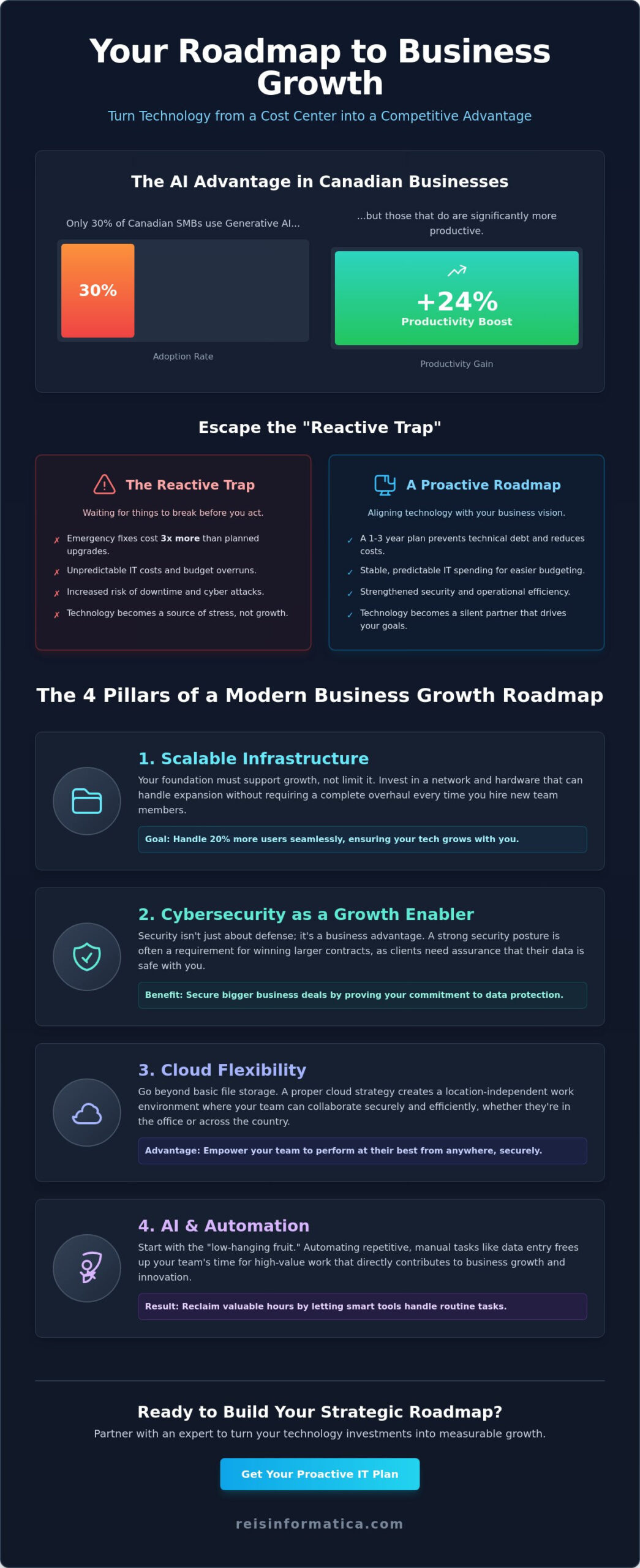
Did you know that while only 30% of Canadian small and medium businesses use generative AI, those that do are already 24% more productive? It’s a staggering gap that highlights why so many leaders feel like they’re playing catch-up. You probably feel the weight of unpredictable IT costs and the constant worry that a single cyber attack could halt your operations. With the Bank of Canada holding interest rates at 2.25% and new carbon taxes impacting your bottom line, every dollar spent on tech needs to work harder. Developing a technology roadmap for business growth isn’t just about buying new gadgets; it’s about making sure your tools actually serve your vision.
We understand that you want to focus on your core business, not troubleshoot server errors or guess next year’s software budget. This guide shows you how to turn technology into a silent partner that drives efficiency and security. We’ll outline a clear 12 to 24 month plan to help you leverage initiatives like the federal productivity super-deduction and the national AI strategy. You’ll learn how to stabilize your IT spending, protect your data, and finally get a bird’s-eye view of your digital future.
Key Takeaways
- Avoid the “Reactive Trap” by shifting from emergency fixes to a proactive 1-3 year plan that prevents technical debt and reduces long-term costs.
- Explore the four pillars of modern IT, including how a strong cybersecurity posture acts as a growth enabler to help you secure bigger business contracts.
- Master a five-step process to create a technology roadmap for business growth that aligns your specific IT investments with your long-term expansion goals.
- Learn how to audit your current tech stack to eliminate wasted spending and ensure you only pay for the tools your team actually uses.
- Discover how partnering with a Managed Service Provider provides the fractional leadership and implementation support needed to keep your strategy on track.
What is a Technology Roadmap and Why Does Your Growth Depend on It?
A technology roadmap is a high-level visual plan that aligns your business goals with specific IT solutions over a 1 to 3 year period. It serves as the bridge between your current capabilities and your future business aspirations. If you look at the formal definition of What is a Technology Roadmap, you’ll see it’s about matching short-term and long-term goals with specific technology solutions to ensure you aren’t just buying tech for tech’s sake.
Many leaders fall into the “Reactive Trap” by waiting for a server to fail or a security breach to happen before they act. This approach is expensive. Waiting for things to break usually costs three times more than planned upgrades. It’s the difference between a controlled office renovation and an emergency repair after a flood. In 2026, digital maturity is the primary differentiator. In competitive Canadian hubs like Mississauga and London, a technology roadmap for business growth is what separates market leaders from those struggling to keep up.
The Difference Between IT Support and IT Strategy
Think of IT support as the team that keeps the lights on. They fix what’s broken and handle daily glitches. IT strategy, however, is about building the foundation for more lights and a much bigger building. You shouldn’t just focus on outputs like how many tickets were closed. Instead, focus on outcomes. Are your systems making your team more efficient? Is your data secure? A strategic approach ensures your technology actually supports your bottom line.
Common Signs Your Business Needs a Strategic Roadmap
If you’re constantly hit with surprise hardware costs or software license renewals you didn’t see coming, you need a plan. Another red flag is seeing employees use personal devices or clunky workarounds because the company’s official tech is too slow. These inefficiencies drain your profits. Leveraging Managed IT Services helps you identify these gaps before they become crises, turning your technology into a predictable asset rather than a source of stress.
The 4 Pillars of a Modern Business Growth Roadmap
Building a technology roadmap for business growth requires more than just a list of new apps. You need a foundation that supports expansion without forcing a total system rebuild every time you succeed. A modern roadmap is built on four essential pillars that ensure your tech is a facilitator, not a bottleneck.
- Scalable Infrastructure: Your network should handle 20% more users without requiring a total overhaul. With the 2025 federal productivity super-deduction allowing for accelerated depreciation, now is the perfect time to invest in hardware that grows with you.
- Cybersecurity as a Growth Enabler: Security isn’t just about defense. A strong posture helps you win bigger contracts because larger clients demand proof that their data is safe in your hands.
- Cloud Flexibility: This goes beyond simple storage. It’s about creating collaborative, location-independent work environments where your team can perform securely from anywhere in Canada.
- AI and Automation: Look for the “low-hanging fruit.” Automating manual data entry or inventory tasks can save your team hours of repetitive work.
If you’re ready to see how these pillars fit your specific goals, exploring IT strategy and leadership can help you prioritize your next moves.
Building a Human Firewall in 2026
Even the most expensive software can’t stop a breach if someone clicks a malicious link. Cybersecurity training is just as important as the latest firewall. In 2026, data breaches are a “when” not “if” scenario for unprepared Canadian firms. Investing in cybersecurity services ensures your team knows how to spot threats before they disrupt your operations.
Leveraging AI for Practical Business Solutions
AI isn’t just for tech giants. Small businesses in Calgary or Halifax are using AI business solutions to automate customer service and inventory management. Considering that Canadian SMEs using generative AI are already 24% more productive, ignoring this pillar means leaving money on the table. It’s about using smart tools to handle the routine, letting your people focus on growth.
5 Steps to Create Your Technology Roadmap for 2026
Turning a vision into a reality requires a structured approach. It’s not about complex jargon; it’s about clear milestones that align with your bottom line. Follow these five steps to build a technology roadmap for business growth that actually delivers results.
- Step 1: Audit Your Current Tech Stack. Look at what you’re actually using versus what you’re paying for. You might find “ghost” licenses for former employees or overlapping tools that do the same thing.
- Step 2: Define 12-Month Business Goals. Are you expanding into new markets like Milton or Oakville? Do you want to increase remote work options? Your tech must support these specific moves.
- Step 3: Gap Analysis. Identify the hurdles. If your goal is remote expansion but your server is physically tied to one office, that’s a gap that needs a cloud solution.
- Step 4: Budgeting and Prioritization. Allocate funds based on ROI and risk mitigation. Focus on the projects that either generate revenue or prevent a total operational shutdown.
- Step 5: Review and Adapt. A roadmap is a living document. Review it quarterly to ensure it still matches the market reality and your company’s progress.
If you’re unsure where to start with your audit, you can schedule a strategy session with our team to get a professional perspective on your current setup.
Local Considerations for Canadian Businesses
Canadian leaders must navigate specific regulations like PIPEDA. When choosing Cloud Services and Products, ensure your data residency meets these privacy laws. Additionally, consider the local labor market. If you want to attract top talent in the Waterloo tech corridor, your tech stack needs to be modern and efficient. Professionals in these hubs won’t stay long if they’re forced to use sluggish, outdated systems.
Setting Realistic Timelines
A “rip and replace” strategy is rarely the right answer for a growing business because it causes too much friction. It’s better to phase in new technologies. For example, if you’re adopting AI, start with one department like customer service before rolling it out across the entire firm. This gradual approach keeps your staff from feeling overwhelmed and ensures each phase is stable before moving to the next.
Executing the Roadmap: Why Managed IT is the Secret Weapon
Creating a plan is a vital first step, but the real challenge lies in making it happen. Many leaders find that their technology roadmap for business growth ends up as “shelfware,” a document that sits on a digital shelf because daily operations get in the way. This is known as the execution gap. When you’re busy managing staff and serving customers, finding the time to oversee a complex cloud migration or a security overhaul is nearly impossible.
A Managed Service Provider (MSP) acts as your secret weapon by filling this gap. Instead of hiring a single IT manager who may have limited bandwidth or specialized knowledge, an MSP provides a whole team of experts. They act as your fractional CIO, offering high-level strategy and the technical hands needed to implement every step of your roadmap. This allows you to focus on your core business goals while professionals handle the technical heavy lifting.
- Expert Implementation: You get access to specialists in cybersecurity, cloud architecture, and AI without the overhead of multiple full-time salaries.
- Predictable Results: Projects are finished on time and within budget because they’re managed by teams who do this every day.
- Strategic Continuity: Your roadmap stays active. Quarterly reviews ensure your tech evolves alongside your business needs.
Building a Resilient Foundation in Canada
Execution is only as good as the foundation it sits on. Infrastructure services provide the “pipes” that your roadmap flows through. If your underlying network or server environment is unstable, even the best AI tools won’t perform. You can learn more about this in our Infrastructure Services Guide, which helps you build the resilience needed for long-term growth.
Strategic Partnership vs. Vendor Relationship
You don’t just need a vendor who sells you hardware; you need a partner who understands the local markets in Kitchener, Cambridge, and Waterloo. A strategic partner takes the time to learn your business goals and ensures every technical decision supports them. They act as a vigilant guardian of your operations, preventing issues before they disrupt your day. If you’re ready to turn your vision into a reality, book a strategy session with Reis Informatica today to start building your custom roadmap.
Take the Next Step Toward Sustainable Growth
You’ve seen how a technology roadmap for business growth transforms IT from a source of stress into a silent facilitator of your success. By focusing on the four pillars of modern infrastructure and following a structured five-step planning process, you move away from reactive fixes. You begin to build a foundation that supports expansion while protecting your data from evolving threats. It’s about making sure every dollar you spend on technology actually helps you reach your 12 month goals.
Realizing this vision doesn’t have to be a solo journey. We provide expert IT strategy and leadership to help you navigate the complexities of modern digital tools. With local support across major Canadian hubs and comprehensive cybersecurity and AI solutions, we ensure your operations remain resilient. Whether you’re refining your current setup or starting from scratch, having a vigilant partner makes all the difference. Ready to build a roadmap that actually drives growth? Let’s talk.
Your business deserves a strategy that works as hard as you do. We’re here to help you turn that vision into a reality.
Frequently Asked Questions
How much does it cost to develop a technology roadmap for a small business?
The investment required for a technology roadmap for business growth depends on the size of your operation and the complexity of your current systems. Instead of a one-time fee, many Canadian leaders find this service is most effective when integrated into a long-term strategic partnership. This approach ensures the plan is continuously monitored and adjusted without unexpected consulting bills. It’s about shifting from random tech purchases to a structured investment plan.
How often should our technology roadmap be updated?
You should review your roadmap quarterly and perform a comprehensive update once a year. Business goals change fast, and new opportunities, like the federal productivity super-deduction, can shift your priorities. Regular check-ins ensure your IT strategy remains aligned with your actual operations. This prevents your roadmap from becoming outdated shelfware that no longer serves your team’s needs in real-time.
Can a technology roadmap help reduce our annual IT spending?
Yes, a well-executed technology roadmap for business growth significantly reduces wasted IT spending. By auditing your tech stack, you identify and remove duplicate software subscriptions and unused hardware licenses. It also helps you avoid the high costs of emergency repairs, which can be three times more expensive than planned upgrades. A roadmap turns your technology into a predictable, manageable expense rather than a series of expensive surprises.
What is the difference between a technology roadmap and an IT budget?
An IT budget is a financial document that tracks your spending, while a roadmap is a strategic vision for where your company is going. The roadmap defines your goals, such as expanding to new cities or adopting AI solutions. Once the roadmap is set, it dictates what your IT budget should look like. Think of the roadmap as the blueprint and the budget as the cost of materials.
Do I need a full-time CTO to create a technology roadmap?
You don’t need a full-time CTO on your payroll to develop a professional strategy. Many growing businesses in Canada leverage managed IT services to access fractional IT strategy and leadership. This gives you the expertise of a high-level executive at a fraction of the cost of a full-time hire. You get the same strategic depth and implementation support while keeping your overhead low and your focus on growth.