Is your technology an investment that pays dividends, or is it just another unpredictable bill you pay every month? If you feel like you’re constantly writing checks for fixes while falling behind on innovations like AI, you aren’t alone. Many business leaders find themselves stuck in a cycle of reactive spending where their tech capabilities don’t actually match their long-term goals. This is where professional IT strategy consulting changes the game. Instead of just keeping the lights on, a strategic approach ensures every dollar spent on your digital infrastructure directly supports your company’s expansion.
We understand that technical jargon is often overwhelming and the fear of making the wrong move is real. We promise to show you how to turn your technology into a reliable growth engine through practical, high-level planning. You’ll learn how to create a clear technology roadmap that offers predictable budgeting and a genuine competitive edge through automation. We’re going to explore how to align your business goals with the latest tools to ensure your company remains resilient and profitable through 2026 and beyond.
Key Takeaways
- Learn how to move away from reactive “break-fix” repairs toward a proactive model that treats technology as a strategic growth engine.
- Discover how to leverage AI business solutions and automation to boost operational efficiency and stay ahead of the competition in 2026.
- Understand why modern IT strategy consulting prioritizes cybersecurity as a foundational element to protect your business and ensure continuity.
- Explore the vCIO model, which provides your business with executive-level technology leadership and predictable budgeting without the cost of a full-time hire.
- Identify the essential qualities to look for in a Canadian technology partner, including the value of local support in hubs like Calgary, Waterloo, and Mississauga.
What is IT Strategy Consulting and Why Does it Matter in 2026?
Information technology consulting is often misunderstood as just calling a technician when the Wi-Fi goes down. In reality, IT strategy consulting is the process of aligning every piece of software and hardware you own with your specific business goals. It’s the difference between buying tools because they’re popular and investing in systems that actually help you scale. Think of IT strategy as the bridge between your current operational state and your 5-year growth targets.
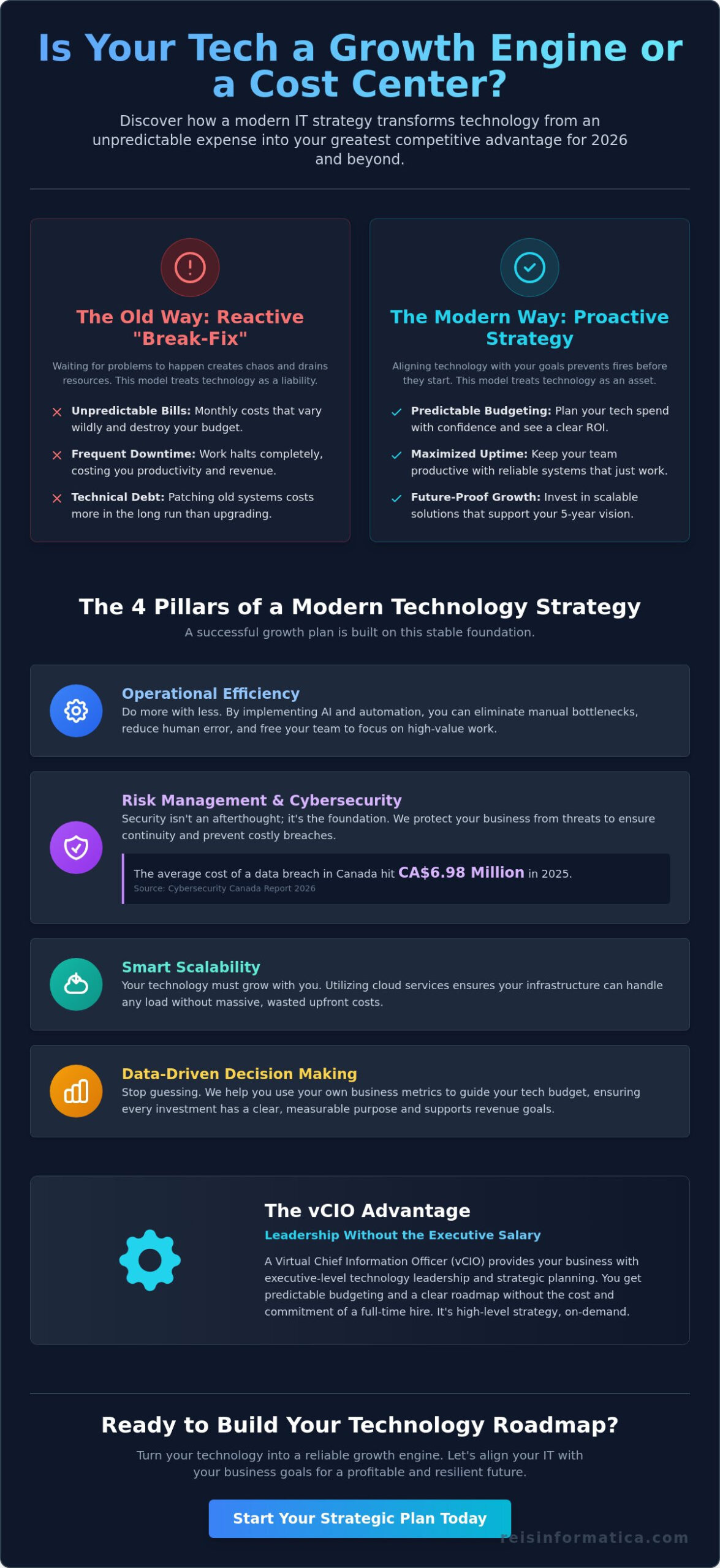
The old “break-fix” model is dead. Waiting for things to snap before fixing them creates a chaotic environment where your team can’t work. Modern strategy is proactive. It looks ahead to prevent fires before they start. In 2026, this approach is non-negotiable. With AI moving at lightning speed and remote-first work becoming the permanent standard, you need a plan that keeps you agile. Without it, you’re just reacting to a world that’s changing quicker than your budget can keep up with.
Compliance also plays a massive role now. With strict regulations like Quebec’s Law 25 and the federal Bill C-8 in full effect, a lack of strategy isn’t just inefficient; it’s a legal risk. Professional IT strategy consulting ensures your growth doesn’t come at the cost of security or regulatory fines.
The Difference Between IT Support and IT Strategy
IT support is essential; it keeps the lights on and the emails flowing. However, strategy is what decides which room those lights should be in. Relying only on support leads to “technical debt.” This happens when you patch old systems instead of upgrading them, eventually costing you more in lost productivity and emergency repairs than a proper plan would have. Support fixes the past; strategy builds the future.
Signs Your Business Needs a Strategic Reset
You might need a change if your technology feels like a hurdle rather than a help. Watch out for these red flags:
- Frequent downtime that halts your team’s progress.
- Unpredictable monthly bills that vary wildly and blow your budget.
- Feeling “stuck” using old software that doesn’t talk to your other tools.
- The total absence of a clear technology roadmap for the next 18 months.
If you’re experiencing any of these, your tech is likely a cost center. A strategic reset can flip that script, turning your digital tools into a genuine engine for growth.
The 4 Pillars of a Modern Technology Strategy
A successful growth plan doesn’t happen by accident. It requires a stable foundation built on four critical areas. When we provide IT strategy consulting, we focus on these pillars to ensure your technology supports your business rather than draining its resources. Each pillar works together to create a seamless operational environment where your team can thrive without technical friction.
- Operational Efficiency: This is about doing more with less. By implementing AI business solutions and automation, you can remove manual bottlenecks that slow down your team and increase human error.
- Risk Management: Security shouldn’t be an afterthought. High-quality cybersecurity services act as a foundation for every other tech decision. Considering the average cost of a data breach in Canada hit CA$6.98 million in 2025 according to the Cybersecurity Canada Report 2026, this pillar is about survival as much as growth.
- Scalability: Your tech should grow as you do. Utilizing cloud services ensures that whether you have five employees or fifty, your infrastructure can handle the load without massive, wasted upfront costs.
- Data-Driven Decision Making: Stop guessing what works. Use your own business metrics to guide where your tech budget goes, ensuring every investment has a clear purpose.
Aligning Tech Spend with Revenue Goals
It’s time to stop viewing IT as a black hole for cash. To see a real return on investment, you need to measure how each tool contributes to your bottom line. Whether it’s reducing the time to close a sale or lowering overhead, every dollar should have a purpose. If you’re wondering how this works in practice, understanding what managed IT services can do for your business is a great place to start. If you want to see how these pillars fit your specific needs, you can explore our strategy options.
Future-Proofing for AI and Automation
Your 2026 strategy must account for the massive shift toward generative AI and machine learning. These technologies require robust infrastructure services to handle significantly higher data demands. Preparing now means you won’t be left behind when your competitors start using these tools to move faster than you. IT strategy consulting helps you build that resilience today so you’re ready for whatever tomorrow brings.
The vCIO Advantage: Leadership Without the Executive Salary
Hiring a full-time executive to manage your technology isn’t always feasible for growing companies. This is where a Virtual Chief Information Officer (vCIO) provides a massive advantage. They offer the high-level expertise you need for IT strategy consulting at a fraction of the cost of a full-time hire. For businesses in Milton, Cambridge, and London looking to scale, this model provides a seat at the leadership table for someone who speaks both business and tech.
A vCIO acts as your business partner, not just another vendor. They’re invested in your success because their role is to ensure your technology facilitates growth rather than hindering it. Through effective IT strategy consulting, they align your digital tools with your revenue targets, providing a level of foresight that most small businesses lack.
What Does a vCIO Actually Do?
A vCIO doesn’t just fix computers; they look at your business from 30,000 feet. They handle complex budget planning so you don’t get hit with surprise costs. They also manage your technology vendors, ensuring you get the best value for your software licenses. Most importantly, they make sure that cybersecurity awareness is a core part of your company culture. This isn’t a one-time project; it’s an ongoing partnership focused on your long-term roadmap.
Strategy vs. Implementation: Closing the Gap
One of the biggest frustrations for business owners is seeing a great plan sit on a shelf. A vCIO closes the gap between high-level goals and daily execution. They work directly with the technical team to ensure the strategy actually happens. This reduces friction because they translate your business goals into technical tasks that the staff can follow. It means you don’t have to worry about the “how”, you just get to see the results.
If you’re ready to get executive-level guidance for your growth, explore our IT strategy and leadership services.
Choosing the Right IT Strategy Partner in Canada
Selecting a partner for IT strategy consulting is one of the most significant decisions a business leader makes. It’s not just about technical skills. It’s about finding a team that understands the Canadian business environment. Local presence in cities like Calgary, Waterloo, and Mississauga is vital. It allows for hands-on strategy and a deeper understanding of regional economic shifts. You should look for a partner that offers comprehensive IT services, moving seamlessly from high-level planning to the daily support your team relies on.
A great partner also brings deep knowledge of the legal landscape. With the IT consulting industry in Canada projected to reach $126.6 billion in 2026 according to IBISWorld, the market is crowded. However, few partners truly master the nuances of Canadian data privacy laws. Whether it’s ensuring compliance with Quebec’s Law 25 or preparing for the upcoming federal Bill C-8, your consultant must ensure your growth plan is legally sound. This industry-specific knowledge prevents costly legal headaches as you scale.
Questions to Ask a Potential IT Consultant
When you’re interviewing a potential partner, look for clarity and business acumen. Ask: “How do you measure the success of a technology roadmap?” and “Can you show examples of aligning IT with business growth in my specific industry?” If they can’t provide clear, results-oriented answers without hiding behind jargon, they aren’t the right fit for your leadership team. You need a partner who talks about revenue and ROI, not just bits and bytes.
Why Reis Informatica is the Strategic Choice
We position ourselves as the “Guardian of Continuity” for your business. With a strong presence in Kitchener, Waterloo, Halifax, and beyond, we provide the local expertise you need to thrive. We handle the technical complexity so you can focus on your core mission. Our approach is proactive, focusing on preventing risks before they disrupt your operations. We’re ready to help you turn technology into your greatest asset for the years ahead.
Let’s build your 2026 technology roadmap together and ensure your business is prepared for the future.
Secure Your Business Growth for 2026
The landscape of 2026 demands more than just basic tech support. We’ve explored how a proactive roadmap turns technology from a constant expense into a powerful growth engine. By focusing on the four pillars of efficiency, risk management, scalability, and data, you ensure your business stays resilient. Professional IT strategy consulting isn’t just for enterprise corporations; it’s the secret weapon for any Canadian leader who wants to scale without technical friction.
Our team brings specialized expertise in AI and cybersecurity alignment to businesses across Kitchener, Waterloo, Calgary, and Halifax. We pride ourselves on a conversational approach that translates complex leadership challenges into clear, actionable plans. You don’t need to be a tech expert to have world-class technology driving your revenue. We act as your specialized partner, taking the weight of technical complexity off your shoulders.
Ready to align your tech with your business goals? Explore our IT Strategy & Leadership services.
Your path to a more predictable and profitable future starts with a single strategic step. We’re here to guide you every step of the way. Let’s build something great together.
Frequently Asked Questions
What is the difference between IT consulting and IT strategy?
IT consulting usually addresses a specific project or technical hurdle, like migrating to a new server. In contrast, IT strategy consulting focuses on the “why” behind your technology investments. It ensures that every tool you adopt over the next several years directly supports your revenue targets and operational goals. One is about fixing a moment in time; the other is about building a roadmap for the future.
How much does IT strategy consulting cost for a small business?
The cost depends on the complexity of your operations and the depth of the planning required. Most businesses find that a flat-fee model or a monthly retainer for a vCIO is more cost-effective than hiring a full-time executive. This approach provides predictable budgeting while ensuring you have high-level expertise on hand. It’s an investment that typically pays for itself by preventing expensive technical debt and wasted software spend.
Do I need a full-time CIO if I hire a strategy consultant?
You don’t need a full-time CIO when you have a dedicated strategy partner. A consultant or vCIO provides the same leadership, budget oversight, and long-term planning without the six-figure executive salary and benefits package. This model allows you to access top-tier talent only when you need it, which is ideal for businesses in the growth phase that need executive-level guidance but want to keep overhead lean.
How often should our technology roadmap be updated?
We recommend a major review of your technology roadmap at least once a year, with smaller quarterly check-ins. Because the landscape of AI and Canadian compliance laws changes so rapidly, waiting longer than twelve months can leave you vulnerable. Regular updates ensure your tech stack remains aligned with your shifting business priorities and that you aren’t overpaying for licenses or tools you no longer use.
Can an IT strategy help reduce our monthly overhead costs?
Absolutely. A well-executed IT strategy consulting engagement identifies redundant software licenses, reduces costly downtime, and automates repetitive manual tasks. By consolidating your infrastructure and moving to efficient cloud models, you can turn a bloated IT budget into a lean, predictable line item. This shift from reactive repairs to proactive management significantly lowers the total cost of ownership for your entire technology environment.