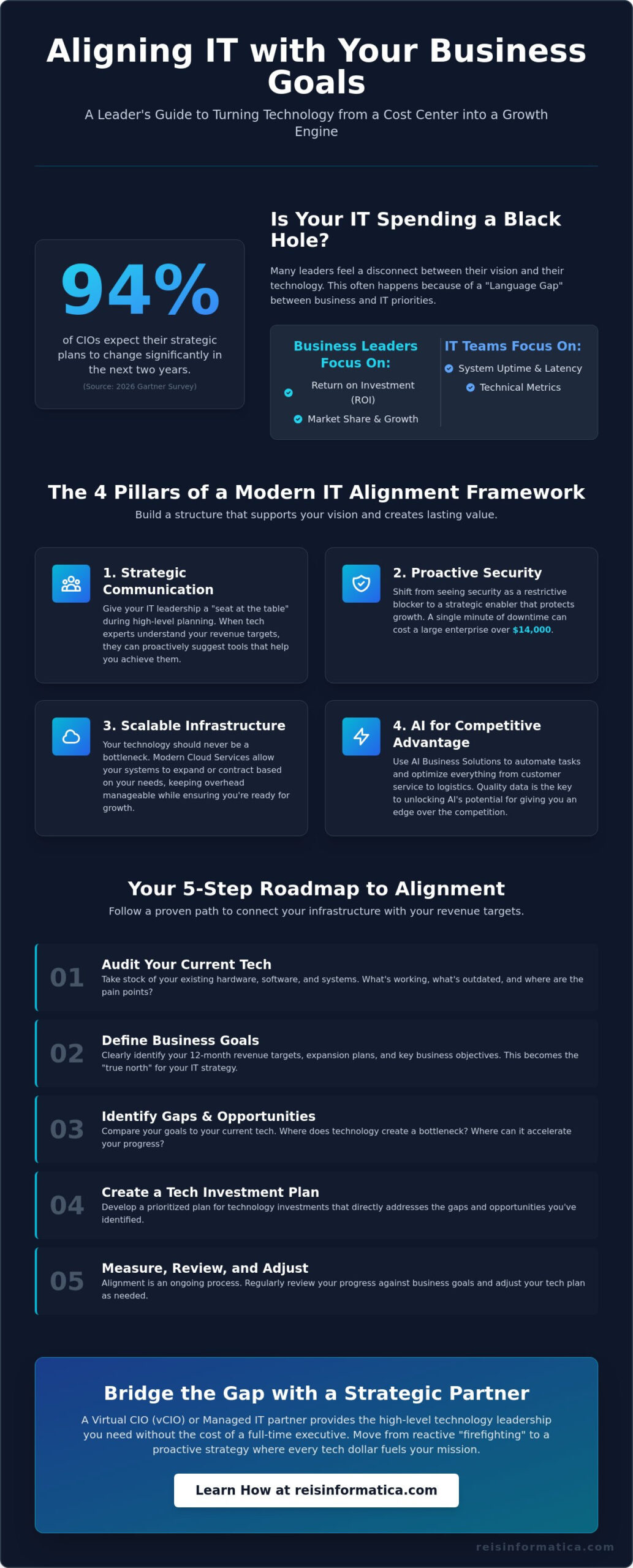
Did you know that 94% of CIOs expect their strategic plans to change significantly within the next two years? It’s a staggering figure from a 2026 Gartner survey that highlights why so many leaders feel like their technology spending is a black hole. You might feel that your IT team speaks a different language than your leadership team, or perhaps you’re worried that competitors are leveraging AI more effectively while you’re just trying to keep the lights on. Learning how to align IT with business goals isn’t just about buying the latest software. It’s about building a bridge between your long term vision and your daily infrastructure.
We understand that you want tech to be a silent, efficient facilitator rather than a source of frustration. This guide will show you how to stop treating technology as an expensive burden and start using it as a strategic engine that drives your specific objectives. You’ll discover a clear roadmap for your investments and learn how to foster better communication so your tech scales naturally as your company grows. By the end, you’ll have the tools to transform your digital environment into a proactive partner that protects your operations and fuels your success.
Key Takeaways
- Bridge the communication gap by learning how to translate technical metrics like “uptime” into the business results and ROI your leadership team cares about.
- Shift your perspective on cybersecurity, moving it from a restrictive “blocker” to a strategic enabler that protects your company’s growth and stability.
- Follow a proven five-step roadmap to discover how to align IT with business goals by auditing your current infrastructure against your 12-month revenue targets.
- Explore how a Virtual CIO (vCIO) can act as a strategic partner, providing the high-level technology leadership your organization needs without the cost of a full-time executive.
- Understand why modern IT alignment requires a “seat at the table” for technology leaders to ensure every tech dollar spent directly fuels your mission.
What is IT-Business Alignment and Why Does it Feel So Difficult?
At its core, Business-IT alignment is the state where every dollar you spend on technology directly supports your company’s mission and bottom line. It sounds simple, but for many leaders, it feels like a constant uphill battle. This difficulty often stems from a “Language Gap.” While you’re focused on return on investment (ROI) and market share, your IT team might be focused on technical metrics like uptime and latency. When these two worlds don’t speak the same language, your overall strategy suffers.
Understanding how to align IT with business goals is no longer optional in 2026. Technology isn’t just a support function tucked away in a back room; it’s the very foundation of your operations. Misalignment leads to more than just daily frustration. It creates specific risks that can cripple a growing organization:
- Wasted budgets on software or hardware that nobody actually uses.
- Hidden security vulnerabilities that put your client data at risk.
- Missed market opportunities while your more agile competitors move faster.
The Cost of the ‘Set It and Forget It’ Mentality
Treating your IT like a utility, similar to electricity or water, is a trap that prevents strategic growth. If you only think about your tech when something breaks, you’re operating in a reactive mode. This approach builds up “technical debt,” which is the long term cost of choosing easy, quick fixes over sustainable solutions. This debt eventually slows your entire team down and makes it impossible to pivot when the market changes.
Moving from Cost Center to Strategic Partner
The biggest shift you can make is viewing IT as a revenue driver rather than an expense. Instead of just fixing laptops, your technology strategy should help you find new ways to reach customers or improve internal efficiency. Transitioning to Managed IT Services is often the first step in this journey. It allows you to move away from constant firefighting and toward a proactive partnership where tech experts help you hit your 2026 targets with confidence.
The 4 Pillars of a Modern IT Alignment Framework
Achieving a modern perspective on IT-business alignment requires more than just a list of tasks. It’s about building a structure that supports your vision. Here are the four pillars that define how to align IT with business goals in a way that creates lasting value for your organization.
The first pillar is Strategic Communication. This means ensuring your IT leadership has a regular “seat at the table” during high level planning. When tech experts understand your revenue targets or hiring plans, they can suggest tools that actually help you hit them. Without this, IT remains in a reactive bubble, solving problems you had yesterday instead of preparing you for tomorrow.
Pillar 2: Security and Business Continuity
Many leaders see security as a series of restrictive rules, but it’s actually about protecting your ability to grow. By investing in Cybersecurity Services, you’re preventing the downtime that can cost large enterprises over $14,000 per minute. It’s also vital to foster Cybersecurity Awareness across your entire team. A culture of safety ensures your human firewall is just as strong as your digital defenses.
The third pillar is Scalable Infrastructure. Your technology should never be a bottleneck for expansion. Modern Cloud Services allow your systems to expand or contract based on your current headcount and project load. This flexibility keeps your overhead manageable while ensuring you’re always ready for a sudden surge in business.
Pillar 4: Leveraging AI for Competitive Advantage
Identifying bottlenecks is the first step toward automation. Using AI Business Solutions can help you optimize everything from customer service to complex logistics. However, remember that data quality is the absolute prerequisite for any AI project. These tools are only as effective as the information they process. If you’re ready to see how these pillars apply to your specific setup, exploring our IT strategy and leadership options is a great place to start.
5 Steps to Align Your IT Strategy with Your 2026 Goals
Moving from a theoretical framework to a practical action plan is where most organizations struggle. To succeed, you need practical advice and steps that bridge the gap between your boardroom and your server room. Here is your “Monday morning” plan for how to align IT with business goals effectively.
Step 1: Define Your Non-Technical Business Goals. Before looking at a single piece of hardware, list your targets for the next 12 months. Are you aiming for a 20% revenue increase? Do you plan to hire 50 new remote employees? Or perhaps you’re expanding into a new territory? These are the real drivers of your tech strategy.
Step 2: Auditing Your Foundation
Once your goals are set, you must determine if your current Infrastructure can actually support them. A Technology Audit is a comprehensive health check for your business’s future that identifies hidden risks. Look for outdated hardware or slow software that acts as a drag on your team’s daily productivity. If your foundation is cracked, your growth will be limited.
Step 3: Create a Joint Roadmap. Every IT project should be mapped to a specific business outcome. For example, instead of just “moving to the cloud,” frame it as “adopting cloud solutions to support a flexible, remote hiring strategy.” This ensures everyone understands the “why” behind the spend.
Step 5: The Quarterly Business Review (QBR)
Market conditions, especially in Canada, can shift rapidly. You should meet with your IT partner every 90 days to review performance and realign on your goals. Use KPIs like “Time to Market” or “Customer Acquisition Cost” to judge if your tech is truly helping you win. If you’re ready to build a roadmap that actually works, let’s talk about our IT strategy and leadership services today.
Step 4: Allocate a Strategic Budget. Shift your mindset away from emergency fixes. Stop spending only when things break. Instead, dedicate funds to growth investments that proactively improve your efficiency and security posture. This turns your IT department into a predictable engine for success rather than a source of financial surprises.
Bridging the Gap: Why Managed IT is the Shortcut to Alignment
Many business owners find that even with a clear roadmap, the daily execution of technology strategy is overwhelming. This is where Managed IT acts as a shortcut. Instead of trying to master complex systems yourself, you partner with experts who specialize in how to align IT with business goals. It’s about moving from a “do it yourself” approach to a model where technology is managed by a vigilant, strategic partner who understands your vision.
A central part of this partnership is the Virtual Chief Information Officer, or vCIO. Think of a vCIO as a translator. They take your high level business needs and turn them into concrete technical projects. They provide “Leadership-as-a-Service,” giving you access to the same strategic thinking a full-time CTO would provide without the six-figure executive salary. This is particularly valuable for mid-sized organizations that need high level guidance but aren’t ready for a full-time hire.
Choosing a Canadian-based partner like Reis Informatica offers a distinct advantage. We understand local regulations and the specific market dynamics that impact your operations. We act as a guardian of your continuity, managing the technical complexity so you can focus entirely on your core mission.
Focusing on Your Core Business
Every hour you spend trying to troubleshoot a server or research software is an hour you aren’t spending on sales, hiring, or innovation. This is the “Opportunity Cost” of unmanaged IT. When you offload the technical burden, you reclaim your time. If you’re curious about how this partnership works in practice, you can read our guide on what are managed IT services for a deeper look at the model.
Scalability Without the Overhead
Managed IT allows you to scale your technology as naturally as your headcount grows. You get the benefit of a modern, structured organization that handles the complexity of IT strategy and leadership for you. This model ensures your tech remains a silent facilitator rather than a bottleneck. Remember, alignment isn’t a one-time destination. It’s a journey that requires constant vigilance and a partner who’s committed to your long term success.
Transform Your Technology into a Strategic Growth Engine
Technology shouldn’t be a black hole for your budget or a source of constant frustration. By bridging the language gap between leadership and technical teams, you ensure every dollar spent serves a clear purpose. We’ve seen how a proactive framework, built on robust security and scalable infrastructure, prevents the downtime that stalls expansion. Learning how to align IT with business goals is the most effective way to move from reactive firefighting to strategic leadership.
You don’t have to manage this transition alone. Reis Informatica offers expert vCIO leadership specifically for Canadian SMBs, providing the high level strategy you need to stay ahead. With proactive management focused on your unique business growth, we provide comprehensive support across Kitchener, Waterloo, Calgary, and beyond. We take care of the technical complexity so you can focus on the vision that drives your company forward.
Book a Strategic IT Consultation with Reis Informatica Today and start building a foundation that’s as ambitious as your goals. Your journey toward a more secure and efficient future starts with a single conversation.
Frequently Asked Questions
What is the first step in aligning IT with business goals?
The first step is to clearly define your non-technical business objectives for the next 12 to 24 months. You can’t align technology to a target that doesn’t exist yet. By identifying goals like revenue growth or geographic expansion first, you provide the context your IT team needs to select the right tools. This ensures every project has a clear purpose from the start.
How do I measure the ROI of IT-business alignment?
You measure ROI by tracking business outcomes rather than just technical metrics like “uptime.” Look for improvements in productivity and cost reduction across your operations. For example, enterprises using AIOps-powered management software in 2026 resolve incidents 60% faster. These results prove that your technology is actively driving efficiency instead of just acting as a recurring expense for the company.
Does a small business really need an IT strategy?
Yes, every small business needs a strategy to avoid wasting budget on reactive fixes. Without a plan for how to align IT with business goals, you risk outgrowing your systems or facing denied cyber insurance claims due to poor controls. A basic strategy ensures your infrastructure supports your current headcount while remaining flexible enough for future growth. It’s about being proactive rather than waiting for a crisis to occur.
What is a vCIO and how do they help with alignment?
A vCIO, or Virtual Chief Information Officer, is a strategic partner who provides high level technology leadership on a fractional basis. They help with alignment by acting as a bridge between your executive team and your technical staff. They translate your business requirements into a prioritized roadmap of tech projects. This allows you to access executive expertise without the cost of a full-time, six-figure salary.
How often should we review our IT-business alignment roadmap?
You should review your roadmap at least once every 90 days during a Quarterly Business Review (QBR). Market conditions and internal priorities can change quickly, especially with the rapid evolution of AI. Regular reviews allow you to adjust your technology investments and ensure your IT team remains focused on your most current business objectives. This cadence keeps your strategy agile and prevents your tech from falling behind.