
Is your day constantly interrupted by slow computers, unreliable network connections, or the nagging worry of a potential cyberattack? For many small business owners, technology often feels less like a tool for growth and more like a source of unpredictable costs and constant distraction. You know you need professional support, but the expense of a full-time IT department is out of reach, and relying on a reactive “IT guy” only solves problems after they’ve already impacted your operations. This is precisely why a strategic shift towards managed IT services for small business is becoming a game-changer.
In this ultimate guide, we will demystify this proactive approach to technology management. You will discover how a dedicated IT partner can eliminate your tech headaches for good, secure your valuable data against modern threats, and provide a stable, predictable monthly cost. Prepare to gain the peace of mind that comes from knowing your IT infrastructure is in expert hands, freeing you to focus 100% on what truly matters: driving your business forward.
Key Takeaways
- Learn why the traditional ‘break-fix’ IT model creates expensive downtime and how a proactive approach keeps your business running smoothly.
- Exchange unpredictable, high-cost IT emergencies for a flat, predictable monthly fee, and understand the true ROI for your Canadian business.
- Effective managed IT services for small business go beyond daily support; discover how the right partner provides strategic planning to help you scale securely.
- Arm yourself with a checklist of critical questions to ask any potential provider, ensuring you choose a partner that aligns with your specific operational needs.
Why Your Small Business Has Outgrown the ‘Break-Fix’ IT Model
For many startups and small businesses, the initial approach to technology is simple: when something breaks, you call someone to fix it. This traditional ‘break-fix’ model seems financially prudent at first glance-you only pay for IT support when you absolutely need it. However, as your Canadian business grows and your reliance on digital infrastructure deepens, this reactive stance quickly becomes a significant liability, hindering the very growth you’re working to achieve.
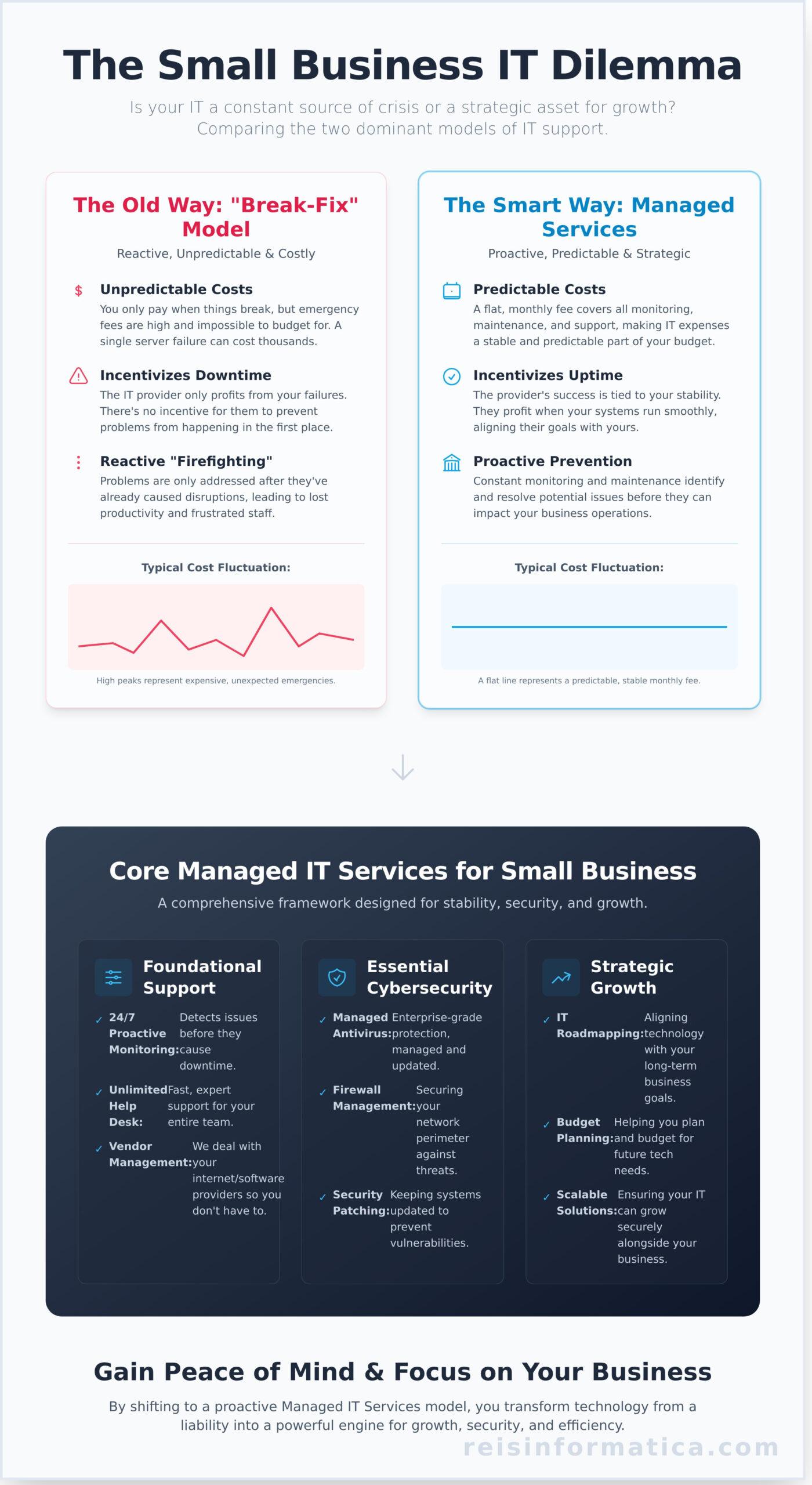
The fundamental flaw of the break-fix model is that it incentivizes downtime. Your IT support only profits when your systems fail. This creates a relationship built on emergency, not strategy, and leaves your business vulnerable to a host of hidden costs that go far beyond a simple repair invoice.
The Vicious Cycle of Reactive IT Support
Imagine a critical server crashes during your busiest season. Operations grind to a halt, panic sets in, and your team is left waiting for an emergency technician. This scenario highlights the core issues of reactive support. The costs are unpredictable and often exorbitant, with emergency call-out fees in Canada easily exceeding C$500 before any work even begins. More importantly, the repeated cycle of downtime erodes productivity, frustrates employees, and damages the trust you’ve built with your customers. It’s a constant state of firefighting that prevents any meaningful technological progress.
Shifting to a Proactive Partnership Model
The alternative is to move from a reactive vendor to a proactive partner. This is the foundation of managed IT services for small business. Instead of paying for individual emergencies, you invest in a predictable, flat monthly fee for comprehensive monitoring, maintenance, and support. This model, formally known as Managed Services (learn more about What are Managed Services?), fundamentally realigns incentives. Your Managed Services Provider (MSP) is motivated to prevent problems before they can disrupt your operations.
An MSP’s success is directly tied to your business’s stability and uptime. By proactively managing your network, applying security patches, and optimizing system performance, they ensure your technology becomes a reliable asset for growth, not a source of constant crisis. This partnership allows you to focus on your core business, secure in the knowledge that a dedicated team is vigilantly protecting your digital infrastructure.
Core Managed IT Services: What’s Included for a Small Business?
When you partner with a Managed Services Provider (MSP), you’re not just hiring an on-call technician; you’re adopting a complete technology framework designed for stability and growth. A comprehensive plan of managed IT services for a small business moves your company from a reactive, break-fix model to a proactive strategy that prevents problems before they disrupt your operations. Below is a checklist of the essential services you should expect.
Foundational Support: Keeping Your Team Productive
The core of any managed IT plan is ensuring your team can work efficiently and without interruption. This is achieved through a multi-layered support system:
- 24/7 Proactive Monitoring: Your MSP acts as a vigilant guardian, using advanced tools to monitor the health of your network, servers, and workstations around the clock. This allows for the detection of early warning signs-like a failing hard drive or unusual network traffic-so issues can be resolved before they cause costly downtime.
- Unlimited Help Desk: Give your employees a single, reliable point of contact for any tech issue. Instead of wasting time trying to solve problems themselves, they can get immediate, expert assistance, keeping productivity high.
- Vendor Management: Stop spending hours on the phone with your internet or software providers. Your MSP can manage these relationships, acting as your technical liaison to resolve issues faster and let you focus on your business.
A complete plan ensures all your bases are covered. See our full suite of managed IT services.
Essential Cybersecurity: Your First Line of Defense
In today’s digital landscape, robust security isn’t optional. An MSP provides the essential layers of protection that every Canadian business needs. This proactive stance is a cornerstone of effective small business security, protecting you from threats you may not even see. Key services include:
- Managed Antivirus & Firewall: These are the non-negotiable basics. An MSP doesn’t just install software; they manage, update, and monitor these tools to ensure they are configured correctly to block malware and unauthorized access.
- Patch Management: Outdated software is a primary entry point for cybercriminals. Your provider will systematically apply security patches to your operating systems and applications, closing vulnerabilities as soon as they are discovered.
- Email Security: With phishing being a top threat, advanced email filtering is critical. This service scans incoming emails to block spam, viruses, and malicious links before they reach your employees’ inboxes.
This is a core part of our dedicated cybersecurity services.
Business Continuity: Backup and Disaster Recovery
What would happen if your data was suddenly lost due to hardware failure, cyberattack, or natural disaster? An MSP ensures you have a clear answer. It’s crucial to understand the difference between a simple backup (a copy of your files) and a disaster recovery plan (a strategy to restore full operations). Your provider will implement an automated, secure backup solution and, more importantly, regularly test the restoration process to guarantee your data is safe and can be recovered quickly when you need it most.
Strategic IT: How an MSP Becomes Your Growth Partner
True scalability isn’t just about fixing problems as they arise; it’s about preventing them and building a technology framework that fuels your ambitions. The right provider of managed IT services for small business moves beyond day-to-day support to become a strategic partner. They stop your technology from being a recurring cost centre and transform it into a competitive advantage, ensuring every investment is aligned with your long-term business objectives.
A crucial part of this competitive advantage is a professional, SEO-optimized website. While your MSP handles the backend infrastructure, a specialist can ensure your digital storefront is effective. For example, the team at WebAssICT focuses on creating custom websites that help entrepreneurs establish a strong online presence from the start.
Your Virtual CIO (vCIO): Executive-Level Strategy, SMB Price
Imagine having an executive-level technology expert dedicated to your success, but without the C$150,000+ annual salary. That is the value of a Virtual Chief Information Officer (vCIO). This professional acts as your strategic advisor, creating a detailed technology roadmap that aligns directly with your business goals. Whether you plan to expand, hire remotely, or improve operational efficiency, your vCIO ensures your IT infrastructure is ready. They help you budget predictably, maximize ROI on tech spending, and proactively address the complex threats detailed in guides like the FCC’s on Cybersecurity for Small Businesses, giving you peace of mind.
Leveraging the Cloud for Efficiency and Scalability
Aging on-premise servers are expensive to maintain, vulnerable to failure, and difficult to scale. A modern MSP guides your digital transformation by helping you leverage the power of the cloud. They analyze your needs to select, implement, and manage the right solutions-like Microsoft 365 or private cloud hosting-that enable your team to work securely from anywhere. By managing your cloud services, an MSP ensures optimal performance, robust security, and cost-effectiveness, freeing up capital and resources so you can focus on growing your business, not maintaining hardware.
The Financial Case: Predictable Costs vs. Catastrophic Failures
For many Canadian business leaders, the central question is direct: Is a monthly fee for IT support truly worth it? The answer becomes clear when you contrast a predictable operational expense with the sudden, crippling costs of a technological failure. Relying on a break-fix model is a financial gamble where the odds are not in your favour. A server crash, a data breach, or prolonged network failure doesn’t just come with a repair bill; it brings your entire operation to a halt.
This is where the strategic value of managed IT services for small business becomes undeniable. It shifts your IT from a source of unpredictable, reactive expenses to a stable, budgeted line item that actively protects your revenue and operational continuity.
Calculating the True Cost of IT Downtime
The cost of an outage goes far beyond a simple repair invoice. Consider a conservative scenario for just one hour of downtime at a 10-person company:
- Lost Productivity: 10 employees x C$35 average hourly wage = C$350 in lost wages.
- Lost Revenue: If your business generates C$1 million annually, one hour of stopped sales or production costs approximately C$500 in lost revenue.
In this example, a single hour of downtime costs C$850 in direct, measurable losses. This figure doesn’t even account for intangible-but significant-costs like reputational damage with clients, potential data recovery fees, or overtime pay needed to catch up.
Budgeting for IT as an Investment, Not an Expense
A flat-rate monthly fee transforms your technology budget from a variable risk into a predictable investment. This stability allows for precise financial planning, eliminating surprise capital expenditures. Furthermore, the proactive maintenance included in managed IT services for small business extends the lifespan of your hardware, delaying costly replacements. The most significant return, however, is the “soft ROI”: when your team isn’t frustrated by tech issues, their productivity and focus on core business goals improve dramatically. By partnering with a dedicated IT provider, you are investing in the stability and efficiency that fuels sustainable growth. Learn more about how a strategic partnership can protect your bottom line at reisinformatica.com.
How to Choose the Right Managed IT Provider for Your Business
Selecting a managed services provider (MSP) is a critical strategic decision that extends far beyond hiring an on-call help desk. The right partner becomes an extension of your team, a guardian of your operational continuity, and a catalyst for growth. This choice demands careful evaluation to ensure you find a provider who aligns with your business goals and can deliver on their promises. A local presence is crucial, as it guarantees fast, effective onsite support when remote troubleshooting isn’t enough to resolve a critical issue.
Key Questions to Ask a Potential MSP
To differentiate a true partner from a simple service vendor, begin by asking targeted, benefit-oriented questions. Their answers will reveal their commitment to your success.
- What are your guaranteed response and resolution times as defined in your Service Level Agreement (SLA)? A clear, documented SLA is non-negotiable. It contractually defines service standards, ensuring you receive the level of support your business requires to maintain productivity.
- Can you provide references from Canadian businesses of a similar size and industry? Speaking with current clients offers unbiased insight into the provider’s reliability, expertise, and customer service quality.
- How do you approach cybersecurity and ensure compliance with data privacy regulations like PIPEDA? A robust provider will detail a multi-layered security strategy, from proactive monitoring and employee training to incident response plans that protect your sensitive data.
- How will you help us plan for future technology needs and create a strategic roadmap? A forward-thinking partner looks beyond today’s problems to help you budget for and implement technology that will support your long-term growth.
Finding a Forward-Thinking Partner
The most valuable providers of managed IT services for small business focus on your business outcomes, not just technical specifications. They actively seek ways to improve your efficiency, reduce operational friction, and leverage technology for a competitive advantage. This includes advising on emerging tech like practical AI business solutions that can automate tasks and unlock new opportunities. Avoid providers with a purely reactive, break-fix mentality; your goal is a proactive partnership that prevents problems before they impact your operations.
Ultimately, your MSP should provide the peace of mind that allows you to focus on your core business. By asking the right questions and looking for a strategic, forward-thinking partner, you can build a foundation for secure and sustainable scaling. To learn how a proactive IT strategy can benefit your business, visit us at reisinformatica.com.
Empower Your Business with a Strategic IT Partner
For Canadian small businesses, the path to sustainable growth is no longer paved with reactive IT fixes. As we’ve explored, embracing managed IT services for small business means transforming technology from a source of unpredictable costs into a powerful strategic asset. This allows you to focus on your core objectives, secure in the knowledge that your digital infrastructure is not just maintained, but optimized for performance and security.
The right partner acts as a vigilant guardian for your operations. With Reis Informática, you gain more than support; you get proactive, 24/7 monitoring, comprehensive cybersecurity, and strategic guidance from experienced vCIOs. If you’re ready to build an IT strategy that fuels your ambition and provides true peace of mind, it’s time to connect. Schedule a free consultation to build your small business IT strategy and take the first step towards unlocking your company’s full potential.
Frequently Asked Questions About Managed IT Services
Is my business too small for managed IT services?
No business is too small to protect its critical data and ensure operational efficiency. In fact, small businesses are often prime targets for cyber threats due to limited resources. Managed IT services provide enterprise-level security and proactive support scaled to your specific size and budget. This allows you to focus on growth with the confidence that your technology foundation is stable, secure, and ready to scale with you.
What’s the difference between managed IT services and hiring an IT consultant?
The key difference is the relationship model. An IT consultant is typically hired for a specific, project-based task, like an office move or a server upgrade. A managed service provider (MSP), on the other hand, acts as a long-term strategic partner. We provide continuous, proactive monitoring, management, and support for your entire IT infrastructure to prevent problems before they impact your business operations.
How much do managed IT services typically cost for a small business?
In Canada, costs for managed IT services for a small business typically range from C$80 to C$250 per user, per month. The final price depends on the complexity of your infrastructure and the specific services included, such as cybersecurity, cloud management, and 24/7 support. This predictable monthly fee provides a stable IT budget, preventing the costly surprises associated with unexpected downtime or emergency repairs.
How long does it take to onboard with a new managed IT service provider?
A structured onboarding process is crucial for a smooth transition and typically takes between two to six weeks. This timeline allows for a thorough assessment of your current systems, strategic planning, and the deployment of monitoring and security tools. Our goal is to complete this process with minimal disruption to your daily operations, ensuring a seamless handover of your IT management.
Will I lose control over my IT systems if I hire an MSP?
Quite the opposite. You gain greater strategic control by offloading the day-to-day technical complexities. You remain the decision-maker for all major IT strategies and investments, while your MSP partner handles the execution, maintenance, and monitoring. This partnership empowers you to make informed decisions about your technology without being bogged down by technical minutiae, freeing you to focus on your core business.
Can an MSP work with the cloud services we already use?
Absolutely. A core function of an MSP is to integrate with and optimize your existing technology stack. Whether you use Microsoft 365, Google Workspace, or other specialized cloud applications, we ensure they are secure, efficient, and properly integrated. Our expertise enhances the value of your current investments, guaranteeing they are configured for maximum productivity and security within your operations.