
A July 2026 PwC report found that 49% of business leaders struggle to measure the value and return on investment of cloud investments. That challenge makes calculating cloud ROI for business more than a comparison of monthly bills: it means weighing the full cost of moving and operating workloads against the value they create.
It’s understandable if the numbers feel difficult to pin down. Migration, security, training and ongoing operations all affect total cost, while benefits such as faster delivery, greater agility and stronger resilience can be harder to express in dollars. Finance and IT teams may also have different priorities, so a shared, credible case needs clear assumptions and measures.
This guide shows you how to create a transparent cost-and-benefit model, compare cloud options fairly with your current environment, and connect business goals to measurable indicators. You’ll also learn how to document assumptions and review results after implementation, so your next cloud decision is grounded in evidence rather than guesswork.
Key Takeaways
- Define cloud ROI by comparing business value with the full investment, using a realistic current-state baseline.
- When calculating cloud ROI for business, include transition work, training, subscriptions, support and ongoing management, not just cloud bills.
- Test your assumptions with conservative, expected and higher-benefit scenarios to see how different outcomes affect the decision.
- Use your findings to decide whether to proceed, adjust scope or phase the work, then assign owners for cost reviews, security, continuity and KPI tracking.
What Does Cloud ROI Mean for a Business Decision?
Cloud return on investment (ROI) compares the business value an organisation expects from a cloud environment with the full investment required to achieve it. That investment includes more than the recurring bill. A useful calculation compares the proposed approach with a realistic picture of the current environment: technology costs, staff effort, service interruptions and the work needed to maintain systems. Without that baseline, it’s difficult to tell whether a cloud proposal creates value or simply shifts costs.
Cloud ROI measures the value a business receives relative to the full cost and effort required to deliver it. For a quick introduction to the technology behind the decision, see Cloud computing explained.
Which business outcomes belong in a cloud ROI case?
Start with outcomes leaders can connect to business objectives, then identify how to measure each one. Potential areas include infrastructure spending, staff time spent maintaining systems, service continuity and the capacity to support a new location or business process. For example, if the goal is to free staff for higher-value work, record the time spent on routine maintenance before the change and compare it with the time spent afterward. Treat expected benefits as estimates until you have evidence to support them. This makes calculating cloud ROI for business more credible across IT and finance.
Why cloud ROI differs from comparing monthly bills
A bill-only comparison leaves out the work around a move: planning, migration, staff training, transition support and ongoing management. It can also miss the effort required to maintain the current environment. Cloud adoption doesn’t automatically reduce total costs. A new model may increase some expenses while improving outcomes elsewhere. Compare the complete picture over the same period, and connect each claimed benefit to a measure you can review. This is especially relevant when evaluating cloud services for a Waterloo business, where operational needs should shape the comparison.
How to Calculate Cloud ROI: Include the Full Cost and Benefit Picture
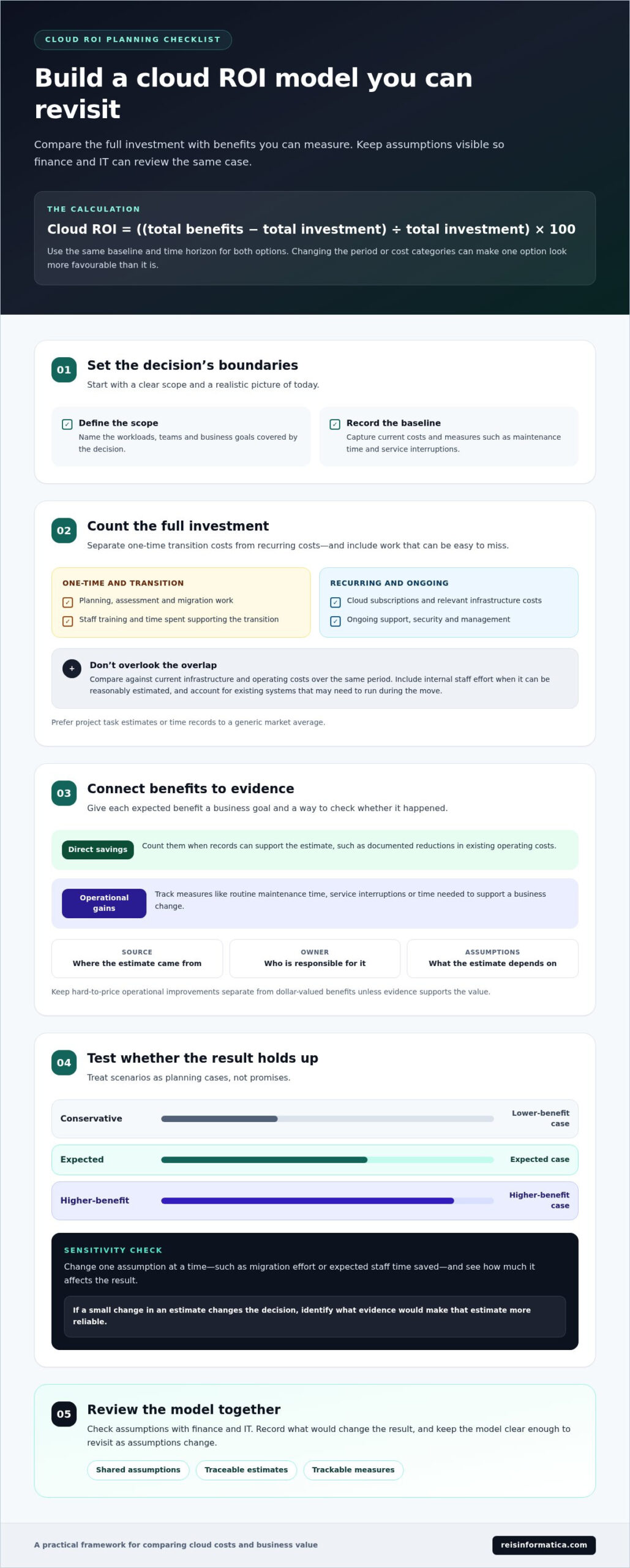
Use the same time period to compare the proposed cloud environment with the current setup. First, estimate the total investment, including one-time transition work and recurring costs. Then estimate the benefits the business can support with evidence. Keep financial benefits separate from operational improvements that are useful but difficult to value reliably.
Cloud ROI = ((total benefits − total investment) ÷ total investment) × 100. This expresses the result as a percentage. Keep the baseline and time horizon consistent: comparing different periods or cost categories can make either option look more favourable than it is. For a Canadian business, record monetary estimates in C$ and document the assumptions behind them.
Which costs belong in a cloud total cost of ownership?
Separate one-time costs from recurring ones so decision-makers can see when and why expenses occur. Include project-specific estimates for:
- Planning, assessment and migration work
- Staff training and time spent supporting the transition
- Cloud subscriptions and any relevant infrastructure costs
- Ongoing support, security and management
Compare these with current infrastructure and operating costs over the same period. Include internal staff effort where it can be reasonably estimated. For example, use project task estimates or time records rather than a generic market average. Check for costs that may continue during a transition, such as maintaining existing systems while workloads move.
How to value benefits without overstating them
Count direct savings only when records can support the estimate, such as documented reductions in existing operating costs. For benefits that are harder to price, agree on operational indicators instead. These might include staff time spent on routine maintenance, service interruptions or the time needed to support a business change. Track those measures separately rather than assigning them an unsupported dollar value.
Make the model transparent by noting each estimate’s source, owner and assumptions. For example, state whether an expected reduction in maintenance time comes from staff estimates or recorded work. This gives finance and IT a shared basis for reviewing the case. A carefully scoped cloud services plan can connect the proposed environment with the costs and operating outcomes your model is designed to assess.
How to Build and Test a Cloud ROI Calculation Before Deciding
A useful model is one you can revisit as assumptions change. Use this five-step process to make the calculation clear to both business and IT stakeholders:
- Set the scope. Define which workloads, teams and business goals the decision covers.
- Establish the baseline. Record current costs and relevant measures, such as time spent maintaining systems or service interruptions.
- Estimate costs. Use project-specific figures for the proposed approach, including transition and ongoing expenses.
- Value benefits. Connect each expected benefit to a business goal and a measure you can track.
- Review the model. Check assumptions with finance and IT, and record what would change the result.
Build conservative, expected and higher-benefit scenarios. These are planning cases, not promises. Then run sensitivity checks: adjust one assumption at a time, such as migration effort or expected staff time saved, to see which changes have the greatest effect on the result. If a small change in an estimate alters the decision, identify what evidence would make that estimate more reliable before committing.
Which KPIs help validate cloud ROI after implementation?
Choose measures tied to the project’s original goals, not simply data that’s easy to collect. Depending on the work, track ongoing cost, service availability, staff effort or delivery speed. For every KPI, record its owner, starting baseline, measurement source and review date. Compare results with the baseline, and note changes in project scope or assumptions so the review stays fair.
How to compare cloud options and transition approaches
Assess public, private and hybrid options against the same business requirements and cost horizon. If a phased move could limit disruption or test a key assumption, model that approach separately, including its transition steps and measures of success. Keep each scenario grounded in the same objectives. A cloud services plan can help frame the options and their operational needs. Use this process for calculating cloud ROI for business before making a decision.
For businesses in Kitchener, Waterloo, Cambridge, Mississauga, Milton, Calgary, Halifax and London, the same principle applies: compare cloud options against your organisation’s actual workloads, operating needs and goals. Explore cloud services planning as you assess your options.
Turn Cloud ROI Findings Into a Practical Business Roadmap
An ROI calculation should lead to a decision and a plan, not sit in a spreadsheet. If the case is sound and the assumptions are supportable, proceed. If costs or benefits remain uncertain, revise the scope, phase the work to test key assumptions or reassess the inputs before committing. A lower projected return can still inform a useful decision if it shows which business priorities need a different approach.
What a cloud roadmap should define
Turn the decision into clear steps that business and IT stakeholders can follow. Define the priorities, what will move, who owns each responsibility and when progress will be reviewed. Set governance for ongoing cost reviews, security responsibilities, continuity planning and KPI reporting. If continuity is part of the business case, include backup and recovery planning, and identify how recovery readiness will be assessed. These details connect projected value with the work needed to sustain it.
How managed cloud planning supports ongoing ROI reviews
Cloud ROI can change as business needs and workloads change, so plan to revisit assumptions after implementation. Assign owners to review costs, operational indicators and scope changes, then use those findings to guide adjustments. This keeps cloud operations connected to business priorities instead of treating the original calculation as a permanent forecast.
Reis Informatica’s cloud services include Microsoft 365, Azure, Google Workspace and hybrid setups. For businesses in Waterloo and across Kitchener, Cambridge, Mississauga, Milton, Calgary, Halifax and London, a roadmap can account for the chosen environment alongside security, continuity and ongoing management needs. Cloud services can be planned around the organisation’s requirements, while regular reviews help identify when the plan should change. This makes calculating cloud ROI for business an ongoing management practice, not just a one-time approval exercise.
Ready to turn your findings into practical next steps? Discuss a cloud plan for your business.
Put Your Cloud Decision Into Motion
A cloud ROI model shouldn’t be a one-time approval document. Use it as a shared reference when business priorities shift, so leaders can revisit whether the plan still supports the outcomes that matter. The next step in calculating cloud ROI for business is turning the case into a conversation about priorities, responsibilities and acceptable trade-offs, not chasing a single percentage.
That conversation works best when business and IT can examine the same assumptions together. Reis Informatica has operated since 2001, with a certified Canadian team and an in-house Security Operations Center. This experience can help bring operational considerations into cloud planning while keeping the focus on your organisation’s goals.
Start with the decision your model needs to support, then shape a cloud plan around it. Discuss a cloud plan for your business and take the next step with clarity and confidence.
Frequently Asked Questions
What is the formula for calculating cloud ROI?
A common formula is ((total benefits − total investment) ÷ total investment) × 100. Set the evaluation period before calculating cloud ROI for business, then use costs and benefits from that same period. Separate measured results, such as a documented change in subscription spending, from estimates, such as expected staff productivity gains. The percentage is a planning estimate, not a promise of future performance.
What costs should a business include when calculating cloud ROI?
Include relevant planning, migration, setup and training work, plus recurring subscriptions, support and management. Account for internal effort using a reasonable estimate based on project tasks or staff time records. Then compare with current costs over the same period. If an estimate is uncertain, record why and how it was developed rather than substituting a generic average that may not fit your business.
Is moving to the cloud always cheaper than keeping on-premises systems?
No. Moving workloads can change how technology is funded and maintained, but it doesn’t guarantee a lower total cost. The outcome depends on the systems you already operate, the effort required to move them, ongoing service needs and how resources are used. For example, a workload with steady demand may compare differently from one that needs extra capacity only during busy periods.
How long does it take for a cloud investment to deliver a positive ROI?
There’s no standard timeline. The point at which benefits outweigh investment depends on the work required upfront, recurring costs and how soon the expected outcomes can be measured. Choose an evaluation period that matches the project’s purpose, then compare actual results with the original baseline at planned review points. If business needs or scope change, update the assumptions rather than treating the original estimate as fixed.
Can cybersecurity and disaster recovery benefits be included in cloud ROI?
Yes, if they support defined business goals and you assess them with suitable evidence. Include the relevant security and recovery work in the investment, then track indicators such as recovery readiness, restore-test results or service continuity. Avoid assigning a dollar value to a breach or outage that may never happen unless you have a defensible method. Review the measures and assumptions with both business and IT stakeholders.