Are you tired of unexpected IT bills derailing your budget? Does the constant worry of downtime or a potential cyberattack keep you from focusing on what truly matters—growing your business? For many leaders, the cycle of reactive, break-fix IT support is a major source of inefficiency. But what if there was a way to transform your technology from a constant headache into your greatest strategic asset? This is the core promise of an it managed services model.
In this complete guide, we demystify Managed IT Services. You will discover how partnering with a Managed Service Provider (MSP) can provide you with a predictable monthly cost, fortify your cybersecurity defenses, and ensure your technology runs smoothly and proactively. It’s time to reclaim your focus and gain the peace of mind that comes from knowing your IT infrastructure is in expert hands, allowing you to drive your business forward with confidence.
Key Takeaways
- Understand the shift from reactive, unpredictable IT fixes to a proactive partnership that prevents problems before they impact your operations.
- Discover how a flat-rate monthly fee makes your technology costs predictable, helping you budget more effectively without surprise C$ invoices.
- Learn how a strategic it managed plan boosts your cybersecurity defences while freeing up your internal resources to focus on revenue-generating activities.
- Compare the pros and cons of managed services versus in-house IT to confidently decide which model best supports your company’s long-term growth.
What Exactly is Managed IT? (Beyond the Technical Jargon)
Picture this: it’s the end of the quarter, and your central server crashes. Operations grind to a halt, customer data is inaccessible, and every minute of downtime translates directly into lost revenue. This is the exact kind of crisis that a modern IT strategy is built to prevent.
Put simply, managed IT is not a repair service you call when things break; it’s a proactive partnership designed to stop them from breaking in the first place. The ultimate goal is to ensure your technology infrastructure runs smoothly, securely, and efficiently, freeing you to focus on your core business. This is delivered by a Managed Service Provider (MSP)-your outsourced technology partner committed to prevention and long-term strategy, not just last-minute fixes.
The Critical Shift: From Reactive ‘Break/Fix’ to Proactive Management
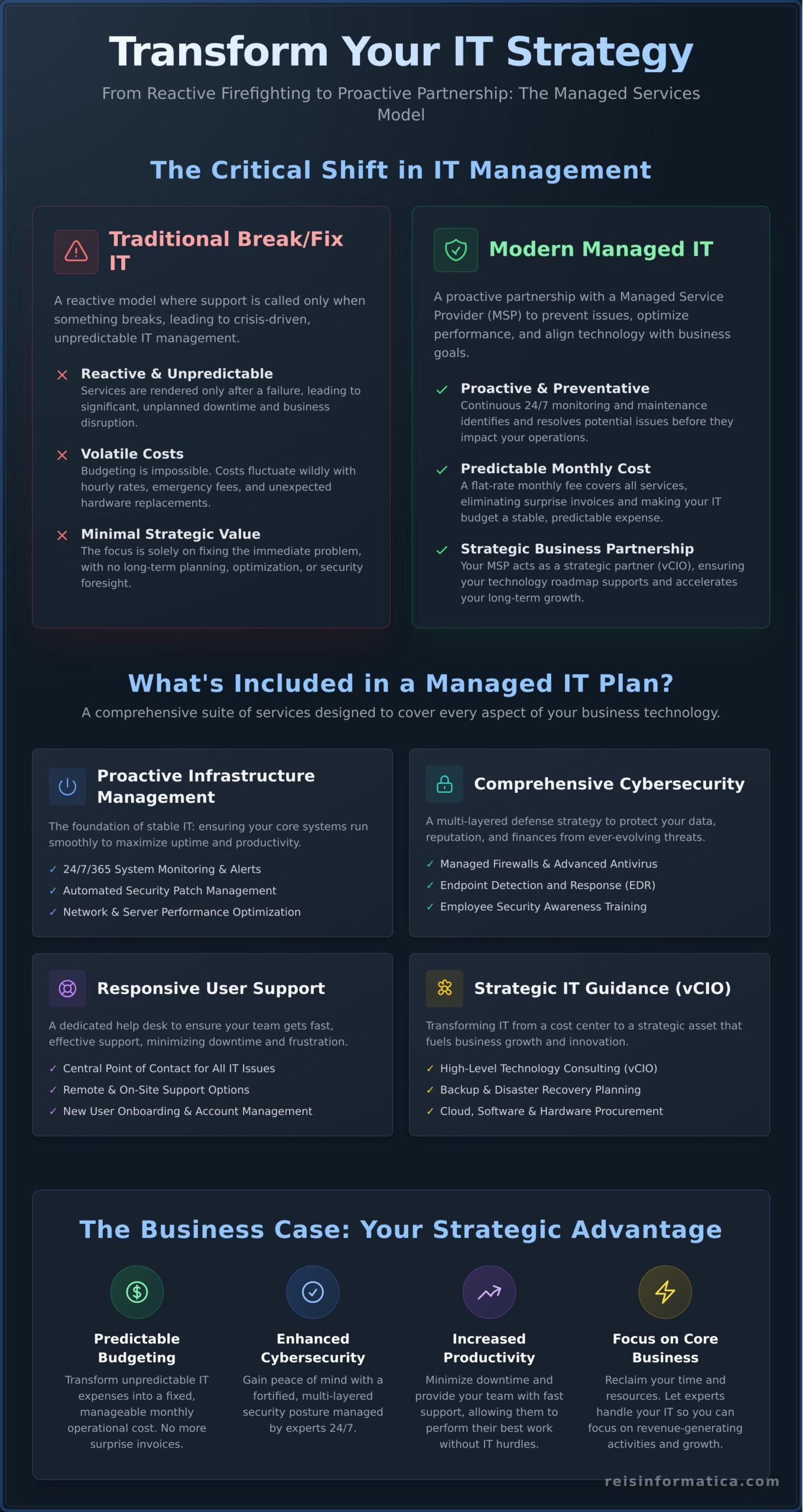
For years, the standard IT support model was ‘break/fix’: a device fails, and you call a technician for an emergency repair. This reactive method is fraught with risk for any Canadian business. It leads to unpredictable costs, with emergency fees often reaching thousands of C$, and extended downtime while you wait. More importantly, it offers zero strategic oversight. A proactive approach, where your environment is it managed by a dedicated partner, flips this model on its head through continuous monitoring and preventative maintenance, identifying and resolving issues before they impact your operations.
Defining the Managed Service Provider (MSP)
The partner that delivers this proactive service is called a Managed Service Provider (MSP). An MSP is a company that remotely manages a customer’s IT infrastructure and end-user systems, a practice detailed in the field of Managed Services. In practical terms, they become your complete, outsourced IT department—firms like KASTEC IT B.V. exemplify this model. This partnership goes far beyond a simple help desk; it encompasses a full spectrum of technology management, including 24/7 system monitoring, robust cybersecurity, data backup, and long-term strategic planning to align your technology with your business goals.
What’s Included? A Breakdown of Core Managed IT Services
A core strength of managed IT services is its predictable, all-inclusive model. Instead of paying for IT support on a reactive, per-incident basis, you invest in a comprehensive service package for a flat monthly fee. This approach transforms your IT budget from a variable expense into a stable operational cost. These packages bundle a wide range of proactive services, typically grouped by business function to ensure every aspect of your technology is covered. While plans are standardized for clarity, a true partner will customize the scope to align perfectly with your unique operational needs and growth objectives.
Proactive Infrastructure Management
This is the foundation of any strong it managed service. Instead of waiting for something to break, your provider acts as a vigilant guardian of your core systems. The goal is to maximize uptime and prevent issues before they disrupt your business. This typically includes:
- 24/7 Monitoring: Constant oversight of your servers, network, and critical devices to detect and resolve issues before they impact operations.
- Patch Management: Systematically applying software updates to all systems to close security gaps and ensure stability.
- Performance Optimization: Ensuring your entire infrastructure runs at peak efficiency, directly supporting employee productivity.
Comprehensive Cybersecurity Protection
In today’s digital landscape, a robust defense is non-negotiable. Managed services deliver a multi-layered security strategy designed to protect your data, reputation, and finances. This involves deploying and managing essential tools like firewalls, advanced antivirus, and endpoint detection, while continuously monitoring for emerging threats. Critically, it also includes employee security awareness training to fortify your team against phishing and social engineering attacks.
Responsive User Support (Help Desk)
Your team needs fast, effective support to stay productive. A managed help desk provides a single, dedicated point of contact for all employee IT issues, from password resets to software glitches. With both remote and on-site support options, problems are resolved quickly, minimizing frustrating downtime. This service also handles essential user administration, including managing accounts, permissions, and streamlining the IT onboarding process for new hires.
Strategic IT Guidance and Planning
Beyond daily operations, a true IT partner helps you plan for the future. This strategic layer ensures your technology not only supports but also drives your business goals. Key components include robust backup and disaster recovery planning for business continuity, virtual CIO (vCIO) services for high-level technology consulting, and expert management of your cloud services, software licenses, and hardware procurement. This transforms IT from a cost centre into a strategic asset.
The Business Case: Key Benefits of Adopting Managed IT
Moving beyond a reactive, break-fix IT model is a critical strategic decision. For Canadian business leaders, the value of managed IT services isn’t measured in technical jargon, but in tangible operational and financial gains. It’s about transforming technology from an unpredictable expense into a powerful driver of growth, security, and efficiency, directly impacting your bottom line.
Control Costs and Gain Predictable Budgeting
One of the most significant challenges for any business is managing unpredictable expenses. A sudden server failure or critical software issue can result in emergency repair bills costing thousands of Canadian dollars. An it managed services model replaces this financial volatility with a flat, predictable monthly fee. This shifts your spending from reactive capital expenditures (CapEx) to a manageable operating expense (OpEx), improving cash flow and making your technology return on investment (ROI) easier to calculate and justify.
Access a Full Team of IT Experts
Hiring, training, and retaining a single, full-time IT specialist-let alone a team with diverse skills-is a major investment. A managed services partnership gives you immediate access to a deep bench of certified experts in:
- Cybersecurity and threat management
- Cloud infrastructure and migration
- Network engineering and support
- Data backup and disaster recovery
You gain the benefit of enterprise-grade tools and a collective knowledge base that would otherwise be out of reach for most small to medium-sized businesses.
Providers specializing in flexible and scalable services, such as SolaaS LTD, exemplify this by offering tailored IT and telecommunications solutions that adapt to a business’s specific needs.
Enhance Security and Ensure Compliance
In today’s digital landscape, a single data breach can be devastating to your reputation and finances. Proactive security is non-negotiable. A managed services provider acts as your vigilant guardian, constantly monitoring for threats, applying patches, and managing vulnerabilities before they can be exploited. This ensures your operations remain secure and compliant with critical Canadian data privacy regulations like PIPEDA, protecting both your customer data and your company’s future.
Increase Focus on Your Core Business
Every hour your team spends troubleshooting IT issues is an hour not spent serving customers, innovating, or driving revenue. By outsourcing your technology management, you eliminate distractions and minimize costly downtime. When your systems run smoothly and expert support is always available, your employees remain productive and focused on their primary roles. Let an expert team handle the complexities of your infrastructure. See how our proactive approach brings peace of mind to businesses.
Managed IT vs. Other Models: Finding the Right Fit for Your Business
While managed IT services offer a powerful framework for operational stability and growth, they are not the only solution available. The optimal IT support model for your business depends entirely on your company’s size, budget, operational complexity, and strategic goals. Understanding the key differences is the first step toward making a confident, informed decision.
Let’s compare the most common IT support structures to help you identify the right fit.
Managed IT vs. an In-House IT Department
An in-house team provides unparalleled physical presence and deep knowledge of your company culture. However, this model carries significant overhead. In Canada, the cost of a single senior IT professional-including salary, benefits, and ongoing training-can easily exceed C$100,000 annually. Managed IT services provide access to an entire team of specialists in areas like cybersecurity, cloud computing, and network infrastructure for a predictable monthly fee, delivering enterprise-level expertise without the enterprise-level payroll.
Managed IT vs. the ‘Break-Fix’ Model
The break-fix model is purely reactive: when technology fails, you call a technician and pay for the repair. While it seems cost-effective for businesses with minimal tech needs, the financial risk is high. Costs are unpredictable, and this model incentivizes downtime-the provider only profits when your systems are broken. A proactive it managed approach flips this dynamic. Your success is our success; we are motivated to prevent problems, ensuring your systems remain secure and operational.
Understanding Co-Managed IT: A Hybrid Approach
Co-managed IT is a strategic partnership that supplements, rather than replaces, your existing in-house IT staff. This hybrid model allows your internal team to focus on daily operations and strategic projects while offloading specialized or time-intensive tasks to a managed services provider (MSP). Common examples include 24/7 network monitoring, advanced cybersecurity defence, or managing complex cloud environments. It’s the ideal solution for companies with an IT manager who needs to scale their capabilities.
.comparison-table { width: 100%; border-collapse: collapse; margin-top: 20px; font-size: 0.9em; }
.comparison-table th, .comparison-table td { border: 1px solid #ddd; padding: 12px; text-align: left; }
.comparison-table th { background-color: #f2f2f2; font-weight: bold; }
.comparison-table tr:nth-child(even) { background-color: #f9f9f9; }
| Feature | In-House IT | Break-Fix Model | Managed IT Services |
|---|---|---|---|
| Cost Structure | High Fixed Cost (Salaries, Benefits) | Unpredictable (Pay-per-incident) | Predictable Monthly Fee |
| Primary Goal | Internal Support & Projects | Repair After Failure | Proactive Prevention & Optimization |
| Expertise | Limited to Team’s Knowledge | Varies by Technician | Broad Team of Specialists |
| Best For | Large enterprises with significant budgets. | Micro-businesses with non-critical IT needs. | SMBs seeking strategic growth and stability. |
Ultimately, the right choice depends on how critical technology is to your business’s continuity and growth. If your operations depend on reliable, secure, and efficient IT, an it managed services model provides the strategic alignment and peace of mind you need to focus on what you do best. Explore how a partnership with Reis Informática can secure your infrastructure and empower your team.
Is Your Business Ready for Managed IT Services?
Transitioning to a managed services model is a strategic decision. If your current IT approach feels more reactive than proactive, leaving you to deal with problems as they arise, it may be time for a change. Evaluating your current operational pains is the first step toward building a more resilient, efficient, and secure technology infrastructure. This self-diagnosis will help you determine if partnering with an IT managed services provider is the right move for your Canadian business.
Signs You’ve Outgrown Your Current IT Solution
If you recognize your business in the following scenarios, you are likely feeling the strain of an inadequate IT framework. Consider these common indicators:
- Frequent Downtime: Your operations are regularly interrupted by system crashes, slow network performance, or recurring technical glitches that impact productivity.
- Ineffective Support: Your employees complain about slow response times from your current IT support, or issues are never truly resolved, only patched temporarily.
- Cybersecurity Anxiety: You are concerned about the growing threat of data breaches, ransomware, and phishing attacks but lack the in-house expertise to implement a robust security strategy.
- Unpredictable Costs: Your IT budget is inconsistent, with unexpected repair bills and emergency call-out fees making it impossible to forecast expenses accurately.
Key Questions to Ask a Potential MSP
When vetting a potential partner, asking the right questions is crucial. A transparent and capable provider will welcome them. Be sure to inquire about:
- Service Level Agreement (SLA): What specific services are included? What are your guaranteed response and resolution times for critical issues?
- Cybersecurity and Data Backup: How do you protect our data from modern threats? What is your protocol for data backup, and how quickly can you restore our systems after an incident?
- Client References: Can you provide case studies or references from businesses in a similar industry or of a similar size to ours?
Understanding Common Pricing Models
Transparency in pricing is a hallmark of a trustworthy provider. Most models are designed for predictable monthly billing. Common structures include per-user or per-device pricing, which scales with your team, and tiered plans that offer different levels of service. Always look for a clear proposal with no hidden fees, ensuring you understand exactly what you are paying for each month.
Ultimately, the goal of an it managed services partnership is to provide peace of mind and a stable platform for growth. By offloading your technology management, you empower your team to focus on core business objectives. Ready to explore a proactive IT strategy? Get a custom quote today.
Transform Your Technology from a Cost Centre to a Growth Engine
Ultimately, managed IT services represent a fundamental shift in how modern Canadian businesses approach technology. It’s about moving beyond the reactive break-fix cycle and embracing a proactive partnership that fuels growth. As we’ve detailed, this strategic model delivers enhanced cybersecurity, predictable costs, and access to specialized expertise, allowing you to focus on your core mission while your technology infrastructure is expertly managed.
The right partner does more than just solve problems; they prevent them. At Reis Informática, we act as your strategic technology guardian, providing proactive, 24/7/365 monitoring to ensure operational continuity. Our deep expertise in cybersecurity and cloud solutions means your critical assets are protected, while our strategic leadership ensures your approach to it managed services aligns perfectly with your business goals.
Your technology should be a competitive advantage, not a constant concern. If you’re ready to unlock that potential, the next step is a simple conversation. Let’s build an IT strategy that drives your business forward. Schedule a free consultation today and discover the peace of mind that comes with a true technology partnership.
Frequently Asked Questions About Managed IT Services
What is the difference between Managed IT and IT support?
Traditional IT support is reactive; you call for help only when something breaks. In contrast, managed IT services are fundamentally proactive. We continuously monitor your systems to identify and resolve potential issues before they can impact your operations. This strategic approach focuses on maintaining system health, ensuring cybersecurity, and maximizing uptime, shifting the focus from fixing problems to preventing them entirely. It’s the difference between an emergency repair and a comprehensive maintenance plan.
How much do managed IT services typically cost for a small business?
In Canada, small businesses can typically expect to invest between C$75 and C$200 per user, per month. The exact cost depends on factors like the complexity of your IT environment, the number of users, and the specific services required, such as advanced cybersecurity or cloud management. This predictable monthly fee provides a clear return on investment by reducing costly downtime and eliminating unexpected repair bills, turning your IT into a manageable operational expense.
Will I lose control over my IT if I hire an MSP?
On the contrary, you gain more strategic control. Partnering with a Managed Service Provider (MSP) means delegating the complex, day-to-day technical management, not your overall IT strategy. You remain in the driver’s seat for all major decisions. We provide the expertise, data, and recommendations to help you make informed choices, freeing you to focus on how technology can drive your business forward instead of worrying about its daily upkeep.
Are managed IT services only for large companies?
Not at all. Small and medium-sized businesses (SMBs) often see the most significant benefits from professionally managed IT. An MSP gives you access to a full team of enterprise-level experts and sophisticated security tools at a predictable cost-something that is often financially prohibitive to build in-house. This allows your business to enhance its security posture, improve efficiency, and compete more effectively, regardless of its size.
What is a Service Level Agreement (SLA) and why is it important?
A Service Level Agreement (SLA) is a critical component of your contract that formally defines the standards of service you will receive. It outlines specific, measurable metrics such as guaranteed system uptime, response times for support requests, and security protocols. The SLA is your assurance of quality and accountability. It provides complete transparency and ensures that your provider is committed to delivering the performance and reliability your business depends on.
How long does it take to switch to a managed service provider?
A well-planned transition is designed for minimal disruption. For most small to medium-sized businesses, the onboarding process takes between two and six weeks. This timeline includes a comprehensive discovery phase, strategic planning, deployment of management and security tools, and a carefully managed handover of responsibilities. Our structured approach ensures a seamless migration, allowing your team to stay focused and productive throughout the entire process.