
Last Tuesday, Sarah discovered that four days of rendering progress could vanish in seconds when her server buckled under a complex BIM file. It’s a story we hear too often in Ontario’s competitive landscape, where technical lag translates to missed milestones and frustrated clients. You understand that your technology should be an invisible engine for design, not a source of friction. Finding the right IT services for architecture firms in Toronto means moving beyond basic support to a partnership that prioritizes high-performance uptime and intellectual property security.
You’ve likely felt the sting of a software crash during a final render or the frustration of slow file sharing on a massive project. In this 2026 guide, you’ll discover how to identify a provider that masters the specific demands of Revit, Rhino, and secure remote site visits across the GTA. We’ll break down the essential criteria for a strategic technology roadmap that ensures your firm scales without the threat of digital downtime.
Key Takeaways
- Learn why modern BIM environments require specialized support to handle data-heavy workflows and meet the intense project timelines of the Toronto market.
- Discover how to identify a proactive partner who understands AEC software, helping your firm avoid the costly downtime of traditional “break-fix” models.
- Protect your proprietary designs from evolving cyber threats by shifting from basic antivirus to advanced endpoint detection and response (EDR).
- Explore how specialized IT services for architecture firms in Toronto can leverage cloud rendering and AI to automate repetitive tasks and boost studio productivity.
- Gain a competitive edge by aligning your technology budget with your growth goals through a strategic vCIO roadmap and proactive infrastructure management.
Why Toronto Architecture Firms Need Specialized Managed IT in 2026
The architectural landscape in Toronto has undergone a radical transformation. By 2026, the transition from traditional CAD to complex, data-heavy Building Information Modeling (BIM) is no longer a choice but a requirement for survival. Your studio’s ability to compete hinges on how fast your team can process massive datasets and render high-fidelity models. Standard IT services for architecture firms in Toronto must go beyond basic troubleshooting to address the specific bottlenecks of modern design workflows.
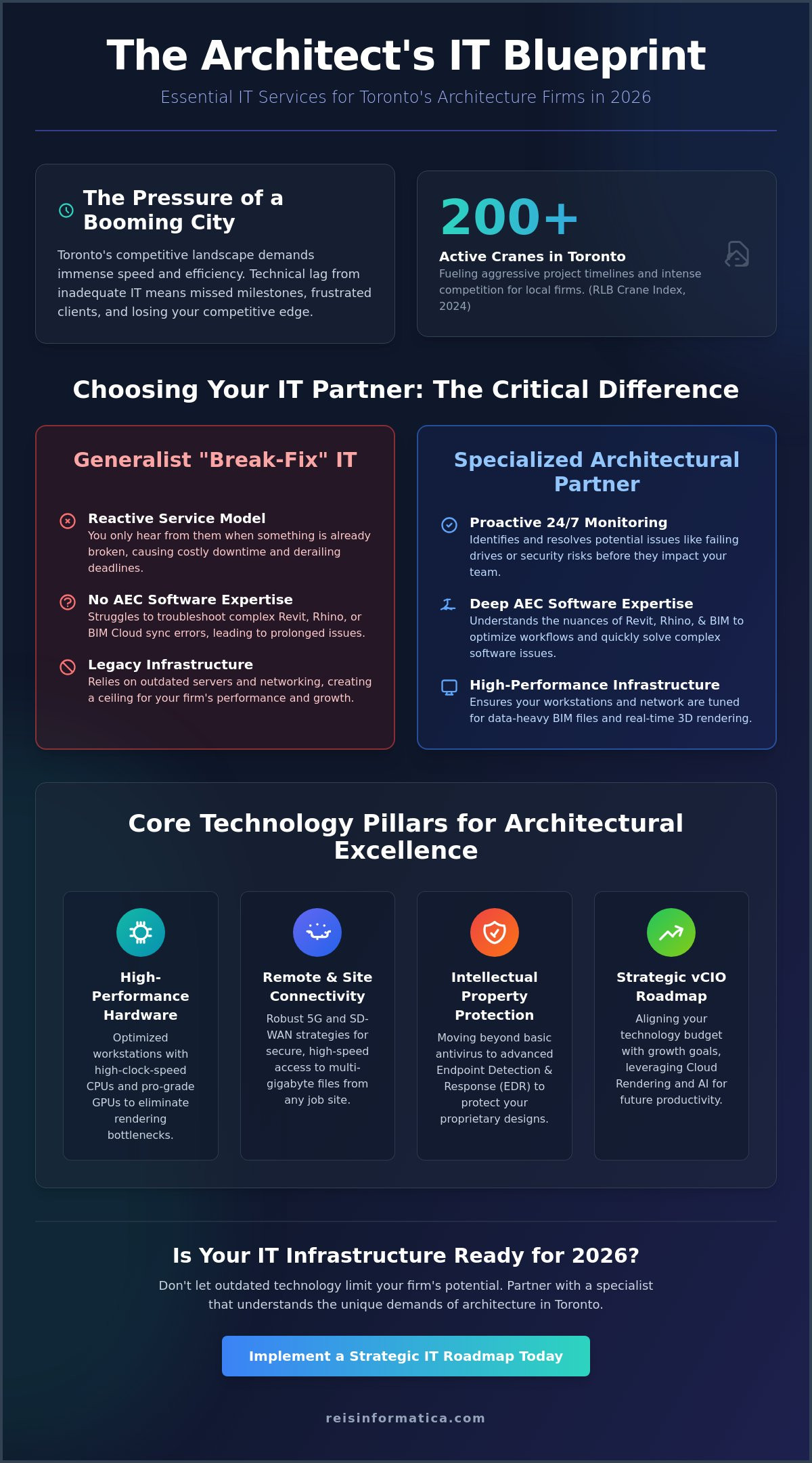
Toronto continues to lead North America in the RLB Crane Index, with over 200 active cranes shaping the skyline as of late 2024. This volume puts immense pressure on local firms to meet aggressive delivery timelines. When your hardware lags, you aren’t just losing minutes; you’re losing the competitive edge needed to win the next landmark project. Many firms struggle with technical debt, where legacy servers and outdated networking protocols act as a ceiling for their most talented designers. Relying on a general Managed Service Provider (MSP) that doesn’t understand the nuances of architectural software often results in reactive fixes rather than proactive optimization.
The High-Performance Requirements of Design Software
Standard business workstations are built for spreadsheets and email, but they crumble under the weight of Revit, Rhino, or SketchUp. These applications require specific hardware configurations, particularly high-clock-speed CPUs and professional-grade GPUs, to handle real-time 3D rendering and walkthroughs. If your infrastructure isn’t optimized, a simple sync to a central model can take ten minutes instead of ten seconds. This latency directly impacts your bottom line. Specialized IT services ensure that your hardware and software environment is perfectly tuned, preventing the crashes and compatibility errors that derail project milestones.
Remote Collaboration and Site Access
Modern Toronto projects demand seamless connectivity between the downtown studio and the construction site. Your project managers need secure, instant access to multi-gigabyte files while standing in the middle of a job site in the Entertainment District or East Harbour. This requires a robust high-speed networking strategy that utilizes 5G and SD-WAN technologies to ensure large files move without friction. Without a specialized setup, remote access becomes a security vulnerability and a productivity killer. Specialized IT support for architects acts as a catalyst for project speed, ensuring that technology accelerates creativity rather than hindering it.
Evaluating Managed Service Providers: What Architects Must Look For
Choosing the right partner for IT services for architecture firms in Toronto requires looking beyond basic technical support. You need a team that understands the rhythm of a design studio. A generalist provider might struggle to troubleshoot a complex BIM cloud synchronization error, while a specialist knows exactly how Revit interacts with your local network. In 2026, the gap between “standard IT” and “architectural IT” has widened. Your provider must speak the language of AEC (Architecture, Engineering, and Construction) to ensure your technology accelerates your creativity instead of hindering it.
The biggest risk to your firm is a reactive, “break-fix” service model. If you only hear from your IT team when something stops working, you’re already losing money. For a mid-sized Toronto firm handling a C$50 million project, a single afternoon of downtime can derail a municipal submission deadline. Modern Managed IT Services focus on prevention. This involves 24/7 monitoring that catches a failing drive or a security vulnerability before it impacts your designers. This proactive stance acts as a guardian for your operational continuity.
Local presence in the GTA remains a critical factor even in a cloud-heavy era. While remote troubleshooting handles 90% of issues, physical infrastructure still requires hands-on expertise. When a high-end plotter fails or a server room cooling system glitches during a July heatwave in Ontario, you can’t wait for a technician to drive in from another province. A local partner provides the “boots on the ground” necessary for rapid hardware recovery and strategic on-site consultations as you scale your team to win larger private or public contracts.
The Checklist for Architectural IT Partners
- Software Mastery: Confirm they have documented experience managing AutoCAD and Revit licensing. They should understand the nuances of Autodesk’s Token Flex or Named User models to prevent overspending.
- Deadline Reliability: Demand specific response time guarantees. A “critical” ticket during a major project deadline should trigger a response within 15 minutes, not 4 hours.
- Growth Support: Ensure the provider can scale your infrastructure quickly. If you win a major Waterfront Toronto contract and need to onboard five new architects next week, your IT partner must be ready to deploy workstations and permissions immediately.
Infrastructure and Hardware Procurement
Your hardware strategy must balance performance with cost efficiency. In 2026, many firms are moving toward a hybrid model. This involves high-end local workstations for real-time design and server-side rendering for heavy processing. Your IT partner should guide these purchases, ensuring every C$5,000 workstation is optimized for the specific GPU requirements of your rendering software. Protecting the intellectual property stored on this hardware is equally vital. Following guidelines like Cybersecurity for Small Business helps ensure your proprietary designs remain secure from external threats.
Managing software updates is another area where a specialist shines. Pushing a Windows update in the middle of a rendering task can corrupt files and waste hours of work. A vigilant partner schedules these updates during off-hours, testing them first to ensure they don’t break your plugins. Building this type of resilient foundation is the core of modern Infrastructure Services, giving you the peace of mind to focus entirely on your next design. If you’re unsure if your current setup can handle your 2026 project load, consider booking a technical discovery session to identify hidden bottlenecks.
Protecting Intellectual Property: Cybersecurity for Modern Design Studios
Your blueprints are more than just technical drawings. They represent years of proprietary research and design innovation. In 2024, the average cost of a data breach in Canada hit C$6.32 million, making security a business-critical priority for every partner. Cybercriminals often target architectural firms because their servers hold sensitive infrastructure data and high-value project bids. Relying on basic antivirus software isn’t enough anymore. Modern IT services for architecture firms in Toronto must transition to Endpoint Detection and Response (EDR). Unlike traditional tools that wait for a known threat, EDR monitors system behavior in real-time to stop sophisticated ransomware before it can lock down your project folders.
Meeting the security standards for major Toronto tenders is another significant hurdle. Whether you’re bidding for City of Toronto projects or provincial infrastructure via Metrolinx, you’ll need to prove your data is secure. This often includes having comprehensive cyber insurance. Most insurers now require specific technical controls, such as encrypted backups and active monitoring, before they’ll even issue a policy. We help you bridge the gap between these technical requirements and your firm’s business eligibility.
Technology is only half the battle. Your staff is your “Human Firewall.” We focus on training your team to recognize sophisticated phishing attempts that look like legitimate requests from contractors or clients. One clicked link can bypass the best firewalls, so ongoing education is your first line of defense against social engineering.
Layered Defense Strategies for Design Firms
A single layer of security is a single point of failure. We implement Multi-Factor Authentication (MFA) across all project management tools to ensure that stolen passwords don’t lead to stolen data. Secure file sharing protocols are also vital when you’re collaborating with external consultants on large-scale builds. You can learn more about our comprehensive Cybersecurity Services to see how we protect your firm’s perimeter from evolving threats.
Disaster Recovery: Protecting Your Project History
Architectural projects often involve multi-terabyte folders that are difficult to move or restore quickly. Cloud-based backups are essential for ensuring these massive datasets are preserved off-site. It’s not just about having a copy of the data; it’s about how fast you can use it. We focus on testing your recovery plan regularly to ensure your studio can be back online in minutes, not days, after a hardware failure. Our specialized IT services for architecture firms in Toronto provide the resilient infrastructure needed for long-term continuity. For more details on building a secure network, explore our IT Services resource for professional firms.
Scaling Your Firm with Cloud Rendering and AI-Driven Workflows
Toronto’s architectural landscape is shifting rapidly. Your firm no longer needs to tether its best designers to high-end, noisy workstations for days at a time just to finish a single visualization. By moving intensive rendering tasks to the cloud, your team can continue drafting on their local machines while a remote server farm handles the heavy lifting. This shift is a core component of modern IT services for architecture firms in Toronto, allowing boutique studios to compete with global giants without investing C$50,000 or more in local server hardware every three years.
Cloud-based workflows do more than just speed up pictures. They modernize how you collaborate. Instead of emailing massive files or dealing with slow VPNs, your team can integrate global consultants directly into Toronto-based projects through a centralized cloud environment. This setup ensures that everyone works on the same version of a Revit or Rhino file in real time, eliminating the version control errors that often lead to costly site revisions.
The Future of AI in Architecture
AI isn’t just a buzzword; it’s a practical tool for automating repetitive drafting and administrative tasks. Using AI Business Solutions allows your firm to implement generative design, which tests thousands of design permutations in seconds to find the most resource-efficient layout. AI-driven resource management prevents project overruns by identifying potential bottlenecks in the scheduling phase before they consume your project’s contingency budget. This predictive power helps you maintain a 10% to 15% higher profit margin on complex builds.
Cloud Services Tailored for Design
Choosing between private and public cloud environments depends on your firm’s specific security needs and data sovereignty requirements. Private clouds offer dedicated resources for sensitive project data, while public options provide unmatched scalability for massive BIM files. Integrating specialized Cloud Services ensures low-latency access, which is vital for real-time collaboration. It’s about making sure a designer in North York and a partner in downtown Toronto see the same changes instantly without lag.
Adopting these technologies also changes your balance sheet for the better:
- Reduced Capital Expenditure: Swap unpredictable C$15,000 hardware refreshes for predictable monthly cloud subscriptions that scale with your project load.
- Enhanced Mobility: Your architects can present high-fidelity models on a tablet at a job site in the GTA without carrying a heavy laptop.
- Hardware Longevity: Offloading rendering to the cloud means your local workstations stay fast and relevant for 2 years longer than average.
Effective IT services for architecture firms in Toronto focus on making technology invisible. When your infrastructure scales automatically, your architects can focus on design rather than troubleshooting server crashes or waiting for a progress bar to finish. This agility is what defines a competitive firm in 2026.
Implementing a Strategic IT Roadmap with Reis Informatica
Choosing the right technology partner means finding a team that understands a five-minute server crash during a project deadline is a catastrophe. Our vCIO (virtual Chief Information Officer) approach changes the way you look at your tech stack. Instead of viewing IT as a recurring bill, we help you treat your C$ budget as a strategic asset. We align your infrastructure with your firm’s 2026 growth goals, ensuring you have the processing power and storage capacity ready before you win that next major contract.
We’ve spent years embedded in the Toronto AEC community. Our technicians understand the specific demands of Revit, Rhino, and heavy CAD files. We know how these applications stress a network. Our commitment to you is built on proactive vigilance. We don’t wait for things to break. We anticipate the needs of your designers and project managers so they can keep their focus on the drafting table. When you invest in IT services for architecture firms in Toronto, you’re buying the freedom to design without technical friction.
Transitioning to a new IT provider often feels risky for firms with active projects. We’ve perfected a seamless onboarding process that happens entirely in the background. We document your environment and secure your endpoints without interrupting your team’s workflow. The Reis Informatica promise is simple: we manage the complexity of your servers, cloud security, and backups so you can focus on your architectural vision. Your technology should be invisible and efficient, acting as the silent foundation for every structure you build.
Proactive Support Across the GTA and Beyond
Our team provides dedicated support to firms across Toronto, Mississauga, Milton, and the Waterloo tech corridor. We utilize a “Vigilant Partner” model, which means we’re monitoring your systems 24/7 to catch vulnerabilities before they impact your billable hours. This philosophy is at the core of our business. For a deeper look at how this methodology protects your firm, read our guide on What is Managed IT?
Next Steps: Your Technology Audit
The first step toward a stable environment is understanding where your current infrastructure stands. We offer specialized discovery phases where we analyze your network speed, security protocols, and hardware lifecycles. We provide a clear report that identifies immediate risks and long-term opportunities for cost savings. This isn’t a generic scan; it’s a deep dive into the specific tools your architects use every day.
Ready to stabilize your firm’s digital foundation? Secure your firm’s future with a strategic IT consultation and discover how IT services for architecture firms in Toronto can transform your operational efficiency.
Designing Your Firm’s Future with a Modern IT Foundation
As Toronto’s architectural landscape evolves toward 2026, your firm’s success depends on more than just creative vision. It requires a robust digital backbone that protects your intellectual property and accelerates your project timelines. By integrating proactive monitoring for zero-downtime rendering and specialized expertise in Revit, AutoCAD, and BIM workflows, you ensure your designers stay focused on their craft rather than troubleshooting software glitches. Technical stability is the silent partner in every award-winning design.
Choosing the right IT services for architecture firms in Toronto means partnering with a team that understands the unique demands of modern design studios. Our local GTA-based support team provides the strategic roadmap necessary to scale your firm with AI-driven workflows and secure cloud environments. You don’t have to manage these technical complexities alone. With a dedicated partner, your infrastructure becomes a competitive advantage that drives efficiency and growth across the Ontario market.
Empower your design team with specialized Toronto IT services. Contact Reis Informática today.
We’re ready to help you build a more resilient and innovative studio today.
Frequently Asked Questions
Why do architecture firms need specialized IT services instead of general IT support?
Architecture firms require specialized IT services for architecture firms in Toronto because standard support doesn’t account for the heavy resource demands of design software. While a generalist might fix an email issue, an industry expert understands how to optimize hardware for high-end rendering and large file transfers. This specialized knowledge prevents software crashes that can cost a firm 15 percent in billable productivity annually.
Can Managed IT services help improve our Revit and AutoCAD performance?
Managed IT services significantly boost Revit and AutoCAD performance by fine-tuning workstation hardware and network settings. We focus on optimizing GPU acceleration and reducing server latency, which are critical for real-time model synchronization. Our team ensures your local area network handles the 500 MB to 2 GB file sizes common in BIM projects without bottlenecking or freezing.
How does Reis Informatica secure our firm’s blueprints and intellectual property?
Reis Informatica protects your intellectual property through a multi-layered security framework that includes end-to-end encryption and strict access controls. We implement 24/7 threat monitoring to detect anomalies before they become breaches. This proactive approach ensures your sensitive blueprints remain secure, meeting the data protection standards required for major Toronto infrastructure projects and government contracts.
Does your IT support cover remote staff and construction site connectivity?
Our support extends to every location where your team works, from home offices to active construction sites across Ontario. We deploy secure VPNs and robust mobile connectivity solutions to ensure architects access project files without delay. Whether a staff member is at a site in the GTA or working remotely, they’ll have the same level of security and speed as they do in the main office.
What is a vCIO and why does my architecture firm need one?
A vCIO, or Virtual Chief Information Officer, acts as your senior technology consultant to align IT spending with your firm’s growth goals. Instead of just fixing broken PCs, your vCIO helps you plan budgets and choose the right software for future projects. This strategic oversight is vital for Toronto firms looking to scale while keeping technology costs predictable and avoiding expensive, last-minute hardware upgrades.
How do you handle the massive storage requirements of BIM and 3D rendering?
We manage the massive storage needs of BIM and 3D rendering by implementing scalable hybrid cloud solutions and high-speed local storage. Since a single architectural project can generate over 10 GB of data, we use tiered storage to keep active files fast and archive older ones efficiently. This method ensures your designers never run out of space during critical production phases or while meeting tight project deadlines.
What are the costs associated with Managed IT for architects in Toronto?
Managed IT services for architecture firms in Toronto typically range from C$150 to C$300 per user each month, based on industry averages for comprehensive support. These costs cover proactive maintenance, cybersecurity, and help desk support. Investing in a fixed-fee model helps your firm avoid the C$200 per hour emergency rates common with reactive providers who only show up when something breaks.
How quickly can you respond to a server or software crash during a deadline?
We prioritize server and software crashes during deadlines with a guaranteed response time, often reaching critical issues within 15 minutes. Our team uses remote monitoring tools to identify potential failures before they stop your work. If a server goes down, our disaster recovery protocols aim to have your team back online in less than four hours to keep your project on schedule.