A broad cybersecurity policy can leave AI-specific gaps. An AI security policy for businesses sets practical rules for which tools staff may use, what information they can enter, and how to manage AI-related risks and incidents. It complements broader AI governance and cybersecurity policies rather than replacing them.
AI can help teams work more efficiently, but public tools may handle business information in ways employees don’t expect. Clear guidance helps staff understand what data to protect, how to assess AI tools, and when a person should review an output before it informs a decision. This article explains what an AI security policy covers, how it supports privacy and risk management in Canada, and how it differs from broader AI and cybersecurity policies. It also outlines practical areas a useful policy should address, from approved tools and access controls to monitoring and incident response.
Key Takeaways
- Set clear boundaries for which AI tools employees can use and what business information they can enter.
- Assess how each tool handles data, access, and outputs before bringing it into workplace processes.
- Build human review and incident response into AI use, especially when outputs could affect people or business decisions.
- Keep AI-specific security rules distinct while aligning them with your broader AI governance and cybersecurity policies.
What Is the Impact of AI on Data Governance & Privacy?
AI systems can process sensitive information, create new paths for data exposure, and influence decisions. Strong governance defines what data may be used, who can access it, and how privacy risks are managed.
AI-Related Data Threats
Prompt injection uses hidden instructions to manipulate an AI system, while model poisoning corrupts training data and can distort later outputs. Both threats may undermine safeguards or produce unreliable results. Data leakage occurs when sensitive information appears in prompts or outputs. If a public tool shares inputs with its vendor, data exfiltration or intellectual property loss may follow, including exposure of confidential business documents.
Information Management and Data Protection
Managing information used by AI means controlling it throughout its lifecycle, from collection and training to prompts, outputs, storage, and deletion. Start by classifying information and limiting access to the people and systems that need it. Apply role-based permissions, strong authentication, and audit trails. Encrypt data at rest and in transit, anonymize sensitive details where practical, and set retention rules. Assess whether a tool uses submitted information to train models or keeps it isolated.
AI Privacy Compliance
AI privacy compliance means aligning data practices with privacy obligations that apply to the business, its people, and its customers. Canada’s federal privacy law, PIPEDA, is identified as SC 2000, c. 5 by the Department of Justice Canada. Organizations should build data minimization and protection into AI governance, then assess whether regional rules also apply to their operations. ISO/IEC 42001 provides a management-system approach for governing AI, including controls, accountability, and continual improvement, according to the International Organization for Standardization.
Approval for Personal Data Use
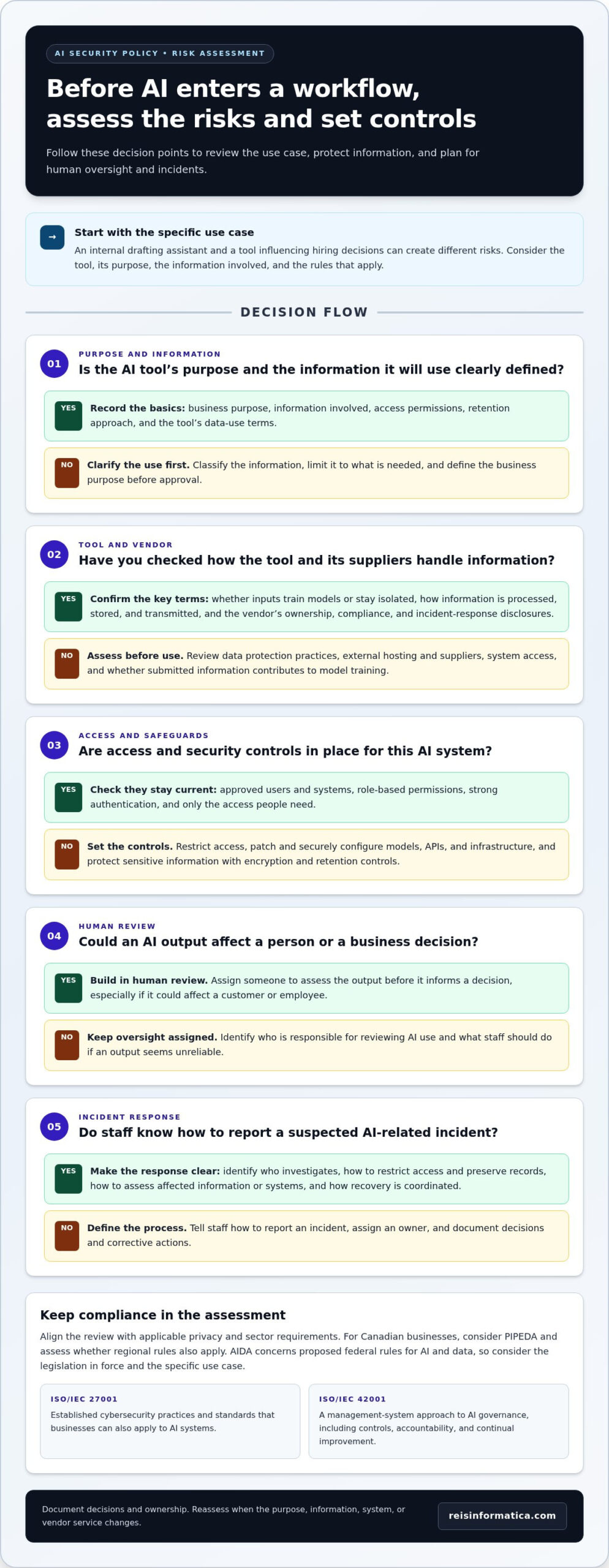
Governance approval means reviewing an AI tool before it uses personal information for a defined business purpose. For employee data, confirm that collection is reasonable and necessary for that purpose, and obtain consent when legally required. Record the purpose, data involved, access permissions, retention approach, and the tool’s data-use terms. Review the approval again if the purpose or information changes, such as adding personal details to a workflow that previously used only non-personal data.
AI-related risk assessment and mitigation
A risk assessment maps how an AI system could expose sensitive data, disrupt operations, or produce harmful outputs. For Canadian businesses, consider the tool, its purpose and data, and the rules that apply to its use.
AI Risk Assessment and Regulatory Alignment
AI risk assessment identifies threats, estimates their business impact, and assigns controls before deployment. It matters because an internal drafting assistant and a tool influencing hiring decisions create different risks. AIDA concerns proposed federal rules for AI and data; businesses should consider the legislation in force and their specific use case when assessing obligations. Canadian businesses can also apply established cybersecurity practices and standards, including ISO/IEC 27001, to AI systems. Align the review with applicable privacy and sector requirements, then document decisions and ownership.
Third-Party and Supply-Chain Risk
Third-party risk management examines how an AI vendor and its suppliers handle information, system access, and security incidents. A vendor’s model may rely on external hosting, data services, or software components, creating routes to unauthorized access beyond your direct control. Before use, assess the vendor’s data protection practices, ownership terms, compliance disclosures, incident response capabilities, and how it processes, stores, and transmits inputs. Review whether submitted information contributes to model training. Reassess when the vendor changes its service or supporting suppliers.
Securing AI Models, Data, and Integrations
Securing an AI system means protecting its model, information, and connections to business tools throughout its use. Limit access to approved users and systems, apply strong authentication, and grant only necessary permissions. Keep models, APIs, and underlying infrastructure patched and securely configured. Protect sensitive data with encryption and retention controls, and monitor how inputs and outputs move through integrations. Include AI in threat modelling and incident response planning. Test systems for weaknesses before deployment and after material changes, then record findings and assign follow-up actions.
What is an AI Security Policy?
An AI security policy sets rules for approved tools, employee access, human review, and incident response. For a small Canadian business, implementation costs depend on the tools, existing safeguards, data sensitivity, and staff training required.
Human Oversight of AI Incidents
Human oversight means assigning people to review AI use, assess incidents, and decide what action to take. It matters because an AI tool can produce unreliable output or expose information without recognizing the business impact. For example, an employee should pause a workflow if an AI-generated recommendation could affect a customer or employee.
A clear incident response process tells staff how to report a suspected attack, who investigates, and how to limit further harm. The response lead can restrict access, preserve relevant records, assess which information or systems were affected, and coordinate recovery. Record the incident, decisions, and corrective actions so the organization can improve its controls.
Employee Access and Usage Monitoring
Access controls define which employees can use each AI system and what their accounts allow them to do. Broad permissions can expose sensitive business information to people who don’t need it. Use role-based access and strong authentication, and promptly remove access when job responsibilities change or an employee leaves.
Usage monitoring records how employees and systems interact with approved AI tools. Combine access logs with identity and access management, network monitoring, and data loss prevention controls to spot unusual activity, such as repeated attempts to upload restricted files. Explain to employees what workplace use is permitted and how monitoring works. Clear guidance supports consistent reporting when someone notices unexpected AI output, data exposure, or misuse.
AI security policy versus broad AI and cybersecurity policies
An AI security policy for businesses focuses on protecting AI tools, their data, and connected systems. It translates broad security goals into rules for everyday situations, such as whether staff may paste customer information into a public generative AI tool.
A broader AI policy usually addresses how an organization selects, governs, and uses AI systems. It can explain who approves new use cases, how teams consider fairness, and when people must review important outputs. An AI security policy focuses more narrowly on threats such as unauthorized access, data exposure, model compromise, and incident response. The policies can work together rather than compete.
Cybersecurity policies cover the organization’s wider technology environment, including accounts, networks, devices, and incident handling. ISO/IEC 27001 provides an information security framework that can include AI systems as business assets. Existing controls may apply to an AI platform, but AI use can introduce additional questions: what happens to prompts, how outputs are shared, and whether connected tools can access sensitive records.
Canadian law may create AI-related obligations without requiring a document specifically titled an AI security policy. Requirements depend on jurisdiction, sector, and use case. A business can establish one combined policy or add an AI security section to existing documents. Whatever its title, a well-scoped AI security policy for businesses should cover each relevant risk.
For example, a company’s cybersecurity policy might require strong authentication for all business systems. Its AI rules can then specify which employees may access a particular tool, what information they can submit, and who reviews its output. A broader AI governance policy can set approval and accountability expectations. Together, these layers connect technical safeguards with responsible use.
The practical takeaway: map AI-specific risks to existing controls, then add rules where those controls leave gaps. If you’re aligning AI use with your broader security program, explore cybersecurity services for support with business security needs.
Reisinformatica.com: Managed IT aservices
Reis Informatica helps businesses in Kitchener, Waterloo, Cambridge, Mississauga, Milton, Calgary, Halifax, and London connect AI use with the technology and security practices that support daily operations. Turn to the team to assess how AI fits your environment, strengthen cybersecurity, or plan business use of AI solutions.
Managed IT services support the wider technology environment in which approved AI tools operate. Cybersecurity services address security needs, while AI Business Solutions help businesses explore practical AI use. Private and Public Cloud Services and products can also be part of planning where business systems and data operate.
Start by identifying your business goal, the information involved, and the safeguards your current environment needs. Contact Reis Informatica to discuss your business’s AI and IT needs.
Make AI security part of everyday decisions
A policy works best when employees can apply it in the moment, not just find it in a document. Give teams a clear way to raise concerns, and revisit the rules as business needs, tools, and workflows change. This keeps oversight connected to real operations instead of treating security as a one-time writing exercise.
An AI security policy for businesses can also guide future technology decisions. Before introducing a new AI use, identify its business purpose, the information involved, and who is accountable for its results. This creates a practical foundation for responsible adoption and keeps security in view from the start.
If you’re ready to discuss how AI security fits your organization’s technology environment, contact reisinformatica.com about AI security. A thoughtful next step can help your team move forward with greater clarity and confidence.
Frequently Asked Questions
Are Training & Awareness Programs Important for AI?
Yes. Training helps employees recognize unsafe AI use before it exposes information or leads to unreliable work. Use realistic examples, such as asking staff to rewrite a customer email without including identifying details. Explain how to report a suspicious output or accidental disclosure, and give teams a simple decision guide for common tasks. Refresh the guidance when approved tools or workplace processes change.
How can organizations ensure regulatory compliance when implementing Generative AI Technologies?
Start by mapping each generative AI use to the information it processes, the people affected, and the business purpose. Canadian organizations should consider PIPEDA and any other privacy or sector rules that apply to their activities. For example, a tool used to summarize employee feedback raises different privacy questions from one used to draft public marketing copy. Record the review and its decisions.
What Are the Audit & Compliance Considerations of AI?
AI audits should create a clear record of approvals, access, changes, and human decisions. For a customer-support assistant, retain enough information to trace which system produced a response and who reviewed an escalated case. Check whether the tool’s use still matches its approved purpose, and document identified gaps and corrective actions. These records help leaders explain how the organization oversees its AI use.
What Are the Ethical Considerations of AI?
Ethical AI use includes fairness, transparency, privacy, and accountability for decisions. For example, if a recruitment team uses AI to organize applications, people should review whether the process could disadvantage candidates or rely on unsuitable information. Explain AI’s role to affected people where appropriate, and provide a route for human review. Assign an owner who can investigate concerns and recommend changes.
What are the contents of an AI policy?
An AI policy should identify its scope, approved uses, prohibited information, responsibilities, review expectations, and reporting process. It can also explain how teams request approval for a new tool, record its business purpose, and handle AI-generated material before sharing it. For example, require a named reviewer to approve AI-assisted customer communications. Keep the language accessible so employees can apply the rules in everyday tasks.
What does a good AI policy look like?
A good AI policy is clear enough for employees to follow and specific enough for managers to enforce. It distinguishes routine uses, such as drafting a general meeting agenda, from higher-impact uses that require additional review. The policy names accountable roles, explains how staff can raise concerns, and connects AI rules to existing workplace processes. Test it against realistic scenarios, then revise unclear instructions based on employee feedback.