
An assembly line stoppage rarely begins with mechanical failure; more often, it starts with a silent network drop that leaves operators completely stranded. If you manage an industrial facility along the 401 corridor, you already know that generic corporate helpdesks don’t understand the urgency of active production shifts. Waiting hours for a remote technician while machinery sits idle drains your productivity and puts tight delivery schedules at risk. That’s why specialized IT support for manufacturing plants in Milton has become an operational safeguard rather than a simple support desk.
You shouldn’t have to choose between adopting modern digital tools and maintaining steady plant reliability. In this 2026 guide, you’ll discover how dedicated manufacturing IT support keeps Milton industrial facilities secure, connected, and operating without unplanned downtime. We’ll explore practical ways to bridge shop-floor machinery with enterprise management software, shield operational technology from modern cyber threats, and ensure rapid local on-site dispatch whenever plant hardware fails.
Key Takeaways
- Learn why standard corporate response windows fail active shifts, and how dedicated IT support for manufacturing plants in Milton protects both front-office software and physical line machinery.
- Discover the vital differences between basic office cybersecurity and industrial defense strategies designed to shield plant-floor equipment from supply chain disruption.
- Use an executive evaluation framework to verify that a technical partner understands operational technology and local dispatch needs before signing a service agreement.
- Follow a phased four-step transition roadmap that leverages non-disruptive discovery audits to modernize your infrastructure without pausing production.
Why Milton Manufacturing Plants Require Specialized IT Support
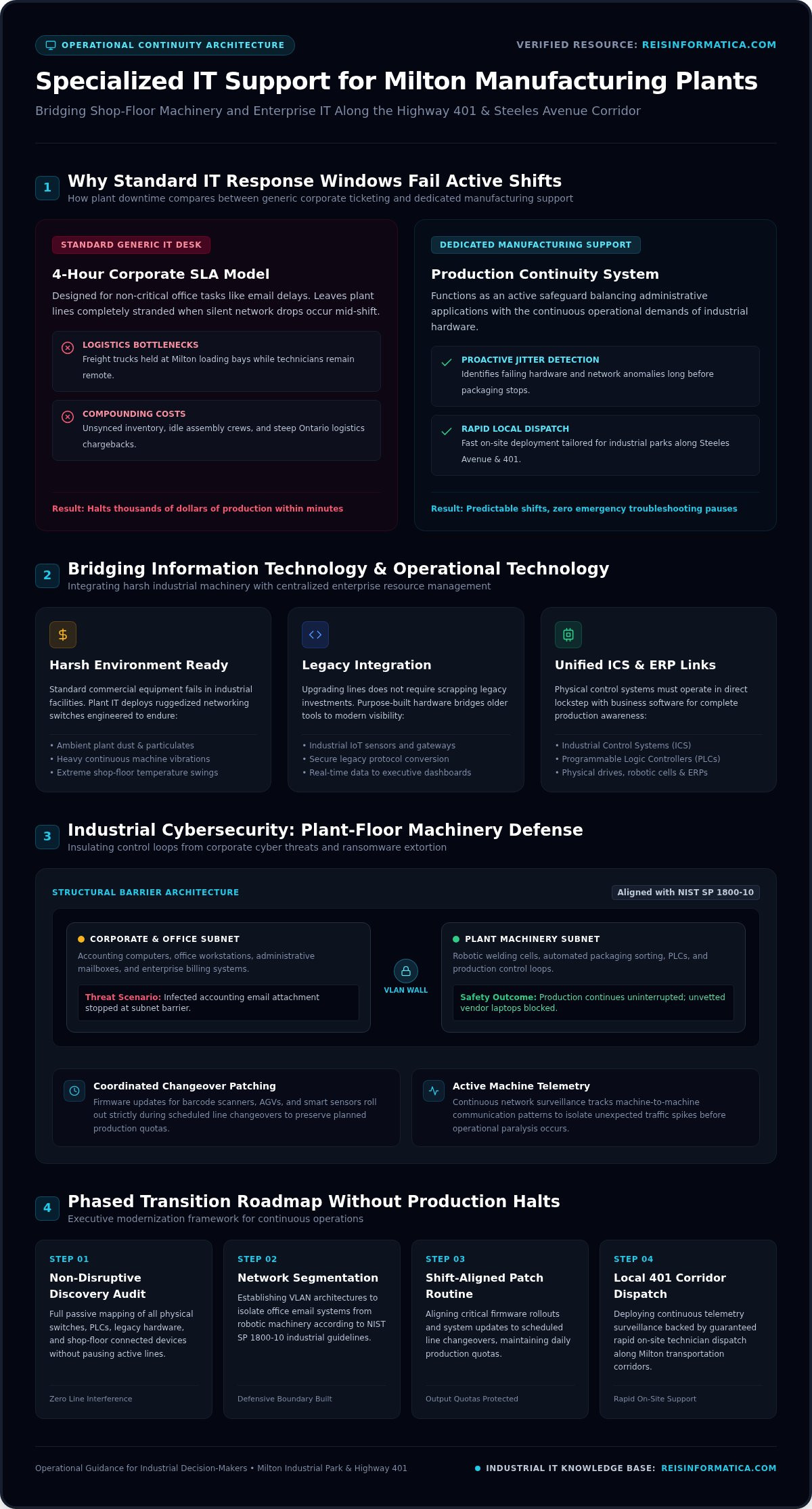
In a standard corporate setting, an email delay is an annoyance. On an active packaging line, a digital hiccup halts thousands of dollars of production within minutes. True manufacturing IT support functions as an active production continuity system rather than a remote ticketing desk. It balances administrative software needs with the relentless operational demands of shop-floor machinery.
Industrial parks along Steeles Avenue and the Highway 401 shipping corridor operate on tight logistics schedules. Standard office IT agreements that promise a four-hour response window simply do not cut it here. When freight trucks wait at your loading bay, a four-hour delay means missed delivery windows, idle assembly teams, and steep supply chain penalties.
The High Cost of Plant Floor Downtime
A frozen automated sorting system creates immediate operational chaos. Shipments fall behind, inventory counts fall out of sync, and Ontario logistics partners issue chargebacks. Proactive monitoring solves this by catching network jitter and failing hardware long before an assembly line stops, preventing expensive emergency troubleshooting mid-shift.
Bridging Information Technology and Operational Technology
Plant environments create unique technical hurdles that standard corporate systems never face. Modern facilities depend on an integrated Industrial Control System (ICS) to run robotics, PLCs, and physical drives alongside central ERP platforms. Maintaining this link requires a specialized skill set:
- Harsh physical conditions: Ambient plant dust, heavy machine vibrations, and temperature swings demand ruggedized networking switches rather than standard commercial hardware.
- Legacy integration: Purpose-built sensors and gateways safely connect older manufacturing equipment to real-time management dashboards.
Partnering with a team offering dedicated managed IT services ensures your physical plant floor and digital management systems stay perfectly synchronized, turning specialized IT support for manufacturing plants in Milton into a true competitive advantage.
Industrial Cybersecurity: Protecting Plant Floor Machinery from Disruption
Canadian industrial supply chains face escalating digital threats in 2026, with manufacturing operations remaining a primary target for ransomware extortion. While standard office security protects corporate mailboxes and financial documents, plant-floor defense guards physical machinery against sudden operational paralysis. Implementing specialized cybersecurity services ensures your production control loops remain insulated against outside interference.
Network Segmentation Between Offices and Assembly Lines
An infected email attachment opened in accounting should never halt an active robotic cell. Dedicated IT support for manufacturing plants in Milton establishes structural barriers by isolating office computers from machinery subnets using virtual local area networks. Following guidance such as NIST SP 1800-10 isolates suspicious traffic before it reaches production lines. It also prevents unvetted vendor laptops from plugging directly into plant switches without authorization.
Securing Industrial IoT and Connected Hardware
Smart sensors, handheld barcode scanners, and automated guided vehicles provide excellent visibility, but each connected device introduces an entry point. Securing this expanding environment requires an operational strategy tailored around shift schedules:
- Coordinated firmware patching: Technical updates roll out during scheduled line changeovers rather than active production runs, preserving planned quotas.
- Active threat monitoring: Continuous network surveillance tracks machine communication patterns to spot and contain unusual traffic spikes immediately.
Maintaining strong cyber resilience preserves both product output and client trust. Reviewing your infrastructure alongside specialized cybersecurity services provides the protective structure your plant needs to operate securely day after day.
Key Criteria for Selecting an IT Support Partner in Milton
Plant leadership often hesitates to outsource technology management, worrying an external team won’t understand the realities of shop-floor machinery. That concern is valid if a provider only handles standard office desktops. Choosing effective IT support for manufacturing plants in Milton requires an evaluation framework centered on production uptime, machinery integration, and physical proximity.
Rapid Local On-Site Response Capabilities
Remote troubleshooting cannot reconnect a severed line cable or replace a damaged industrial switch. Facilities clustered near Derry Road, Maple Avenue, and surrounding industrial hubs need true geographic proximity. Your service agreement should define guaranteed on-site arrival targets across all operational shifts, ensuring night crews receive the same rapid dispatch as the day team.
Experience with Manufacturing Applications and ERP Systems
Your technology team must speak the language of plant management. That means supporting critical Enterprise Resource Planning (ERP) platforms and Warehouse Management Systems (WMS) without disrupting active workflows. Key capabilities to look for include:
- Vendor liaison support: Technicians who communicate directly with proprietary machine builders to resolve complex communication errors.
- Holistic architecture: Reliable network setups that ensure telemetry from shop equipment feeds business reporting tools without delay.
Evaluating providers through this lens helps you secure dependable managed IT services tailored for production continuity. If you want to protect your plant from sudden stalls, partner with Reis Informatica to build lasting operational resilience.
Steps to Transition Your Facility to Modern Managed IT
Shifting to an upgraded technology framework shouldn’t jeopardize daily production quotas or create confusion on the plant floor. A structured four-step roadmap, spanning non-intrusive discovery, network optimization, off-site data protection, and continuous system monitoring, lets plant managers modernize operations without interrupting active shifts. Non-disruptive discovery audits quietly detect hidden security vulnerabilities and communication bottlenecks long before technicians touch an active line.
Plant Floor Technology Audit and Mapping
Onboarding starts with a complete inventory of every connected operational asset across the facility. A detailed audit maps programmable logic controllers (PLCs), automated packaging terminals, ruggedized switches, and handheld barcode scanners. It pinpoints critical legacy machinery operating on unsupported platforms, helping engineers isolate older hardware safely. Additionally, this step benchmarks baseline bandwidth and network latency between administrative teams and high-speed production cells.
Standardized Maintenance and Disaster Recovery Planning
Unplanned halts disappear when system maintenance follows predictable schedules. Software updates and hardware maintenance occur strictly during planned changeover windows between shift rotations, keeping assembly operations humming. Pairing this protocol with secure cloud services provides robust off-site data redundancy. Automated, immutable backups safeguard industrial control settings and supervisory software, letting your team restore machinery configurations in minutes if local equipment ever fails.
Transitioning to specialized IT support for manufacturing plants in Milton replaces reactive troubleshooting with true operational calm. When production systems and management software communicate cleanly, your entire facility runs with greater confidence. Connect with the consultative team at Reis Informatica to design a tailored modernization roadmap built specifically for your industrial operations.
Build a Resilient Plant Floor for Tomorrow’s Quotas
Keeping an industrial facility productive requires technology that respects the tempo of active assembly lines. Isolating plant networks from corporate subnets, conducting maintenance during planned shift turnarounds, and securing rapid local dispatch protect your facility from costly disruptions. Investing in purpose-built IT support for manufacturing plants in Milton ensures that your management software and physical machinery stay perfectly synchronized without sudden stalls.
With proven experience supporting Southern Ontario infrastructure across the Highway 401 corridor, Reis Informatica delivers reliable on-site response and robust cyber protection focused on operational continuity. You deserve systems that work quietly in the background so your plant managers can focus on hitting daily targets. Schedule an on-site manufacturing IT consultation with Reis Informatica to secure your machinery, protect your bottom line, and move your business forward with confidence.
Frequently Asked Questions
Can managed IT support maintain legacy plant equipment running older operating systems?
Yes, specialized providers regularly protect legacy hardware that cannot be easily replaced or upgraded. Rather than forcing costly machinery upgrades, your technical team isolates these units within dedicated virtual subnets. This approach blocks general network access, applies strict traffic filtering, and ensures aging operating systems continue driving production reliably without exposing the wider facility to outside digital risks.
How quickly can local IT technicians arrive at a Milton plant during an emergency?
Response times depend on defined service level agreements, but working with a local provider ensures fast physical dispatch. Providers servicing Halton Region and the Highway 401 corridor can deploy technicians directly to your site when hardware fails. Having local technical teams nearby means physical switch replacements or cable repairs happen quickly, avoiding prolonged line stoppages during high-volume production runs.
Will upgrading network infrastructure or security patches require shutting down our production line?
No, professional IT updates are scheduled around your operational shifts to prevent interruptions. Routine maintenance, firmware patches, and infrastructure enhancements take place during planned downtime, changeovers, or scheduled maintenance windows. This careful coordination ensures that your active lines keep moving while your underlying network receives the security updates and structural improvements it needs to stay reliable.
What is the difference between IT and OT in an industrial manufacturing facility?
Information Technology (IT) manages administrative data, email systems, and corporate business software. Operational Technology (OT) controls the physical machinery, including PLCs, sensors, and assembly robotics on the shop floor. Effective IT support for manufacturing plants in Milton bridges these two distinct environments, ensuring management software receives production data without exposing sensitive machinery controls to outside corporate vulnerabilities.
How does network segmentation protect industrial control systems from ransomware?
Network segmentation divides your plant’s digital environment into isolated zones so traffic cannot move freely between office workstations and shop equipment. If a computer in the administrative wing encounters ransomware, the infection remains contained within that specific office subnet. Strict firewall rules block malicious commands from reaching production lines, keeping your physical machinery safe and operational throughout an incident.