Imagine finding out a well-meaning employee used an unapproved AI tool to analyze a sensitive client contract, unknowingly sending private data to a public server. It’s a scenario keeping many Canadian business owners awake at night, especially as tools evolve faster than internal policies. You want your team to be productive, but you can’t risk your reputation or a legal headache. Implementing a practical AI governance framework for SMBs is the only way to ensure your data stays private while your team stays fast.
We agree that technology should be a silent facilitator, not a source of constant stress. This guide will help you build a system that protects your business while empowering your team to innovate safely. You will learn how to set clear usage rules, vet AI vendors with confidence, and stay compliant with evolving regulations like PIPEDA and Bill C-27. By the end, you will have a clear roadmap to turn AI from a hidden risk into a strategic advantage that puts you miles ahead of the competition.
Key Takeaways
- Understand how internal policies and technical guardrails eliminate the risks of unapproved tools while keeping your business data secure.
- Learn the four pillars of a practical AI governance framework for SMBs to ensure your client information stays private and under your control.
- Follow a five-step process to inventory your team’s current software and create an approved list of secure, Canadian-compliant AI vendors.
- Discover how a strategic IT partner acts as a fractional CIO to align your technology usage with long-term business goals and operational serenity.
What is AI Governance and Why Does Your SMB Need It?
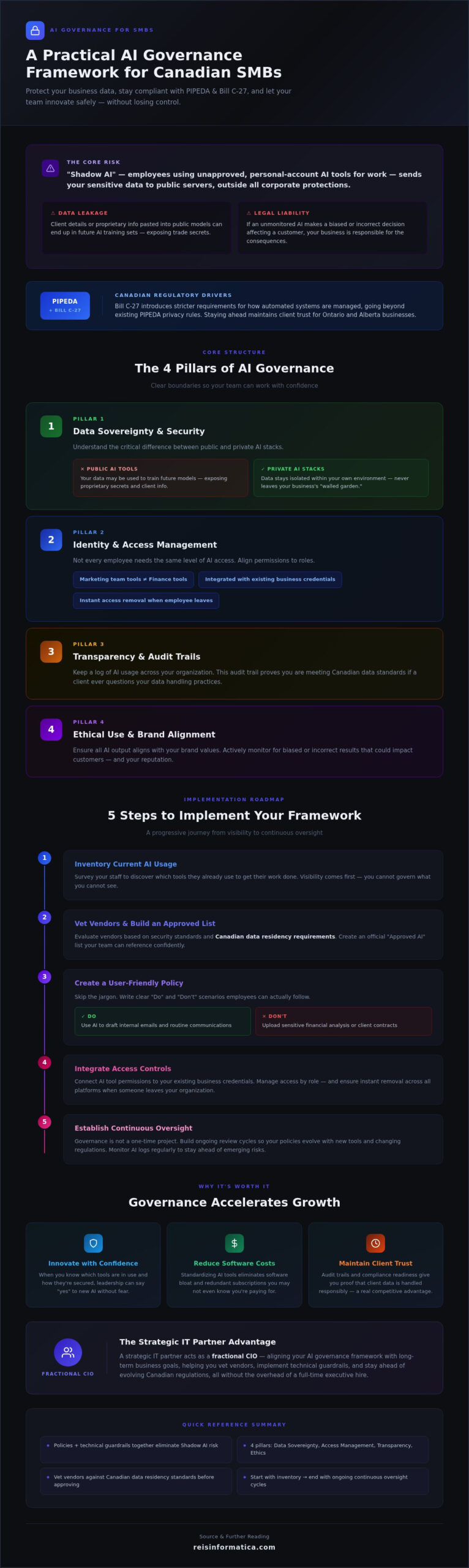
AI governance is a set of internal policies and technical guardrails that manage how your team interacts with Artificial Intelligence. It provides the structure needed to adopt new tools without losing control over sensitive information. Without a formal AI governance framework for SMBs, your staff might turn to “Shadow AI.” This occurs when employees use personal accounts or unvetted tools for work, creating a major security liability because your data is no longer protected by corporate protocols. AI governance is the bridge between your business potential and your digital safety.
For businesses in Ontario and Alberta, compliance is a significant driver for these policies. While PIPEDA has long governed privacy, Bill C-27 introduces stricter requirements for how automated systems are managed. Staying ahead of these rules helps you maintain client trust and ensures your operation remains under competent management as regulations evolve.
The Risks of Ungoverned AI
The primary danger is data leakage. When employees paste proprietary info or client details into public models, that data can end up in training sets for future updates. This means your trade secrets could theoretically be exposed to others. There is also the issue of legal liability. If an unmonitored AI makes a biased or incorrect decision that impacts a customer, your business is responsible for the consequences.
The Benefits: Why Governance Speeds Up Growth
Implementing a clear AI governance framework for SMBs removes the fear factor for leadership. When you know exactly which tools are in use and how they are secured, you can innovate with confidence. Standardizing your AI business solutions also reduces software bloat and costs by ensuring you aren’t paying for redundant tools. It turns technology into a silent, efficient facilitator of your core business goals.
The 4 Pillars of a Practical AI Governance Framework
Building an AI governance framework for SMBs isn’t about creating red tape. It’s about establishing clear boundaries so your team can work with confidence. A solid framework rests on four essential pillars that protect your operations while encouraging smart experimentation. Integrating these elements ensures you aren’t just reacting to tech trends, but managing them with authority.
Pillar 1: Data Sovereignty and Security
The biggest distinction you need to understand is the difference between public and private AI stacks. Public tools often use your data to train their future models. This is a major risk for proprietary secrets or client information. Private AI stacks keep your data isolated within your own environment. This level of control is a core part of robust managed cybersecurity services. It ensures your data never leaves the “walled garden” of your business.
Pillar 2: Identity and Access Management
Giving every employee the same level of AI access is a mistake. Your marketing team needs different tools than your finance department. By integrating AI access with your existing business credentials, you can manage permissions with precision. This proactive approach means that if an employee leaves, their access is cut off instantly across all platforms. It’s a simple way to maintain serenity and security in your digital workspace.
The final two pillars focus on accountability and ethics. Transparency requires keeping a log of AI usage. This serves as an audit trail that proves you are meeting Canadian standards if a client ever asks about your data handling. Ethical use ensures that any AI output aligns with your brand values and doesn’t produce biased results. If you’re feeling overwhelmed by these moving parts, a strategic IT partner can help you align this AI governance framework for SMBs with your specific business goals.
5 Steps to Implementing Your AI Framework in 2026
Implementing an AI governance framework for SMBs doesn’t have to be a daunting project. It’s a progressive journey that starts with visibility and ends with continuous oversight. By following a structured approach, you can turn AI into a secure asset rather than a hidden liability. Start by taking an inventory of your current usage. Survey your staff to discover which tools they already use to get their work done. Once you have a list, vet vendors based on security standards and Canadian data residency requirements to create an “Approved AI” list.
Step 3: Creating a User-Friendly Policy
A good policy should be easy to read and follow. Avoid technical jargon and focus on practical “Do” and “Don’t” scenarios. For example, tell your team that using AI to draft an internal email is encouraged, but uploading sensitive financial analysis or client contracts is strictly prohibited. This clarity helps employees make the right decisions without needing to ask for permission every time. It builds a culture of transparency where people feel safe using approved tools.
Technical guardrails are the next logical step. Implementing a governed gateway allows you to monitor and secure AI interactions in the background. This acts as a protective layer. It stops sensitive data from leaving your network before a breach can occur, providing that essential serenity for leadership.
Step 5: The Role of Continuous Monitoring
AI technology moves fast, so your governance shouldn’t be a one-time project. It’s a living process. Schedule quarterly reviews with your IT partner to adapt to new tools and emerging risks. This ensures your AI business solutions remain effective and compliant as the market changes.
Are you ready to build a secure foundation for your company? Explore our AI business solutions to start your governance journey today.
How a Strategic IT Partner Simplifies AI Governance
Managing a complex AI governance framework for SMBs doesn’t have to fall entirely on your shoulders. Many business owners in Waterloo or Calgary find that while they understand the “why,” the day-to-day “how” is where things get complicated. This is where a strategic IT partner steps in to provide fractional leadership. Instead of hiring a full-time AI Ethics Officer, you gain access to a vCIO who ensures your technology aligns with your long-term goals.
We move your operation from a reactive state of fixing leaks to a proactive model of preventing breaches. This shift is essential for cost efficiency. Outsourcing your governance needs allows you to access high-level expertise without the overhead of a dedicated executive salary.
Bridging the Technical Gap
Technology moves at a lightning pace. Our role is to translate complex AI updates into practical business decisions you can act on. Whether it’s a change in privacy laws or a new security feature in your software, we provide the clarity you need. If you’re looking for this kind of high-level guidance, our Fractional CIO in Waterloo service offers the strategic roadmap your leadership team requires.
Achieving Serenity Through Managed IT
You should be able to focus on your core business activities without worrying about whether your data is leaking through an unvetted chatbot. We handle the technical guardrails so you don’t have to. By integrating governance into your Managed IT Services, we act as a vigilant guardian for your digital operations. This partnership provides the serenity that comes from knowing your operation is under competent, constant management. We ensure your AI governance framework for SMBs stays current, compliant, and effective as you scale.
Secure Your Competitive Edge with AI Governance
Adopting a robust AI governance framework for SMBs is the most effective way to ensure your team moves fast without compromising security. By establishing clear pillars for data privacy and following a structured implementation plan, you eliminate the risks of Shadow AI and standardise your operations. This proactive approach doesn’t just protect your data; it builds a foundation of serenity that allows you to focus on your primary business goals.
You don’t have to navigate the complexities of PIPEDA or Bill C-27 alone. Our strategic vCIO guidance provides the technical authority and preventative management needed to keep your operation compliant and modern. It’s time to turn AI into a silent, efficient facilitator for your success. We are here to act as your vigilant partner, assuming responsibility for the technical complexity so you can lead with confidence.
Secure your business with a custom AI Governance Framework from Reis Informatica. Let’s work together to build a safe, innovative future for your company.
Frequently Asked Questions
Is AI governance mandatory for small businesses in Canada?
AI governance is practically mandatory for Canadian businesses due to laws like PIPEDA and the evolving Bill C-27. If you operate in regions like Kitchener or Mississauga, you are legally responsible for protecting client data. An AI governance framework for SMBs ensures you meet these requirements. It moves your business from a reactive state to a proactive model, ensuring your operation remains under competent management while staying compliant.
What is the biggest risk of using ChatGPT for business tasks?
The most significant risk is data leakage through public models. When staff members use unvetted tools for work, they might unknowingly upload sensitive client contracts or proprietary information. This data can then be used to train future updates of the model, making it accessible to others. This creates a major security liability that can damage your reputation and lead to legal issues for your business in Calgary or London.
How much does it cost to implement an AI governance framework?
The investment required depends on your current technology stack and business goals. While we don’t provide flat rates here, most Canadian SMBs find that partnering with a vCIO is significantly more efficient than hiring a dedicated internal specialist. This strategic approach allows you to implement necessary guardrails without the overhead of an executive salary. It turns technology into a facilitator that supports your growth while keeping your operational costs predictable.
Can I just block all AI tools to stay safe?
Blocking all tools is often a losing strategy. In our experience with businesses from Milton to Halifax, total bans usually lead to “Shadow AI,” where employees use personal devices to access unapproved software. This makes your data even harder to track. Implementing a managed AI governance framework for SMBs is a better alternative. It allows your team to innovate safely, giving you a strategic advantage over competitors who are stuck in a cycle of restriction.
What is the difference between AI governance and cybersecurity?
Cybersecurity is the shield that protects your entire network from external hackers and malware. AI governance is the set of rules and guardrails that manage how your team interacts with specific automated tools. Think of cybersecurity as the lock on your front door and governance as the protocol for who can use the equipment inside. Both are essential components of a proactive, preventative approach to managing your digital operations safely.