
Did you know that the average cost of a data breach for a Canadian organization reached $6.98 million in 2025? For a business owner here in Nova Scotia, that isn’t just a scary statistic; it’s a potential threat to everything you’ve built. It’s easy to feel overwhelmed by complex federal laws like Bill C-8 or the fear of a sudden, business ending shutdown. You likely want to focus on your core goals without the constant worry that a single click could compromise your entire operation. We understand that technical jargon often makes security feel out of reach, but having a solid cybersecurity incident response plan Halifax leaders can trust is now a business necessity.
In this guide, you’ll learn how to build a resilient response strategy tailored for our local landscape to minimize downtime and protect your reputation. We’ll break down the latest Canadian privacy standards and provide a clear roadmap for recovery. By the end, you’ll have the confidence to maintain business continuity, knowing your team is prepared to handle any digital crisis with a professional and proactive approach.
Key Takeaways
- Understand how a modern incident response plan acts as a strategic roadmap to protect your business from evolving digital threats and expensive operational downtime.
- Learn the essential steps to develop a cybersecurity incident response plan Halifax organizations need to meet updated 2026 compliance standards and minimize financial risks.
- Discover how to audit your local infrastructure and empower your staff to act as a first line of defense against sophisticated cyberattacks.
- Explore how partnering for proactive monitoring helps you maintain business continuity and keeps your focus on core goals while technical risks are managed.
What is a Cybersecurity Incident Response Plan and Why Does Your Halifax Business Need One?
A cybersecurity incident response plan Halifax businesses implement is a structured roadmap for detecting, responding to, and recovering from cyberattacks. By following established principles of Cybersecurity Incident Management, your leadership team can act with precision during a crisis. In 2026, the landscape has shifted. With the Critical Cyber Systems Protection Act (CCSPA) now in force, Halifax’s growing professional sectors face higher scrutiny than ever. You can no longer rely on passive hope. Shifting to a “when, not if” mindset ensures your operations remain resilient. An Incident Response Plan is your primary business insurance against digital catastrophe.
The True Cost of Being Unprepared in Atlantic Canada
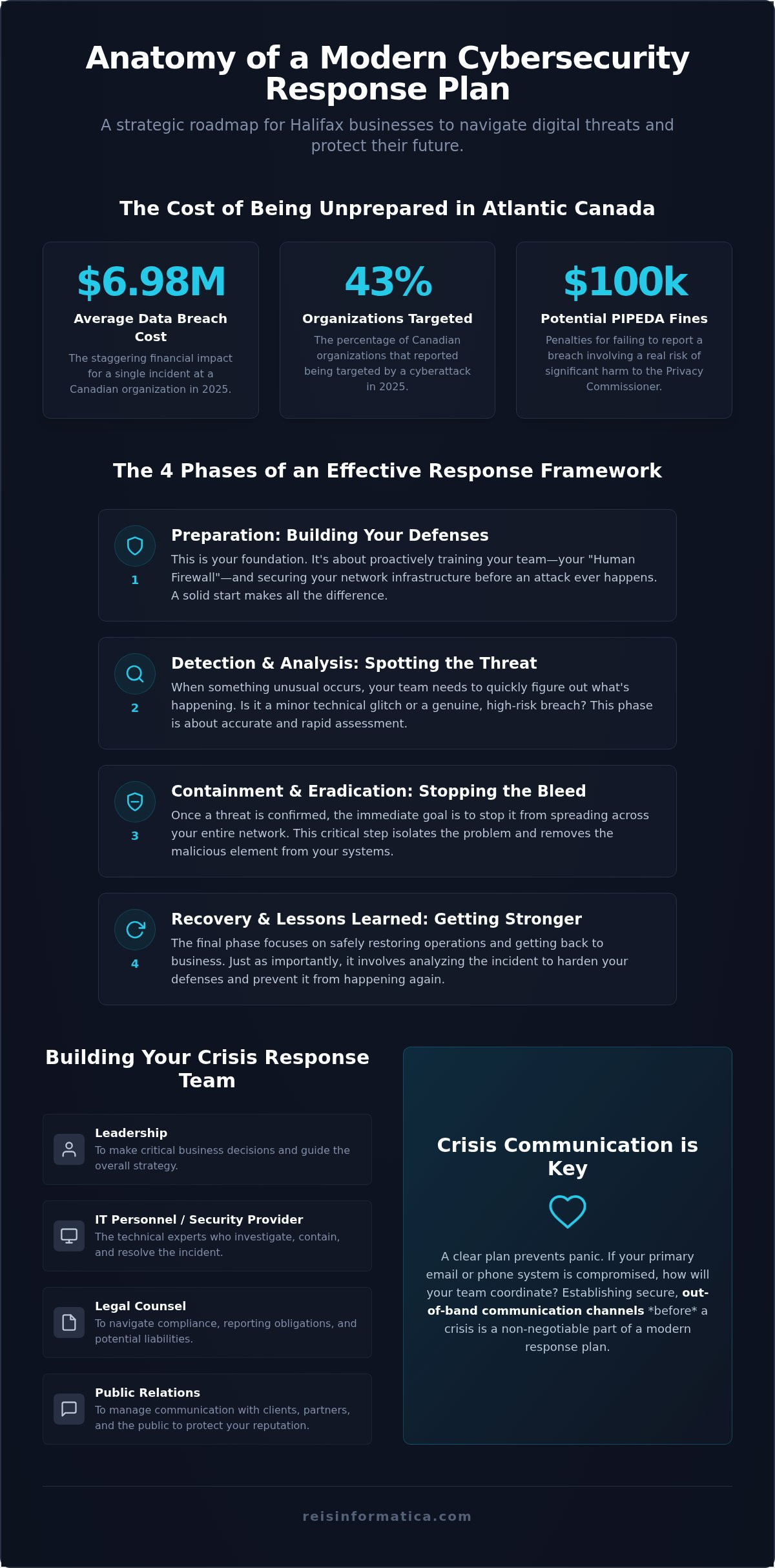
Halifax is a tight-knit business community where reputation is everything. If a breach occurs, local clients who value data sovereignty may lose trust instantly. Beyond the hit to your brand, the financial fallout is steep. IBM reports that the average cost of a Canadian data breach rose to $6.98 million in 2025. This includes lost productivity and the long-term impact of operational downtime that can shutter a business for weeks.
Meeting Canadian Compliance Standards
Compliance isn’t optional anymore. Under PIPEDA, Halifax firms must report breaches involving a “real risk of significant harm” to the Privacy Commissioner. Failing to do so can lead to fines of up to $100,000. Additionally, most cyber insurance providers in 2026 require a formal, tested response plan before they’ll issue a policy. A tested cybersecurity incident response plan Halifax companies maintain ensures they stay on the right side of the law while our cybersecurity services act as a vigilant guardian of your data.
The Core Components of an Effective 2026 Incident Response Framework
A successful framework for a cybersecurity incident response plan Halifax businesses rely on moves beyond simple software. It requires a balanced approach to preparation, detection, and recovery. In Halifax, where 43% of Canadian organizations reported being targeted by a cyberattack in 2025 according to CIRA, your foundation must be solid. Your strategy starts with preparation. This involves training your “Human Firewall” and securing your network foundation. Detection and analysis follow, helping you distinguish a minor technical glitch from a genuine, high-risk breach.
Once a threat is identified, containment and eradication are critical. You must stop the “bleeding” immediately to prevent the infection from spreading across your entire local infrastructure. Finally, recovery and lessons learned ensure you get back to business while hardening your defenses for the future. Detailed guidance from the Canadian Centre for Cyber Security provides a strong baseline for these phases.
The Human Element: Who is on Your Response Team?
A robust cybersecurity incident response plan Halifax leaders implement identifies key stakeholders before a crisis hits. This team should include leadership, IT personnel, legal counsel, and public relations experts. Many local firms find that partnering with a managed cybersecurity provider offers the external expertise needed to manage technical complexity while the business owner focuses on operations.
Communication Protocols During a Crisis
Clear communication prevents panic. You need protocols for what to tell employees and Halifax clients. If your primary email or phone system is compromised, you’ll need secure out-of-band communication channels to coordinate your response. Thinking through these details now creates the operational serenity we aim for. If you’re unsure where to start, reviewing your managed IT strategy can help align your technology with your business goals.
5 Essential Steps to Creating Your Halifax-Specific Response Plan
Building a custom cybersecurity incident response plan Halifax leaders can execute requires more than a generic template. You need a strategy that reflects your local operations and specific risks. While the NIST Incident Handling Guide provides a globally recognized foundation for these procedures, your plan must be practical for your local team to use under pressure. Following these five steps will help you move from vulnerability to readiness.
- Audit Your Local Infrastructure: Map every piece of hardware and every data silo in your Halifax office. You can’t protect what you don’t track.
- Define Severity Levels: Create clear categories for incidents. A lost company phone requires a different response than a full ransomware lockdown.
- Establish Local Partnerships: Identify Halifax-based legal counsel and technical support before a crisis hits. Waiting until you’re hacked to find an expert is a recipe for disaster.
- Document Your Playbooks: Write clear, non-technical instructions for specific scenarios like phishing or data theft. These should be readable by any staff member.
- Test and Refine: Conduct regular tabletop exercises. These simulated drills ensure your leadership team knows exactly how to react when a real threat emerges.
Tailoring the Plan to Halifax Industry Needs
Halifax’s law firms and financial services providers face unique pressures regarding client confidentiality and data sovereignty. Your response strategy should integrate directly with your managed IT services to ensure a seamless transition from detection to recovery. This alignment ensures that your security posture supports your specific business goals without creating operational friction.
The Role of AI in 2026 Incident Response
Speed is the most critical factor in modern defense. By 2026, AI business solutions have become essential for automating the “First Hour” of a response. These tools can detect anomalies and isolate infected systems in seconds, far faster than a human operator could. This proactive approach minimizes damage and keeps your business running while you investigate the root cause.
If you’re ready to secure your organization’s future, our team can help you build a cybersecurity incident response plan Halifax businesses trust for long-term stability.
Partnering for Protection: How Managed Security Secures Halifax’s Future
A cybersecurity incident response plan Halifax businesses develop is only as strong as the team managing it. In 2026, the era of reactive IT is over. You can’t afford to wait for a system failure to realize you’ve been breached. High performing organizations have shifted to a proactive security posture where 24/7 monitoring is the new standard. This constant vigilance allows technology to remain a silent facilitator for your growth rather than a source of stress.
At Reis Informatica, we act as your strategic partner and guardian. We take the weight of technical complexity off your shoulders so you can focus on your core business goals. For additional tips on training your staff to recognize threats, read our guide on Cybersecurity Awareness. This resource helps you build the human firewall necessary to support your technical defenses.
Why Local Expertise Matters in a Breach
Working with a partner who understands the Halifax market and Nova Scotia’s specific regulatory climate provides a significant advantage. When a crisis occurs, pre-established trust and local access reduce response times drastically. You aren’t just a ticket number in a global queue. You’re a local partner whose continuity is our top priority. This proximity ensures that your recovery is handled with the urgency your business deserves.
Next Steps for Halifax Business Owners
The journey toward digital resilience starts with an initial risk assessment. This process identifies vulnerabilities in your current setup before they can be exploited. From there, your cybersecurity incident response plan Halifax strategy should evolve from a static document into a living, breathing security culture. This proactive approach ensures your operations are under competent management, giving you the confidence to lead without fear of digital disruption.
Securing Your Competitive Edge in Halifax
Building a resilient cybersecurity incident response plan Halifax leaders can rely on isn’t just about ticking technical checkboxes. It’s about ensuring your business continues to thrive despite the evolving digital threats of 2026. We’ve explored how preparation involves mapping your local infrastructure and empowering your team to act as a human firewall. By integrating advanced tools and clear communication protocols, you transform security from a potential burden into a silent facilitator for long term growth. Our local Halifax support team provides the 24/7 proactive security monitoring and strategic vCIO guidance you need to maintain operational serenity and focus on your core goals.
Taking these steps today protects your reputation and guarantees that you’re meeting modern Canadian compliance standards without the stress of managing it alone. Secure your Halifax business today with a professional cybersecurity assessment. You’ve built a strong foundation for your business; now it’s time to ensure its future is protected by experts who care about our local community.
Frequently Asked Questions
What is the first thing a Halifax business should do during a breach?
The first step is to isolate the affected systems to prevent the threat from spreading further across your network. Once you’ve contained the immediate risk, you should activate your cybersecurity incident response plan Halifax team and notify your technical lead. Don’t shut down machines entirely unless instructed; doing so can destroy forensic evidence needed for recovery. Clear communication with your stakeholders and legal counsel should follow to ensure compliance with privacy laws.
How often should we update our cybersecurity incident response plan?
You should review and update your plan at least once a year or whenever your local infrastructure undergoes a significant change. In 2026, the rapid evolution of AI powered threats means a static document quickly becomes obsolete. Regular testing through tabletop exercises helps identify gaps in your strategy. Refining your protocols after any minor technical incident ensures your team remains sharp and your recovery roadmap stays current with the latest security standards.
Does my small business in Halifax really need a formal IR plan?
Every organization regardless of size needs a formal strategy to handle digital crises. Small businesses are often viewed as easier targets by cybercriminals who use automated tools to find vulnerabilities. Without a plan, the time lost during a breach can lead to business ending downtime or permanent reputational damage. A structured approach ensures you can recover quickly, maintain client trust, and protect your bottom line against increasingly sophisticated extortion tactics.
How does an incident response plan help with cyber insurance in 2026?
Most insurance providers now require proof of a tested cybersecurity incident response plan Halifax before they’ll approve a policy. Having a formal framework demonstrates that your business is a lower risk; this can lead to more favorable premiums and comprehensive coverage limits. Insurers want to see that you have a proactive strategy for mitigation rather than a reactive approach that relies solely on luck to survive a breach.
Can managed IT services in Halifax help build my response plan?
Managed IT services are essential for building and maintaining a professional response strategy. A local partner like Reis Informatica provides the technical expertise and strategic vCIO guidance needed to tailor a plan to your specific operational goals. We handle the heavy lifting of auditing your infrastructure and establishing 24/7 monitoring. This collaboration ensures your response plan isn’t just a document on a shelf but a living part of your business continuity strategy.