
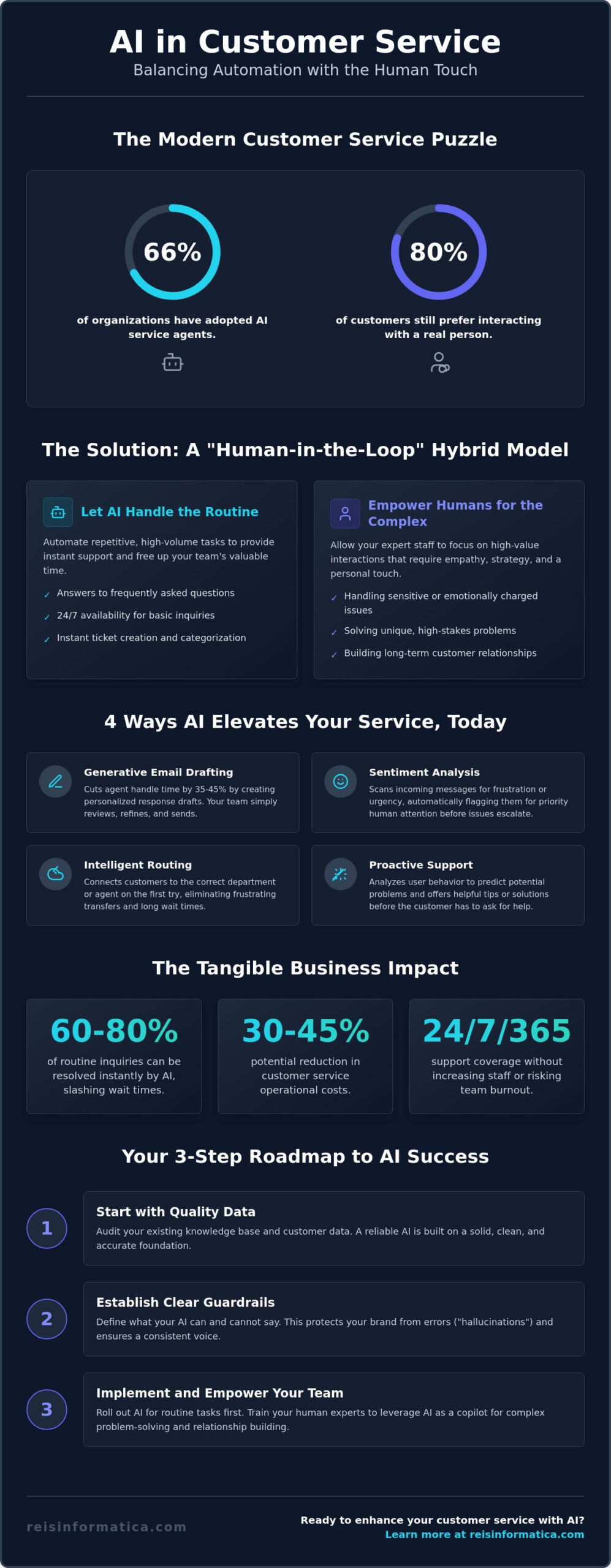
Did you know that while 66% of organizations have adopted AI service agents in 2026, nearly 80% of customers still say they prefer interacting with a real person? It’s a challenging paradox for any business leader. You’re likely feeling the pressure of rising expectations for 24/7 availability and the ongoing difficulty of retaining skilled support staff, yet the fear of a chatbot making a high-profile mistake or “hallucinating” keeps you cautious. We understand that technology should be a silent, efficient facilitator of your goals, not a barrier between you and your clients.
In this guide, we’ll show you how to strategically implement AI for improving customer service to achieve faster response times and significantly reduce your team’s daily workload. You’ll discover how to leverage these tools to boost efficiency without losing the personal touch your business is known for. We will walk through the essential steps for building a hybrid support model that uses AI to handle routine inquiries while empowering your human experts to focus on the high-value, emotional connections that drive long-term retention and operational stability.
Key Takeaways
- Understand the shift from simple chatbots to intelligent assistants that use context and sentiment to deliver a more helpful experience.
- Discover how to leverage AI for improving customer service by using sentiment analysis to flag and prioritize urgent issues before they escalate.
- Learn how to protect your brand from AI hallucinations by establishing clear guardrails for what your automated tools can and cannot say.
- Understand why data residency is a critical security factor and how keeping customer information on Canadian servers ensures better compliance.
- Get a step-by-step roadmap for implementation, starting with a quality audit of your current data to build a reliable foundation for your new tools.
What is AI for Customer Service and Why Does It Matter in 2026?
AI for customer service isn’t just a single tool. It’s a sophisticated ecosystem. This includes Natural Language Processing (NLP) to understand what customers say and predictive analytics to guess what they might need next. In 2026, the shift from basic, clunky chatbots to intelligent assistants is complete. These assistants don’t just follow scripts; they understand context and sentiment. With 66% of organizations now using AI service agents, the role of AI in customer service has expanded to become a foundational layer of business operations. For companies in Mississauga or Calgary, providing 24/7 support is now a baseline expectation. Customers don’t want to wait until Monday morning for an answer. By using AI for improving customer service, you meet these demands without burning out your staff. We advocate for a “human-in-the-loop” model where AI manages repetitive tasks, leaving your team free to handle complex, high-stakes issues.
The Evolution of the Customer Experience (CX)
Traditional support relied on phone queues and long email wait times. AI-augmented support changes this by offering instant, accurate responses at any hour. This method of using AI for improving customer service relies on Conversational AI, which is the technology that allows machines to engage in natural, human-like dialogue with your users. This evolution ensures that your business stays relevant and responsive in a fast-moving market.
Key Benefits for the Modern Business Leader
Implementing AI Business Solutions provides several immediate advantages. You can handle a sudden spike in tickets without a linear increase in hiring costs. Industry data shows AI can resolve 60-80% of inquiries instantly, which slashes your “time-to-resolution” metrics and can reduce operational costs by 30-45%. Finally, your team won’t have to answer the same “Tier 1” password reset questions fifty times a day, which keeps them engaged and happy.
4 Practical Ways AI Improves Your Customer Service Right Now
Transitioning from conceptual strategy to daily operations is where the real value appears. Deploying AI for improving customer service allows your team to move faster while maintaining high standards. Here are four ways this technology works for you today:
- Generative Email Drafting: AI creates personalized responses based on the customer’s specific inquiry. Your agents simply review and refine the text, which can cut handle time by 35-45%.
- Sentiment Analysis: The system scans incoming tickets to detect frustration or anger. It automatically flags these cases so your team can prioritize sensitive issues before they escalate.
- Intelligent Routing: AI ensures that a customer reaching out to your London or Halifax office is connected to the right expert instantly. This eliminates unnecessary transfers and frustration.
- Proactive Support: By analyzing usage patterns, AI can predict when a customer might encounter a hurdle. It then triggers a helpful tip or solution before the customer even realizes there’s a problem.
Empowering Your Team with AI Copilots
AI doesn’t just work behind the scenes; it acts as a real-time partner for your staff. During live calls, AI copilots listen to the conversation and provide instant suggestions from your internal knowledge base. This keeps your team confident and accurate without needing to put customers on hold. If you’re looking to integrate these capabilities into your workflow, exploring AI Business Solutions is a logical next step to ensure your infrastructure is ready.
Hyper-Personalization at Scale
Your customers want to feel known, not like a number in a database. AI makes this possible by integrating with your CRM to analyze past purchase history and preferences. When a client reaches out, the AI provides the agent with a tailored greeting and specific solutions based on that individual’s history. This level of detail used to be reserved for small boutique shops, but now any organization can deliver personalized service at scale. Using AI for improving customer service through hyper-personalization ensures every interaction feels intentional and informed. If you want to see how this fits into your broader technology roadmap, our managed IT services can help align your tools with your business goals.
Solving the Security and Implementation Challenges
Adopting new technology always comes with risks. When using AI for improving customer service, the biggest fear for many leaders is the “hallucination” effect. This happens when an AI confidently provides incorrect information to a client. You can mitigate this risk by setting strict parameters and grounding the AI in your specific company data. By limiting the AI’s creative freedom, you ensure it only speaks from your verified knowledge base. This keeps your brand’s reputation safe while still reaping the benefits of automation.
Data residency is another critical factor. For Canadian businesses, ensuring that customer data stays on Canadian servers isn’t just a preference; it’s often a legal necessity. We recommend that your strategy for AI for improving customer service includes a thorough review of where your data is stored and processed. Before you flip the switch on any AI tool, you must prioritize “clean data.” According to a Gartner survey, 62% of failed AI customer service projects are caused by poor data preparation. If your existing records are messy, your AI will be too. Integrating these tools into a comprehensive cybersecurity strategy ensures that your innovation doesn’t create new vulnerabilities.
Navigating Canadian Privacy Standards (PIPEDA)
Your AI tools must be configured to respect the Personal Information Protection and Electronic Documents Act (PIPEDA). This means having clear consent from users and ensuring that AI agents don’t inadvertently share sensitive personal details. Data encryption is the baseline for any AI implementation in 2026. Without these protections, you risk legal complications and a loss of customer trust. We can help you audit your current setup to ensure full compliance with local privacy laws.
The Managed IT Foundation for AI
AI isn’t a standalone app; it’s a heavy workload that requires a robust network. Your cloud infrastructure must be capable of handling high-speed data processing without lag. If your foundation is weak, the user experience will suffer, leading to the exact frustration you’re trying to avoid. Building a resilient foundation through managed IT services ensures that your systems are ready for the demands of 2026. If you’re concerned about your current infrastructure’s readiness, contact our team for a strategy session to secure your operational continuity.
Your Roadmap to Implementing AI in Customer Service
Implementing AI for improving customer service isn’t a project you should rush. A successful rollout requires a structured approach that prioritizes your operational stability and long-term results. We recommend following these four steps to ensure your transition is smooth and secure:
- Step 1: Identify Friction Points. Start by looking at where your team gets stuck. If your staff spends hours answering simple questions about shipping or password resets, these are the perfect candidates for automation. Solving these “low-hanging fruit” issues provides immediate ROI.
- Step 2: Audit Your Data. Your AI is only as reliable as the data it uses. Check that your customer records and knowledge base articles are accurate, up-to-date, and accessible. This is also the time to ensure your data handling practices align with Canadian privacy standards.
- Step 3: Launch a Pilot Project. Don’t go customer-facing on day one. Start with an internal “Copilot” that helps your staff find information faster. This builds team confidence and allows you to catch any “hallucinations” in a controlled environment.
- Step 4: Scale with Expert Guidance. Once your internal pilot is successful, you can begin deploying customer-facing tools. Partnering with a specialist ensures that the technical integration doesn’t disrupt your existing workflows.
Choosing the Right AI Partner
Success depends on finding a partner that understands your specific business context. Look for a team that offers local support in cities like Waterloo or Milton and focuses on your business strategy rather than just selling a software license. A managed IT partner acts as a vigilant guardian for your technology, overseeing the entire AI lifecycle from initial setup to ongoing security patches. This approach lets you focus on your core business while we handle the technical complexity.
Measuring Success Beyond the Hype
To see the real value of AI for improving customer service, you must track the right metrics. Focus on Customer Satisfaction (CSAT) scores and First Response Time (FRT) to measure efficiency. You should also monitor employee retention rates; when your team is no longer buried under repetitive tickets, their morale and productivity typically rise. If you’re ready to build a more responsive and efficient support operation, book a consultation for AI Business Solutions to start your strategic roadmap.
Securing Your Competitive Edge in 2026
The landscape of customer support has fundamentally shifted. We’ve explored how AI for improving customer service can reduce operational costs by up to 45% while freeing your team to focus on high-value interactions. By prioritizing a hybrid model that balances automation with human empathy, you’re not just keeping up with modern standards; you’re setting a new benchmark for your industry. Success in this new era requires a clean data foundation, a clear roadmap, and a commitment to security.
You don’t have to navigate these technical complexities alone. We provide expert local support across Ontario, Alberta, and Nova Scotia, focusing on secure, PIPEDA-compliant implementations that protect your brand. Our strategic IT leadership bridges the gap between sophisticated tech and your specific business goals, ensuring your transition is both smooth and profitable. If you’re ready to transform your support operations with a partner you can trust, explore AI Business Solutions with Reis Informatica today. Your path to a more efficient and resilient future is well within reach.
Frequently Asked Questions
Is AI for customer service only for large corporations?
No, AI is highly accessible for small and medium-sized businesses in 2026. Many modern platforms offer tiered pricing that allows smaller organizations to leverage AI for improving customer service without a massive upfront investment. These tools help smaller teams handle higher volumes of inquiries efficiently, allowing them to compete with much larger organizations by providing 24/7 support.
Will AI replace my customer service representatives?
AI is designed to augment your team rather than replace it. While it handles a high percentage of routine inquiries like tracking orders or resetting passwords, your human representatives remain essential for managing complex, emotional, or high-value customer interactions. This hybrid approach improves employee morale by removing repetitive tasks and allowing your staff to focus on more meaningful work that requires a personal touch.
How do I ensure AI doesn’t give incorrect information to my customers?
You can prevent incorrect information by grounding your AI in a verified, internal knowledge base. By setting strict parameters, you ensure the system only answers questions using your approved data. Regular audits and a “human-in-the-loop” review process during the initial rollout help catch and correct any potential errors before they reach your customers, maintaining your brand’s reputation for accuracy.
What are the costs associated with implementing AI in a small business?
Implementation costs depend on the specific tools you choose and the scale of your operations. Many businesses opt for a “pay-per-resolution” model, where you only pay for successful AI interactions, or a monthly subscription. When planning your budget for AI for improving customer service, consider not just the software fees but also the foundational work required to prepare your data and train your team on the new system.
Does my data stay in Canada if I use AI for customer service?
Your data can stay in Canada provided you select a solution that supports local data residency. This is a critical requirement for PIPEDA compliance and maintaining customer trust. We work with business leaders to ensure their AI infrastructure and cloud services are configured to keep sensitive information on Canadian servers, providing the security and legal peace of mind your organization needs.