
In the rapidly evolving landscape of 2026, the greatest threat to your business isn’t just a line of malicious code-it’s the sophisticated, AI-driven scams landing in your team’s inboxes daily. For many business owners, the fear of ransomware halting operations is a constant weight, often compounded by the frustration of complex technical jargon and boring training videos that your staff simply ignores. True cybersecurity awareness has moved beyond simple passwords; it is now about empowering your people to act as your first line of defense. At Reis Informática, we believe technology should provide tranquility, not headaches, allowing you to focus on growth while your infrastructure remains resilient and secure.
This guide is designed specifically for leaders who want to move past the confusion and build a robust “human firewall.” You will learn how to transform your employees from your biggest security risk into your strongest asset against modern, AI-powered threats. We will show you how to achieve a secure environment with minimal operational friction, ensuring you meet compliance and $1-million-plus insurance requirements with ease. By the end, you will have the peace of mind that comes from knowing your team is vigilant and your business is protected by a culture of proactive safety.
Key Takeaways
- Understand how to build a “human firewall” by turning your team into a proactive line of defense that protects your business when software alone isn’t enough.
- Discover why traditional training is obsolete against today’s AI-driven scams and how to recognize the sophisticated tactics used by modern cybercriminals.
- Learn how a structured cybersecurity awareness program lowers your risk of expensive data breaches while keeping your company compliant with essential regulations.
- Get a clear roadmap for implementing continuous, bite-sized learning that builds strong security habits without interrupting your team’s daily productivity.
- See how partnering with a managed security expert provides the proactive monitoring and peace of mind you need to focus on growing your business.
What is Cybersecurity Awareness and Why Does Your Business Need It?
In the modern Canadian business landscape, security awareness is no longer just a checkbox for the IT department; it is a fundamental pillar of operational health. At its core, cybersecurity awareness is the combination of knowledge and daily habits that empower your team to protect your company’s digital assets. It is the transition from simply having “antivirus software” to fostering a culture where every employee understands their role in the company’s safety.
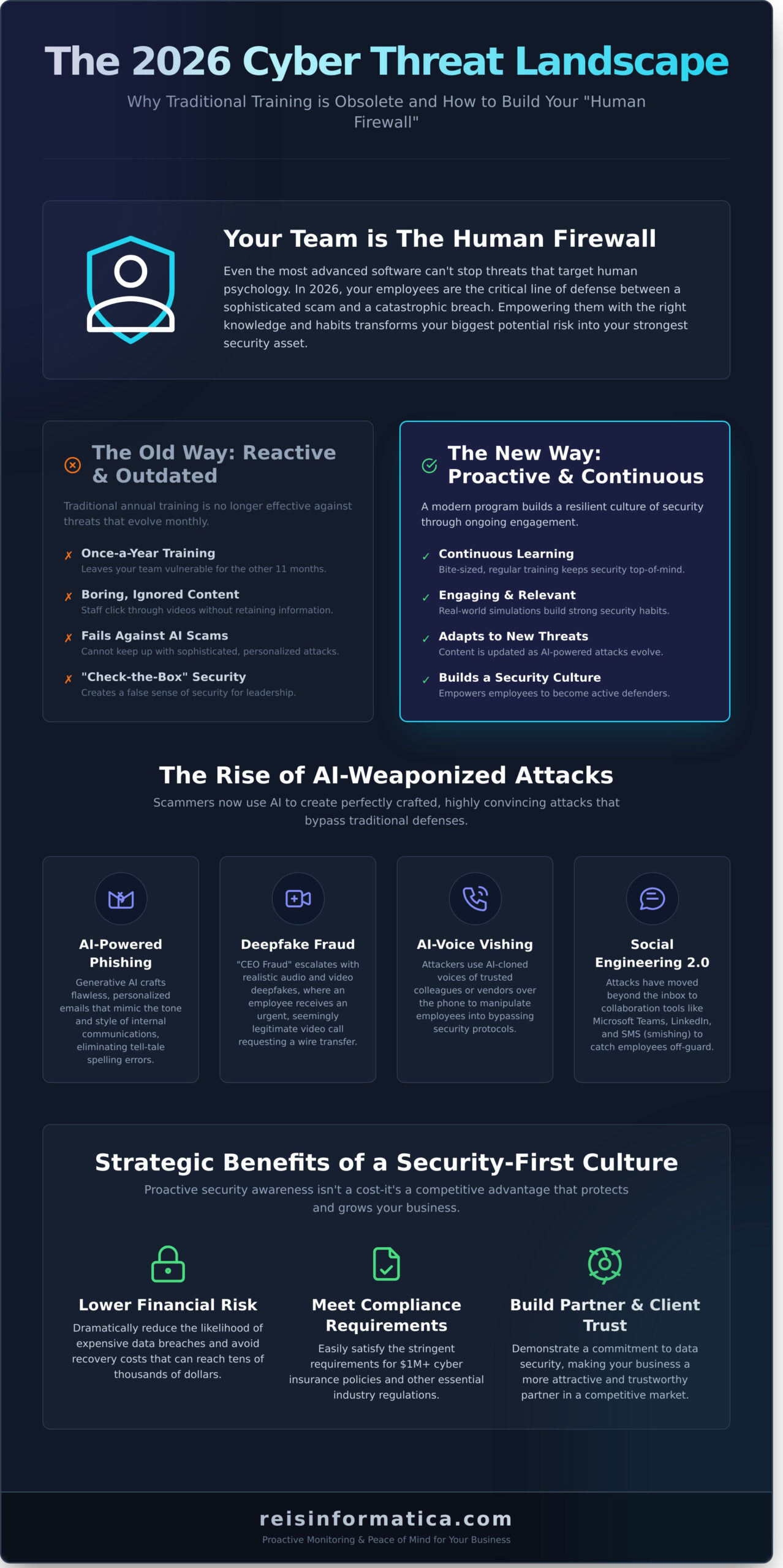
Think of your employees as your “Human Firewall.” While software provides essential barriers, your people are the final line of defense when a sophisticated threat slips through the cracks. In an era where a single misstep can lead to recovery costs reaching tens of thousands of C$, shifting your strategy from reactive fixing to proactive prevention is the smartest investment you can make for your business continuity.
Beyond the Software: Why Tech Alone Isn’t Enough
Even the most robust cybersecurity services cannot fully protect a business if the users are not alert. High-end encryption and firewalls are designed to stop code-based attacks, but modern hackers often prefer targeting human psychology. A “perfect” system can be bypassed in seconds if an employee is tricked into providing a password or clicking a malicious link. By understanding that cybercriminals exploit trust rather than just software vulnerabilities, your team becomes an active part of your security infrastructure rather than its weakest link.
The 2026 Reality: Cybersecurity as a Competitive Advantage
As we look toward 2026, a strong security culture has become a major competitive edge. Clients and partners in Canada are increasingly selective, preferring to work with organizations that can prove their data is handled with care. Furthermore, meeting the stringent requirements of modern cyber insurance providers often hinges on having a documented cybersecurity awareness program in place. By making safety a natural, “frictionless” part of the workflow, you aren’t just stopping hackers-you are building a brand that partners can trust implicitly, ensuring your long-term stability in an unpredictable digital world.
The 2026 Threat Landscape: Why Traditional Training is Obsolete
In 2026, the “obvious” scam is a thing of the past. Cybercrime has matured into a professionalized industry that mirrors legitimate corporate structures, complete with R&D departments and help desks. This rapid evolution means that traditional, once-a-year cybersecurity awareness training is no longer enough to protect your Canadian business. When threats evolve in monthly cycles, an annual refresher leaves your team vulnerable for the remaining eleven months of the year.
Modern attackers are increasingly leveraging AI business solutions to automate their reconnaissance and scale their attacks with terrifying precision. For business owners in Canada, staying ahead requires a shift from “checking a box” to building a proactive culture of safety. Following updated cybersecurity best practices is essential to ensure your infrastructure remains a secondary thought while you focus on growth.
The Rise of AI-Powered Phishing and Deepfakes
AI has eliminated the spelling errors and awkward phrasing that used to give scammers away. Today, generative AI can craft perfectly personalized emails in seconds, mimicking the exact tone and style of your internal communications. Beyond text, we are seeing a surge in “CEO fraud” powered by audio and video deepfakes, where an employee might receive a realistic video call from an executive requesting an urgent wire transfer.
Vishing, in the modern era, involves the use of AI-cloned voices to impersonate trusted colleagues or vendors during phone calls to manipulate employees into bypassing security protocols.
Social Engineering 2.0: Beyond the Inbox
Effective cybersecurity awareness today must look beyond the email inbox. Attackers have moved into collaboration tools like Microsoft Teams, LinkedIn, and even SMS (smishing) to catch employees off-guard. We are also seeing the “Long Game” approach, where attackers build rapport over weeks before ever asking for data.
- Multi-channel attacks: Scammers may message an employee on LinkedIn before sending a “follow-up” file on Teams.
- The rapport trap: Building trust makes employees less likely to verify requests through official channels.
- Social media fuel: Oversharing professional details on social media provides attackers with the “hooks” they need to create believable, targeted lures.
By understanding that the threat is constant and highly sophisticated, Canadian businesses can move toward a more resilient, vigilante mindset that protects both their data and their peace of mind.
The Strategic Benefits of a Security-First Culture
Investing in cybersecurity awareness isn’t just a “check-the-box” exercise for HR; it is a fundamental business strategy that protects your bottom line. When your team understands the risks, the measurable impact is immediate. For instance, consistent training can drop phishing “click rates” from over 30% to low single digits, effectively neutralizing the most common entry point for hackers.
A security-first culture provides several high-level advantages for Canadian business owners:
- Measurable Cost Savings: In Canada, the cost of recovering from a data breach can easily reach hundreds of thousands of dollars in forensics, legal fees, and lost productivity. Prevention through education is consistently 10x cheaper than reactive incident response.
- Regulatory Compliance: Whether you are navigating PIPEDA or province-specific regulations like Quebec’s Law 25, a trained workforce is essential for meeting legal data protection requirements and avoiding heavy fines.
- Employee Empowerment: Instead of feeling like a liability, employees become proactive “human firewalls.” As noted in the FTC’s guide on Cybersecurity for Small Business, a structured approach to security helps build a culture of shared responsibility.
Protecting Your Brand Reputation
Trust is your most valuable currency. A single employee mistake can lead to a public PR crisis that takes years to repair. By prioritizing cybersecurity awareness, you aren’t just protecting data; you are making a brand promise to your clients. Using your high security standards as a marketing tool demonstrates that you are a reliable partner, which is a powerful differentiator in the modern Canadian marketplace.
Operational Efficiency and Reduced Downtime
A security-conscious team means fewer “emergency” IT tickets and fewer work stoppages caused by malware infections. This environment allows your managed IT services to focus on proactive infrastructure improvements rather than constant firefighting. Furthermore, there is a direct connection between security hygiene and device performance; alert users notice suspicious background activity earlier, keeping your hardware running efficiently and reducing long-term maintenance costs.
How to Implement a Modern Cybersecurity Awareness Program
Building a resilient culture of security isn’t about checking a box once a year; it’s about creating an environment where protection is second nature. To move beyond basic compliance and achieve true cybersecurity awareness, business owners should follow a structured, proactive roadmap that focuses on human behavior as much as technical controls.
- Step 1: Baseline Testing – Before you can improve, you need to know your starting point. Use initial assessments to identify which departments are most vulnerable to social engineering.
- Step 2: Continuous Education – Replace long, annual seminars with “micro-learning.” These are bite-sized, 5-minute modules that fit into a coffee break without disrupting productivity.
- Step 3: Phishing Simulations – Send safe, simulated “threats” to your team. This provides real-world practice in a controlled environment, helping staff recognize the subtle red flags of a real attack.
- Step 4: Reporting Channels – If an employee sees something odd, they need a “one-click” way to report it. A simple process ensures your IT team can act before a small mistake becomes a costly breach.
- Step 5: Measurement and Feedback – Track your progress. Celebrate “security wins,” such as a high reporting rate, to keep the team motivated and engaged in protecting the business.
From Passive Videos to Active Engagement
The days of 30-minute mandatory lectures are over; they lead to boredom, not better security. Modern programs use gamification-think leaderboards and badges-to turn learning into a friendly competition that drives habit formation. When an employee clicks a simulated phishing link, the immediate, non-punitive feedback they receive acts as a “teachable moment” that anchors the lesson far more effectively than a generic lecture. This active approach ensures cybersecurity awareness stays top-of-mind throughout the Canadian business year.
Tailoring Training to Different Roles
One size does not fit all in IT security. Your Finance team, handling wire transfers and C$ invoices, requires deep dives into Business Email Compromise (BEC), whereas your Creative team might need to focus on intellectual property theft. For executives, we recommend “white-glove” training focused on high-stakes “whaling” attacks. Furthermore, with the rise of hybrid work in Canada, your program must include specific guidance on home-office security, such as securing personal Wi-Fi routers and adhering to PIPEDA-compliant data handling while off-site.
Need help building a custom roadmap for your team? Explore how we can help at reisinformatica.com.
Partnering for Peace of Mind: The Managed Security Advantage
As a Canadian business owner, your focus should be on growth and operations, not on trying to act as your own Chief Information Security Officer (CISO). While building cybersecurity awareness among your staff is a critical first line of defense, it is only one piece of the puzzle. True data protection happens when you combine an educated workforce with robust cloud services and professional oversight.
Moving from traditional “IT support” to a Strategic Technology Partner means you no longer have to worry about the “what ifs.” By integrating smart technology with human vigilance, you create a safety net that protects your bottom line and your reputation in the Canadian market. This comprehensive approach requires a stable foundation, which is why many business leaders are investing in professional infrastructure services that build resilient IT foundations to support both security initiatives and business growth.
Why Proactive Vigilance Beats Reactive Training
Training prepares your team for the “knowns,” but proactive monitoring catches the “unknowns” that even the best-trained employee might miss. At Reis Informática, we manage the technical complexity so you can stay focused on running your business. Our layered defense strategy combines advanced endpoint protection with human intelligence, ensuring that if a mistake happens, the system is there to catch it.
- Continuous Monitoring: We act as your vigilant partner, staying ahead of emerging 2026 trends to keep your infrastructure secure.
- Integrated Safety: We ensure your cloud tools and employee habits work in harmony, preventing costly downtime that can impact your C$ revenue.
- Proactive Response: We don’t just fix what’s broken; we prevent the break from happening in the first place.
Getting Started: Your Cybersecurity Roadmap
Improving your security doesn’t require a technical degree. You can start today by conducting a simple “culture audit” in your office: observe if passwords are left on sticky notes or if staff feel comfortable reporting suspicious emails without fear of blame. A healthy security culture starts with open communication.
To evaluate your current standing, ask your current IT provider these three essential questions:
- How are we measuring the effectiveness of our cybersecurity awareness training?
- What specific tools are monitoring our network for threats 24/7?
- Is our current recovery plan tested and ready for a real-world scenario?
Ready to move from reactive fixes to a proactive shield? Contact Reis Informática today for a consultative security strategy and discover the tranquility that comes with expert protection.
Securing Your Business Future: The Human Firewall Advantage
In 2026, protecting your Canadian business requires more than just updated software; it requires a culture of vigilance. As we’ve explored, traditional training is no longer enough to stop sophisticated threats. By prioritizing cybersecurity awareness, you empower your team to become your strongest line of defense, transforming potential vulnerabilities into a proactive human firewall that protects your bottom line and your reputation.
The good news is that you don’t have to navigate these technical complexities alone. At Reis Informática, we act as your vigilant partner, providing expert-led Managed IT services specifically tailored for the Canadian market. Our team delivers proactive 24/7 monitoring and threat prevention to stop attacks before they start. Plus, with our strategic vCIO leadership, non-technical business owners gain the high-level guidance needed to make informed decisions without getting lost in jargon. We handle the security, so you can focus on what you do best: growing your business.
Ready to replace tech-related stress with total peace of mind? Secure your business with a proactive cybersecurity strategy from Reis Informática. Let’s work together to build a safer, more resilient future for your company.
Frequently Asked Questions
Is cybersecurity awareness training mandatory for small businesses?
While there isn’t a single federal law that mandates training for every small business in Canada, regulations like PIPEDA require you to have “comparable levels of protection” for personal data. In practice, this makes training essential. Beyond legalities, most cyber insurance providers now require proof of employee training before they will issue a policy or pay out a claim following a breach.
How often should employees receive cybersecurity training in 2026?
By 2026, the old “once-a-year” seminar is no longer effective against rapidly evolving threats. We recommend a continuous approach: monthly micro-learning sessions of 5 to 10 minutes, paired with quarterly phishing simulations. This consistent cadence ensures cybersecurity awareness remains a top priority for your team without disrupting their daily productivity or causing “training fatigue” in the workplace.
What is the most common cybersecurity threat to employees?
Phishing remains the most prevalent threat facing Canadian employees today. Whether it is a deceptive email disguised as a Canada Post delivery notification or a “spoofed” message from a senior executive asking for an urgent wire transfer, these attacks target human psychology. Because these scams bypass technical filters by tricking the user, your staff is often the primary target for attackers.
Can software replace the need for cybersecurity awareness training?
Software is a vital layer of protection, but it is not a silver bullet. Even the most advanced AI-driven firewalls cannot stop an employee from voluntarily giving their login credentials to a convincing scammer over the phone. Think of software as your building’s locks and training as the habit of not opening the door to strangers; you need both to ensure total business continuity.
How do I measure the success of an awareness program?
The best way to measure success is through “Phish-Prone %” and reporting rates. Effective cybersecurity awareness programs track how many employees click on a simulated phishing link versus how many use the “Report” button to alert IT. A successful program shows a steady decline in clicks and an increase in proactive reporting, proving that your team is actively defending your digital infrastructure.
What should an employee do if they accidentally click a phishing link?
If a mistake happens, the employee should immediately disconnect their device from the Wi-Fi and notify your IT department or service provider. At Reis Informática, we encourage a “no-blame” culture. When employees feel safe reporting an error quickly, your technical team can isolate the threat before it spreads, significantly reducing the potential for data loss or expensive operational downtime.
How much does a professional cybersecurity awareness program cost?
For most Canadian businesses, a professionally managed awareness program typically costs between C$5 and C$15 per user, per month. This investment covers automated testing, educational content, and detailed compliance reporting. When you consider that the average cost of a data breach for a Canadian firm can reach millions, this small monthly fee is a highly cost-effective way to ensure long-term stability.
What is the “Human Firewall” and how do I build one?
A “Human Firewall” refers to a workforce that is so well-trained they act as a proactive layer of security. You build one by moving away from “scare tactics” and toward a partnership model. By providing your team with the right tools and knowledge, they stop being a vulnerability and start being your strongest line of defense, allowing you to focus on your core business goals.