
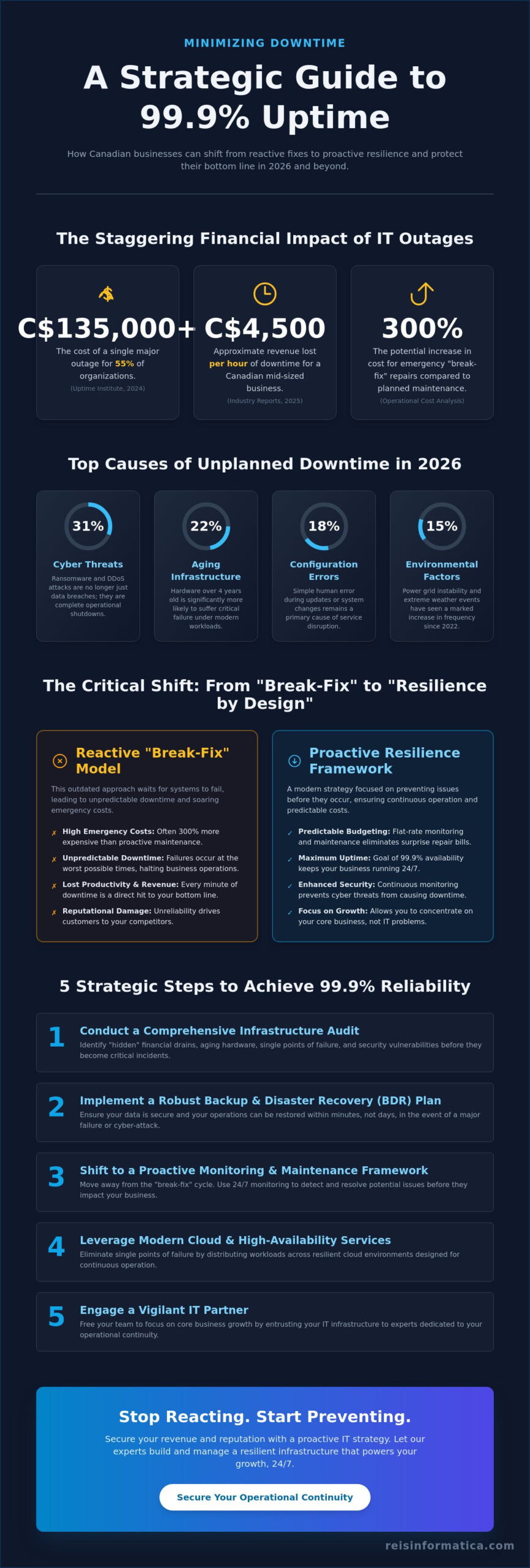
Did you know that a 2024 report from the Uptime Institute revealed that 55% of all service outages cost organizations over C$135,000 in lost revenue and recovery fees? Whether you’re managing a logistics firm in Calgary or a tech startup in Waterloo, seeing your systems freeze during peak hours isn’t just an inconvenience. It’s a direct hit to your bottom line. You likely already know that reactive “break-fix” models are failing your budget, often leading to emergency repair bills that are 300% higher than planned maintenance. Learning how to reduce IT downtime is no longer a luxury for 2026; it’s the foundation of your operational survival.
We agree that your focus should stay on growing your business, not troubleshooting server errors or worrying about data loss. This guide provides the strategic framework you need to eliminate technical disruptions, protect your revenue, and maintain 99.9% system uptime through 2026. You’ll discover a proactive technology roadmap that shifts your infrastructure from a source of anxiety to a silent, 24/7 engine of productivity monitored by experts who prevent issues before they start.
Key Takeaways
- Identify the “hidden” financial drains of system outages, from lost employee productivity to reputational risks in competitive markets like Mississauga and the GTA.
- Discover how to reduce IT downtime by shifting from a reactive “break-fix” mindset to a proactive framework focused on “resilience by design.”
- Learn how modern cloud services and high-availability infrastructure can eliminate single points of failure to keep your operations running smoothly.
- Master a five-step strategic approach to reliability, starting with a comprehensive infrastructure audit and a robust Backup and Disaster Recovery (BDR) plan.
- See how a vigilant IT partnership allows Canadian business owners to stop worrying about technical glitches and focus entirely on their core growth.
Understanding the Real Cost of IT Downtime for Canadian Businesses
IT downtime is any period where systems, networks, or applications are unavailable for business use. It’s a direct halt to your revenue stream. While many owners focus on the immediate technical fix, the true damage lies in hidden costs. You’re paying employee wages for zero output. You’re losing client trust that took years to build. In competitive markets like Mississauga or Kitchener, a single afternoon of silence can drive a long-term partner straight to a competitor. Understanding how to reduce IT downtime begins with recognizing it as a business risk, not just a tech problem.
By 2026 standards, the tolerance for failure has vanished. With global supply chains relying on real-time data and 38% of Canadian professionals working remotely, your network must be a constant. High availability is a strategic business framework that prioritizes continuous service delivery over simple technical uptime, ensuring your operations persist even if specific components fail. Investing in a high-availability IT infrastructure is no longer optional for those who want to remain competitive in the Canadian market.
The Financial Impact on Local Economies
A two-hour outage in a Waterloo tech firm differs significantly from a retail outage in Milton. For the tech firm, downtime might stall a software deployment worth C$50,000 in billable hours. For the retailer, it means abandoned carts and a tarnished local reputation. According to 2025 industry reports, the average Canadian mid-sized business loses approximately C$4,500 for every hour of total system unavailability. These losses stem from missed opportunities and the ripple effect on client retention. Building a resilient foundation through professional infrastructure services is the only way to protect your bottom line from these unpredictable hits.
Common Causes of Disruptions in 2026
Identifying the root cause is the first step in learning how to reduce IT downtime effectively. In the current landscape, disruptions generally fall into three categories:
- Aging Infrastructure: Hardware over four years old is 22% more likely to suffer a critical failure. Many businesses in Halifax and Calgary still struggle with legacy servers that can’t handle modern workloads.
- Environmental Factors: Local power grid instability or extreme weather events, which have increased in frequency by 15% since 2022, can take entire offices offline instantly.
- Cyber Threats: Ransomware and DDoS attacks are now responsible for 31% of unplanned outages in Canada. These aren’t just security breaches; they’re operational shutdowns.
- Configuration Errors: Simple human errors during software updates account for nearly 18% of downtime incidents.
A proactive approach ensures these common triggers don’t turn into multi-day disasters. You need a partner who monitors these variables 24/7, allowing you to focus on growth while we handle the technical vigilance.
The 3 Pillars of a High-Availability IT Infrastructure
Building a resilient IT environment isn’t about buying the most expensive gear and hoping for the best. It requires a strategy we call “resilience by design.” Instead of the traditional “fix it when it breaks” mentality, high-availability systems are engineered to stay operational even when individual components fail. Modern cloud services are the cornerstone of this approach. They allow businesses to distribute their workloads across multiple virtual environments, effectively removing the single points of failure that used to plague on-premise server rooms. When your infrastructure is designed to be elastic, a hardware glitch in one area doesn’t bring your entire operation to a halt.
Hardware quality is a significant part of the equation, but it’s only half the battle. The other half is expert configuration. A C$15,000 enterprise-grade server provides little value if its failover protocols aren’t tested or if its storage isn’t partitioned for maximum redundancy. True stability happens when high-quality hardware meets a professional setup that prioritizes constant availability. This is exactly how to reduce IT downtime from hours of frustration to mere seconds of automated recovery.
Redundancy and Failover Systems
Redundancy is the practice of having a “Plan B” that’s already running in the background. A failover is the automated process that switches your operations to that secondary system the moment the primary one falters. For businesses in Kitchener and Cambridge, this often starts with diverse internet connections. Relying on a single fiber line is risky; a local construction crew hitting a cable can disconnect your office for an entire afternoon. By implementing a secondary connection from a different provider, your network can switch over instantly, keeping your team productive.
Data storage follows the same logic. Using cloud-based backup and disaster recovery ensures that your critical files aren’t tied to a single physical location. If a server in your Waterloo office experiences a power surge, your employees can continue working by accessing mirrored data in a secure, off-site data centre. It’s about creating a safety net that catches your business before it hits the ground.
Proactive 24/7 Monitoring and AI Business Solutions
The traditional IT model relied on “alerting,” which meant someone got a notification after a system crashed. We’ve moved beyond that. Today, AI business solutions allow us to shift from reacting to predicting. AI algorithms can monitor hardware health in real-time, identifying patterns like rising CPU temperatures or erratic disk read speeds that signal a failure is imminent. This allows us to replace a part during scheduled maintenance rather than during an emergency outage.
Real-time monitoring is also the only effective way to catch “silent” failures. These are background processes, like a database sync or a security scan, that stop working without triggering a loud error message. Constant vigilance ensures these small glitches don’t snowball into major disruptions. If you’re looking for a partner to watch over your systems while you focus on growth, consider how a managed IT strategy can provide that peace of mind.
Proactive vs. Reactive Support: Why the “Break-Fix” Model is Failing Local Businesses
Many business owners in the Waterloo region believe they’re saving money by avoiding monthly service fees. They call a technician only when a server crashes or the Wi-Fi dies. This “break-fix” approach is like skipping every doctor’s visit until you need emergency surgery. It feels cheaper in the short term, but the long-term costs of lost productivity are staggering. A 2024 study by Aberdeen Strategy & Research found that the average cost of unplanned downtime for small to mid-sized businesses has risen to over C$12,000 per hour. Relying on reactive support is no longer a viable strategy for companies looking for how to reduce IT downtime in a competitive Canadian market.
The “fix it when it’s broken” mentality ignores the invisible costs of tech friction. When systems run slowly or software hangs, your team loses minutes every hour. Over a year, these micro-outages cost more than a total system failure. Shifting to a proactive model means your technology is managed by a partner who prevents these issues before they impact your payroll. It’s the difference between reacting to a fire and installing a world-class sprinkler system.
The Conflict of Interest in Traditional IT Support
The traditional IT model creates a fundamental misalignment between you and your provider. Under an hourly billing system, your IT person makes more money the longer your systems stay broken. They have zero financial incentive to implement permanent fixes that prevent future issues. If a technician earns a C$150 hourly rate to fix a recurring server issue, the business model rewards them for your misfortune. They aren’t villains, but the model doesn’t encourage them to spend hours finding a permanent root cause when a quick “band-aid” fix keeps the billable hours flowing next month.
In contrast, a fixed-fee managed IT services model shifts the risk to the provider. Because they receive a flat monthly rate, every minute they spend fixing a problem is a cost to them. Their profit depends on your systems running perfectly. This partnership ensures their primary goal is identical to yours: absolute uptime. It transforms the relationship from a vendor transaction into a strategic alliance where the provider acts as a vigilant guardian of your operational continuity.
Cybersecurity as a Downtime Prevention Tool
In 2026, technical glitches aren’t the primary threat to your operations. Ransomware and data breaches now cause 54% of all unplanned outages according to recent industry reports. If your IT support only reacts after a breach occurs, the damage is already done. Proactive cybersecurity services act as a 24/7 digital sentry. By monitoring for vulnerabilities before they’re exploited, you eliminate the most common cause of extended shutdowns.
A single phishing email can lock your entire Kitchener office out of their files for days. This is why modern network security services are a critical layer of operational defense. You don’t just need someone to fix a laptop; you need a system that prevents malicious actors from entering your network in the first place. This proactive stance is the most effective way for local leaders to understand how to reduce IT downtime while protecting sensitive client data and maintaining a professional reputation.
5 Strategic Steps to Minimize Outages and Boost Reliability
Learning how to reduce IT downtime requires a shift from fixing what’s broken to preventing the break entirely. For businesses in the Waterloo Region and across Canada, reliability isn’t just a technical metric; it’s the foundation of client trust. By following a structured roadmap, you can transform your technology from a source of stress into a silent, efficient engine for growth.
Auditing Your Current Vulnerabilities
The first step involves a deep dive into your existing environment. Many organizations in Kitchener or Mississauga office parks rely on legacy infrastructure hidden in server closets. You must identify “end-of-life” hardware, as equipment older than five years has a 32% higher failure rate. Additionally, review your Service Level Agreements (SLAs) with current vendors. Many business owners discover their contracts don’t actually guarantee uptime, only “best effort” response times. In local business hubs, common bottlenecks often include aging internal wiring or a lack of redundant internet connections, which can lead to frequent micro-outages.
- Step 1: Conduct a Comprehensive IT Infrastructure Audit. Map out every server, workstation, and network switch to find weak links before they fail.
- Step 2: Implement a Robust Backup and Disaster Recovery (BDR) Plan. Ensure your data is backed up off-site in secure Canadian data centres, allowing for rapid recovery if a local disaster strikes.
- Step 3: Standardize Hardware and Software. Reducing the variety of devices in your office minimizes compatibility errors and makes troubleshooting much faster.
The Role of Employee Training
Technology is only half the battle. Human error remains a top three cause of unplanned outages in Canada. A single accidental click on a malicious link can encrypt your entire network, leading to days of lost productivity. You can significantly lower this risk by teaching your team better password hygiene and how to spot sophisticated phishing attempts. When you invest in employee cybersecurity awareness, you turn your staff into an active defense layer.
The Human Firewall is a business’s first line of defense, where every staff member acts as a vigilant guardian against digital intrusions. By empowering your team, you discover how to reduce IT downtime by stopping threats at the point of entry.
- Step 5: Partner with a Proactive Managed Service Provider (MSP). Instead of waiting for a crash, a professional partner provides 24/7 oversight to catch and resolve issues in the background.
A proactive approach ensures your operations remain steady while your competitors struggle with technical debt. If you are ready to secure your infrastructure and eliminate the high costs of technical failure, explore our professional IT services to build a more resilient business today.
How Reis Informática Secures Operational Continuity for Our Partners
Reis Informática views technology through the lens of a “Vigilant Partnership.” We don’t just react to tickets. We anticipate roadblocks before they cost your business money. Our goal is to shift your mindset from tech-anxiety to a state of strategic focus. When you partner with us for Managed IT services, you aren’t just hiring a help desk. You’re gaining a dedicated team committed to your tranquility and growth. We believe that understanding how to reduce IT downtime is the foundation of a competitive Canadian business in 2026.
Our approach is designed to be proactive rather than reactive. We monitor your systems 24/7 to catch minor glitches before they escalate into major outages. This constant oversight provides the stability needed for your team to work without interruption. By removing the burden of technical management, we allow you to focus on your core mission. It’s about creating an environment where technology is an asset, not a source of stress.
Local Expertise, National Reach
A partner who understands the local business landscape in Waterloo or Mississauga provides a distinct advantage. We maintain a strong presence in Calgary, Halifax, London, and the GTA tech corridor to support our partners wherever they operate. This geographical spread allows us to offer faster on-site response times when remote fixes aren’t enough. If a hardware failure occurs in a Kitchener warehouse, our technicians can be there quickly to resolve it. This local touch is a critical component of how to reduce IT downtime effectively.
Our teams act as the “invisible and efficient” technology arm of your company. We handle the complexity of servers and networks so you can lead your people. Having local experts means we understand specific regional challenges, from local compliance needs to regional connectivity issues. We don’t believe in one-size-fits-all solutions. Instead, we tailor our support to the specific demands of the Canadian market and your unique industry requirements.
Your Next Steps Toward Zero-Downtime
Moving toward a zero-downtime environment requires a shift in strategy. We offer a no-obligation consultation to evaluate your current infrastructure health and identify hidden vulnerabilities. From there, we create a custom technology roadmap tailored for the rest of 2026. This roadmap ensures your budget is spent on improvements that drive ROI rather than emergency repairs. Our roadmaps typically include:
- A full audit of your hardware lifecycle to prevent surprise failures.
- Optimization of cloud resources to ensure C$ costs remain predictable and efficient.
- Strategic alignment of your IT budget with your 2026 business growth goals.
- Implementation of redundant systems to ensure continuity during unexpected events.
Don’t let technical debt or outdated systems hold your business back. Moving from a reactive state to a proactive one is the best investment you can make for your operational security. Get started with a proactive IT strategy from Reis Informática today.
Take Control of Your Technical Future
Your business depends on technology that stays out of the way and just works. Moving beyond the outdated break-fix model is the first step toward true operational stability. By implementing proactive monitoring and building a high-availability infrastructure, you protect your bottom line from the high costs of unexpected outages. Industry research from Gartner indicates that the average cost of network downtime can reach C$7,500 per minute. Understanding how to reduce IT downtime isn’t just a technical goal; it’s a strategic necessity for growth in 2026.
Reis Informática provides the vigilant support you need to maintain focus on your core objectives. With local teams established in 8+ Canadian cities and 24/7 threat detection, we ensure your systems remain resilient. Our consultative approach prioritizes your tranquility, turning complex infrastructure into a reliable asset. We act as your expert partner, managing the technical complexity so your team can focus on what they do best.
Secure your business continuity with Reis Informática’s Managed IT Services
Your path to a more reliable future starts with a partner who watches over your network so you don’t have to.
Frequently Asked Questions
What is a good IT downtime percentage for a small business?
A “Three Nines” or 99.9% uptime rate is the standard benchmark for small businesses in 2026. This target limits your total yearly outages to approximately 8.77 hours. While 100% is the ideal goal, maintaining 99.9% availability provides a realistic balance between infrastructure costs and operational reliability for firms in Kitchener and Waterloo.
How much does one hour of IT downtime typically cost a Canadian company?
Canadian small to mid-sized businesses lose an average of C$10,000 for every hour their systems remain offline. This calculation includes lost employee wages, missed sales opportunities, and potential service recovery fees. For larger enterprises in high-volume sectors, these costs often escalate to C$150,000 or more per hour depending on the complexity of their digital operations.
What is the difference between planned and unplanned downtime?
Planned downtime involves scheduled maintenance windows while unplanned downtime happens without any warning. You’ll use planned sessions to install security patches or upgrade hardware during low-impact hours to keep systems healthy. Unplanned events, such as a sudden server failure or a cyberattack, cause immediate disruption and usually require expensive emergency intervention to resolve.
Can Managed IT services completely eliminate downtime?
No service can guarantee 100% uptime, but Managed IT services bring your business as close as possible to that goal. Partners focus on how to reduce IT downtime by using 24/7 monitoring to catch 85% of potential failures before they impact your workflow. It’s a shift from a reactive model to a proactive strategy that ensures your infrastructure stays resilient.
How does cloud computing help in reducing IT outages?
Cloud computing reduces outages by removing your reliance on a single physical server located in your office. If your local hardware fails, your team simply logs in from another device to access cloud-hosted applications and data. Leading Canadian cloud providers offer 99.99% availability, which ensures your business stays functional even if your physical office faces a power or hardware crisis.
What should be included in a business disaster recovery plan?
A recovery plan must prioritize your Recovery Time Objective (RTO) and Recovery Point Objective (RPO). The RTO defines how many minutes your business can afford to be offline; the RPO determines the maximum amount of data loss you can tolerate. You should also include a clear chain of command and step-by-step restoration procedures for your most critical applications.
Is human error a significant cause of IT downtime in 2026?
Human error remains a primary driver of outages, accounting for 82% of all IT-related incidents and security breaches this year. Simple mistakes, like accidental file deletions or falling for sophisticated phishing attempts, often lead to significant system shutdowns. Regular staff training and automated safeguards are essential to protect your business from these common internal risks.
How often should we perform IT infrastructure audits?
You should conduct a comprehensive IT infrastructure audit at least once every 90 days. Quarterly reviews help you identify aging hardware before it crashes and ensure your security patches are fully up to date. Regular audits allow your business to scale safely while maintaining the high level of stability your Canadian clients expect from a professional organization.