What if the most expensive person on your payroll isn’t an employee at all, but the “invisible” cost of technology that doesn’t align with your business goals? If you’re tired of “break-fix” IT support that only shows up when something stops working, you aren’t alone. Many Canadian business owners feel the frustration of wasting their budget on tools that don’t talk to each other while worrying about falling behind competitors who are already leveraging AI. Utilizing virtual CIO services allows you to stop reacting to tech problems and start leading with a proactive strategy that treats technology as a revenue driver rather than just a monthly expense.
It’s a common struggle to balance the need for high level leadership with the reality of a growing company’s budget. This article will show you how fractional expertise bridges the gap between daily support and long term growth without the $200,000 base salary of a full time executive. We’ll explore how a vCIO builds a predictable budget and a clear technology roadmap for the next three to five years. You’ll also learn how this strategic partnership helps you stay ahead of strict new Canadian privacy regulations and evolving cybersecurity risks so you can focus on your core business with total confidence.
Key Takeaways
- Discover how virtual CIO services provide the executive-level leadership you need to bridge the gap between daily tech support and long-term business growth.
- Learn the process for creating a three-year technology roadmap that replaces “surprise” IT bills with predictable, goal-oriented budgeting.
- Find out why the most successful Canadian SMBs move beyond reactive “break-fix” models to embrace a strategic “spotlight” approach to technology.
- Identify the key qualities to look for in a local IT partner to ensure your technology stack remains secure, compliant, and competitive in the Canadian market.
What Are Virtual CIO Services and Why Does Your Business Need Them?
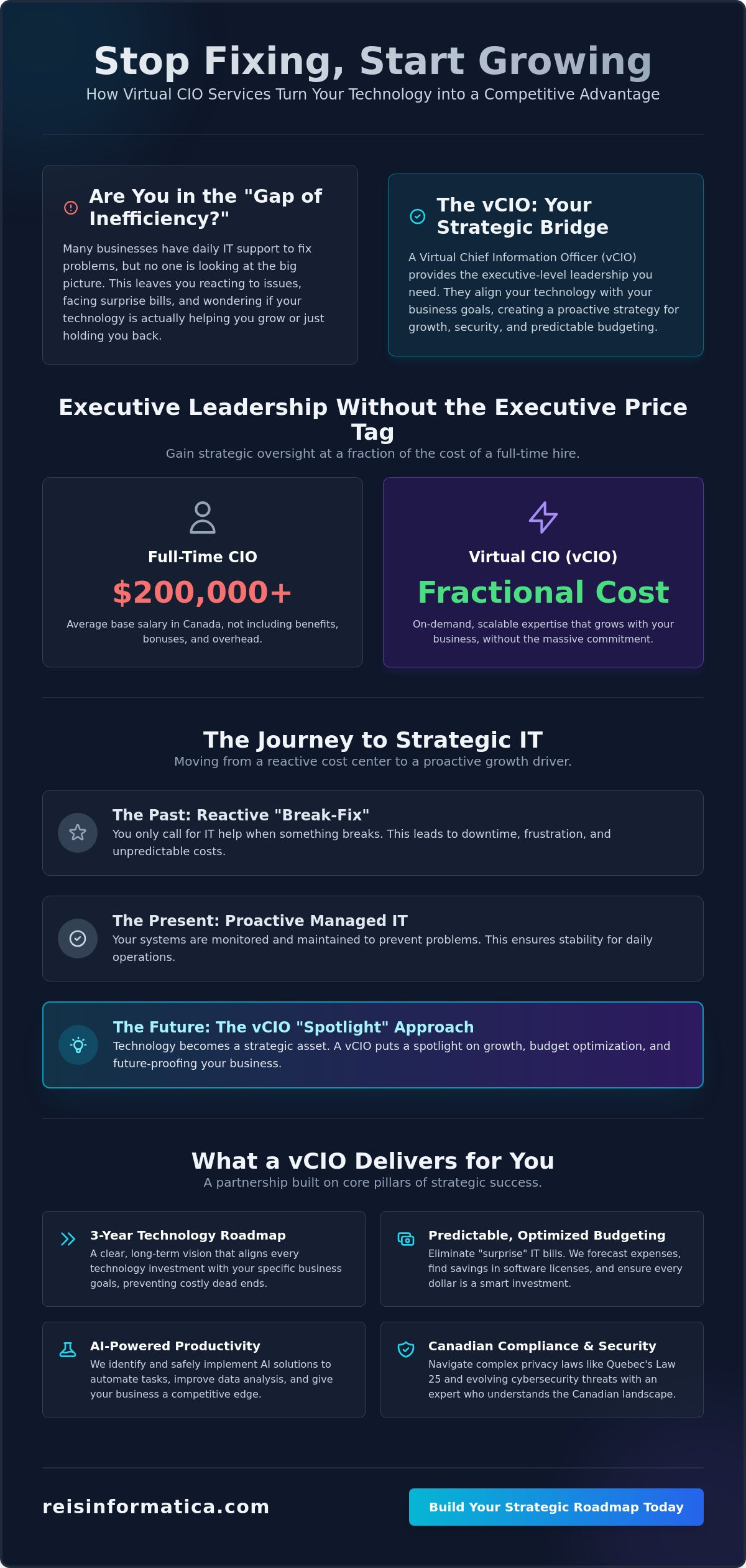
A Virtual CIO (vCIO) is a strategic partner who provides executive-level IT leadership on a fractional basis. Instead of just fixing broken hardware, they focus on how technology can help you reach your specific business goals. Many growing companies find themselves stuck in a “Gap of Inefficiency.” This happens when you have a team to handle daily support tickets, but no one is looking at the big picture. You have support, but you don’t have a vision. Virtual CIO services solve this by shifting your focus from reactive “break-fix” maintenance to proactive, growth-oriented management. Ultimately, a vCIO acts as the essential bridge between your business objectives and your technical execution.
vCIO vs. Traditional CIO: The Fractional Advantage
In Canada, hiring a full-time Chief Information Officer typically requires a base salary of $200,000 or more, not including benefits and bonuses. For many small and medium-sized businesses, this cost is a significant barrier to getting the leadership they need. The vCIO model offers a scalable alternative, providing on-demand expertise without the massive executive overhead. This strategic layer works in tandem with your Managed IT Services, ensuring that while your daily operations stay smooth, your long-term roadmap remains on track.
Signs Your Business Has Outgrown Basic IT Support
Does your IT feel like a “black box” where budget goes in but clear results never come out? If you’re unsure how your technology spend actually helps your bottom line, you’ve likely outgrown basic support. Common triggers for seeking fractional leadership include rapid company scaling or the sudden need to meet strict compliance requirements. You might also find that basic tools aren’t enough to stop modern threats, requiring more advanced cybersecurity services. When technology starts to feel like a bottleneck rather than a facilitator, it’s time for a more sophisticated approach.
The Core Pillars of a Strategic IT Roadmap
A technology roadmap isn’t just a list of upcoming purchases. It’s a comprehensive three-year vision that aligns your digital tools with your business goals. When you utilize virtual CIO services, your partner builds this plan by looking at the specific conditions of the Canadian market. They account for local economic shifts and the unique challenges of scaling a business in regions like Ontario or British Columbia. This strategic roadmap prevents technical debt from stalling business growth by ensuring every new tool integrates seamlessly with your existing systems instead of becoming a future bottleneck.
Budgeting is where the vCIO’s value becomes immediately visible. They work to eliminate “surprise” expenses by forecasting hardware lifecycles and software renewals years in advance. They also dive deep into your current software licensing to find overlaps or unused seats that drain your cash flow. Beyond the numbers, your vCIO acts as the single point of accountability for vendor management. You no longer have to spend hours on the phone with internet providers or software vendors; your vCIO handles those technical conversations, ensuring you get the service level you’re paying for.
Navigating the AI Revolution
Productivity is the new competitive frontier, and your roadmap must address it. A vCIO identifies specific areas where AI business solutions can automate repetitive tasks or improve data analysis. They act as a vigilant partner, vetting these tools for security and actual return on investment before they touch your network. This ensures you aren’t just following a trend, but adopting technology that truly drives revenue.
Risk Management and Compliance
Staying compliant in Canada is becoming more complex. With changes to federal privacy laws expected in 2026 and the strict requirements of Quebec’s Law 25, you need a leader who understands data sovereignty. Your vCIO ensures your data stays within Canadian borders when required and prepares your business for high-stakes audits. This planning serves as the foundation for your infrastructure services, creating a resilient environment that protects your reputation. If you’re ready to see how a customized plan can protect your operations, exploring strategic IT leadership is a great first step.
vCIO vs. Managed IT: Moving Beyond Reactive Support
Many business owners tell us, “I already have an IT guy.” While having a dependable technician is vital, there’s a significant difference between a technician and a strategist. A technician is the person you call when a server goes down or a password needs resetting. They’re focused on the “now.” In contrast, virtual CIO services focus on the “next.” They don’t just fix the problem; they analyze why the problem happened and how to prevent it from ever returning. It’s the difference between someone who keeps the lights on and someone who decides where to point the spotlight to grow your business.
The “Gold Standard” for Canadian SMBs is having both layers working together. Your managed IT team provides the foundational support that keeps your daily operations running smoothly. Meanwhile, your vCIO provides the leadership that ensures your technology investments actually drive revenue. If you’re curious about how the baseline support works, you can learn more about managed IT services to see how they form the bedrock of your business. This dual approach ensures you aren’t just spending money on IT; you’re investing in a competitive advantage.
The Strategic Quarterly Business Review (QBR)
One of the most valuable parts of this partnership is the Quarterly Business Review. This isn’t a meeting to discuss closed tickets or technical jargon. It’s a high-level boardroom discussion focused on metrics that matter to leadership. We look at your system uptime, the return on investment for recent projects, and specific ways to mitigate new risks. It’s a time to ensure your technology is still following the roadmap we built together, making adjustments as your business evolves.
Cloud Strategy and Scalability
As businesses in cities like Mississauga or Calgary embrace hybrid work, the role of the vCIO becomes even more critical. They guide your move to cloud services, ensuring your team can collaborate securely from anywhere. This isn’t just about picking a provider; it’s about business continuity planning. Your vCIO builds the disaster recovery strategies that keep your data safe, ensuring that even if the unexpected happens, your operations don’t skip a beat. If you want to stop worrying about tech and start focusing on your goals, it’s time to explore strategic IT leadership.
Choosing the Right vCIO Partner for Your Canadian Business
Selecting the right partner for virtual CIO services is about more than just checking technical boxes. You need a leader who understands the specific challenges of the Canadian business landscape. Whether your operations are based in Waterloo, London, or across Ontario, local expertise matters. A partner who knows the regional market can better anticipate the regulatory shifts and economic trends that impact your bottom line. At Reis Informatica, we take a professional and consultative approach. We act as a vigilant guardian of your operations, identifying potential risks and strategic opportunities long before they become urgent problems.
What to Look for in a vCIO Provider
A great vCIO needs more than just a deep knowledge of servers and code. They must possess strong business acumen and the empathy required to understand your unique organizational culture. You should look for a provider with a proven track record in high-stakes areas like cybersecurity and AI business solutions. When your IT partner understands your business goals as well as you do, they can recommend technology that actually solves problems instead of just adding complexity. This empathy leads to better outcomes because the solutions are tailored to how your team actually works.
Next Steps: From Chaos to Clarity
The transition from reactive IT to strategic leadership doesn’t happen overnight, but the path is clear. It starts with a comprehensive technology audit to find your strategic gaps. From there, your vCIO builds a customized roadmap that aligns with your three to five year goals. Finally, we move into the execution phase, where that plan becomes a reality. This process turns technology from a source of anxiety into a predictable driver of revenue. If you’re ready to move from technical chaos to strategic clarity, contact Reis Informatica for a strategic IT consultation today.
Transform Your Technology Into a Strategic Asset
Technology shouldn’t be a source of constant stress or an unpredictable drain on your budget. By leveraging virtual CIO services, you transition from a reactive “break-fix” cycle to a proactive, growth-focused strategy. We’ve discussed how a clear roadmap eliminates surprise costs and how fractional leadership provides executive-level insight without the massive overhead. It’s about making sure your tools work for you, not the other way around. When your technology aligns with your vision, your business can scale without the usual friction.
At Reis Informatica, we specialize in helping business leaders in Kitchener, Waterloo, Calgary, and beyond make sense of complex topics like AI Business Solutions and Cybersecurity. Our approach is tailored for leaders, focusing on business outcomes rather than technical jargon. We act as your vigilant partner to ensure your infrastructure remains secure and scalable as you grow. If you’re ready to stop guessing and start leading with a clear plan, Book Your Strategic IT Roadmap Consultation with Reis Informatica. You can build a more resilient and profitable future for your business today.
Frequently Asked Questions
How much do virtual CIO services typically cost for a mid-sized business?
The cost is a fractional investment compared to hiring a full-time executive. In Canada, a Chief Information Officer’s base salary often exceeds $200,000 plus benefits. Virtual CIO services provide that same level of strategic leadership for a much smaller monthly retainer. This model allows you to access high-level expertise that fits your budget, ensuring you only pay for the strategic guidance your company needs to grow.
Does a vCIO replace my current IT department or Managed IT provider?
No, a vCIO complements your existing technical support. Your managed IT team or internal department handles daily tasks like resetting passwords and fixing hardware. The vCIO focuses on the big picture, ensuring those daily activities align with your business goals. It’s a partnership where the support team keeps the lights on while the vCIO decides where to point the spotlight for the best return on investment.
How often does a vCIO meet with company leadership?
Most businesses find that a Strategic Quarterly Business Review (QBR) provides the perfect rhythm. These meetings focus on your technology roadmap, budget performance, and upcoming risks. However, your vCIO is also available for as-needed consultations when you’re making major decisions. Whether you’re planning an office move or considering a new software platform, they provide the leadership needed to ensure the project succeeds.
Can a vCIO help with industry-specific compliance like HIPAA or PIPEDA?
Yes, helping you navigate complex Canadian regulations is a core part of the role. A vCIO ensures your data management practices meet federal PIPEDA standards and provincial laws like Quebec’s Law 25. This oversight is critical as we approach 2026, when new federal privacy legislation is expected to introduce much higher fines for non-compliance. They help you build a secure framework that protects both your data and your reputation.
What is the first thing a vCIO does when they start working with a new company?
The process always begins with a comprehensive technology audit. This assessment goes beyond a simple inventory of your computers. It looks at your security posture, software licensing, and how well your current tools support your workflows. This deep dive identifies the “Gap of Inefficiency” in your current setup. Once the audit is complete, your vCIO uses that data to build a customized three-year roadmap that guides your future technology investments.