Your inbox is likely flooded with tech updates, but how much of it is just noise? Between endless gadget reviews and consumer-focused hype, it’s dangerously easy for your business to miss the information that truly matters-like a critical security patch or a cloud solution that could redefine your operational efficiency. This is precisely why a generic tech feed isn’t enough. Your organization requires a dedicated intelligence source, a strategic pc newsletter designed not for hobbyists, but for business leaders focused on security, productivity, and growth.
This article will show you exactly how to filter that clutter and secure the IT intelligence your business needs to stay competitive through 2026 and beyond. We’ll break down how a curated source can deliver proactive cybersecurity alerts, provide clear, actionable advice on leveraging new technologies for your specific business size, and help you build a strategic IT budget with confidence. It’s time to transform your technology updates from a daily distraction into your most powerful competitive advantage.
Key Takeaways
- Understand the critical difference between consumer tech hype and enterprise IT intelligence to avoid costly missteps in your technology strategy.
- Discover the core components of a high-impact pc newsletter, focusing on actionable cybersecurity alerts for Canadian businesses and crucial infrastructure insights.
- Implement a 4-step audit to eliminate low-value tech news and identify the specific information gaps in your company’s IT stack.
- Learn how a strategic IT partner transforms your information intake from a source of distraction into a competitive advantage, ensuring you are never caught by a ‘tech surprise’.
Beyond the Hype: Why Your Business Needs a Strategic PC Newsletter in 2026
In an era saturated with digital noise, the term ‘newsletter’ can feel outdated. However, while the history and evolution of newsletters spans centuries, its modern business application has never been more critical. For a Canadian Small to Medium-sized Enterprise (SME) in 2026, a strategic pc newsletter is not a marketing flyer; it is a curated intelligence feed. It delivers vital, actionable updates on endpoint security, infrastructure health, and productivity, empowering you to make decisions based on enterprise needs, not consumer hype.
As real-time AI integration and sophisticated cybersecurity threats become standard operational risks, the line between passive ‘Tech News’ and actionable ‘IT Intelligence’ has become a matter of business survival. The former tells you what is new; the latter tells you precisely what to do about it to protect your assets and maintain a competitive edge.
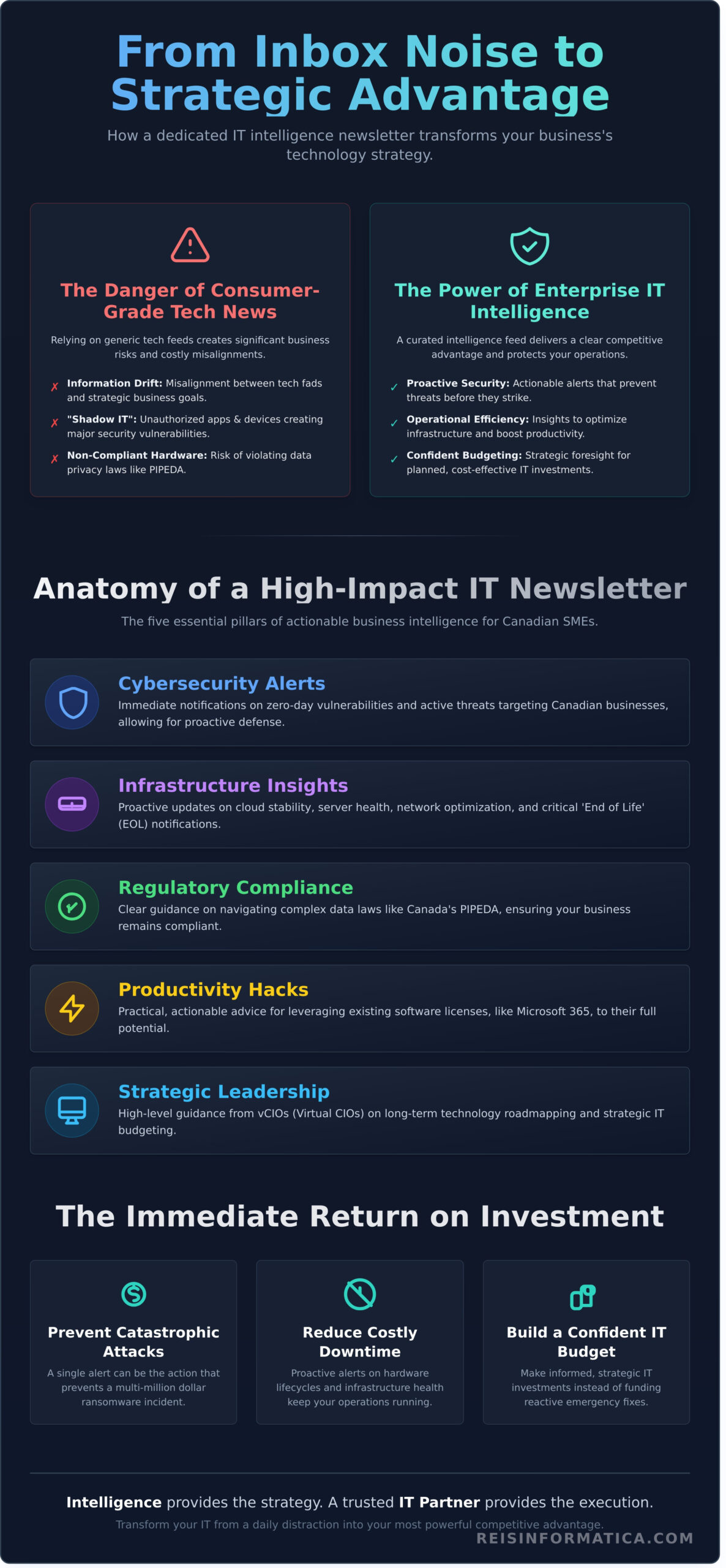
The Danger of Consumer-Grade Tech Advice
Following popular ‘best of’ lists often leads to procuring non-compliant hardware that can violate Canadian data privacy laws like PIPEDA. This reliance on unvetted advice also fuels ‘shadow IT’-the use of unauthorized apps and devices within your network, creating significant security vulnerabilities. Information Drift is the costly misalignment between popular technology consumption and strategic business goals.
The ROI of Staying Informed
The return on investment for curated intelligence is immediate and substantial. A five-minute weekly read that flags a critical software vulnerability can be the action that prevents a multi-million dollar ransomware attack. Our clients consistently reduce costly downtime by acting on proactive alerts about hardware lifecycles-a direct result of staying informed. A well-designed pc newsletter provides the strategy; expert managed IT services provide the ultimate execution to protect your operations and ensure peace of mind.
The Anatomy of a High-Impact Business IT Newsletter
A generic tech update clutters your inbox; a strategic IT newsletter empowers your business. The difference lies in its composition. A truly valuable pc newsletter moves beyond product announcements and focuses on delivering actionable intelligence that protects and optimizes your operations. It’s a direct line to the insights that ensure your technology infrastructure is a stable asset, not a source of risk.
An effective newsletter is built on five pillars of essential business information:
- Cybersecurity Alerts: Immediate notifications on zero-day vulnerabilities and threats specifically targeting Canadian businesses.
- Infrastructure Insights: Proactive updates on cloud stability, server maintenance schedules, and network optimization opportunities.
- Regulatory Compliance: Guidance on navigating data laws like Canada’s PIPEDA, especially for businesses handling sensitive information.
- Productivity Hacks: Practical advice for leveraging existing software licenses, such as Microsoft 365, to their full potential.
- Strategic Leadership: High-level guidance from vCIOs (Virtual Chief Information Officers) on long-term technology roadmapping.
Cybersecurity as a Primary Pillar
In today’s threat landscape, a newsletter must prioritize threat intelligence. Timely alerts allow your organization to be proactive rather than reactive. However, information without a clear action plan is just noise. This is where professional cybersecurity services become critical, translating a notification about a new vulnerability into a concrete defensive strategy. It’s equally important to distinguish credible threats from fear-mongering; we recommend you regularly audit your tech information diet to ensure your sources are reliable and relevant to your business context.
Cloud and Infrastructure Continuity
Your operations depend on the health of your digital infrastructure. A high-impact pc newsletter provides transparent updates on the performance of your cloud services, whether public, private, or hybrid. Furthermore, it offers strategic foresight, such as crucial ‘End of Life’ (EOL) notifications for systems like Windows Server. This advance warning allows for planned, orderly migrations that prevent security gaps and costly emergency upgrades, ensuring your business remains secure and efficient.
Consumer Tech vs. Enterprise Intelligence: Knowing the Difference
Not all technology news is created equal. A newsletter tailored for a consumer audience operates on a fundamentally different premise than one designed for enterprise decision-makers. For businesses, the distinction is critical. Consumer-focused content prioritizes the “what’s new and cool,” fueling excitement for the latest gadgets. In contrast, an enterprise-focused pc newsletter answers “what’s stable, secure, and scalable,” recognizing that technology is a strategic asset, not a hobby. This shift reflects the growing strategic importance of technology in business, where decisions impact the entire operational framework.
This difference is most apparent in how value is measured. Generic tech newsletters often create a “shiny object syndrome” in the workplace, where employees request the latest hardware seen in a review without considering its integration or security implications. A strategic IT partner focuses on Total Cost of Ownership (TCO), not just the Manufacturer’s Suggested Retail Price (MSRP). TCO accounts for the full lifecycle cost in Canadian dollars-including deployment, maintenance, security patching, and potential downtime-providing a realistic measure of an asset’s true business value.
Evaluating Information Sources
To cut through the noise, decision-makers must vet their information sources carefully. A high-value newsletter should be vendor-neutral, offering objective analysis rather than sponsored content, and have a clear B2B focus. While AI is powerful for curating news feeds, human expert oversight remains indispensable for providing strategic context. Today, topics like AI business solutions are standard, but their practical application requires an expert perspective that algorithms alone cannot provide.
The Shift from Hardware to ‘Service-First’ Thinking
Modern business technology discussions have evolved beyond physical specifications. A valuable pc newsletter now dedicates more space to SaaS (Software as a Service), IaaS (Infrastructure as a Service), and cybersecurity frameworks than to processor clock speeds. The focus is on outcomes and continuity, which is why Managed Services are a cornerstone topic. It’s about ensuring the systems that power your business are always available, secure, and efficient. As we often say: “Hardware is the vessel, but the service layer is the lifeblood of modern business continuity.”
How to Audit Your Tech Information Diet: A 4-Step Plan
In a world saturated with information, the quality of your inputs directly impacts the quality of your strategic decisions. A cluttered inbox filled with low-value updates is more than a distraction-it’s a business liability. Treating your information sources with the same scrutiny as a financial investment allows you to filter out noise and focus on insights that drive real-world results. This disciplined, four-step approach transforms your inbox from a chaotic feed into a strategic command centre.
Step 1: The Great Unsubscribe
Your inbox is one of your most valuable strategic assets; it’s time to protect it. Begin by aggressively filtering out “deal” newsletters that encourage impulsive, non-standardized tech spending. A C$100 discount on an unapproved laptop model can create thousands in support and security costs down the line. It’s also critical to distinguish between ‘Tech Enthusiast’ content (product reviews, gaming news) and ‘Business Decision’ content (cybersecurity trends, compliance updates). The former is a hobby; the latter protects your company.
Step 2: Identify Your Knowledge Gaps
With the noise gone, you can identify the gaps in your knowledge. Look at your core business operations-from finance and HR to sales and logistics. Where does technology play a critical role, and what do you know the least about? Are you blind to emerging cybersecurity threats targeting Canadian businesses? Do you have a clear picture of how AI could optimize your supply chain? Answering these questions highlights the specific knowledge you need to acquire.
Step 3: Prioritize Quality Over Quantity
Now, prioritize depth over frequency. Instead of subscribing to a dozen daily digests, select two or three high-signal, weekly or bi-weekly sources. A well-curated pc newsletter focused on business technology will deliver vetted analysis, not just breaking news. This ensures you spend less time reading and more time understanding the strategic implications for your organization.
Step 4: Implementing Insights with Your MSP
Information is only valuable when it leads to action. The final step is creating a simple, repeatable process to turn insights into operational improvements with your IT partner. This “Action Loop” ensures your strategy evolves proactively, not reactively.
- Forward Critical Alerts: When a newsletter highlights a new software vulnerability or phishing tactic, forward it directly to your managed IT team with a simple query: “Are we protected against this?” This single action reinforces a culture of shared vigilance.
- Fuel Your QBRs: Use newsletter topics as talking points for your Quarterly Business Reviews (QBRs). Discussing industry trends shows you are an engaged partner and helps your IT provider align their recommendations with forward-looking business goals.
- Evolve Your IT Strategy: The insights from your curated pc newsletter feed provide a roadmap for the future. Use them to ensure your IT strategy, from hardware procurement to cloud adoption, keeps pace with the evolving technology landscape, safeguarding your competitive edge.
Reis Informática: Your Partner in Proactive IT Intelligence
Staying informed through industry updates is a critical first step, but information without action is simply noise. A vulnerability alert or a notice about end-of-life software is useless until it’s addressed. This is where Reis Informática transcends the role of a service provider to become your vigilant strategic partner. We don’t just forward you the news; we translate it into a proactive defense for your business, ensuring you are never caught by a tech surprise.
Our Approach to Strategic Communication
Our team constantly monitors the complex IT landscape-from security bulletins to hardware advancements-so you don’t have to. We filter the overwhelming flow of technical data, curating what matters for your specific operations. Instead of you needing to decipher a dense pc newsletter, we provide clear, business-ready intelligence. Our communication is direct: we identify the risk, explain its potential impact on your business, and detail the precise steps we are taking to mitigate it. This is the essence of our role as your Vigilant Partner: we watch the horizon, so you can focus on yours.
Take the Next Step Toward IT Tranquility
The journey from information overload to operational intelligence is the bridge between reacting to problems and preventing them entirely. By partnering with Reis Informática, you move beyond passively reading about technology and into a state of active, managed security and efficiency. Let us handle the complexity of your IT infrastructure so you can dedicate your full attention to growth.
Technology should be an invisible, reliable asset that powers your business, not a constant source of concern. With our expert oversight, it can be.
Ready to transform your IT from a liability into a strategic advantage? Contact us today for a complimentary infrastructure audit and discover what true IT tranquility feels like.
From Information Overload to Strategic Advantage
In 2026, navigating the complexities of business technology requires more than just staying informed-it demands strategic intelligence. As we’ve explored, the difference between generic consumer tech hype and enterprise-focused insights is the gap between reactive problem-solving and proactive growth. Auditing your information diet and understanding the anatomy of a high-impact pc newsletter are the first steps toward building a resilient and competitive technology infrastructure for your Canadian business.
You don’t have to build this strategy alone. Reis Informática acts as your dedicated technology partner, translating complex IT developments into clear, actionable advantages. With our expert vCIO leadership, proactive 24/7 cybersecurity monitoring, and certified status as Microsoft and Cloud partners, we provide the clarity and security you need to focus on what matters most: your business.
Take the next step towards transforming your IT from a cost centre to a strategic asset. Schedule a Strategic IT Consultation with Reis Informática and let’s ensure your technology decisions today build a more profitable and secure tomorrow.
Frequently Asked Questions
What is the best tech newsletter for small business owners in 2026?
Predicting the single “best” newsletter is difficult, as the ideal source depends on your specific industry and needs. However, the most valuable newsletters for Canadian small businesses will offer a blend of strategic insights, cybersecurity alerts, and practical advice. Look for publications from reputable sources like IT World Canada or, for more tailored guidance, the newsletter from your Managed Services Provider (MSP), which can provide context specific to your operational reality.
How often should I be reading IT industry updates?
For most business owners, a weekly digest is the optimal frequency. This schedule allows you to stay informed about significant trends, security vulnerabilities, and new technologies without creating information overload. Your goal is to maintain strategic awareness for decision-making, not to track every minor development. Key team members in technical roles, however, may benefit from daily updates to manage immediate operational needs and threats effectively.
Can a PC newsletter help with PIPEDA or industry compliance?
While a general tech newsletter provides broad awareness, a specialized security-focused PC newsletter from an IT partner is a powerful tool for compliance. These publications offer timely alerts on new cyber threats and evolving regulatory requirements under Canadian laws like PIPEDA. They translate complex technical mandates into actionable business steps, helping you proactively adjust your security posture and maintain a strong compliance framework to protect sensitive client and company data.
What is the difference between a consumer tech blog and an MSP newsletter?
A consumer tech blog focuses on gadgets, software reviews, and news for individual enthusiasts. Its primary goal is often entertainment or informing personal purchasing decisions. In contrast, a newsletter from a Managed Services Provider (MSP) is a strategic business resource. It delivers actionable advice on cybersecurity, infrastructure efficiency, and productivity tools designed to protect company assets, reduce costs, and support your business objectives directly.
Should I allow my employees to subscribe to tech newsletters?
Yes, encouraging your team to subscribe to reputable tech newsletters is a highly effective and low-cost investment in their professional development. It promotes a culture of continuous learning and security awareness across the organization. Informed employees are better equipped to recognize potential phishing threats, identify opportunities for process improvement with new tools, and contribute to the overall technological resilience and innovation of your business.
How do I know if a tech news source is biased toward certain vendors?
A reliable tech source prioritizes objective analysis. Look for signs of bias, such as consistently favouring one brand without acknowledging competitors or failing to disclose sponsored content and affiliate partnerships. Trustworthy sources will compare multiple solutions, discuss both the advantages and disadvantages of each, and focus on solving a business problem rather than simply promoting a specific product. This ensures the advice serves your interests, not a vendor’s.
What are the ‘must-watch’ tech trends for Canadian businesses this year?
For Canadian businesses, the three dominant trends are practical AI integration, enhanced cybersecurity resilience, and cloud cost optimization. Companies are leveraging AI to automate routine tasks and improve data analysis for better decision-making. Simultaneously, a focus on robust cybersecurity is non-negotiable to defend against rising threats and ensure compliance with PIPEDA. Finally, businesses are actively managing cloud spending (FinOps) to maximize efficiency and return on investment from their digital infrastructure.