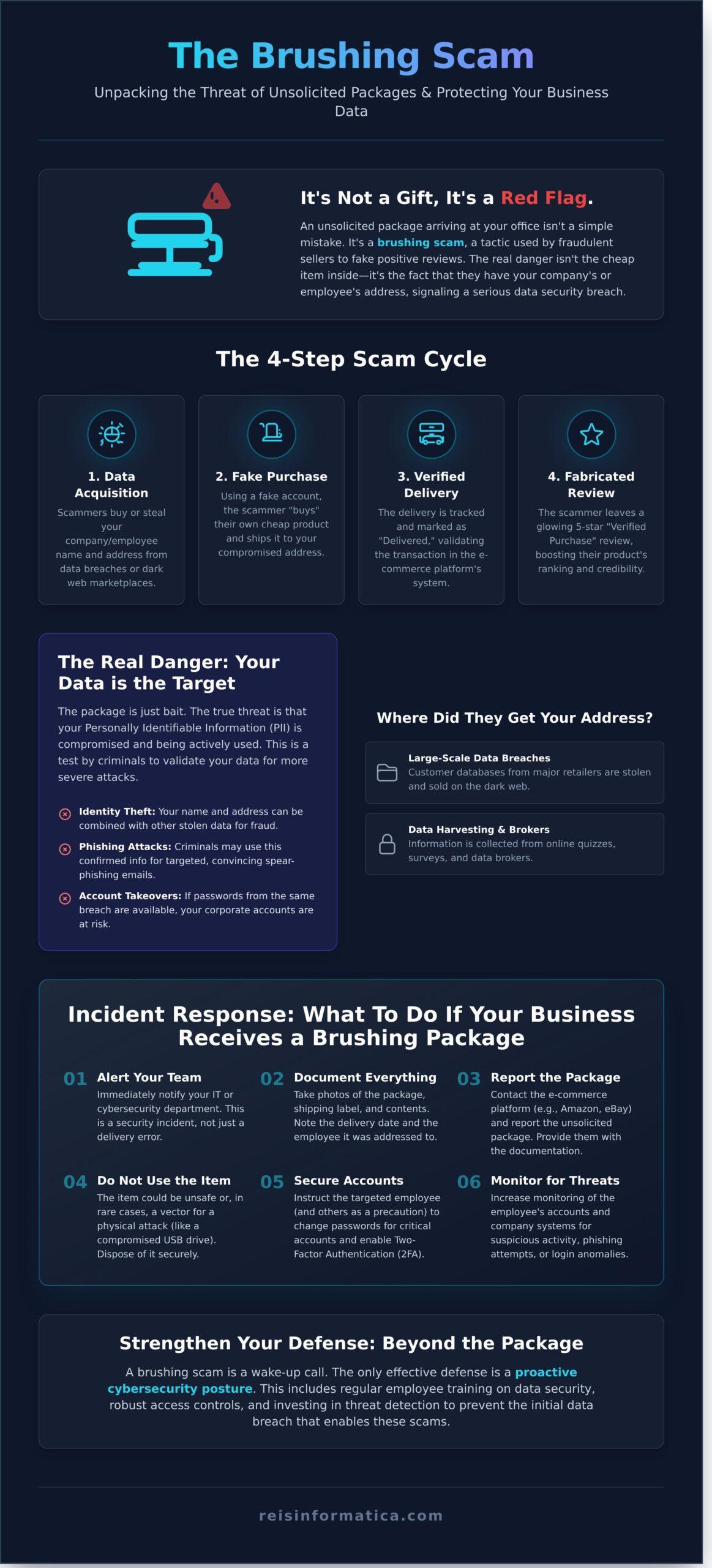
An unexpected package arrives at your office, addressed to an employee, but nobody ordered it. While it might seem like a harmless mistake or even a pleasant surprise, this ‘free’ item could be a critical warning sign that your company’s data has been compromised. This scenario is a classic example of a growing threat, and it’s essential for US business leaders to understand what is brushing scams. Far from a random act of kindness, this tactic is used by fraudulent online sellers to artificially boost their ratings-and the fact they have your address is the real cause for concern.
It’s a clear signal that your business or employee information is exposed and being exploited, creating anxiety around data breaches and potential liabilities. In this guide, we will demystify exactly how these scams work and explain why they are a major red flag for your data security. Most importantly, we will provide the exact steps and a clear checklist your business must take to stay safe, so you can eliminate the uncertainty and maintain complete peace of mind about your company’s data integrity.
Key Takeaways
Learn what is brushing scams and why receiving an unsolicited package at your office is a critical data security alert, not a simple mistake.
Discover the true purpose behind these scams: to exploit your company’s compromised information, which is a far greater risk than the package itself.
Get a clear, step-by-step protocol for your team to follow if a brushing package arrives, ensuring you document the incident for security analysis.
Understand why a proactive approach to cybersecurity is the only effective way to protect your business from the data breaches that enable these scams.
What is a Brushing Scam? The Hidden Truth Behind ‘Free’ Packages
Have you ever received a package you didn’t order? While your first thought might be a simple mistake or a surprise gift, it could be the first sign of a brushing scam. This deceptive technique is used by third-party sellers on major e-commerce platforms to artificially boost their product rankings and credibility. To understand what is brushing scams, you must look past the “free” item and see the data manipulation happening behind the scenes. The core of the scam, as detailed in resources like Wikipedia’s entry on the brushing e-commerce tactic, is not about the product you receive; it’s about exploiting your identity to create a fake, “verified” sale.
The psychology is simple: receiving something for free often lowers our security guard. We may feel confused but are unlikely to investigate a C$2 trinket. Scammers rely on this indifference to operate undetected. Despite platform crackdowns, this remains a significant issue in 2026 because of the constant availability of leaked personal data and the immense value that high product ratings hold in a competitive digital marketplace.
How the Scam Works: Step-by-Step
The process is methodical and designed to trick marketplace algorithms that prioritize verified purchases. Here’s a breakdown of the typical lifecycle of a brushing scam:
Data Acquisition: Scammers first obtain your name and shipping address. This information is often purchased in bulk from data brokers or harvested from previous data breaches.
The Fake Purchase: Using a fake buyer account they control, the scammer “purchases” their own product and has it shipped to your address.
Verified Delivery: The shipment generates a legitimate tracking number. Once the courier service marks the package as delivered, the transaction is validated in the e-commerce system.
The Fabricated Review: The scammer then logs into their fake buyer account and leaves a glowing, five-star review for the product, which now appears with the powerful “Verified Purchase” badge.
Common Items Sent in Brushing Scams
The actual item sent is always inexpensive and lightweight to minimize shipping costs. The product itself is irrelevant-it’s merely a prop to legitimize the transaction. Common items include plastic trinkets, cheap jewelry, phone accessories, or even packets of seeds. By 2026, we’ve seen a trend toward sending items that look high-tech but are non-functional, such as fake smartwatches or USB drives with no memory. This evolution preys on the recipient’s curiosity, making the delivery seem slightly more legitimate while costing the scammer just a few dollars.
The Real Danger: Why Your Personal Data is the Actual Target
Receiving an unsolicited package can feel strange, but the item itself-whether it’s a pair of sunglasses or a phone charger-is not the real threat. The package is merely a symptom of a much deeper problem: your business or personal data has been compromised. Understanding what is brushing scams involves looking past the physical item and recognizing it as a clear signal that your information is in the hands of unknown entities. This is why authorities take the issue seriously; the United States Postal Inspection Service provides an official guide on What to Do if Your Business Receives a Brushing Package, highlighting that the core issue is the illegal use of your data.
The fact that a scammer has your name and address means your Personally Identifiable Information (PII) is ‘in the wild.’ This data is a valuable commodity for cybercriminals, who can use it for far more than just sending a trivial package. It’s a test, a validation that your data is accurate and can be used for more severe forms of identity theft or fraud down the line.
Where Did They Get My Address?
Your information likely came from one of several sources. Large-scale data breaches at major retailers are a primary culprit, where customer databases are stolen and sold on the dark web. Another common method is data harvesting through seemingly harmless online activities, like ‘free’ quizzes or surveys that ask for your details in exchange for a result. Once obtained, your information is often bundled with millions of other records and sold and resold within vast scammer networks, making it difficult to trace the original leak.
Is My Credit Card at Risk?
In most brushing scams, you are not directly charged for the item. The scammer typically uses a separate, often stolen, credit card or a fake account to make the purchase. However, this doesn’t mean your financial data is safe. If a criminal has your name and address, they may also have your email or old passwords from the same data breach. This can lead to more dangerous attacks like ‘credential stuffing,’ where they use your leaked credentials to try and access more valuable accounts, such as your banking, email, or primary business software. The brushing package acts as a warning sign of this potential for a full account takeover.
Why Brushing Scams are a Corporate Security Warning
When an unexpected package arrives at your office, addressed to an employee who never ordered it, it’s easy to dismiss it as a simple mistake. However, for a business, this is more than a strange delivery; it’s a security alert. While many articles explain what is brushing scams from a consumer perspective, the corporate implications are far more serious. These incidents cleverly bypass your digital defenses-like firewalls and email filters-by arriving as a physical object at your front door.
The real danger isn’t the low-quality product inside the box. The package is proof that an employee’s professional data, including their name and your office address, has been compromised. This could stem from a breach in a third-party service or, more alarmingly, a leak within your own corporate systems. The risk escalates with ‘malicious inserts.’ Imagine the package contains a seemingly free USB drive or phone charger. An unsuspecting employee plugging it into a company computer could introduce malware, ransomware, or spyware directly into your secure network.
The Threat to Business Reputation
Beyond the immediate data risk, brushing can tarnish your company’s image. If your business name is used to post fake five-star reviews for questionable products, it creates a misleading and unprofessional association. It also raises internal questions about data security. A proactive approach involves regular audits to identify and minimize data exposure, a core component of our cybersecurity services that helps protect both your employees and your brand integrity.
Data Privacy Compliance (CCPA/GDPR) Implications
A brushing incident is a tangible sign of a data leak. As noted in the official guidance on brushing scams, the primary concern is that personal information has been exposed. For businesses in Canada dealing with international clients, this can trigger serious compliance issues under regulations like GDPR. Your IT department must treat these events not as junk mail but as potential data breach indicators that require investigation. These incidents often highlight unseen vulnerabilities, revealing critical gaps in your IT infrastructure management that need to be addressed immediately to prevent a more significant breach.
What to Do if Your Business Receives a Brushing Package
Discovering an unsolicited package at your office can be confusing, but it’s a security signal that requires a calm, methodical response. While the item itself is often harmless, the incident indicates that your business’s data has been compromised. Here’s a clear action plan to protect your company.
First, take these immediate steps:
Stay Calm: In Canada, you have no legal obligation to pay for or return unsolicited goods. You can legally keep, discard, or donate the item.
Document Everything: Do not discard the packaging right away. Take photos of the shipping label, tracking numbers, and sender’s information. This is valuable data for your IT security log and any subsequent reports.
Change Passwords Immediately: Treat this as a data breach. The scammer likely has your name, business address, and potentially an associated email or account. Immediately update the passwords for your primary business accounts, especially on e-commerce platforms like Amazon or Shopify.
Understanding what is brushing scams is about recognizing them not as a random delivery, but as a symptom of a data leak. Your next steps are crucial for containing the potential damage.
Reporting to the Platforms
Notify the marketplace where the seller operates. Go to the customer service or help section of the retailer’s website (like Amazon, eBay, or Walmart) and search for how to “report an unsolicited package.” Provide them with all the documented information. If a fake review appears under your name, follow the platform’s process to report it as fraudulent. Reporting helps these platforms identify and remove bad actors, protecting the entire business community.
The ‘Never Plug It In’ Rule
If the unsolicited item is an electronic device-especially a USB drive, a ‘smart’ charger, or any IoT gadget-the risk escalates dramatically. Never connect it to any company computer or network. These devices can be loaded with malware, ransomware, or hardware keyloggers designed to steal credentials and financial data. Treat these items as hazardous e-waste for your network and dispose of them safely without ever connecting them to a power source or data port.
Ultimately, a brushing package is a clear warning sign. It confirms your information is available to cybercriminals. This is why professional identity and credit monitoring is a wise investment for any Canadian business, providing an essential layer of defense. For a comprehensive review of your company’s security posture, contact the experts at Reis Informática.
Strengthening Your Defense: Beyond the Brushing Scam
A brushing scam might seem like a strange but harmless event. However, it’s often the first visible sign that your business or personal data has been compromised. In today’s complex digital environment, simply reacting to threats as they appear is no longer a viable strategy for Canadian businesses. A proactive defense, built on a foundation of professional cybersecurity services, is the only way to stay ahead.
Understanding what is brushing scams is the first step, but preventing the underlying data leak is the real goal. Cybercriminals are constantly evolving their methods. The businesses that thrive will be those that move from a reactive “break-fix” model to a proactive, predictive security posture. This involves identifying vulnerabilities before they can be exploited by a managed IT provider who can spot data leaks before the first unsolicited package ever arrives.
Implementing Proactive Monitoring
A modern defensive strategy means having eyes on your digital assets 24/7. Key components include:
Dark Web Monitoring: We actively scan hidden corners of the internet where stolen data is bought and sold. This allows us to detect a breach the moment your information appears, giving you a critical head start to secure your accounts.
Multi-Factor Authentication (MFA): Think of MFA as a digital deadbolt. Even if a criminal steals a password, they can’t access your account without the second verification step from your device. It is the ultimate shield against account takeover.
This constant vigilance is a core component of how our managed IT services protect your operations around the clock, creating a culture of security awareness from the ground up.
The Reis Informática Approach to Business Safety
At Reis Informática, we believe that technology should provide peace of mind, not create more problems. We go beyond simply fixing IT issues; we act as your vigilant partner, safeguarding your business’s continuity. Our custom security audits are designed to uncover the hidden cracks in your digital foundation where data might be leaking-the very source of issues like brushing scams.
Stop waiting for unexpected packages to signal a problem. Let’s secure your data from the inside out. Contact us for a comprehensive security review and build a resilient defense for your business.
Your Proactive Defense Against Brushing Scams and Beyond
Ultimately, a brushing scam is more than an unsolicited package-it’s a clear signal that your business’s data has been compromised. The most important takeaway is that these deliveries are symptoms of a much larger data security vulnerability. Understanding what is brushing scams is the first step, but recognizing them as a warning sign is the critical insight that allows you to protect your company from more sophisticated threats down the road.
Don’t wait for a random box to expose a critical gap in your security. A proactive strategy is the only way to ensure your operations remain secure and uninterrupted. At Reis Informática, we provide the peace of mind you need to focus on your business, acting as your vigilant technology partner. With our Expert Managed IT Support and Proactive Cybersecurity Monitoring, we safeguard your digital assets against today’s evolving threats.
The package itself is typically not dangerous, but the scam is a serious red flag for your data security. The true risk is what it reveals: your personal or business name and address have been exposed and are being used by unknown third parties. This indicates your information was likely compromised in a data breach. It’s a critical alert to review your account security and be vigilant for other signs of fraudulent activity.
Do I have to pay for items I didn’t order?
Absolutely not. Under Canadian consumer protection laws, you have no legal obligation to pay for unsolicited goods delivered to you. The Federal Trade Commission (FTC) rules, which are mirrored by provincial regulations in Canada, state that you can legally consider such items an unconditional gift. The sender cannot demand payment or bill you, so you can dismiss any financial concerns and focus on the security implications of the event.
Should I return the package to the sender?
We advise against returning the package. The return address provided is often fake or belongs to an uninvolved fulfillment centre, making the effort futile. Attempting a return will not resolve the underlying data security issue and may even cost you time and money for shipping. The most effective course of action is to report the incident to the relevant e-commerce platform and then dispose of the item as you see fit.
Can a brushing scam lead to identity theft?
While a brushing scam is not direct identity theft, it is a significant warning that your data is compromised. The fact that scammers have your name and address means they may have acquired more sensitive information from the same source. This event should prompt you to be extra vigilant. We recommend monitoring your financial statements, checking your credit report, and updating passwords on key accounts to proactively guard against potential identity fraud.
What should I do with the seeds or items I received?
If you receive unsolicited seeds, do not plant them under any circumstances. They could be invasive species that are harmful to Canada’s local ecosystem. You should report them to the Canadian Food Inspection Agency (CFIA) and follow their specific disposal instructions. For other common, low-value items, you are legally entitled to keep, donate, or safely discard them. Prioritize safety and environmental responsibility over the unsolicited item.
How do scammers get my name and address?
Scammers typically acquire your information from a data breach. When a website or service you use is hacked, personal details like names, emails, and shipping addresses are often stolen and sold on the dark web. Scammers then purchase these lists to execute their schemes. In other cases, your information may have been scraped from public records or social media profiles. It’s a reminder of how crucial strong, unique passwords are for every online account.
Is my Amazon or eBay account hacked if I get a brushing package?
Not necessarily. In most cases of what is brushing scams, the seller uses your name and address to create a completely new, fake account to “purchase” the item and leave a verified review. Your actual account is likely secure. However, you should treat this as a security warning. It’s the perfect opportunity to log in to your e-commerce accounts, change your password, and enable two-factor authentication (2FA) for an added layer of protection.
Can I keep the items sent in a brushing scam?
Yes, you can. In Canada, provincial consumer protection laws treat unsolicited goods received by mail as an unconditional gift. You are under no obligation to pay for the item, return it, or even store it. Once you have reported the incident to the appropriate marketplace (like Amazon or eBay) and taken steps to secure your online accounts, you are free to keep, donate, or dispose of the item as you wish without any legal repercussions.