
What if the technology meant to support your mission is actually the biggest hurdle standing in its way? It is a common frustration for local leaders who want to focus on their community but find themselves trapped by aging hardware and the constant fear of a data breach. You likely agree that every dollar spent on fixing a crashed server is a dollar taken away from your core cause. Finding reliable non-profit IT services in Halifax shouldn’t feel like a luxury reserved for large corporations, especially when donor trust and operational continuity are on the line.
This strategic guide will show you how to leverage professional IT support to protect your sensitive data, stabilize your monthly costs, and empower your staff. We will walk you through the July 2026 Microsoft pricing updates, the upcoming FOIPOP Act changes, and how to use modern tools to maximize your impact without needing a degree in computer science. You can finally stop worrying about the technical “what-ifs” and get back to the work that truly matters for our city.
Key Takeaways
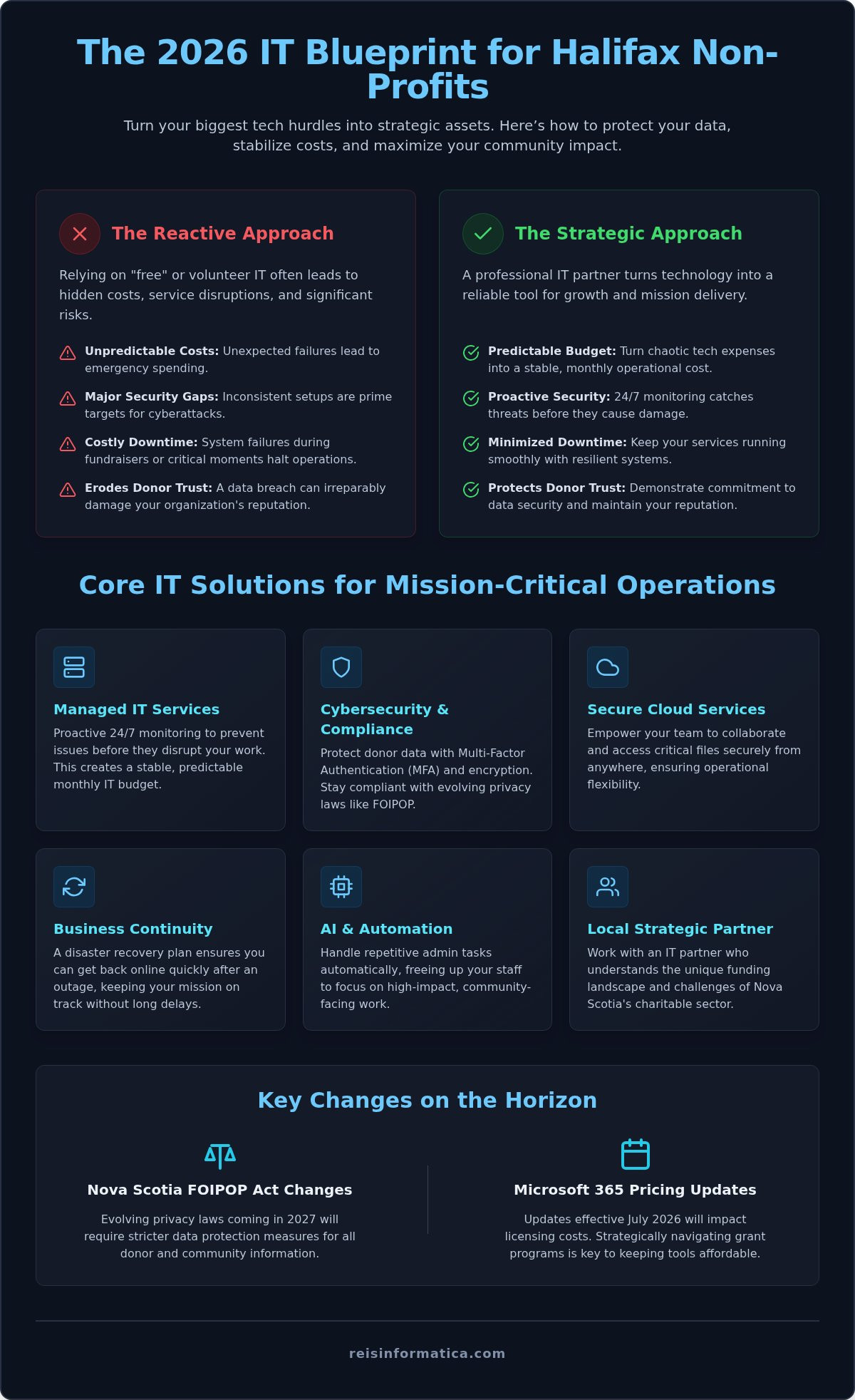
- Learn how managed non-profit IT services Halifax can turn unpredictable tech expenses into a stable, monthly budget that protects your organization’s bottom line.
- Understand the critical steps to safeguard donor data and maintain compliance with Nova Scotia’s evolving privacy laws coming in 2027.
- Discover how to navigate complex licensing and grant programs, including the July 2026 Microsoft 365 updates, to ensure your team has the best tools at the lowest cost.
- Identify how AI and automation can handle repetitive administrative tasks, allowing your staff to focus entirely on community impact rather than technical troubleshooting.
- Find out what to look for in a strategic local partner who understands the unique challenges and funding landscape of the Nova Scotian charitable sector.
What are Non-Profit IT Services in Halifax?
When we talk about non-profit IT services Halifax, we are describing a specialized branch of technology management designed to align with the unique financial and regulatory constraints of the charitable sector. This approach ensures that every technological decision supports the organization’s social goals rather than draining limited resources. In 2026, specialized IT services serve as the mission-critical foundation that allows Halifax charities to scale their impact while keeping operational risks at zero.
Local organizations face distinct hurdles, such as ensuring data residency within Canadian borders to satisfy provincial privacy standards and navigating regional grant applications. Securing reliable non-profit IT services Halifax allows your leadership team to move from a state of constant “firefighting” to one of strategic growth. This shift is part of a broader trend in Nonprofit technology where digital tools are treated as strategic assets rather than unavoidable expenses. By moving to managed IT services, teams can stop worrying about sudden hardware failures.
Why ‘Cheap’ IT Often Costs More for Charities
It is tempting to rely on a tech-savvy volunteer or a board member’s relative to manage your servers. While well-intentioned, this “free” help often leads to inconsistent documentation and major security gaps. When a critical system fails during a major fundraising gala, the cost of downtime far exceeds the price of professional support. Outdated systems don’t just slow down your staff; they can halt service delivery entirely, leaving the community you serve at risk.
Protecting Donor Trust in the Digital Age
Donors trust you with their personal information and financial details. Because non-profits often have smaller security budgets, they have become prime targets for cyberattacks in recent years. Protecting this trust requires more than just software; it involves building a “human firewall” through regular staff training. Simple protocols, like multi-factor authentication and encryption, are essential cybersecurity services that keep your organization’s reputation intact while meeting the requirements of the upcoming Nova Scotia FOIPOP Act changes.
Core IT Solutions for Halifax Non-Profits in 2026
Building a resilient operation in 2026 requires more than just a helpdesk. It involves a suite of tools that work silently in the background to ensure your team remains productive. Effective non-profit IT services Halifax prioritize managed IT, which means your systems are monitored 24/7. This proactive stance catches a failing hard drive or a suspicious login attempt before it disrupts your morning staff meeting or halts a fundraiser.
Security is the next layer of this foundation. By implementing multi-factor authentication (MFA) and end-to-end encryption, you protect your organization’s reputation from the fallout of a data breach. As you look to scale your outreach, you might also strategically integrate artificial intelligence to streamline your administrative tasks. Cloud services empower non-profit teams to access critical documents and collaborate securely from any location across Nova Scotia, whether they are in the office or working from home.
Secure Data Management and Compliance
Managing donor information means staying compliant with federal PIPEDA standards. You can integrate cybersecurity services directly into your daily workflow without making things harder for your team. It is about setting up guardrails that stay invisible until they are needed. For a better understanding of how these frameworks look in practice, see our guide on IT risk assessment services in London ON for similar framework ideas.
Business Continuity: Planning for the Unexpected
Halifax charities often operate on thin margins, making a disaster recovery plan a necessity rather than an option. If a local power outage or a server failure hits, you need to know exactly how quickly you can get back online. You can learn how to implement disaster recovery services for your foundation to ensure your mission never pauses for long. If you’re unsure where your current gaps are, reaching out for a professional IT strategy review can provide the clarity you need to move forward with confidence.
How to Choose the Right Halifax IT Partner
Selecting the right provider for non-profit IT services Halifax requires looking beyond a standard directory listing. You need a partner who understands that your budget is tied to specific grant cycles and donor expectations. Start by verifying their experience with non-profit licensing programs like TechSoup. This knowledge is essential for navigating the July 2026 Microsoft pricing updates and can save your organization thousands in annual software costs.
Staff comfort is equally vital for operational success. Prioritize providers that offer a friendly, non-technical helpdesk. If your team hesitates to call support because they feel overwhelmed by jargon, your systems will eventually suffer from neglected updates. A true partner also provides strategic leadership, often called a Virtual CIO (vCIO), to help you plan multi-year budgets. Finally, ensure they have a local presence in Halifax. Remote support is efficient, but certain hardware issues require a technician to walk through your doors. This strategic guide to IT support provides a solid framework for these vetting steps.
Budgeting for IT: Beyond the Monthly Fee
Many charities struggle with “surprise” repair bills that wreck their annual planning. A fixed-fee model through managed IT services provides the predictability you need. Instead of paying for every hour a technician spends fixing a problem, you pay for the outcome of a stable and secure environment. This approach allows you to maximize your technology spend and allocate more funds directly to your community programs.
Questions to Ask a Potential IT Provider
Before signing a contract, ask these two critical questions to ensure a good fit:
- Do you have direct experience with non-profit specific software and donor databases?
- How do you handle security protocols and data access for volunteers who use their own personal devices?
If you are ready to secure a partner who understands the local charitable landscape and the technical requirements of the sector, contact our Halifax team today to discuss your 2026 strategy.
Maximizing Impact with AI and Modern Strategy
By mid-2026, the gap between traditional charities and tech-forward organizations has widened significantly. Approximately 25% of Canadian non-profits have now started using AI and automation tools to handle repetitive administrative tasks. This shift allows small teams to achieve more without increasing their headcount. When you implement non-profit IT services Halifax that include modern automation, your staff can trade hours of manual data entry for direct community engagement.
Data analytics also plays a vital role in modern fundraising strategy. Currently, only 44% of Canadian charities use data to inform their decision-making processes. This leaves a massive opportunity for your organization to better understand donor behavior and improve outreach efficiency. Implementing AI business solutions can simplify complex non-profit reporting by automatically gathering impact metrics and financial data into clear, board-ready documents.
Technology should never be an afterthought. Creating a 3-year technology roadmap ensures that your hardware and software grow alongside your organization. This long-term planning prevents the sudden, unbudgeted expenses that often derail charitable projects. It is about building a scalable environment where your tools support your mission rather than limiting it.
The Role of Strategic IT Leadership
Most Halifax non-profits don’t have the budget for a full-time IT Director, but they still need high-level guidance. A fractional or virtual CIO (vCIO) fills this gap by providing executive-level strategy at a fraction of the cost. They help you navigate complex decisions, from choosing the right donor management system to ensuring your underlying infrastructure is sound. For a look at the basics of a stable setup, explore our Managed Network Services guide for infrastructure fundamentals. If your organization is also expanding its physical footprint, our guide on network design for a new office location in London ON covers the cabling standards and hardware planning needed to ensure a seamless launch from day one.
Next Steps for Halifax Non-Profit Leaders
The best way to start your digital transformation is with a comprehensive security audit. This process identifies immediate risks to your donor data and highlights where your current systems might be failing you. Reis Informatica is committed to supporting the Halifax community through specialized tech partnerships that prioritize mission impact over technical jargon. By securing a reliable partner for non-profit IT services Halifax, you can finally focus on your core mission with the peace of mind that your operations are under expert management.
Securing Your Organization’s Impact for 2026 and Beyond
Technology doesn’t have to be a source of stress or a constant drain on your organization’s limited budget. By shifting to a proactive management model, you can stabilize your monthly expenses and ensure your team has the reliable tools they need to serve the community effectively. Protecting donor trust through strict adherence to Canadian privacy standards is no longer optional; it is a critical part of your operational integrity. As you look toward the future, these digital foundations will determine how effectively you can scale your mission.
Choosing the right partner for non-profit IT services Halifax means finding a team that understands the local landscape and the specific requirements of charitable grants. Our Halifax-based support team focuses on proactive security and strategic leadership to keep your mission moving forward without technical interruptions. We bring the deep expertise in Canadian non-profit compliance that your leadership team needs to feel secure and focused.
Book a friendly IT consultation for your Halifax non-profit today to see how we can help you navigate the complexities of modern technology. You have the vision to change lives in our city; let us provide the technical foundation to make it happen.
Frequently Asked Questions
Are there special IT discounts available for Halifax non-profits?
Yes, Canadian registered charities can access significant savings through global programs like TechSoup and specific Microsoft grants. As of July 2026, eligible organizations can receive Microsoft 365 Business Basic for free for up to 300 users. Leveraging these non-profit IT services Halifax allows your team to access professional-grade tools while keeping your overhead costs as low as possible.
How do managed IT services help with non-profit grant applications?
Managed IT services provide the professional documentation and security standards that many grant providers now require as a prerequisite for funding. When you apply for provincial or federal grants, having a verified business continuity plan and active cybersecurity monitoring proves your organization is a responsible steward of donor funds. This technical readiness often makes your application more competitive in a crowded field.
Is our small non-profit really a target for cybercriminals in 2026?
Small organizations are frequently targeted because cybercriminals view them as “soft targets” that hold valuable donor financial records but lack corporate-level defenses. These attackers use automated tools to find vulnerabilities in outdated hardware or unpatched software. Securing professional non-profit IT services Halifax ensures you have the necessary encryption and multi-factor authentication to protect your reputation and your donors’ sensitive information.
Can an IT provider help us manage our remote volunteers securely?
Yes, an IT provider can implement secure cloud solutions that allow your volunteers to work from their own devices without putting your core network at risk. By using secure access gateways and mobile device management, you can control exactly who has access to specific files. This setup allows your volunteers to contribute from anywhere in Nova Scotia while you maintain complete oversight of your digital assets.
What is the difference between a helpdesk and a strategic IT partner for a charity?
A helpdesk is a reactive service that only fixes a computer or a password when it stops working. A strategic IT partner acts as a Virtual CIO to help you plan long-term technology roadmaps and multi-year budgets. They focus on preventing technical issues before they disrupt your staff, ensuring your technology remains a silent and efficient facilitator for your mission rather than a constant distraction.