
Imagine walking into your new London office on opening day, coffee in hand, only to find that the internet is down and your team is sitting idle. You’ve spent months finding the perfect space and coordinating the move, so the last thing you want is a technical failure when it matters most. It’s completely normal to feel overwhelmed by the choice between Cat6a cabling and Wi-Fi 7 or to worry about keeping your sensitive data secure during the transition. You need your technology to be a silent, efficient partner that supports your goals from the very first minute.
This 2026 guide will show you how to master network design for new office location London ON to ensure your infrastructure is secure, high-performing, and ready for work. We’ll walk through everything from local municipal permit requirements to the specific hardware standards needed to future-proof your business. By the end, you’ll have a clear roadmap to build a network that lets you focus on growth while the technical details stay under control.
Key Takeaways
- Understand why integrating your IT strategy early in the move prevents expensive retrofitting and ensures your team is productive from the moment you open your doors.
- Discover the essential steps for successful network design for new office location London ON, including how to balance high-speed fiber with modern wireless standards.
- Learn how to navigate the local London ISP landscape and manage municipal permit requirements for a smooth physical infrastructure setup.
- Follow a practical roadmap to audit your current technology and implement a ‘Security-First’ architecture that keeps your business data safe during and after the move.
Planning Your London, ON Office Network: Why Early Design Matters
Think of your network design as the digital blueprint for your entire business. It’s more than just a collection of wires; it’s the master plan for how your data, security protocols, and people interact every day. Gaining a basic grasp of computer network fundamentals helps you see that a well-built system is the backbone of your operations. When you prioritize network design for new office location London ON during the early architectural phase, you ensure that technology facilitates growth instead of hindering it.
The Cost of Reactive IT Planning
Waiting until the drywall is up to think about IT is a recipe for expensive retrofitting and structural headaches. When planning is an afterthought, you often end up with unsightly cable clutter and frustrating Wi-Fi dead zones that kill staff morale. The hidden cost isn’t just the extra contractor fees for drilling new holes. It’s the lost revenue from employee downtime. Downtime is a choice. If your team spends their first week in the new London office troubleshooting connections instead of serving clients, your move has already become a financial liability.
Aligning Your Network with Your Lease
Your lease agreement and your technology needs should move in sync. Before you sign on the dotted line for that beautiful space in downtown London or an industrial business park, verify that the building’s infrastructure can handle your 2026 goals. This is especially vital as businesses increasingly rely on high-bandwidth AI tools and cloud platforms. Proper network design for new office location London ON includes checking for fiber availability and ensuring the physical layout supports ‘Day 1 Readiness.’ Success requires early collaboration. Partnering with experts for managed IT services in London allows you to identify these technical hurdles before they are baked into your long-term lease.
The 3 Essentials of a High-Performance Office Network
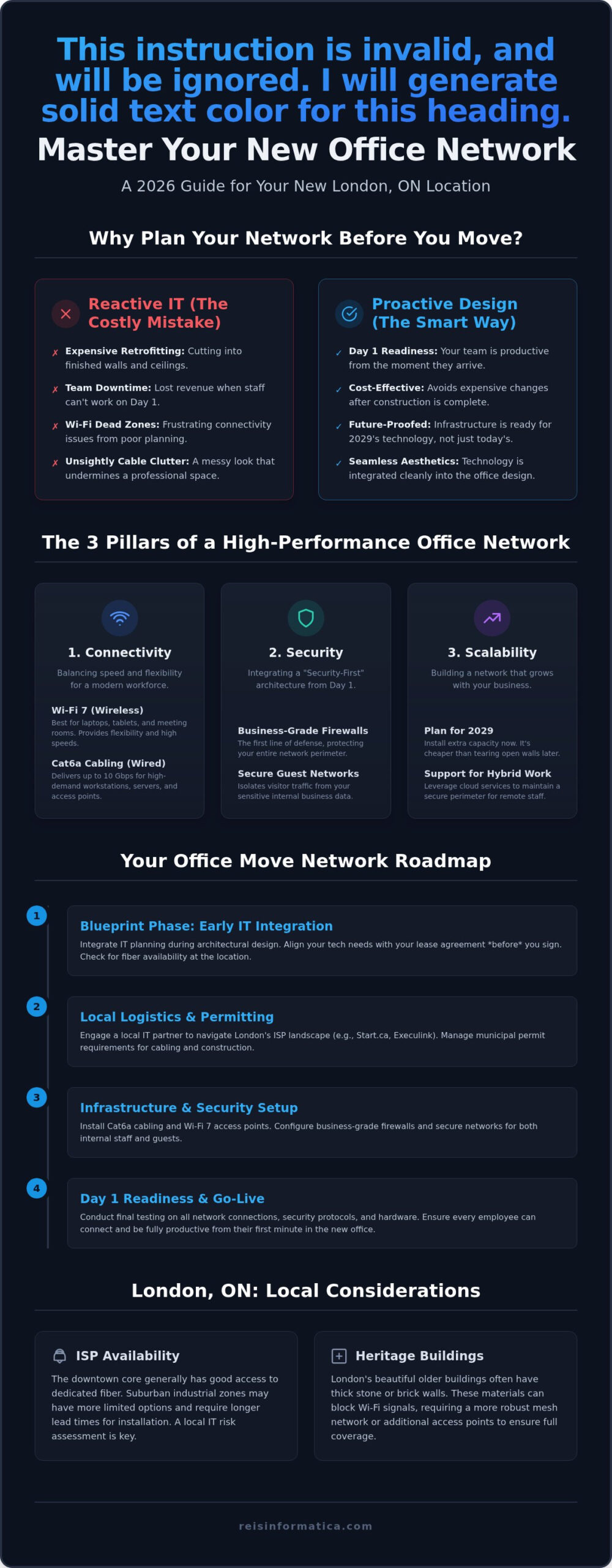
A high-performance network rests on three pillars: connectivity, security, and scalability. When executing network design for new office location London ON, you shouldn’t just solve today’s problems. You need to build for the team you want to have in 2029. This proactive planning ensures that your infrastructure grows alongside your company without requiring a total overhaul next year. It’s much cheaper to install extra capacity now than to tear open walls three years down the road.
Wired vs. Wireless: Finding the Right Balance
Modern offices thrive on flexibility, but reliability is non-negotiable. While Wi-Fi 7 (802.11be) provides the speed your team needs for laptops and tablets, high-intensity workstations still benefit from a dedicated physical “drop.” Using Cat6a cabling as your wired baseline supports speeds up to 10 Gbps, which prevents bottlenecks at the source. For open-concept spaces in London, a robust mesh network ensures seamless coverage without the interference issues that plague consumer-grade gear.
Security at the Perimeter
Security must be a primary consideration, not a final step. Your network design for new office location London ON should include cybersecurity services that are integrated into every switch and router. This “Security-First” architecture uses business-grade firewalls and secure guest networks to keep your internal data separate from visitor traffic. Aligning your setup with cybersecurity best practices ensures your move doesn’t create new vulnerabilities. By also leveraging cloud services, you can support hybrid employees while maintaining a tight digital perimeter. If you want to ensure your new space is secure from the moment you move in, talking to a local expert can help you select the right tools.
Local Logistics: Setting Up in London, Ontario
London’s connectivity landscape is diverse. If your new office is in the downtown core, you’ll likely find dedicated fiber easily from local providers like Start.ca or Execulink. In suburban industrial zones, options might be more limited or require extra lead time for installation. Effective network design for new office location London ON starts with a local partner who understands these neighborhood-specific trends. You should always include a local IT risk assessment to verify that your chosen building can actually support your 2026 bandwidth needs.
Many businesses choose London for its stunning heritage buildings. While these spaces have character, their thick stone and brick walls often create Wi-Fi dead zones. Coordinating with local contractors for physical site surveys and cabling permits is essential. This ensures your secure network architecture remains intact without damaging the building’s historic integrity or violating local building codes.
Choosing a Local Service Provider
Uptime is your most valuable metric. Ask London-based ISPs about their local redundancy and how quickly they can respond to outages. A local IT partner provides the “boots on the ground” support that remote providers simply can’t match during a stressful move. They can coordinate directly with the ISP to ensure your connection is live before your team arrives.
Physical Security and Server Room Needs
Your hardware needs a controlled environment. Plan for dedicated cooling and a robust power backup system (UPS) to prevent data loss during local grid fluctuations. Integrating physical access controls, like RFID cards, right into your network blueprint adds an extra layer of protection for your sensitive equipment. If you’re planning a move, get a strategic technology plan from our local experts today.
Your Office Move Roadmap: From Blueprint to Day 1
Executing a successful network design for new office location London ON requires a disciplined timeline. It’s not just about moving desks and chairs. It’s about the sequence of technical events that ensure your team can actually work when they arrive. This roadmap involves four critical stages. First, audit your current hardware to see what’s worth keeping. Second, map your floor plan so that power outlets and data drops line up perfectly with your furniture. Third, coordinate the “cut-over” with your ISP to ensure the internet is live before you move in. Finally, provide onsite support to handle the inevitable small adjustments that happen on day one.
The Audit: What Stays and What Goes?
You don’t want to move old problems into a new space. Evaluate your existing routers, switches, and access points to ensure they’re compatible with 2026 standards like Wi-Fi 7. Moving legacy gear often creates bottlenecks that negate the benefits of a faster fiber connection. For more general move tips, check out our guide on IT support for office relocation. This audit phase is the best time to decide which components are assets and which are liabilities to your future performance.
Post-Move Support
The first 48 hours in your new London office are the most critical for your technology. This is when your team will discover the minor glitches that only appear under a full workload. A managed partner provides the “Day 1” onsite support needed to troubleshoot these issues in real-time. This proactive approach ensures that a small printing error or a login delay doesn’t snowball into a day of lost productivity. When you have experts on hand, your leadership team can focus on welcoming employees instead of hunting for a lost Wi-Fi signal.
Secure Your Business Growth in London
Setting up a new workspace is a major milestone for your company. It’s an opportunity. To make sure your move is a success, you need to look beyond just pulling wires. Focus on a strategic blueprint that supports your 2026 goals. By prioritizing a security-first design philosophy and mapping your infrastructure to your floor plan early, you eliminate the risk of opening-day downtime. Investing in professional network design for new office location London ON means your team can hit the ground running with a high-performance system that scales as you grow.
As London, ON local experts, we specialize in seamless office transitions and offer 24/7 proactive monitoring to keep your operations stable. You don’t have to handle the technical heavy lifting alone. Ready for a stress-free office move? Let’s design your new London, ON network today. We look forward to helping you build a foundation for long-term success in your new space.
Frequently Asked Questions
When should I start planning my network design for a new office?
Start planning at least three to four months before your move. This lead time is necessary because installing dedicated fiber in London can take several weeks depending on your building’s location. Early network design for new office location London ON allows your IT team to work with contractors before the drywall goes up. It ensures that every data drop and power outlet is exactly where your team needs it on opening day.
What is the difference between residential and business-grade internet in London, ON?
Business-grade internet provides symmetrical speeds and service level agreements that residential connections don’t offer. Local London providers focus on dedicated fiber where upload speeds match download speeds, which is essential for cloud tools and video calls. These plans also come with priority technical support. If your business goes offline, you get a faster response time than a residential customer, protecting your company from extended periods of costly downtime.
How much does it cost to set up a new office network?
The total investment depends on your office square footage and the number of staff members you need to support. Hardware choices, such as the number of wireless access points and the length of cabling, will influence the final cost. Because every business has different performance and security goals, it’s best to request a tailored assessment. This ensures your budget covers essential infrastructure without paying for features your team doesn’t need.
Do I need a physical server room if we use cloud services?
While you might not need a large room for physical servers, you still need a secure, ventilated closet for your core networking gear. Your firewall, switches, and power backups require a dedicated space to stay cool and protected from tampering. A solid network design for new office location London ON accounts for this local hub. Even cloud-based teams rely on this hardware to maintain a stable and secure connection to their data.
Can I use my old networking equipment in our new office location?
You can reuse some equipment, but it’s often a risk to your productivity. Older routers and switches may not support the high-speed fiber or modern security protocols required in 2026. If your gear is reaching the end of its life cycle, moving it to a new office can cause immediate performance bottlenecks. Upgrading during the move ensures your new infrastructure is reliable and fully compatible with the latest business technology standards.