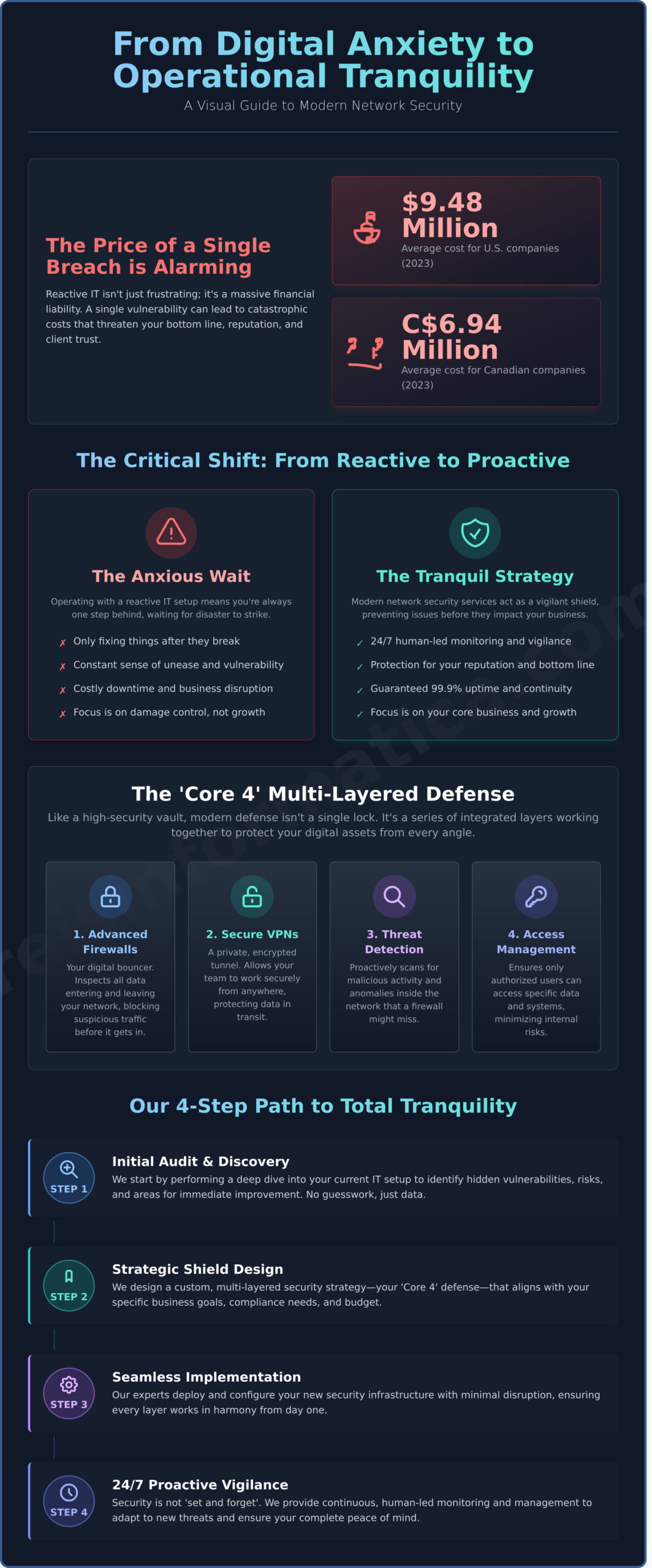
Did you know the average cost of a data breach for U.S. companies reached $9.48 million according to 2023 industry reports? It’s a staggering figure that explains why many business leaders feel a constant sense of unease about their digital safety. You likely suspect your current IT setup is reactive, only showing signs of life when something breaks or a “critical” update pops up. It is frustrating to feel like you’re one hidden vulnerability away from a disaster, especially when the solutions are buried under layers of confusing technical jargon.
We agree that you shouldn’t need a computer science degree to feel confident in your company’s defense. You deserve a partner who focuses on your business continuity rather than just hardware. This guide promises to show you how modern network security services protect your reputation and bottom line without the typical technical headache. We’ll provide a clear roadmap for securing your data and help you find a strategic partner who speaks the language of results instead of code. By the end, you’ll have a transparent plan to move from digital anxiety to total operational tranquility.
Key Takeaways
Learn how modern network security services act as a proactive shield, protecting your bottom line and reputation without requiring you to be a tech expert.
Discover the “Core 4” essential components every business needs to build a multi-layered defense against the evolving digital threats of 2026.
Understand why security is never a “set and forget” task and how active, human-led monitoring prevents the costly downtime that software alone can’t stop.
Find out how to identify a consultative partner who prioritizes your specific business outcomes over technical jargon and sales-first tactics.
Explore a strategic four-step process-from initial audit to 24/7 vigilance-designed to restore your tranquility and let you focus on your core business.
What Are Network Security Services and Why Do They Matter in 2026?
Network security services are the proactive management of the tools and protocols that protect your company’s digital assets. It isn’t just a one-time software purchase. It’s a continuous strategy to keep your data moving safely. For a comprehensive overview of network security, you’ll find it involves everything from hardware settings to user access rules. In 2026, these services function as the invisible shield around your business. They ensure that only the right people get in while keeping the wrong ones out.
The biggest benefit isn’t just technical; it’s the “Tranquility” factor. When you know your infrastructure is monitored, you can stop playing IT manager and get back to being a CEO. By 2026, the threat landscape has shifted. Basic firewalls are no longer enough to stop modern threats. In 2023, the average cost of a data breach in Canada hit C$6.94 million according to IBM research. Today, that risk is even more expensive. Professional network security services connect directly to your bottom line by maintaining 99.9% uptime and protecting your reputation with clients.
Security also keeps you on the right side of the law. Canadian regulations, such as PIPEDA, require businesses to take reasonable steps to protect personal data. Failing to do so can lead to massive fines and legal headaches. Effective network security services turn these complex requirements into a streamlined part of your daily operations. It’s about building a foundation where technology supports your growth instead of creating new risks.
The Real-World Impact of a Secured Network
Let’s look at the “domino effect” of IT downtime. If your network fails, your team can’t access files, your billing stops, and your customers can’t reach you. A secured business starts its morning with a coffee and a productive staff. A breached business starts its morning with a call to a lawyer and a ransom note. It’s also a financial necessity. Currently, many cybersecurity services are a mandatory requirement for business insurance policies in Canada. If you don’t have these protections in place, you might find yourself paying for a breach entirely out of pocket.
Network Security vs. Cybersecurity: Clearing the Confusion
While people often mix them up, there’s a simple way to tell them apart. Think of your business as a physical office building. Cybersecurity is the entire security strategy, including the guards, the background checks, and the alarm system. Network security focuses specifically on the “pipes” and “gates” where your data travels. It’s the locks on the doors and the ID scanners at the entrance. It ensures the flow of information is fast but restricted to authorized users.
Firewall: This is your digital gatekeeper. It inspects every piece of data trying to enter or leave your network and blocks anything suspicious.
VPN (Virtual Private Network): Think of this as a private, encrypted tunnel. It allows your team to work from a home office in Calgary or a site in Halifax while staying connected to the main office securely.
By focusing on these specific gates and pipes, you create a controlled environment. You don’t have to worry about who is accessing your server from a remote location. The system handles the verification for you. This clarity allows your team to collaborate without the constant fear of a digital intruder slipping through the cracks.
The Core Components of Modern Network Security
Think of your business network like a high-security vault. You wouldn’t just lock the front door and leave the back windows open. Effective network security services rely on what we call the “Core 4” essentials. These layers work together like a multi-layered shield, ensuring that if one layer is challenged, three others are standing by to protect your assets. This proactive approach is a vital part of comprehensive IT services, where every piece of your technology works in harmony to keep operations running smoothly. To build this shield properly, we align our strategies with the Cybersecurity Performance Goals, which provide a clear roadmap for protecting critical business data against modern threats.
Advanced Firewalls and Intrusion Prevention
Think of an advanced firewall as your digital bouncer. It stands at the entrance of your network, checking every single piece of data trying to get inside. While traditional firewalls just looked at where data came from, modern versions are much smarter. Intrusion Prevention Systems (IPS) act as the bouncer’s intuition, recognizing suspicious behavior before a threat even starts. A modern firewall doesn’t just block traffic; it intelligently audits every digital interaction your business has. This means it can spot a “polite” piece of data that’s actually carrying a malicious payload, stopping it before it reaches your servers.
Zero Trust Architecture and Secure Remote Access
The old way of thinking was that if you’re inside the office, you’re safe. That logic doesn’t hold up in today’s environment. Zero Trust is a simple concept: “Never trust, always verify.” Every user and every device must prove who they are before they get access, regardless of where they’re sitting. This is crucial for the 2026 hybrid workforce. With roughly 40% of Canadian employees working remotely at least part-time as of 2024, shifting from standard VPNs to identity-based access ensures your data stays safe. Whether an employee is at a coffee shop in Toronto or their home office in Vancouver, their access is tied to their identity, not just a password.
Continuous Monitoring and Threat Detection
Passive tools are like a smoke alarm that only goes off when the building is already on fire. Active monitoring is like having a security guard patrolling the halls 24/7. Cybercriminals don’t stick to a 9-to-5 schedule. In fact, many attacks happen at 3:00 AM on weekends when they think nobody is watching. Automated alerts and human oversight catch these anomalies instantly. In 2023, IBM reported that the average cost of a data breach in Canada reached C$6.94 million. Automated detection can save your team hundreds of hours of manual checking. It allows your network security services to isolate a single infected laptop before a virus can spread to the entire company database.
Implementing these components isn’t just about installing software. It’s about creating a culture of vigilance where your technology works for you, not against you. If you’re unsure if your current setup meets these standards, a quick security health check can identify the gaps before they become liabilities. Modern security must be “always-on” because the threats your business faces never take a day off. By focusing on these core elements, you transition from a reactive “fix-it-when-it-breaks” mindset to a position of strength and stability.
The “Set and Forget” Myth: Why Proactive Management Wins
Many business owners believe that once they’ve purchased a firewall or installed antivirus software, their job is done. This is the “set and forget” trap. In reality, security isn’t a product you buy; it’s a process you maintain. Buying software and walking away is like installing a high-end home security system in a city like Toronto or Vancouver and then never checking the cameras. You have the sensors and the locks, but if no one is monitoring the alerts, a thief can simply take their time bypassing them. A security system that isn’t actively watched is just expensive wallpaper.
Hackers don’t sleep, and they certainly don’t use the same tools they used six months ago. Cybercriminals evolve their tactics daily. In 2023, the number of data breaches globally jumped by 72% compared to the previous year’s record. Without constant system updates and patches, your “new” software becomes obsolete within weeks. Static defenses can’t keep up with dynamic threats.
There’s also the growing risk of “shadow IT.” This happens when your employees use unapproved apps, such as personal file-sharing accounts or unauthorized AI tools, to get their work done faster. These apps bypass your official security measures, creating massive blind spots in your infrastructure. Professional network security services close these gaps by providing the oversight needed to catch these vulnerabilities before they turn into entry points for an attack. We ensure that every device and application connecting to your network is vetted and secure.
The High Cost of Reactive IT
Waiting for a problem to occur before you fix it is the most expensive way to run a business. The “hidden” costs of a breach are staggering. Beyond the immediate ransom, you’re looking at lost productivity, hefty legal fees, and permanent damage to your brand’s reputation. According to IBM’s 2023 report, the average cost of a data breach for Canadian organizations reached C$6.94 million. It’s roughly 10x cheaper to prevent a breach than it is to clean one up.
Understanding What is Network Security? involves realizing that detection and reaction are just as critical as initial protection. Utilizing modern cloud services can simplify this process, allowing for automated backups that make recovery fast and predictable during a crisis. Instead of losing weeks of work, you can be back online in hours.
Why Managed Services Provide Better ROI
For most Canadian small to medium businesses, hiring a dedicated internal security team is financially impossible. A single IT security specialist in Canada can command a salary between C$90,000 and C$120,000 per year. That’s just for one person’s perspective. Managed network security services give you access to an entire team of experts for a fraction of that cost. You’re paying for a collective pool of knowledge and 24/7 coverage.
This provides the “Peace of Mind” that comes from knowing a Vigilant Partner is watching your network while you sleep. We act as your technological right hand, assuming responsibility for the technical complexity so you can focus on your core business goals. We don’t just fix things when they break; we ensure they stay running, stable, and secure through every shift in the digital landscape.
Choosing the Right Network Security Partner for Your Business
Selecting a provider for network security services shouldn’t feel like a high-pressure sales pitch. You aren’t just buying a firewall or an antivirus license; you’re choosing a long-term guardian for your company’s digital assets. A 2023 study found that 43% of cyberattacks target small businesses, yet many owners still make the mistake of choosing a partner based solely on the lowest price tag. This “budget-first” mindset often leads to reactive support, where problems are only fixed after they’ve already caused downtime.
You need a consultative partner rather than a sales-driven vendor. A consultative provider takes the time to understand your specific workflow, industry regulations like PIPEDA in Canada, and your long-term goals. They don’t just push the most expensive hardware; they build a strategy that fits your actual risk profile. This proactive approach ensures your technology remains invisible and efficient, allowing you to focus on your core operations without worrying about the next big threat.
Questions to Ask Your Potential Security Provider
Do you provide 24/7 monitoring or just business-hour support? Cybercriminals don’t work a 9-to-5 schedule. If a breach occurs at 2:00 AM on a Saturday, you need a team that reacts instantly, not on Monday morning.
How do you handle employee training and phishing awareness? Since human error is involved in 82% of data breaches according to recent industry data, your partner must offer ongoing education to turn your staff into a human firewall.
Can you explain your security strategy without using confusing technical jargon? A true expert can translate complex concepts into business outcomes. If they can’t explain how a tool protects your bottom line in plain English, they might not understand your business needs.
Speed is a critical factor that many businesses overlook during the vetting process. When a network goes down, every minute costs money. For a Canadian mid-sized firm, downtime can cost upwards of C$10,000 per hour in lost productivity and missed opportunities. This is why local Canadian-based support is vital. Having experts in your same time zone who understand the local business environment ensures faster response times and easier communication when things get urgent.
Aligning Security with Your Business Growth
Your security needs will look very different when you have 50 employees compared to when you had five. A quality partner ensures your protection scales seamlessly as you hire more people or open new locations. They should implement modular solutions that grow with you, preventing the need for a total “rip and replace” of your systems every few years. They act as an extension of your own team, anticipating needs before they become urgent problems.
Innovation plays a massive role in this scalability. Modern providers leverage AI business solutions to predict and automate security responses. These tools can identify suspicious patterns in milliseconds, often stopping an attack before it even reaches your server. By using AI to handle the heavy lifting of threat detection, your IT partner can focus on high-level strategy and personalized support for your staff.
Don’t leave your company’s future to chance. Reach out to the experts at Reis Informática for a comprehensive security assessment and see how a true partnership can transform your business.
Experience Tranquility: The Reis Informática Approach to Security
Security shouldn’t feel like a second job for a business owner. When you partner with Reis Informática, you aren’t just buying a list of software tools. You’re hiring a dedicated team that watches your back while you focus on scaling your operations. We call this our Vigilant Guard approach. We take the heavy lifting of technical complexity and turn it into a silent, invisible shield that protects your data and your reputation.
We act as the specialized eyes and ears of your infrastructure. Instead of overwhelming you with jargon about encryption protocols or packet filtering, we speak the language of business results. Our goal is simple: we want you to forget that your IT security is even there because it’s working so smoothly. We handle the 2:00 AM alerts and the constant patch cycles so your staff can stay productive without interruptions.
Our unique process is built on four distinct pillars designed for the Canadian market:
Audit: We perform a deep dive into your current setup. We don’t just run a basic scan; we look for the 15% of vulnerabilities that automated tools often miss, specifically looking at how your team handles sensitive data.
Strategy: We build a custom roadmap. If you’re a 30-person firm in Kitchener, your needs are different from a retail chain in Toronto. We align your defense with Canadian regulations like PIPEDA.
Implementation: We deploy your network security services with surgical precision. We work around your schedule to ensure there’s zero downtime for your team.
24/7 Vigilance: Our work doesn’t end after installation. We monitor your systems every second of every day. If a threat appears, we’re already neutralizing it before you’ve even poured your first cup of coffee.
Communication is the heartbeat of our partnership. We believe you deserve to know exactly what’s happening in your network without needing a computer science degree to understand it. We provide clear, plain-English reports that show you exactly how your investment is protecting your bottom line. You’ll always know your status, but you’ll never feel buried in technical noise.
Our Proactive Security Framework
We build our framework to eliminate “IT noise” entirely. In 2023, the average cost of a data breach for Canadian organizations reached a staggering C$6.94 million according to IBM reports. We prevent your business from becoming part of that statistic by focusing on stability and reliability. Our framework doesn’t just react to problems; it predicts them. By cleaning up your digital environment and streamlining your connections, we remove the distractions that typically slow down a growing company. You get a stable platform that just works, allowing your team to hit their targets without technical friction.
Ready to Secure Your Future?
The journey from tech-induced anxiety to total confidence is shorter than you might think. We’ve helped countless Canadian business leaders move away from the “break-fix” mentality and into a state of permanent readiness. Getting started is easy and involves zero pressure. We’ll sit down, look at your current challenges, and show you exactly where the gaps are. You don’t have to carry the weight of your company’s digital safety alone anymore. Let us be the experts who keep your future secure while you lead the way.
The digital landscape of 2026 doesn’t forgive a “set and forget” mentality. With the average cost of a data breach in Canada reaching C$6.94 million according to recent IBM reports, business leaders can’t afford to be reactive. True resilience requires 24/7 proactive monitoring and a defense strategy that evolves daily. You shouldn’t have to spend your evenings worrying about server vulnerabilities or sophisticated phishing attacks.
Choosing the right network security services means finding a partner who values your uptime as much as you do. At Reis Informática, we provide expert technical support and a strategic partnership focused on your long-term expansion. We take full responsibility for your technical complexity so your team stays productive and your data stays locked down. It’s time to move from a state of constant alert to a state of total confidence.
Ready to bulletproof your infrastructure?Get Your Free Network Security Strategy Session today and experience the tranquility of professional protection. Your business deserves the stability that comes with world-class vigilance.
Frequently Asked Questions
What is the difference between network security and cybersecurity?
Network security focuses on protecting the traffic and data moving within your office’s digital infrastructure, while cybersecurity is the broader strategy protecting all your digital assets. Think of network security as the locks and alarms on your office doors; cybersecurity is the entire security team protecting the building, the employees, and the company vault. This distinction is vital because it helps you understand where your specific vulnerabilities lie.
Does a small business with only 10 employees really need professional network security services?
Yes, because 43% of all cyberattacks in Canada target small businesses with fewer than 50 employees. Hackers often view smaller companies as soft targets because they lack the robust network security services larger corporations use. Investing in protection now prevents a data breach that costs Canadian small businesses an average of C$45,000 per incident, which is enough to jeopardize your company’s future.
How much do managed network security services typically cost in 2026?
In 2026, Canadian businesses typically pay between C$150 and C$400 per user each month for managed network security services. This price range usually includes 24/7 monitoring, advanced threat detection, and regular system updates. Your final cost depends on the complexity of your infrastructure and the specific compliance requirements of your industry, such as PIPEDA regulations or industry-specific data privacy standards.
What are the three most common types of network security threats for Canadian businesses?
The three most frequent threats facing Canadian businesses are phishing, ransomware, and credential theft. Statistics from 2024 show that 80% of security breaches involve compromised login details. These attacks often bypass traditional filters, making it essential to have active monitoring that catches suspicious behavior before it turns into a total system lockout. Proactive defense is the only way to stay ahead of these evolving tactics.
How often should my business perform a network security audit?
You should perform a comprehensive network security audit at least once every 12 months. However, if your business handles sensitive client data or undergoes significant growth, moving to a 6-month schedule is a safer bet. Regular audits ensure your defenses keep up with the 35% annual increase in new malware variants discovered by security researchers. It’s the best way to identify weak spots before hackers do.
Can network security services help with hybrid or remote work setups?
These services are vital for hybrid teams because they extend your office’s security bubble to home networks and coffee shops. By using encrypted VPNs and endpoint protection, your team can access company files safely from any location in Canada. This setup prevents hackers from intercepting your data over public Wi-Fi, which is where 25% of remote work breaches begin. It keeps your team productive and your data safe.
What is Zero Trust, and is it necessary for my small business?
Zero Trust is a security model that operates on the principle of “never trust, always verify.” It means your system checks the identity of every user and device every time they try to access a file. It’s highly effective for small businesses because it limits the damage a single stolen password can do; protecting your most sensitive financial records. It’s no longer just for big banks; it’s a modern standard for everyone.
Will network security services slow down my employees’ internet speed?
No, modern security tools won’t noticeably slow down your connection. In fact, professional services often improve performance by blocking background noise and malicious traffic that hogs your bandwidth. You’ll likely find that a clean, monitored network runs more reliably than one cluttered with unoptimized apps and potential malware. It’s about making your technology invisible and efficient so your team can stay focused on their work.