
A cyber insurance application is also a practical test of your security readiness. Cyber insurance requirements for small businesses in Canada vary by insurer and policy, but applications typically ask about your operations, the data you handle, your cybersecurity measures, revenue and prior incidents. Insurers may assess your controls before offering coverage and setting premiums, so understanding your current environment is a useful first step.
It’s reasonable to want to understand what a policy might cover before sharing business details or comparing terms. Cyber risk insurance may help with costs related to a data breach, ransomware, interrupted operations, forensic investigation and third-party claims, depending on the policy. Limits, exclusions and policyholder responsibilities can affect how coverage responds.
This guide explains what cyber insurance can cover, how policy terms work and which security controls to review before applying. You’ll also learn how to organize information about your systems, data, backups, access controls and incident response, so you can approach the application with a clearer view of your risks and coverage needs.
Key Takeaways
- Compare what a cyber policy covers with its exclusions, limits and claim conditions to understand how it may respond to an incident.
- Review the policy period and claims-made wording so you know how timing affects coverage.
- Assess access controls, backups, software protection and incident response before completing an application.
- Organize details about your data, systems and security practices to clarify your coverage needs and identify readiness gaps.
What is cyber risk insurance?
Cyber risk insurance can help a Canadian business manage costs after a cyber incident, subject to the policy. Because coverage, exclusions and security conditions vary, compare the wording with your operations and the data you hold.
Coverage for Canadian Small Businesses
Small businesses that store personal information, process payments or depend on digital systems may use cyber insurance to help address incident-related costs. Depending on the policy, coverage may include breach response, forensic investigation, business interruption, legal expenses and third-party claims. Compare limits and covered services with the information your business holds and the impact an outage could have on operations.
Coverage Types and Exclusions
Policies may cover ransomware response, extortion events, data breach notification, crisis management and extra expenses to restore operations. Some may cover ransomware payments where legally permitted, subject to policy terms. Review exclusions and conditions alongside each coverage type: a policy may set requirements for incident response, eligible losses or specific services. Don’t assume a general property or liability policy covers cyber incidents.
Insurers may ask whether you use multi-factor authentication (MFA) across accounts and devices. MFA adds an identity check beyond a username and password, such as a one-time code. Record where MFA is active and which accounts it does not cover, then compare that information with the application questions and policy conditions.
Privacy Breach Notification and Insurance Requirements
In Canada, a business may be legally required to notify affected individuals and regulators when sensitive information is compromised. Cyber insurance may help cover eligible notification, credit monitoring, legal and regulatory response costs, but it does not replace the business’s reporting duties. Review who coordinates notices and which expenses the policy covers.
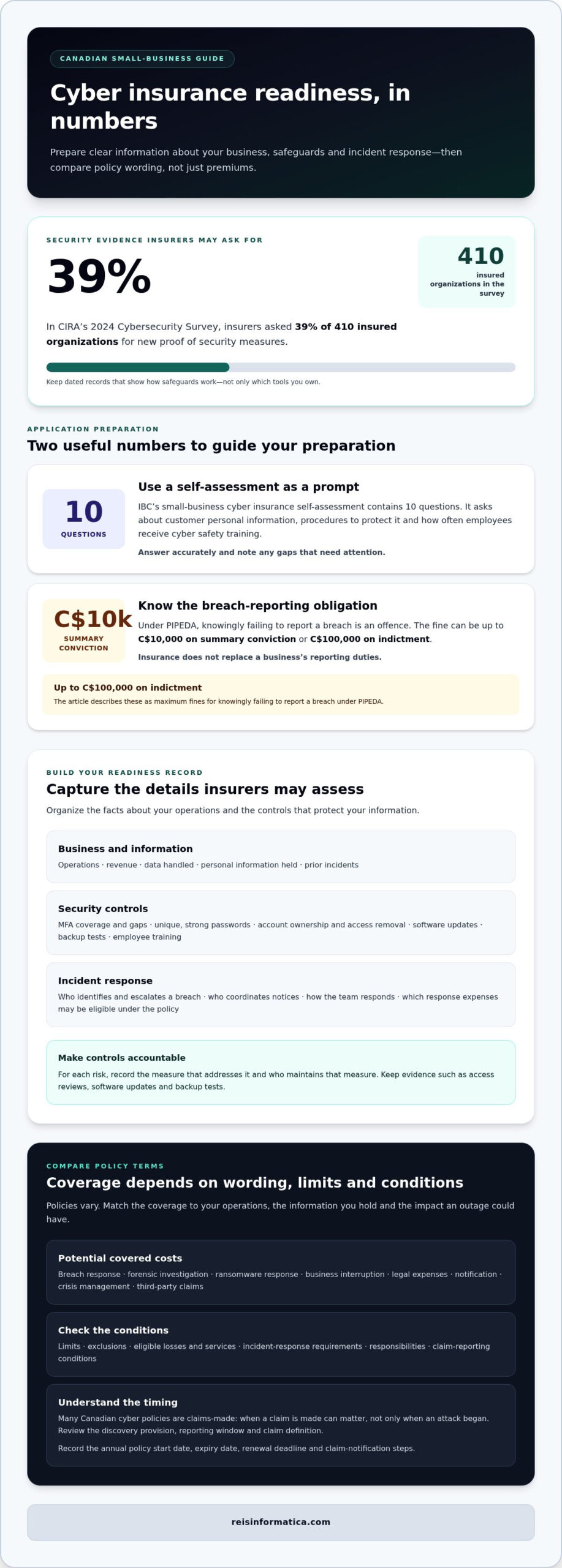
Under PIPEDA, knowingly failing to report a breach is an offence carrying a fine of up to C$10,000 on summary conviction or C$100,000 on indictment. Before applying, document the personal information you hold and how your team would identify, escalate and respond to a breach. This helps connect privacy obligations with policy coverage and incident response planning.
Claims-made policy form and annual policy period
Many Canadian cyber policies use a claims-made form: coverage depends on when a claim is made, not only when an attack began. A discovery provision can affect how an incident discovered later is handled. Understanding cyber insurance requirements for small businesses in Canada includes knowing the policy’s reporting window and how it defines a claim.
An annual policy period sets the dates when coverage applies. Record the start date, expiry date, renewal deadline and claim-notification steps. If an investigation continues near renewal, the policy wording and reporting timeline matter. Renewal alone does not explain how an earlier incident will be treated, so review those terms before the policy period ends.
After reviewing your security controls, compare policy quotes from multiple underwriters using the same business details. Assess limits, covered response services, exclusions, reporting conditions and responsibilities. For example, check whether the wording addresses ransomware response and business interruption instead of comparing premiums alone.
Don’t assume a commercial general liability policy covers cyber claims. Standard policies typically exclude events such as data breaches or ransomware, so review the actual wording. Check whether cyber protection is included and what limits and exclusions apply.
Password practices may also affect the application. Use unique, strong passwords for employee and network accounts, and change them regularly. Document who manages accounts and removes access when someone leaves. These details help describe your security controls accurately and clarify responsibilities under the policy.
A practical review of cyber insurance requirements for small businesses in Canada starts with organized application details: operations, revenue, data practices, prior incidents and security measures. Compare each policy’s claims process and exclusions with the business disruption you could face. Note required safeguards, such as password practices, and assign an owner to maintain each measure throughout the policy period.
Cybersecurity measures that may improve risk profiles
Insurers assess cyber risk through the information an organization handles and the controls protecting it. In CIRA’s 2024 Cybersecurity Survey, insurers asked 39% of 410 insured organizations for new proof of security measures. Keep dated records of safeguards, such as access reviews, software updates and backup tests. Clear evidence helps explain how your controls work, not just which tools you own.
Use a risk-based framework to prioritize controls for your actual operations. A retailer processing payment information, for example, should map payment systems, employee access and third-party connections. Record each risk, the measure that addresses it and who maintains that measure. This creates a practical framework for managing threats, tracking gaps and aligning cybersecurity risk management with business needs.
Insurers may ask about business operations, data handling, revenue, security measures and previous incidents. IBC’s small-business cyber insurance self-assessment contains 10 questions, including whether you collect and store customer personal information, what procedures protect it and how often employees receive cyber safety training. Use those prompts to prepare accurate application answers, then note gaps requiring action.
Premiums and coverage limits reflect the data you handle, revenue, digital exposure and the strength of your security controls. A business processing payments or relying on online sales may face different exposures from one with fewer digital dependencies.
Practical cyber risk management tools include endpoint protection, network defences, secure backups and access management. Pair them with phishing training, software updates and a written incident response plan. Test whether a separate backup can restore essential data, and record the result. These steps help employees recognize threats and give leadership a clearer view of weaknesses that could contribute to breaches or a data breach.
Assessing cyber risks and security controls before applying
Start with a simple map of your business’s data, systems and dependencies. Record what customer information you hold, where it is stored, who can access it and which services support daily operations. A retailer, for example, can trace payment data from checkout through its payment processor. This map helps you assess exposure, likely losses and potential liability.
Readiness gaps are common: 66% of small and medium-sized enterprises say they lack a ransomware response plan, and 70% say they lack skilled cybersecurity personnel. Use these figures as prompts, not as a substitute for assessing your own controls. Identify who can contain an attack, restore systems and communicate with affected people.
To apply, gather accurate details about your operations, revenue, data handling, security controls and prior incidents, then use them to complete insurer applications. To prepare for a claim, keep response contacts, system records and incident notes organized, and follow the policy’s reporting instructions after an incident.
Test your readiness with practical scenarios. Could your team identify a phishing message, disable a compromised account and restore essential files from a separate backup? Write down the steps, owners and gaps revealed by each exercise. IBC’s 10-question self-assessment can help prompt reflection, but it is not an actual risk assessment.
Use the findings to prioritize actions according to business impact: protect sensitive data, limit access, update systems and rehearse incident response. A documented review also gives insurers a clearer account of how you manage exposure. Map your cybersecurity controls against the risks your business actually faces, then keep the assessment current as systems and operations change.
Reisinformatica.com: Managed IT aservices
Reis Informatica can help businesses turn an insurance-readiness review into practical IT priorities. Its Managed IT services support day-to-day technology management, while cybersecurity services address security controls and risk reduction. This support can be useful when your assessment reveals gaps in access management, endpoint protection, backups or incident response, and your team needs help organizing next steps.
For example, a business preparing an application can document its systems, identify who manages each control and plan how to address weaknesses. Reis Informatica’s Private and Public Cloud Services and products can support cloud-related business needs. The goal is to strengthen the technology environment and make safeguards easier to manage, not to treat insurance as a substitute for prevention.
Visit reisinformatica.com to discuss your business’s IT and cybersecurity needs.
Make cyber readiness part of business planning
Insurance readiness isn’t a one-time task. As your business changes its systems, data practices or suppliers, revisit whether your safeguards still match its exposure. Make the review an operating habit: assign ownership, record decisions and connect improvements to business priorities. Preparing for cyber insurance requirements for small businesses in Canada can also strengthen how your organization manages technology over time.
Reis Informatica offers Managed IT services, cybersecurity services, and Private and Public Cloud Services and products. These offerings can support businesses looking to manage IT operations, address security needs or plan their cloud environment as part of a broader readiness effort. Start with the areas that matter most to your organization, then build a practical plan to address them.
Contact reisinformatica.com to discuss your needs and take a considered next step toward stronger business readiness.
Frequently Asked Questions
Who’s covered?
Coverage applies to the people and organizations the policy defines as insured, usually the business purchasing it. Check whether related companies, directors, employees, contractors or subsidiaries qualify; don’t assume they do. For a small business with a holding company and a separate operating company, confirm which legal entity is named and whose actions or claims the policy addresses.
How much does a data breach cost a Canadian business?
That figure describes Canadian organizations overall, not a typical small-business bill. A business’s actual financial impact depends on the information exposed, the length of disruption, response needs and resulting claims. Use the figure as context, not as a budget forecast.
What does an insurance company need to know about your business?
Insurers need a clear picture of your operations and cyber exposure. Prepare a concise description of how you earn revenue, which systems support essential work, what information you hold and which outside providers connect to those systems. Keep answers consistent across application forms and include a record of prior incidents. These details help underwriters understand the business behind the application.
What does being uninsured or underinsured cost a Canadian SMB?
There’s no single cost that applies to every Canadian SMB. Without suitable coverage, the business must fund incident investigation, recovery, interruption expenses and eligible legal or response costs itself. If the limit is lower than the loss, the business remains responsible for the amount above it; exclusions can also leave specific expenses uncovered. The financial effect depends on the incident and policy wording.
What cyber insurance coverage do small businesses in Canada typically need?
Choose coverage based on the business’s data, revenue and reliance on digital systems. A company holding customer records may prioritize breach response and third-party liability, while an online seller may place greater weight on interrupted operations. Review limits, exclusions and response services together. The aim is to address losses that could threaten your operations, not simply select the broadest policy description.
Is cyber insurance legally required for Canadian small businesses?
Cyber insurance is generally optional for Canadian small businesses, but privacy obligations can still apply without a policy. If sensitive information is compromised, a business may have to notify affected individuals and regulators under applicable Canadian requirements. Treat insurance and legal compliance as separate responsibilities: a policy may help fund eligible response costs, but it does not remove breach-reporting duties.