
Did you know that under the Critical Cyber Systems Protection Act, organizations can now face fines of up to $15 million per day for cybersecurity failures? For a business owner in Ontario, that’s a staggering number that changes the conversation from “if” an attack happens to how you stay protected. You’ve worked hard to build a reputation for reliability on the shop floor, but the growing overlap between your office computers and your production machinery creates new risks. This is why finding the right approach to cybersecurity for manufacturing Milton has become just as important as maintaining your physical equipment.
It’s frustrating to feel like your 24/7 production is at the mercy of a digital glitch or a remote hacker. We agree that you should be able to focus on meeting quotas and managing your team, not decoding technical jargon or worrying about rising insurance premiums. This guide promises to help you bridge the gap between your machines and your digital defense to ensure your operations stay resilient. We will walk through the essential steps to protect your industrial control systems, meet strict supply chain security requirements, and find a local partner who truly understands the rhythm of a Milton factory.
Key Takeaways
- Understand why Milton’s strategic location along the 401 corridor makes local plants attractive targets and how to meet new, strict supply chain security demands.
- Learn the critical difference between IT and OT to ensure a simple office virus doesn’t accidentally shut down your shop floor machinery.
- Discover five actionable steps to strengthen cybersecurity for manufacturing Milton, including the use of network segmentation to create digital fire doors.
- Find out how a local, consultative partner can help you transition from reactive firefighting to a proactive stance that ensures 24/7 production continuity.
Why Milton Manufacturers are Prime Targets for Cyber Attacks in 2026
Milton’s position along the 401 corridor makes it a powerhouse for Ontario’s economy. While this location is perfect for logistics and growth, it also puts a digital spotlight on local facilities. Hackers know that Milton SMEs are often the essential links in massive supply chains. If you’re a supplier for a major automotive or aerospace firm, your security is now their business. In 2026, many large contractors require their partners to provide documented proof of their cybersecurity services before renewing contracts or signing new deals.
The pressure to maintain 24/7 production makes you a high-value target for criminals who exploit the fear of a dark shop floor. To put it simply, manufacturing cybersecurity is the practice of protecting both digital data and physical production assets. It’s about more than just your server; it’s about keeping your machines moving and your staff safe. Investing in cybersecurity for manufacturing Milton is no longer just an IT task; it’s a core part of your production line maintenance.
The True Cost of a Production Standstill
A cyber attack isn’t just a line item on an insurance claim. When your systems go down, the clock starts ticking on idle labor costs, unfulfilled orders, and late-delivery penalties. Within the Halton Region manufacturing community, news travels fast. Losing the trust of your neighbors or long-term clients because of a preventable breach can be harder to recover from than the financial loss itself. Securing your industrial control system (ICS) cybersecurity is the only way to ensure your reputation stays as solid as your products.
2026 Threat Landscape: AI-Driven Phishing and Ransomware
The tools attackers use have evolved rapidly. In 2026, we see AI being used to create phishing emails that look exactly like a message from your floor supervisor or a trusted local vendor. These messages often bypass traditional filters and trick even the most cautious employees. We’ve also seen a shift toward extortion. Instead of just locking your files, hackers now steal sensitive designs or client lists and threaten to release them publicly. This makes a proactive defense the only way to maintain true operational serenity.
Bridging the Gap Between the Shop Floor (OT) and the Front Office (IT)
In many Milton factories, there’s an invisible wall between the front office and the production line. Information Technology (IT) handles your emails, billing, and databases. Operational Technology (OT) keeps your CNC machines, robotic arms, and sensors running. For a long time, these two worlds didn’t talk much. But in 2026, they’re more connected than ever. This convergence brings efficiency, but it also opens a backdoor for threats. If your guest lobby WiFi is on the same network as your assembly line, a simple phone virus could stop your production cold.
Securing this connection is the heart of cybersecurity services that protect both your data and your physical output. According to the CISA Critical Manufacturing Sector guidelines, the industry’s reliance on interconnected systems makes it a primary focus for national security. This is why cybersecurity for manufacturing Milton requires a strategy that looks at the whole building, not just the server room. It’s about creating a ‘human firewall’ where every employee, from the loading dock to the executive suite, knows how to spot a threat.
Why Your Machinery is Vulnerable
Many owners believe their machines are safe because they aren’t ‘on the internet.’ This is the myth of air-gapping. In reality, maintenance laptops, USB drives, and remote support links often bridge that gap. Legacy machines were built to last 20 years, not to fight off modern malware. Unlike an office PC that you can just reboot, an Industrial Control System (ICS) needs specialized care to avoid damaging the equipment or ruining a batch of product.
Creating a Unified Security Strategy
True protection comes from integrating your shop floor monitoring with your office Managed IT services. This is where a vCIO (virtual Chief Information Officer) becomes invaluable. They help align your production goals with your digital safety, ensuring that security updates don’t cause unexpected downtime. It’s about moving toward a proactive model where your technology acts as a silent facilitator for your success. If you’re wondering how your current setup stacks up, a quick security review can help identify these hidden gaps before they’re exploited.
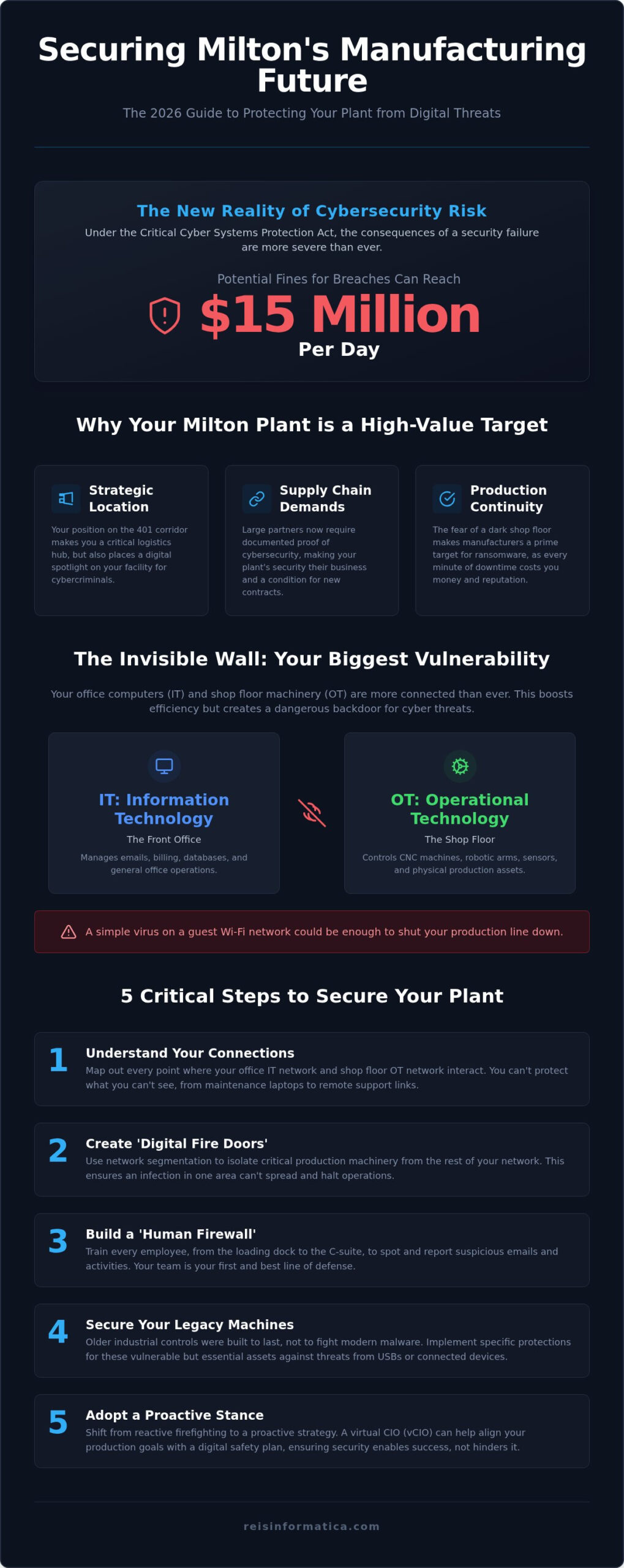
5 Critical Steps to Secure Your Milton Manufacturing Plant
Securing your facility doesn’t have to be an overwhelming technical project. It’s better to think of it as a series of strategic layers that protect your production line. In 2026, the most resilient companies are those that treat cybersecurity for manufacturing Milton as a standard maintenance protocol. By following these five steps, you can move from a reactive state to one of operational serenity.
Step 1: The Comprehensive IT/OT Audit
You can’t protect what you don’t know you have. A thorough audit involves inventorying every connected device in your plant, from the smart sensors on your assembly line to the printers in the front office. This is also the time to identify “End-of-Life” software. Since over a third of manufacturing breaches stem from unpatched devices, replacing or isolating these legacy systems is a top priority for your digital safety.
Step 2: Access Control and Multi-Factor Authentication (MFA)
Passwords are no longer enough to stop modern attackers. Implementing MFA for every user ensures that a single stolen credential doesn’t lead to a full-scale shutdown. It’s especially important to manage third-party vendor access. If a technician needs remote access to your CNC machines, that link should be temporary and strictly monitored to prevent unauthorized entry.
- Network Segmentation: Think of this as installing digital fire doors. By separating your office WiFi from your production network, you ensure a breach in accounting won’t stop the machines on the floor.
- Employee Awareness: Your team is your first line of defense. Regular cybersecurity awareness training helps floor staff recognize the AI-driven phishing attempts that are common in 2026.
- Business Continuity Plan: You need a playbook for when things go wrong. Having robust network security services in place means you can restore operations quickly and avoid the massive fines associated with Bill C-8 non-compliance. Ontario manufacturers across the region are also increasingly turning to a structured disaster recovery plan for manufacturing to minimize recovery time objectives and keep their shop floors moving after an incident.
Building a secure environment is about more than just software; it’s about having a partner who watches the shop while you focus on growth. If you’re ready to secure your production line and protect your bottom line, reach out to our team for a comprehensive security assessment tailored to your Milton facility.
Choosing a Local Cybersecurity Partner in Milton
When your assembly line stops, every minute feels like an hour. This is where the on-site advantage becomes your greatest asset. Having a partner who can be at your Milton plant in minutes rather than hours is the difference between a minor hiccup and a catastrophic shift. While many providers offer remote support, cybersecurity for manufacturing Milton often requires a physical presence to troubleshoot hardware on the shop floor or secure a specific piece of machinery that isn’t behaving.
We believe in providing “operational serenity.” This means we act as your strategic guardian, handling the technical complexity so you can focus on meeting your production quotas. We don’t just sell tools; we provide cybersecurity services that are built around the unique rhythm of a 24/7 manufacturing environment. Choosing a team that understands the difference between an office printer and a high-speed robotic arm is essential for your continuity.
The Value of a Strategic Partnership
Moving away from the “break-fix” mentality is essential for your long-term success. A reactive provider only shows up when something is already wrong, which is usually too late for a busy factory. A consultative partner works with you to align your IT budget with your growth goals. By treating Managed IT services as a proactive investment, you ensure a higher ROI and a much more stable environment where technology facilitates production instead of hindering it.
Next Steps for Milton Plant Managers
If you’re unsure about your current protection, start by asking your provider how they handle OT-specific security. Do they have a plan for securing your legacy equipment? If the answer is vague, it’s time to seek a partner who understands the Halton Region’s industrial landscape. Booking a consultative assessment is the best way to find your weak spots before they become expensive problems. Manufacturers across the broader Ontario region, including those exploring small business IT support Cambridge ON providers can offer, are increasingly recognizing the value of building a proactive IT foundation before a crisis strikes. Our team is ready to help you build a defense that supports your 2026 targets and gives you the peace of mind you deserve.
Securing Your Shop Floor for the Future
Protecting your manufacturing plant in 2026 is about more than just software; it’s about ensuring your machines keep moving and your orders stay on schedule. You’ve seen how the gap between your office computers and your production floor can create hidden risks that threaten your bottom line. By implementing network segmentation and training your team to spot AI-driven threats, you’re taking control of your facility’s future. This proactive approach to cybersecurity for manufacturing Milton turns digital safety into a competitive advantage rather than a hidden cost.
Our team provides expert local support throughout the Milton and Halton Region manufacturing corridors. We focus on strategic vCIO guidance to help you maintain 24/7 uptime while you concentrate on your core business goals. We want to help you achieve true operational serenity by acting as the vigilant guardian of your digital assets. Secure your production line today with a consultative cybersecurity assessment from Reis Informatica.
The transition to a secure, modern factory floor doesn’t have to be a solo journey. With the right local partner, you can build a resilient operation that’s ready for whatever the digital landscape brings next.
Frequently Asked Questions
What is the biggest cybersecurity threat to Milton manufacturers in 2026?
The most significant threat is AI-powered social engineering designed to bypass traditional filters and trick your floor staff. These attacks often lead to extortion, where criminals steal sensitive designs or client data rather than just locking your systems. This makes having a local partner for cybersecurity for manufacturing Milton essential for rapid response and proactive monitoring of your network.
Does my manufacturing plant really need a different security plan for the shop floor?
Yes, your shop floor requires a specialized strategy because Operational Technology (OT) has different vulnerabilities than standard office IT. While an office PC can be easily rebooted, an industrial control system might be damaged or cause production safety issues if handled incorrectly. A tailored plan ensures your machinery stays protected without risking physical damage or unplanned downtime during updates.
How much does cybersecurity for a mid-sized manufacturing plant in Milton cost?
The investment required to secure your facility depends on the complexity of your network and the number of connected devices on your production line. Instead of a one-size-fits-all price, we recommend a consultative assessment to determine your specific risks and priorities. Investing in proactive protection is a strategic move that helps you avoid the massive daily fines associated with new regulations like Bill C-8.
Can a cyber attack actually damage my physical manufacturing equipment?
A cyber attack can indeed cause physical harm to your equipment by overriding safety limits or changing machine parameters. Hackers targeting industrial control systems can cause overheating, mechanical failure, or ruined product batches. This is why securing the connection between your office and the shop floor is critical for maintaining your physical assets and ensuring the safety of your staff.
How do I know if my current IT support is handling cybersecurity correctly?
You’ll know your support is effective if they provide proactive reports and strategic guidance rather than just fixing problems after they occur. Ask your provider for a specific plan regarding your OT environment and legacy machines. If they can’t explain how they are protecting your assembly line from digital threats, it’s likely time to look for a partner with manufacturing-specific expertise. Facilities in the broader Ontario region can also benefit from reviewing a detailed disaster recovery plan checklist for Cambridge ON manufacturers to ensure their recovery strategies are fully documented and tested before a crisis occurs.