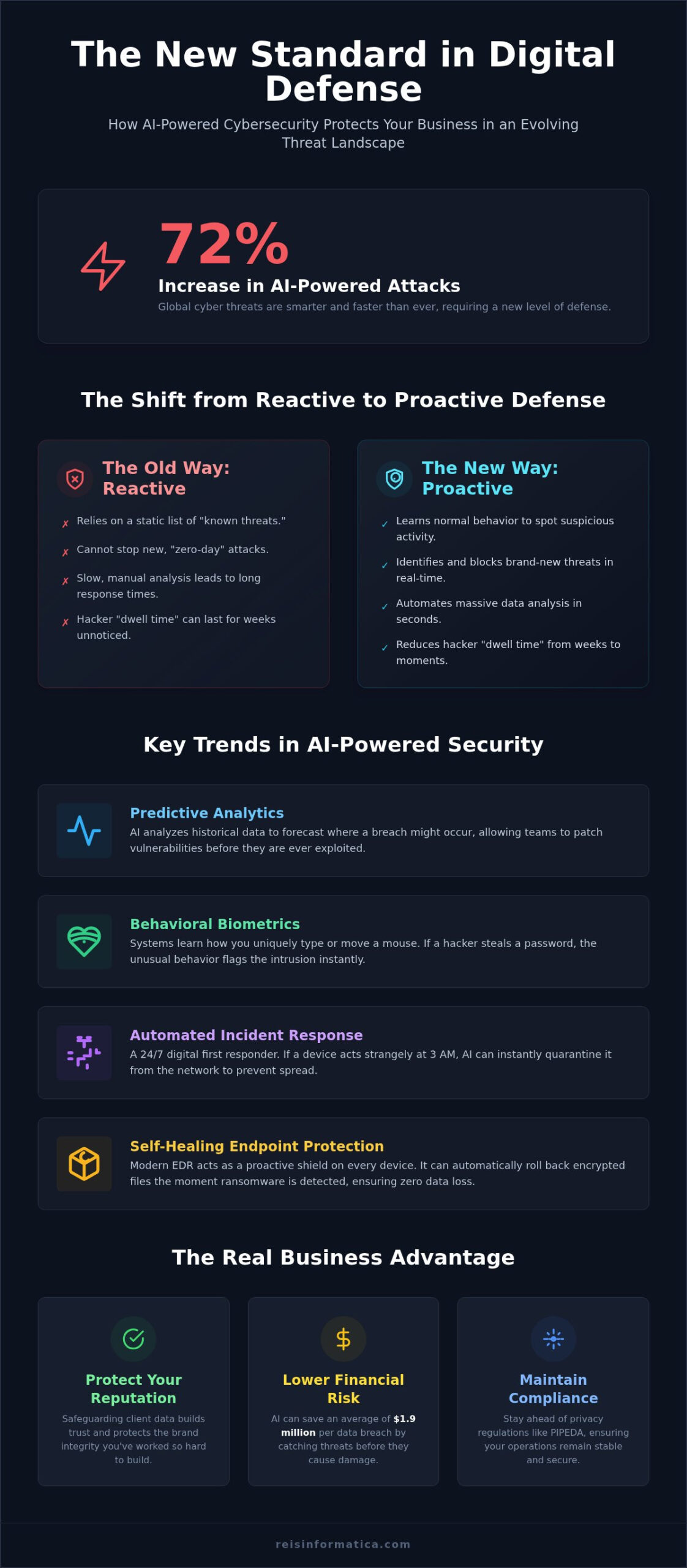
Did you know that AI-powered attacks saw a staggering 72% increase globally in 2026? If you feel like the speed of new cyber threats is outpacing your internal IT staff, you aren’t alone. It’s exhausting to manage a business while worrying if your digital doors are truly locked. The reality of modern defense has shifted, and AI-powered cybersecurity solutions are now the essential engine that allows local businesses to maintain the same defensive strength as global enterprises.
We understand that the constant marketing hype around AI can be confusing and even a bit overwhelming. You need practical tools that work, not just buzzwords. This guide will help you discover how AI is revolutionizing digital defense and how your business can leverage these trends to stay secure in an evolving landscape. We’ll show you how to evaluate providers and implement advanced security locally, ensuring your technology acts as a silent, vigilant guardian so you can focus on your core goals with total peace of mind.
Key Takeaways
- Learn how modern defense systems now learn and adapt in real-time to outpace sophisticated AI-driven attacks like deepfakes and automated phishing.
- Discover how AI-powered cybersecurity solutions leverage predictive analytics and behavioral biometrics to identify threats before they impact your network.
- Understand the critical “human-in-the-loop” framework that ensures advanced technology works seamlessly without causing unnecessary business downtime.
- Find out how partnering with local experts in Ontario provides the strategic vCIO leadership needed to turn complex security tools into a competitive business advantage.
The Evolution of Defense: Why Traditional Cybersecurity Fails in 2026
In the past, cybersecurity was like a digital wall. You built it, and it stood there. But in 2026, hackers use software that changes its own code every few seconds. Traditional tools can’t keep up because they rely on a static list of “known threats.” If a virus isn’t on the list, it gets through. This is why AI-powered cybersecurity solutions have become the new standard for business protection.
Unlike old systems, AI doesn’t just follow a script. It learns. It studies how your data normally flows and identifies deviations in real-time. This shift is part of the broader Applications of AI in Cybersecurity, where machines handle the massive data analysis required to spot a threat in seconds. This speed is vital because modern attacks, like AI-generated deepfakes or hyper-personalized phishing, are designed to bypass human-managed filters. By the time a human analyst notices something is wrong, the damage is often already done. AI reduces “dwell time,” which is the period a hacker spends inside your network, from weeks to mere moments.
From Reactive to Proactive: The Death of the Static Firewall
Signature-based detection is like a security guard holding a stack of “wanted” posters. If the intruder wears a mask or isn’t in the book, the guard lets them in. AI works differently. It’s like a guard who notices someone is pacing nervously or testing every door handle in the hallway. It recognizes suspicious behavior rather than just a face. This proactive approach is the only way to stop “zero-day” threats that have never been seen before. Complementing this approach with penetration testing services Mississauga businesses rely on can help you discover hidden vulnerabilities before real attackers do.
How AI Protects Your Business Reputation
A breach is more than a technical headache; it’s a threat to your brand’s integrity. Clients trust you with their most sensitive information. Failing to protect it can lead to legal fees and a loss of confidence that takes years to rebuild. Research shows that using AI in cybersecurity can save an average of $1.9 million per data breach by catching threats earlier. In Canada, staying compliant with privacy regulations like PIPEDA is a baseline requirement. Our cybersecurity services help you stay ahead of these risks, ensuring your operation remains stable and your reputation stays secure.
Key Trends in AI-Powered Cybersecurity Solutions
The landscape of digital protection has moved far beyond simple virus scans. In 2026, the focus is on anticipation and visibility. Modern AI-powered cybersecurity solutions now use predictive analytics to study historical data and forecast where a breach might occur before a single file is touched. This allows your team to patch vulnerabilities before they are exploited. Another breakthrough is behavioral biometrics. This technology analyzes the unique way a person types or moves their mouse. If a hacker steals an employee’s password but their physical interaction with the computer doesn’t match the established pattern, the system flags the intrusion immediately.
Speed is the ultimate advantage in 2026. Automated incident response systems act as your 24/7 digital first responders. If a laptop begins behaving strangely at 3 AM, the AI can “quarantine” that device from the rest of the network instantly. While these automated actions are fast, they are no longer mysterious. A trend called Explainable AI (XAI) ensures that IT managers receive a clear explanation of why a threat was flagged. This transparency is a priority even at the highest levels, as seen with the launch of the NSA AI Security Center, which aims to standardize how we secure and understand these complex systems.
Endpoint Detection and Response (EDR) Evolution
Endpoint protection has evolved into a proactive shield on every employee device. In 2026, EDR is a self-healing system that can roll back encrypted files automatically the moment a ransomware attempt is detected. This ensures that even if a threat bypasses the initial perimeter, your data remains intact and your downtime is virtually zero.
AI in Email and Communication Security
Phishing has become incredibly sophisticated, but AI is catching up. Modern filters look for “social engineering” by noticing subtle changes in a CEO’s writing style or unusual request patterns in an email. These tools work behind the scenes to keep your inbox clean. To see how these protections integrate with your existing workflow, you can explore our Microsoft 365 security guide. If you want to see how these trends can specifically benefit your operation, our team is ready to discuss custom AI business solutions for your company.
Evaluating AI Security: A Framework for Leaders
Choosing the right AI-powered cybersecurity solutions isn’t just about buying the most expensive software. It’s about how that technology fits into your specific business operations. A common mistake is choosing “isolated” tools that don’t talk to your existing cloud or IT stack. True security comes from integration. Your defense system should provide a unified view of your entire network, from remote laptops to private cloud servers, ensuring no gaps are left for hackers to exploit.
While automation is a major benefit, the “human-in-the-loop” remains vital. AI is excellent at spotting patterns, but it can sometimes flag legitimate business activities as threats. Without expert oversight, these “false positives” could accidentally shut down your operations or block critical client communications. You need a partner who provides the strategic eyes to verify these alerts. As highlighted by CISA on Artificial Intelligence, the focus must remain on using these tools to augment human capability, not replace it entirely. This balance ensures your security is both rigorous and practical.
The ROI of AI Cybersecurity
Investing in advanced defense pays off by preventing the astronomical costs of a breach. In 2026, using AI in cybersecurity can save an average of $1.9 million per data breach. Beyond the money, AI reduces the “noise” of thousands of daily alerts. This allows your IT team to stop chasing ghosts and start focusing on projects that actually grow your business. It’s a shift from being reactive to being strategically focused. To ensure your security investments align with your overall technology budget, working with an expert in IT budget consulting in Mississauga can help you transform unpredictable security costs into a planned, strategic investment.
Questions to Ask Your Security Provider
Before signing a contract, you need clear answers on data sovereignty. For Canadian firms, knowing where your data is stored and processed is non-negotiable for compliance. Ask your provider:
- Does the AI model keep our company data private, or does it “leak” into public training sets?
- How does the system handle novel ransomware variants that have never been seen before?
- Can this solution scale easily if we grow from 10 to 100 employees?
If you want a partner who prioritizes your data privacy and operational continuity, explore our cybersecurity services to see how we protect local businesses.
Implementing AI-Driven Security with a Local Partner
Technology is only half the battle. While global platforms provide impressive data, they often lack the “boots on the ground” presence needed when an actual incident occurs in Kitchener or Mississauga. When you implement AI-powered cybersecurity solutions with a local partner, you get more than just software. You get a team that understands the specific Canadian legal landscape, including PIPEDA compliance and local industry standards. This local expertise ensures that your response times are faster and your security strategy actually fits your community.
The transition from traditional IT to an AI-first model doesn’t have to happen overnight. We guide you through this process by combining advanced AI business solutions with strategic vCIO leadership. This means we don’t just “set and forget” your tools. We constantly align your security posture with your long-term business goals, ensuring that your technology acts as a facilitator for growth rather than a source of stress. It’s about creating a proactive environment where your systems are monitored 24/7 without burdening your internal staff. Part of that alignment includes ensuring your security spending is structured and predictable, which is why many of our clients also benefit from dedicated IT budget consulting in Mississauga to plan their technology investments strategically.
The Reis Informatica Advantage: Security That Scales
A major benefit of working with a local provider is our ability to scale with you. Whether you are a growing startup or an established firm, our Managed IT services integrate seamlessly with advanced AI defense. We understand the nuances of specific sectors, which is why we’ve developed specialized resources like our guide on Cybersecurity for Mississauga Law Offices. This tailored approach ensures you aren’t paying for generic features you don’t need, but are fully protected against the threats you actually face.
Building Your 2026 Security Roadmap
The first step toward a more secure future is a proactive risk assessment. We help you identify where your current vulnerabilities lie and create a clear path toward AI-powered cybersecurity solutions that protect your specific assets. Don’t wait for a breach to discover the gaps in your defense. Reach out to a team that prioritizes your operational continuity and peace of mind. Contact us for a strategic security consultation today and let’s build a roadmap that keeps your operation serene and successful.
Future-Proof Your Digital Infrastructure
The security landscape of 2026 demands more than just traditional firewalls. We’ve explored how moving from reactive tools to self-learning systems can reduce the window of opportunity for hackers and protect your business reputation. By focusing on deep integration and maintaining essential human oversight, you turn complex technology into a silent partner that supports your daily goals rather than a source of constant worry.
Implementing AI-powered cybersecurity solutions doesn’t have to be a leap into the unknown. With our focus on 24/7 proactive monitoring and Canadian data residency, you can feel confident that your operations are under expert management. We provide the strategic vCIO guidance necessary to ensure these tools stay aligned with your unique business roadmap. This proactive approach allows you to stay ahead of threats while keeping your focus on growth and innovation.
Ready to strengthen your defense? Secure Your Business with AI-Powered Strategy today. Taking these steps now creates a foundation of stability that allows you to focus on your core business with total peace of mind.
Frequently Asked Questions
Is AI-powered cybersecurity too expensive for a small business?
No, AI-powered cybersecurity solutions are often more affordable than the alternative of hiring a full-time, around-the-clock security team. Many of these tools are now delivered through managed service models, allowing smaller companies in Ontario to pay a predictable monthly fee. This approach provides enterprise-level protection without the need for a massive upfront investment in specialized hardware or internal staff.
Can AI completely replace my IT department or security team?
AI isn’t a replacement for your IT staff; it’s a force multiplier that handles the repetitive work of scanning millions of data points every hour. While the software identifies and blocks threats at high speeds, your human experts are still needed to set high-level policies and handle complex recovery tasks. Think of it as a 24/7 digital sentry that frees your team to focus on strategic projects.
How does AI security help with PIPEDA compliance in Canada?
AI security simplifies PIPEDA compliance by providing the “proactive safeguards” that Canadian law requires for protecting personal data. These systems maintain detailed, automated logs of who accesses your data and when; this makes the auditing process much faster. If a breach is attempted, the immediate detection capabilities help you meet strict mandatory reporting timelines that are difficult to manage with manual processes.
What is the difference between traditional antivirus and AI-powered EDR?
Traditional antivirus works like a digital wanted poster; it only stops threats it already knows. AI-powered EDR looks for suspicious behavior instead of just matching files. If a laptop suddenly starts encrypting documents at 2 AM, the system recognizes this as a ransomware pattern and stops it instantly. This allows you to block “zero-day” attacks that haven’t been seen by researchers yet. For a deeper look at how your existing defenses hold up against real-world attack scenarios, consider exploring professional penetration testing services Mississauga experts offer to uncover gaps before hackers do.
Will AI security slow down my employees’ computers or network?
Modern AI security is designed to be lightweight and shouldn’t impact your team’s daily productivity. Unlike old-school scans that took over a computer’s entire processor, AI tools use efficient background processes and cloud-based analysis to do the heavy lifting. Your employees can continue their work without lag while the system acts as a silent, efficient facilitator of your company’s safety.