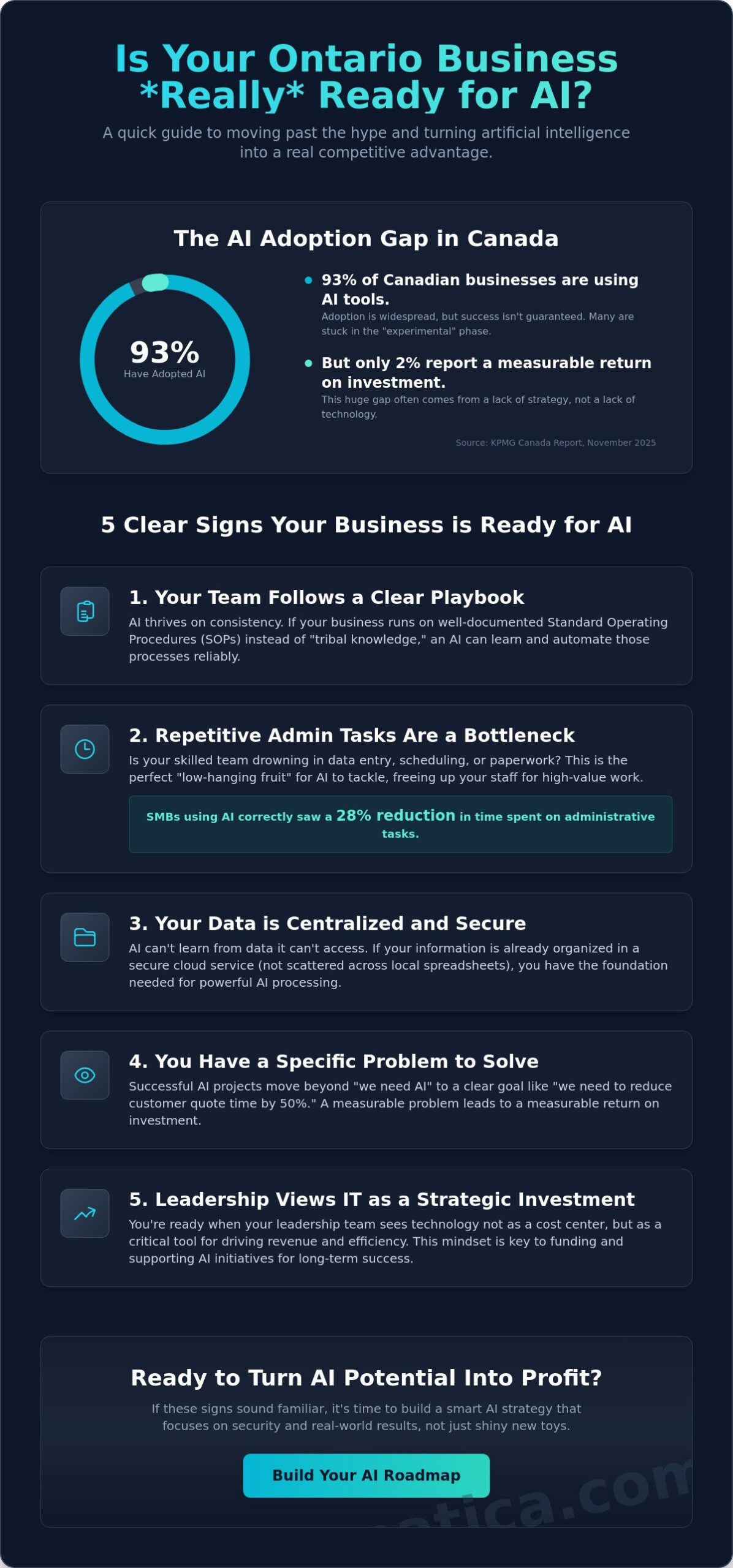
Did you know that while 93% of Canadian businesses have adopted some form of artificial intelligence, only 2% report a measurable return on investment according to a November 2025 KPMG Canada report? This staggering gap often stems from a fear of wasting money on “shiny object” tech or legitimate concerns about data privacy. If you are looking for a clear path forward, understanding the 5 Signs Your Ontario SMB Is Ready to Implement AI is the first step toward ensuring your technology spend actually translates into operational growth. You don’t need a massive IT department to succeed, but you do need a strategy that prioritizes security and practical results.
We understand that as a business leader, you want technology to be a silent, efficient facilitator of your goals. You might worry about a lack of internal technical expertise or how to keep your data safe under new provincial regulations. This guide will provide you with a straightforward framework to evaluate your business maturity. We’ll cover the essential infrastructure required for AI success and show you how to identify specific bottlenecks that these tools can solve. By the end, you’ll have the confidence to decide if your Kitchener business is truly ready to turn AI potential into a reliable competitive advantage.
Key Takeaways
- Learn why having followed Standard Operating Procedures (SOPs) is the most critical operational milestone for successful AI integration.
- Identify the 5 Signs Your Ontario SMB Is Ready to Implement AI to ensure your technology investment delivers measurable ROI instead of becoming a “shiny object” expense.
- Understand the essential role of a secure cloud services foundation in protecting your business data and meeting new provincial transparency requirements.
- Discover how to find “low-hanging fruit” and hidden AI features within your current software stack to start your journey without an enterprise-sized budget.
- Gain a clear framework for aligning AI tools with specific business bottlenecks to turn technology into a silent, efficient facilitator of your core goals.
The 2026 AI Reality Check for Ontario Small Businesses
2026 marks a major shift for local companies. As of January 1, 2026, the Ontario Employment Standards Act now requires employers to disclose the use of AI in hiring processes. This regulatory change signifies that the province has moved past the trial phase of automation. For many, the first step is recognizing the 5 Signs Your Ontario SMB Is Ready to Implement AI before committing a single dollar to new software. You don’t want to be part of the 93% of Canadian businesses that have adopted AI but struggle to see a return on investment.
True readiness isn’t about having the fastest computers or the biggest budget. It’s found at the intersection of clean data, repeatable processes, and strategic leadership. AI readiness is a state where business logic is documented well enough for a machine to follow. If your team still relies on unwritten rules or “tribal knowledge” to get work done, no amount of software will fix the underlying confusion. You’ll simply be stuck in “Experimental AI” where people play with chatbots without a plan to drive revenue.
Moving to “Operational AI” requires a focus on tangible results and risk mitigation. The 2026 AI Reality Check for Ontario Small Businesses shows that success depends on having a clear framework for every tool you adopt. By using professional AI Business Solutions, you can ensure your data stays private while your operations become more efficient. Research from 2025 suggests that Canadian small businesses using these tools properly saw a 28% reduction in time spent on administrative tasks. That is the difference between a “shiny object” and a strategic asset.
Why “Small” is an Advantage in the AI Race
Agility is a superpower for Kitchener-Waterloo startups and Mississauga manufacturers. You can pivot and implement changes in weeks, while corporate giants take years to clear legal hurdles. Today’s niche AI tools cater specifically to SMB budgets and specific use cases, meaning you don’t need a massive IT department to compete. When you identify the 5 Signs Your Ontario SMB Is Ready to Implement AI, you’re positioning your business to be a leader in your specific market. You are turning technology into a silent, efficient facilitator of your long-term growth.
5 Clear Signs Your Business Is Ready for AI Integration
Identifying the 5 Signs Your Ontario SMB Is Ready to Implement AI is less about your technical budget and more about your operational maturity. If your business demonstrates these five indicators, you’re positioned to turn technology into a silent, efficient facilitator of your growth. Success happens when AI solves a specific bottleneck rather than acting as a generic tool.
- Standard Operating Procedures (SOPs) are followed: AI requires a blueprint. If your team follows consistent, documented steps to complete tasks, a machine can learn to replicate those patterns.
- Admin tasks are overwhelming your team: A 2025 survey found that Canadian small businesses using AI reported a 28% reduction in time spent on administrative work. If your staff is drowning in high-volume, low-value data entry, it’s time to automate.
- Your data is centralized in the cloud: AI can’t process information trapped in paper files or disconnected local spreadsheets. Moving to professional cloud services ensures your data is accessible and ready for processing.
- You have a measurable problem to solve: Readiness means moving past “we need AI” to “we need to reduce our customer quote time by 50%.” Specific goals lead to a measurable return on investment.
- Leadership views IT as a strategic investment: When you stop seeing technology as a utility bill and start seeing it as a revenue driver, you’re ready for AI Business Solutions that scale with your goals.
Understanding how to start your AI journey without an enterprise budget begins with these internal checks. It’s about ensuring your foundation is stable enough to support new layers of automation without collapsing under the weight of “shiny object” syndrome.
The “Red Flags”: When to Hit the Brakes on AI
The biggest risk to your ROI is trying to automate a broken process. If your workflows only exist “in people’s heads” and vary from day to day, implementing AI will only make your mistakes happen faster. We often advise clients to document and stabilize their manual processes before introducing complex algorithms. This proactive approach prevents the common pitfall of wasting money on tech that your team won’t actually use because it doesn’t fit their reality.
Building the Foundation: Infrastructure and Cybersecurity
Implementing AI without the right infrastructure is like trying to run a high-performance engine on a bicycle frame. To move beyond the experimental phase, your business needs a solid digital foundation. This starts with robust cloud services that provide the necessary processing power to handle large datasets. Without a centralized cloud environment, your AI tools will struggle to access the information they need, leading to slow performance and unreliable results.
Security must be your primary concern when evaluating the 5 Signs Your Ontario SMB Is Ready to Implement AI. AI tools can inadvertently become data leak risks if they aren’t configured with a “Security First” mindset. This is especially true in regions like Kitchener-Waterloo and the GTA West, where many businesses handle sensitive client information. You must ensure your data remains protected and compliant with Ontario-specific privacy standards like PHIPA or FIPPA. Integrating professional cybersecurity services ensures that the data your AI uses stays within your control and away from unauthorized eyes.
The Ontario Chamber of Commerce’s Artificial Intelligence (AI) Hub highlights that privacy and security are the top hurdles for local small businesses. By addressing these technical requirements early, you transform technology into a silent, efficient facilitator of your goals. You’ll gain the peace of mind that comes from knowing your operation is under competent, proactive management. If you’re unsure about your current setup, it’s wise to evaluate your IT strategy before deploying new automation tools.
The Role of Managed IT in AI Success
A professional managed IT partner acts as a guardian for your digital operations. They prepare your network for the increased traffic that AI applications generate, ensuring that your daily work doesn’t slow down. More importantly, they help you establish “Data Hygiene.” This process involves cleaning and organizing your files so the AI doesn’t learn from old or incorrect information. Clean data is the fuel for successful automation, and it’s a critical step in any realistic AI roadmap for a growing business.
How to Start Your AI Journey Without an Enterprise Budget
You don’t need a massive capital investment to begin your transformation. Once you’ve identified the 5 Signs Your Ontario SMB Is Ready to Implement AI, the next phase is about smart, incremental steps. Start by finding your “low hanging fruit.” This means picking one high-impact, low-complexity use case, such as automating routine customer service responses or streamlining your invoicing process. By focusing on a single bottleneck, you can prove the value of the technology without overextending your resources.
Your next move should be a thorough audit of your current software stack. Many of the tools you already use daily likely have “hidden” AI features that are included in your existing subscriptions. Before you buy anything new, see if your CRM or project management tools offer automation capabilities you haven’t activated yet. If you need guidance on how to integrate these tools safely, partnering with experts who specialize in AI business solutions for SMBs can save you months of trial and error.
Launching a 30-day pilot project is the best way to test your readiness. During this month, don’t just look at the raw numbers. Measure the impact on your team’s “serenity” and overall productivity. If your staff feels less stressed because they’re no longer bogged down by repetitive tasks, you’ve found a winning strategy. This phased approach ensures you are following the 5 Signs Your Ontario SMB Is Ready to Implement AI while keeping your budget under control.
Moving from Strategy to Execution
Success requires a clear technology roadmap before you commit to any major changes. This plan acts as your guide, ensuring every new tool aligns with your long-term business goals. We also recommend a “human-in-the-loop” philosophy. Technology should support your team, not replace their judgment. Keeping a person involved in the final decision-making process maintains quality and builds trust with your clients, ensuring your AI remains a helpful assistant rather than a liability.
Secure Your Competitive Advantage with Practical AI
Turning the promise of artificial intelligence into a reliable business tool requires more than just installing software. It’s about ensuring your internal processes are documented and your data is clean enough for automation to work effectively. By focusing on the 5 Signs Your Ontario SMB Is Ready to Implement AI, you can avoid the common pitfalls of “shiny object” tech and instead build a foundation that supports long-term growth. Remember that starting with a 30-day pilot project allows you to measure real-world impact on your team’s productivity before scaling up.
We provide the local expertise in Kitchener, Waterloo, and the GTA needed to manage these complex transitions. Our approach focuses on secure, risk-managed implementation and strategic vCIO leadership to align your technology with your 2026 goals. We handle the technical complexity so you can focus on your core business activity with total serenity. If you’re ready to move from theory to execution, Explore AI Business Solutions Tailored for Your Team. Your journey toward a more efficient, automated future starts with a single, well-planned step.
Frequently Asked Questions
How much does it cost for a small business in Ontario to implement AI?
Costs depend on the scope of your project and whether you choose pre-built tools or custom integrations. Many local companies offset these investments by applying for government programs like the Digital Competence Centre (DCC) grants, which provide matched funding up to $15,000 for technology planning. It’s wise to evaluate the 5 Signs Your Ontario SMB Is Ready to Implement AI before spending, as a readiness assessment ensures you don’t waste money on tools your infrastructure can’t support yet.
Do I need to hire a data scientist to use AI in my business?
You don’t need to add expensive specialized staff to your payroll to benefit from automation. Most small businesses succeed by leveraging managed AI Business Solutions or partnering with a provider who handles the technical complexity for them. This allows your existing team to focus on high-value work while the technology functions as a silent, efficient facilitator. You simply need a partner who can translate your business goals into a clear technology roadmap.
Is AI safe for my company’s private client data?
AI is safe as long as you avoid using public, consumer-grade platforms for sensitive tasks. By deploying automation within a private cloud environment and using professional cybersecurity services, you can keep your data protected and compliant with Ontario’s 2026 principles for responsible AI. A “Security First” approach ensures that your client information remains private and your business stays ahead of provincial data sovereignty requirements.
What is the most common AI use case for SMBs in 2026?
The most frequent application is automating repetitive administrative tasks to free up staff time. A 2025 survey found that Canadian small businesses using AI tools reported saving an average of 28% of their time on admin work. Many companies in the Kitchener-Waterloo region also use AI to streamline recruitment and customer service, though they must now disclose AI use in job postings to comply with the January 2026 updates to the Ontario Employment Standards Act.
Can AI help with Ontario-specific compliance and reporting?
Yes, AI is highly effective at tracking local regulatory changes and managing complex reporting requirements. For example, automation can help you monitor your eligibility for the Ontario small business corporate income tax rate, which dropped to 2.2% in July 2026. By integrating these tools into your IT strategy, you can ensure your business meets provincial standards while your leadership focuses on hitting core performance metrics.