
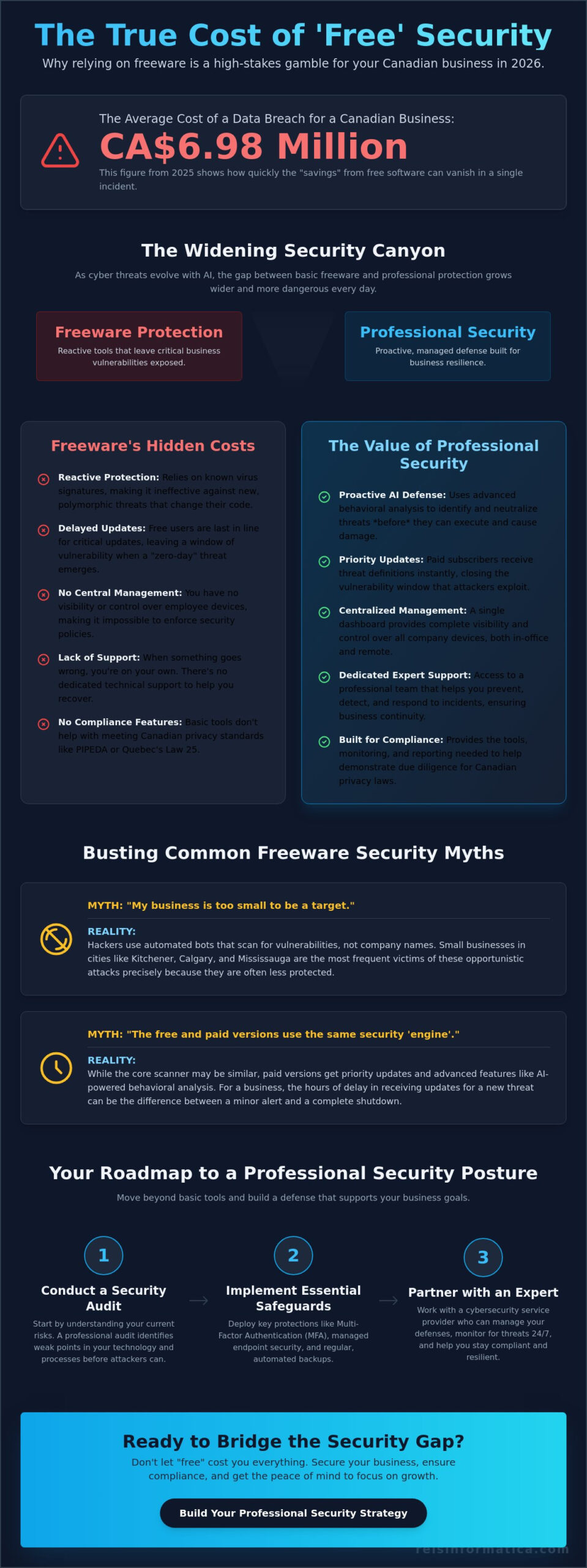
Did you know the average cost of a data breach for a Canadian business climbed to CA$6.98 million in 2025? When you’re managing a tight IT budget, opting for freeware computer security feels like an easy win for the bottom line. It’s natural to want to save money where you can, especially when you’re balancing growth with rising operational costs. However, in 2026, the gap between basic free protection and professional security has become a dangerous canyon that ransomware attackers are ready to exploit.
We agree that every dollar in your budget needs to work hard for your organization. That’s why this article will help you understand why relying on freeware might actually be costing your business more in hidden risks than a premium subscription. You’ll discover how to transition from basic tools to a professional security posture that meets Canadian standards like PIPEDA and Quebec’s Law 25. We’ll provide a clear roadmap to ensure your operations remain resilient, giving you the peace of mind to focus on your core business goals while your technology remains a silent, efficient facilitator of your success.
Key Takeaways
- Understand the hidden limitations of freeware computer security and why the “freemium” model often leaves critical business vulnerabilities exposed.
- Debunk common myths about small business immunity and learn why hackers target organizations in cities like Kitchener and Waterloo regardless of their size.
- Identify the operational risks of using unmanaged software, such as the inability to monitor employee devices or access dedicated technical support when issues arise.
- Discover a clear roadmap for building a professional security posture that prioritizes business continuity and ensures compliance with Canadian privacy laws like PIPEDA.
- Learn how to move beyond basic tools by conducting security audits and implementing essential safeguards like Multi-Factor Authentication across your organization.
Understanding Freeware Computer Security in 2026
When we talk about freeware computer security, we’re referring to software provided at no cost to the user, typically designed to offer a foundational layer of protection against common digital threats. In the Mississauga business community, it’s common to see startups and small teams relying on these tools to keep overhead low. Most of these applications operate on a “freemium” model. This means the developer gives away a basic version for free, hoping you’ll eventually upgrade to a paid subscription for more advanced features. While these tools can be helpful for personal use, they often function in a reactive way. They wait for a known threat to appear before taking action, which is a significant gamble in 2026.
The modern threat landscape has shifted dramatically. Cybercriminals now use AI to launch sophisticated, polymorphic attacks that change their code to evade detection. Basic signature-based scanners, which look for “fingerprints” of known viruses, simply can’t keep up. For a business, this creates a dangerous gap. While freeware might stop a common Trojan, it often lacks the proactive monitoring needed to spot a ransomware attack before it encrypts your server. Transitioning to professional cybersecurity services moves your organization from a state of “hoping for the best” to a posture of active defense and resilience.
The Evolution of Free Security Tools
Free tools have come a long way from the simple virus scanners of the early 2000s. Today, many offer multi-layered suites that include basic firewalls and phishing protection. You might even find a comprehensive list of free security software that includes tools built directly into your operating system. While modern OS-level security is much stronger than it used to be, it’s designed as a general safety net for the average consumer. It doesn’t offer the deep visibility or granular control that a business owner needs to manage multiple devices and remote employees effectively.
Why Businesses are Tempted by Freeware
Budget constraints are a reality for many Canadian SMEs. It’s tempting to think that all security software provides the same level of safety, but that’s a costly misconception. The primary draw of freeware is the CA$0 price tag, which looks great on a balance sheet. However, one in six Canadian businesses faced a cyber incident in 2023. As these attacks become more automated, the cost of a single hour of downtime often far exceeds the annual cost of professional protection. Choosing a tool based only on the initial price ignores the long-term value of business continuity and data integrity.
Busting the Top 4 Myths About Free Security Software
Many business owners believe they’ve found a clever shortcut with freeware computer security. It’s a tempting psychological safety net that feels like getting something for nothing. However, this reliance often stems from fundamental misunderstandings about how modern digital threats operate against Canadian organizations. Let’s look at the four most common myths that leave local businesses vulnerable to expensive disruptions.
The Reality of the “Engine” Argument
While some evaluations of free antivirus software show decent detection rates for known files, they don’t tell the whole story. Paid versions prioritize advanced behavioral analysis and AI that can spot a threat based on what it does, not just what it looks like. Free users also sit at the back of the line for update cycles. When a new “zero-day” threat emerges, paid subscribers usually get the definition updates hours before the free version catches up. For a business, those few hours can be the difference between a normal Tuesday and a total system wipe.
The Myth of the “Small Target”
It’s common to hear managers say, “I’m just a small shop in Waterloo; why would a hacker care about me?” This is the most dangerous line of thinking in the current climate. In 2026, automated botnets target vulnerabilities, not company names, making small businesses the most frequent victims of opportunistic attacks. These bots don’t check your annual revenue before they strike; they simply look for an open door. Building a “human firewall” through Cybersecurity Awareness in 2026 is just as vital as the software you install to protect your endpoints.
Myth 3: The “Clean Up” Fallacy
There’s a belief that if an infection happens, the free tool will just clean it up without any downtime. Real-world recovery is rarely that simple. A virus often leaves backdoors or corrupts critical system files. Cleaning a business machine usually involves hours of downtime and data restoration to ensure the intruder is actually gone.
Myth 4: The Compliance Gap
Finally, many assume freeware is compliant with Canadian data protection laws. It isn’t. Regulations like PIPEDA or Quebec’s Law 25 require “appropriate safeguards” and detailed breach reporting. Most free tools lack the audit logs needed to prove you were protected if a regulator investigates. If you’re concerned about meeting these legal standards, reviewing your current cybersecurity services is a smart first step toward true operational serenity.
Why “Free” Isn’t Enough for Businesses in Kitchener, Calgary, and Beyond
If you have five employees in Kitchener and three in Calgary, managing individual freeware computer security installations is an operational nightmare. There’s no central dashboard to check. You can’t see if an employee disabled their protection because a pop-up was annoying them or if a scan hasn’t run in weeks. This lack of visibility is one of the primary risks of relying on free antivirus in a corporate environment. When you can’t verify your security status across the whole team, you’re essentially flying blind.
The “support gap” is another harsh reality. When a free tool fails or causes a system conflict in Mississauga or Halifax, who do you call? You’re usually left hunting through community forums while your staff sits idle. In a professional setting, waiting for a stranger on the internet to reply to a thread isn’t a viable business strategy. It’s the difference between having a dedicated partner and being entirely on your own during a crisis.
The Hidden Cost of Downtime
Let’s look at the math. If a free tool fails and your team sits idle for even half a day, what does that cost you in wages and lost revenue? The average cost of a data breach in Canada reached CA$6.98 million in 2025, but even a minor infection can be devastating for a small business. Professional Cybersecurity Services provide the proactive monitoring needed to catch threats before they turn into expensive downtime. It’s about spending a little to save a lot of potential grief later.
Compliance and Legal Responsibility
Under PIPEDA, Canadian businesses must use appropriate safeguards to protect personal data. Using a tool meant for home users likely won’t satisfy a regulator or an insurance adjuster if a breach occurs. Most cyber-liability insurance policies require proof of professional-grade protection and detailed audit trails. Without the reporting features found in comprehensive Network Security Services, you might find your insurance claim denied. Protect your organization’s future by partnering with a team that understands the Canadian regulatory landscape through our Cybersecurity Services.
Moving Beyond Freeware: Building a Professional Security Strategy
Transitioning away from freeware computer security isn’t just about buying a better app. It’s about shifting your mindset from reactive firefighting to proactive management. A professional strategy ensures that your technology serves as a silent facilitator for your growth, rather than a constant source of anxiety. To build this posture, you need a structured approach that covers both technical tools and human behavior.
- Step 1: Conduct a Security Audit. You can’t protect what you don’t understand. A comprehensive audit identifies where your data lives and where the “open windows” are in your current setup.
- Step 2: Implement Multi-Factor Authentication (MFA). This is one of the most effective ways to block unauthorized access. Even if a password is stolen, MFA provides a critical second layer of defense.
- Step 3: Embrace Managed IT. Moving to Managed IT Services takes the burden of updates and monitoring off your plate. This model provides the centralized control that free tools lack.
- Step 4: Train Your Team. Your employees are your first line of defense. Regular training turns them into a “Human Firewall” capable of spotting phishing attempts before they click.
The Role of IT Leadership and Strategy
Software alone isn’t a strategy. To truly secure a Mississauga business, you need leadership that aligns technology with your long-term goals. A virtual CIO (vCIO) provides this high-level guidance without the cost of a full-time executive. They help you plan budgets and ensure that every tech investment actually reduces your risk profile. Proactive maintenance beats reactive “cleaning” every time because it prevents the disruption from happening in the first place.
Leveraging AI for Modern Defense
In 2026, we use AI Business Solutions to stay ahead of attackers. These tools can predict and block threats before they even execute on your system. Endpoint Detection and Response (EDR) provides continuous monitoring and response to advanced threats that traditional antivirus misses. By integrating AI and EDR into your freeware computer security replacement plan, you ensure your operation remains resilient against even the most sophisticated modern attacks.
Securing Your Business Growth Beyond Basic Protection
The digital landscape of 2026 requires more than just a foundational safety net. While freeware computer security might offer a starting point for individual users, it lacks the centralized control and proactive defense required to protect a growing Canadian enterprise. Relying on unmanaged tools leaves your operations vulnerable to downtime and regulatory risks under PIPEDA. You’ve learned that true resilience comes from visibility and a strategy that scales with your goals.
Professional security isn’t just about installing software; it’s about a strategic partnership. This approach combines advanced technology with expert leadership to ensure your systems remain a silent, efficient facilitator of your success. By moving from a reactive “cleaning” mindset to proactive management, you protect your business continuity and your professional reputation in an increasingly complex environment.
Whether you operate in Kitchener, Waterloo, Calgary, or Halifax, our team provides the expert IT strategy and proactive monitoring you need to stay ahead of modern threats. Secure your business with a professional Cybersecurity Audit from Reis Informatica today. Taking this step allows you to focus on your core goals with the confidence that your operation is under competent, vigilant management.
Frequently Asked Questions
Is Windows Defender considered freeware computer security?
Yes, Microsoft Defender is a built-in form of freeware computer security that comes pre-installed on Windows devices. While it provides a solid baseline of protection for individual home users, it often lacks the centralized management and advanced reporting features that a business needs. Relying on it alone makes it difficult for a manager to verify that every device in the company is actually updated and secure.
Can I use free antivirus for my small business employees?
You should check the end-user license agreement (EULA) before installing free antivirus on any work machine. Many popular free versions are strictly for personal, non-commercial use, meaning their use in a business setting could lead to legal complications or compliance issues. Beyond the legal aspect, these tools don’t allow you to manage all employee devices from one location, which creates significant visibility gaps for your team.
What is the biggest difference between free and paid security software?
The most significant difference is the ability to manage every device in your organization from a single, unified dashboard. Paid solutions provide this central control, allowing you to push updates and monitor threats across the entire network instantly. They also include advanced detection technologies like Endpoint Detection and Response (EDR). These tools use behavioral analysis to stop new, unknown threats that basic scanners usually miss.
Does free security software protect against ransomware?
Most freeware computer security tools provide basic protection against known ransomware files, but they often struggle against the sophisticated attacks seen in 2026. Modern ransomware frequently uses AI to bypass simple signature-based scanners. Professional-grade solutions offer more robust layers, such as behavioral monitoring that can detect and stop suspicious encryption processes in real time. This proactive approach is essential for maintaining your business continuity and preventing data loss.
How do I know if my current security setup is enough for my business?
You can evaluate your current setup by checking if it meets Canadian regulatory standards like PIPEDA or Quebec’s Law 25. If you cannot produce an audit log showing your protection status or if you lack Multi-Factor Authentication (MFA) across all accounts, your posture is likely insufficient. A professional security audit is the most effective way to identify these hidden vulnerabilities and ensure your operation remains resilient against potential disruptions.