
Recent data from IBM’s 2023 Cost of a Data Breach Report shows that Canadian organizations now face an average cost of C$6.94 million per security incident. You likely feel the weight of this reality every time you hear about a new leak or struggle to translate complex security jargon into plain English. It’s stressful to manage remote teams from Toronto to Waterloo while worrying if a single mistake will compromise your entire network. Implementing modern data breach prevention solutions isn’t just a technical checkbox; it’s the only way to safeguard the reputation you’ve spent years building.
You deserve a strategy that works silently in the background so you can focus on your actual business goals. We’ll show you how proactive, AI-driven tools can shield your infrastructure and ensure you stay compliant with Canadian privacy laws. This guide provides a clear security roadmap to give you total peace of mind, knowing that expert eyes are constantly monitoring your systems for any sign of trouble.
Key Takeaways
- Understand why businesses in regions like Waterloo and Toronto are prime targets for cyberattacks and why a breach impacts much more than just your passwords.
- Discover how to implement modern data breach prevention solutions like Multi-Factor Authentication (MFA) to build a resilient first line of defense for your company.
- Learn how to navigate Canadian privacy regulations, including PIPEDA and PHIPA, to ensure your business remains compliant and avoids significant legal risks.
- Explore the shift from reactive fixes to proactive security through comprehensive cybersecurity audits and AI-driven monitoring that stops threats before they strike.
- Find out how partnering with a local strategic IT expert provides the peace of mind needed to focus on your business while your infrastructure stays secure and efficient.
What is a Data Breach and Why are Local Businesses Targets?
Security isn’t a luxury anymore; it’s a fundamental part of your business continuity plan. To truly understand what is a data breach, you have to look past the cliché of a hooded hacker stealing a single password. A breach occurs whenever sensitive, protected, or confidential data is viewed, copied, or stolen by an unauthorized individual. This includes your proprietary designs, client SIN numbers, and private financial records. For a business in the GTA, this isn’t just a technical glitch. It’s a catastrophic event that can halt operations for weeks.
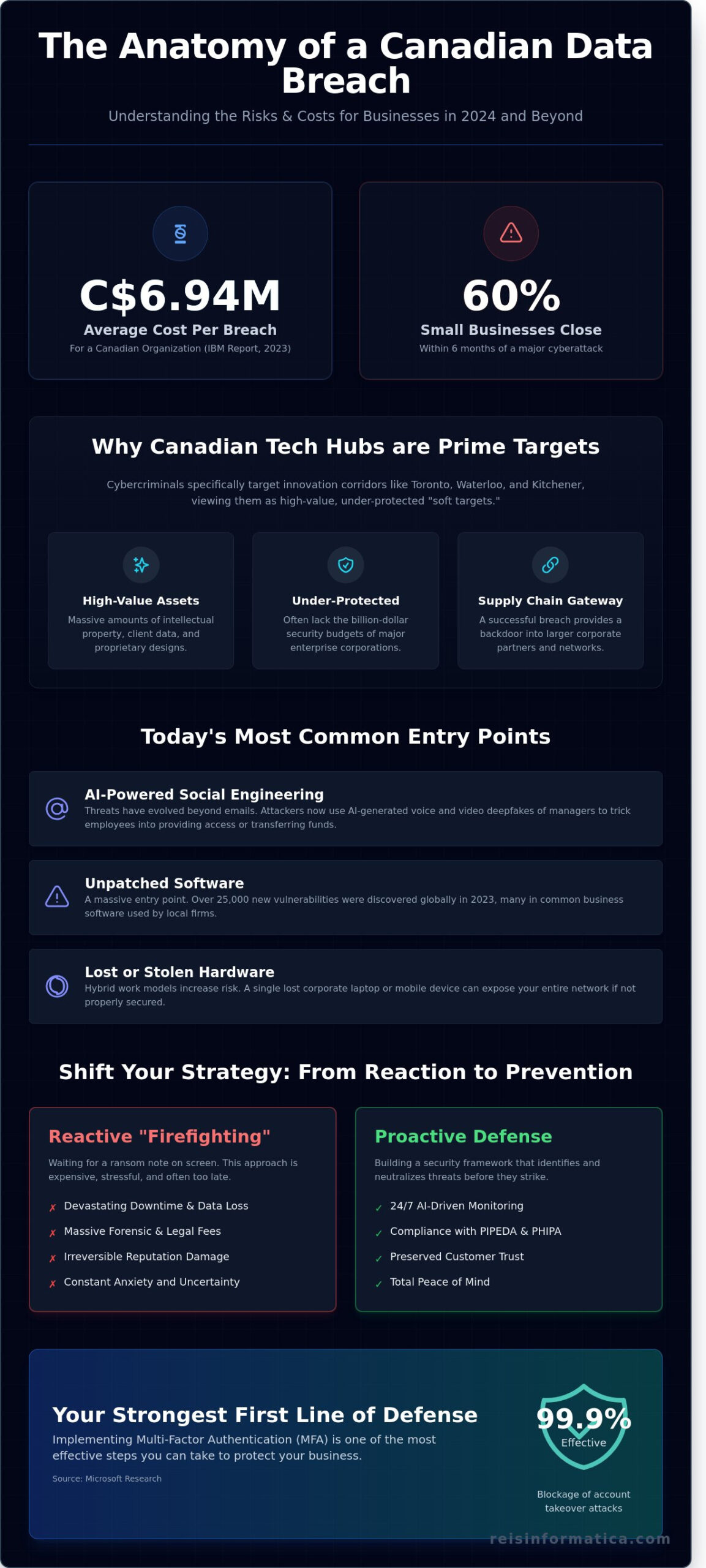
Hackers focus on Kitchener, Waterloo, and Cambridge because these cities represent the heart of Canada’s tech innovation. These mid-sized hubs are filled with high-growth companies that handle massive amounts of intellectual property but often lack the billion-dollar security budgets of major banks. Cybercriminals view these local businesses as “soft targets” with high-value assets. They know that a successful exploit here can provide a backdoor into larger supply chains across North America.
Financial losses from these incidents are staggering. According to the 2023 IBM Cost of a Data Breach Report, the average cost for a Canadian organization reached C$6.94 million. These figures aren’t just from direct theft. They include the heavy price of system downtime, legal fees to comply with the Digital Privacy Act (PIPEDA), and the massive expense of forensic investigations. Most devastatingly, 60% of small businesses that suffer a major breach close their doors within six months because they can’t recover the lost customer trust.
Moving away from reactive “firefighting” is the only way to survive. Many owners wait until a screen turns red with a ransom note before they call for help. This reactive approach is expensive and often ineffective. Implementing proactive data breach prevention solutions allows you to identify vulnerabilities before they’re exploited. You shift the burden from your internal team to a dedicated security framework that monitors your network 24/7. This transition ensures your technology remains an asset rather than a liability.
Common Ways Data Breaches Happen in 2026
Social engineering has evolved into a sophisticated threat using AI-generated voice and video to trick employees into granting access. It’s no longer just a suspicious email; it’s a deepfake of a manager asking for a wire transfer or a login credential. Additionally, unpatched software in everyday tools remains a massive entry point. In 2025, over 25,000 new vulnerabilities were discovered globally, many in software used by local Toronto firms. Finally, lost or stolen corporate hardware continues to plague businesses, especially as hybrid work models keep laptops and mobile devices in transit between the office and home.
The Local Impact on Canadian Business Reputation
A breach in Toronto or Ottawa doesn’t stay quiet; it makes local headlines and spreads through LinkedIn circles instantly. For companies in the Mississauga tech corridor, reputation is your most valuable currency in B2B partnerships. If your systems are compromised, your partners will view you as a weak link in their own security chain. Many modern data breach prevention solutions are now a prerequisite for winning government contracts or working with enterprise-level clients. You must realize that “being small” is no longer a defense. Automated bots scan millions of IP addresses every hour, looking for any open door in Kitchener or Cambridge regardless of the company’s size.
Core Data Breach Prevention Solutions: The Modern Security Stack
Think of your business security as a series of concentric circles. At the center sits your most valuable asset: your data. To protect it effectively, Toronto firms need a layered approach that doesn’t just build a wall, but creates an active defense system. This modern stack relies on four pillars that work together to stop intruders before they gain a foothold. Effective data breach prevention solutions aren’t about buying a single piece of software; they’re about creating an environment where security is built into every click.
Identity and Access Management (IAM) is your first pillar. It acts as a digital gatekeeper, ensuring that an employee in your marketing department can’t access sensitive payroll files. By controlling who sees what, you limit the “blast radius” if an account is ever compromised. When you pair IAM with Multi-Factor Authentication (MFA), your security posture transforms. Microsoft research shows that MFA blocks 99.9% of account takeover attacks. It’s a simple, non-negotiable step that prevents a stolen password from becoming a total catastrophe.
Next, we look at Endpoint Detection and Response (EDR). Old antivirus programs only looked for known viruses, but EDR watches for suspicious behavior. If a laptop in your North York office starts encrypting files at 2 AM, EDR recognizes the pattern of a ransomware attack and isolates the device instantly. Finally, there’s encryption. This is your last line of defense. If a criminal manages to steal a hard drive or intercept a file, encryption makes that data useless to them. It’s a core recommendation found in the privacy breach management toolkit, which serves as a vital resource for Canadian businesses looking to align with federal standards.
Securing Your Remote Workforce
Your team likely isn’t confined to a single office anymore. Whether you have employees working from home in Halifax, Calgary, or London, they need the same level of protection as those in your main headquarters. We recommend moving away from basic VPNs toward Zero Trust Architecture. This approach doesn’t trust any connection by default, even if it comes from a known employee. It’s especially important for managing personal devices used for work, as it ensures your corporate data stays isolated from an employee’s personal apps and files.
Cloud Security Solutions
Many owners worry about the safety of the cloud, but modern cloud services often offer significantly better protection than old on-premise servers. In 2023, IBM reported that the average cost of a data breach in Canada reached C$6.94 million. Cloud providers spend billions on security infrastructure that most small businesses simply can’t afford on their own. The key is configuration. Most cloud leaks happen because of human error, like leaving a database open to the public. We take a “Vigilant Partner” approach, using continuous monitoring to audit your permissions and close those gaps before they can be exploited. Implementing these data breach prevention solutions ensures your transition to the cloud is a step toward better security, not a new risk.
Compliance and Data Protection Standards in Canada
PIPEDA isn’t just a suggestion for Toronto business owners; it’s the federal law that governs how you handle personal information. If your company collects names, email addresses, or payment details, you’re legally responsible for that data’s safety. The Office of the Privacy Commissioner of Canada offers specific data breach prevention tips for businesses to help you stay compliant. Ignoring these standards can lead to heavy fines and a permanent loss of customer trust. We see compliance as the foundation of a healthy business, not just a box to check once a year.
Data sovereignty is another critical piece of the puzzle. Storing your information on Canadian soil keeps it under the protection of Canadian laws. This avoids the complications of the US CLOUD Act, which allows foreign authorities to access data stored on their servers. By keeping your data local, you maintain full control over who sees your proprietary information. Regular security audits serve as your proof of commitment. These reviews show regulators and clients that you’ve implemented professional data breach prevention solutions to safeguard their most sensitive assets.
According to the 2023 IBM Cost of a Data Breach Report, the average cost of a breach for a Canadian organization is C$6.94 million. This figure includes legal fees, lost productivity, and the price of notifying every affected individual. Investing in prevention isn’t just about security; it’s a vital financial strategy to protect your bottom line. We focus on making these technical requirements easy to understand so you can make informed decisions without needing a computer science degree.
Meeting Regulatory Requirements in Ontario
Legal and healthcare firms in Kingston and Milton must follow even stricter rules. The Personal Health Information Protection Act (PHIPA) requires healthcare providers to maintain rigorous access logs and encryption standards. Documenting every security measure you take provides a vital layer of legal protection if an incident occurs. This trail of evidence proves you took “reasonable steps” to prevent a leak. Many insurance providers now require this documentation before they’ll even issue a policy. In 2024, businesses with verified security protocols often see a 10% to 15% reduction in their cyber insurance premiums because they represent a lower risk.
Addressing the “Too Small to Care” Objection
Many small business owners believe they’re too small to be a target. The reality is quite different. Data from 2023 indicates that 43% of all cyberattacks target small and medium enterprises (SMEs). Hackers don’t hand-pick their victims; they use automated bots to scan thousands of Canadian IP addresses every minute. These bots look for any open door, regardless of the company’s size. If your network has a vulnerability, the software will find it and deploy ransomware instantly.
Your larger clients also care deeply about your security. This is known as “Supply Chain” risk. Large corporations in the GTA now audit their smaller vendors to ensure they won’t become a back door for hackers. If you can’t prove you use modern data breach prevention solutions, you might lose out on lucrative contracts. Security has become a competitive advantage. Showing your partners that you’re a “Vigilant Partner” makes you a much more attractive choice for long-term collaboration. It’s about protecting your reputation just as much as your files.
Building a Proactive Defense: Training and AI Monitoring
Transitioning from a reactive “fix it when it breaks” mindset to a proactive stance is the only way to protect your bottom line. In Canada, the average total cost of a data breach reached C$6.94 million in 2023, according to IBM’s annual report. You can’t afford to wait for an alarm to go off. You need a structured approach to data breach prevention solutions that covers both your digital infrastructure and your team’s daily habits.
- Step 1: Conduct a comprehensive cybersecurity audit. You can’t protect what you don’t know exists. An audit identifies where your sensitive data lives, who has access to it, and which legacy systems are creating “back doors” for hackers. This is the foundation for meeting PIPEDA requirements and other Canadian privacy standards.
- Step 2: Implement AI-driven threat detection. These systems learn your business’s normal behavior patterns. If a user account suddenly tries to download 500 client files at 3:00 AM from a local IP address that hasn’t been used before, the AI flags and blocks the activity before the data leaves your network.
- Step 3: Establish a regular awareness training program. Since 82% of breaches involve a human element, your staff needs to know how to spot a “spear-phishing” attempt. Training shouldn’t be a one-time event; it works best when it’s a consistent part of your corporate culture.
- Step 4: Create an Incident Response Plan (IRP). Organizations with a tested IRP and a dedicated team saw breach costs that were C$2.66 million lower than those without one. This plan ensures you’re never caught off guard, providing a clear roadmap for communication, containment, and recovery.
The Human Element: Your Strongest or Weakest Link
Technology alone won’t stop a sophisticated social engineering attack. Hackers often bypass firewalls by simply tricking a person into giving up their credentials. To protect your Toronto or Ottawa office, you need to foster a “Security First” culture where employees feel empowered to question suspicious emails. Explain complex threats to non-technical staff by using simple analogies. For example, tell them that multi-factor authentication is like having both a key and a fingerprint scanner on your front door. When security feels like a shared responsibility rather than a set of annoying rules, your defense becomes much stronger.
Leveraging AI for Real-Time Prevention
Modern AI business solutions handle the high-volume monitoring that humans can’t keep up with. These tools automate the repetitive parts of security, such as scanning thousands of login attempts for signs of brute-force attacks. This reduces the risk of human error and fatigue. Because the global threat landscape never sleeps, the value of 24/7/365 monitoring is immense. AI doesn’t take lunch breaks or holidays. It provides a constant, vigilant eye on your network, ensuring that your data breach prevention solutions are active every second of the day. This proactive layer allows your internal team to focus on growth rather than constantly putting out digital fires.
Don’t leave your company’s reputation to chance. If you haven’t reviewed your internal defenses in the last six months, you might be at risk. Secure your business with a professional security assessment and take the first step toward total peace of mind.
Partnering with a Local MSP for Total Peace of Mind
Many Toronto business owners treat IT like a plumber; they call only when a pipe bursts. This “break-fix” model is inherently dangerous. By the time you call for help, your sensitive data might already be circulating on the dark web. A strategic IT partner works differently. We don’t just fix problems; we prevent them from occurring. Our team specializes in tailored data breach prevention solutions that fit your specific industry needs, ensuring your systems stay resilient against evolving threats.
Local support in cities like London, Milton, and Calgary makes a massive difference for your response times. If a critical server fails or a security alert triggers, you can’t afford to wait for a technician in a different time zone to wake up. You need experts who understand Canadian privacy regulations like PIPEDA and can provide on-site assistance within hours. Local expertise means we understand the specific regional challenges your business faces every day.
Switching to a managed model also stabilizes your finances. A 2023 IBM report highlighted that the average cost of a data breach in Canada has reached C$6.94 million. Instead of risking a sudden, catastrophic expense, partnering with an MSP moves your IT costs from an unpredictable capital expense to a steady operational one. This shift can improve your operational efficiency by up to 25 percent. You get a predictable monthly fee that covers everything, making your budget easier to manage and your business more secure.
Reis Informática acts as your vigilant guardian in this digital world. We assume full responsibility for your technical complexity so you can focus on growth. We don’t just monitor your network; we hunt for vulnerabilities before hackers find them. It’s about moving from a state of constant tech-anxiety to a state of total confidence.
Managed IT Services as a Competitive Advantage
Implementing managed IT services allows your team to stop playing IT support and start focusing on your core business. You gain access to enterprise-grade security tools, such as advanced encryption and 24/7 threat monitoring, on a small business budget. This setup provides incredible scalability. As you grow from 10 employees to 50, your security posture strengthens alongside you without increasing your risk profile.
Next Steps for Your Business
Starting the journey toward better security begins with a simple, honest conversation about your current setup. During a consultation with our specialist team, we’ll perform a vulnerability assessment to identify where your defenses are thin. We explain everything in plain English, avoiding confusing jargon. Choosing the right data breach prevention solutions is the best way to secure your company’s future today. Reach out to our team to schedule your initial audit and take the first step toward total peace of mind.
Take Control of Your Digital Security Today
The threat landscape for Canadian businesses is shifting rapidly. With the average cost of a data breach in Canada reaching C$6.94 million according to 2023 IBM data, waiting for an incident to occur isn’t an option. You need a strategy that combines 24/7 AI monitoring with a deep understanding of local compliance standards like PIPEDA. Implementing the right data breach prevention solutions ensures your operations remain steady while protecting the trust you’ve built with your clients.
Reis Informática has supported businesses across Kitchener, Waterloo, and the GTA for over 20 years. We specialize in translating complex security jargon into clear business outcomes for leaders who don’t have a technical background. Our team acts as your vigilant partner, providing proactive support that stops threats before they reach your network. You deserve the peace of mind that comes from knowing your infrastructure is in expert hands.
Secure your business today with a professional Cybersecurity Audit from Reis Informática
Let’s build a resilient future for your company together.
Frequently Asked Questions
What is the most common cause of data breaches for small businesses?
Human error is the leading cause of security incidents; 82% of data breaches analyzed in the 2023 Verizon Data Breach Investigations Report involved the human element. This usually happens through phishing emails or poor password hygiene. Your team’s daily habits are the first line of defense, so using robust data breach prevention solutions alongside regular training ensures that one accidental click doesn’t compromise your entire Toronto operation.
How much do data breach prevention solutions cost for a mid-sized company?
Most mid-sized firms in Ontario invest between C$2,000 and C$6,000 monthly for comprehensive managed security services. This investment covers 24/7 monitoring, endpoint protection, and incident response readiness. While upfront costs might seem high, the average cost of a Canadian data breach reached C$6.94 million in 2023. Paying for proactive protection is significantly more affordable than recovering from a total system collapse after an attack.
Is my business in Calgary or Halifax really at risk from international hackers?
Yes, hackers target your digital footprint rather than your physical office location. Statistics from 2023 show that 43% of all cyberattacks target small businesses because they often lack enterprise-grade defenses. Distance doesn’t provide safety in a connected world. International syndicates use automated tools to scan for vulnerabilities across Canada, making local businesses just as visible as global corporations to attackers overseas.
Does having a backup protect me from a data breach?
Backups are essential for recovery, but they don’t stop a data breach from happening. While a 3-2-1 backup strategy ensures you can restore files after an attack, it won’t prevent hackers from stealing sensitive client data and threatening to leak it. You need proactive data breach prevention solutions to stop the initial intrusion. Prevention keeps the data inside your walls, while backups just give you a recovery option.
How often should we conduct a cybersecurity audit?
You should conduct a full cybersecurity audit at least once every 12 months to maintain your security posture. If your business undergoes a major change, like migrating to the cloud or adding 10 new employees, you need an interim review. Regular audits identify the 15 to 20 new vulnerabilities discovered daily in common software. Staying on a strict schedule ensures your defenses evolve as fast as the threats do.
What should I do immediately if I suspect a data breach has occurred?
Disconnect the affected device from the network immediately to stop the spread, but don’t turn it off. Powering down can destroy volatile evidence that your IT team needs for a forensic investigation. Once isolated, call your security partner to begin the 4-step containment process. Fast action within the first 60 minutes can reduce the total cost of a breach by over 30% according to recent industry benchmarks.
Can AI completely replace the need for human IT support?
AI can’t replace human IT support because security requires contextual judgment that algorithms lack. While AI tools can process 1 million events per second to find anomalies, they often trigger false positives that need a human expert to resolve. You need a partner approach where technology handles the speed and humans handle the strategy. Relying solely on automation leaves gaps that clever hackers easily exploit through social engineering.