
In 2024, the median salary for a cybersecurity specialist in Ontario tech hubs like Kitchener climbed to C$118,000 per year, and that figure doesn’t even include benefits or office overhead. You likely realize that the cost of in-house IT vs outsourcing is becoming a pivotal financial decision as local talent becomes harder to retain. It’s frustrating to watch your budget disappear into recruitment fees and expensive software licenses before you even solve a single technical issue. You want your technology to be a silent partner in your success, not a constant source of financial strain.
We’re here to provide total clarity by breaking down the real numbers so you can make a confident, data-driven choice for your business. You deserve a predictable monthly IT budget that protects your operations without the stress of local talent wars. This guide compares the projected salaries of 2026 with the streamlined efficiency of a managed partnership. We’ll examine the hidden costs of hiring and show you how to ensure your infrastructure remains in capable, proactive hands.
Key Takeaways
- Discover why the shift from reactive “break-fix” support to proactive managed services is essential for staying competitive in the 2026 Canadian tech market.
- Learn how to accurately calculate the total cost of in-house IT vs outsourcing by accounting for hidden expenses like payroll taxes and the rising talent costs in the GTA.
- See how businesses in Milton and Cambridge use fixed monthly models to access enterprise-grade security tools worth over C$100,000 for a fraction of the price.
- Use our ROI framework to uncover the true impact of “Shadow IT” and calculate exactly how much four hours of downtime costs your business operations.
- Understand how a strategic partnership in the Kitchener-Waterloo-Cambridge tech triangle can eliminate technical headaches so you can focus on your core growth.
The 2026 IT Landscape: Why Canadian Businesses are Rethinking Support
The year 2026 marks a definitive end to the reactive IT era. For years, companies in the Greater Toronto Area relied on a “break-fix” approach, only calling for help when a screen went blue or a server hummed its last breath. That model is now a financial drain. Modern businesses have shifted toward proactive managed services that prioritize uptime over repair. When evaluating the cost of in-house IT vs outsourcing, the decision often hinges on how much downtime your operations can actually survive.
Business owners in Mississauga and Toronto are realizing that “local” support doesn’t mean a technician needs a dedicated desk in their office. High-speed fiber and secure remote access mean an expert can resolve 98% of technical issues without ever stepping foot on-site. This shift allows your team to reclaim expensive square footage while maintaining instant access to high-level engineering. Integrating the business practice of outsourcing into your strategy isn’t just about cutting checks; it’s about gaining a partner that monitors your network while you sleep.
The tech talent crunch in Kitchener, Waterloo, and Cambridge has reached a fever pitch. As of January 2026, the average salary for a mid-level systems administrator in the “Technology Triangle” has climbed to C$98,500. When you factor in the Total Cost of Ownership (TCO), the price tag grows significantly. TCO includes recruitment fees, which often hit 20% of the first-year salary, plus the costs of ongoing certifications and specialized software licenses that an internal hire requires to stay relevant.
The Talent Gap in Ontario and Alberta
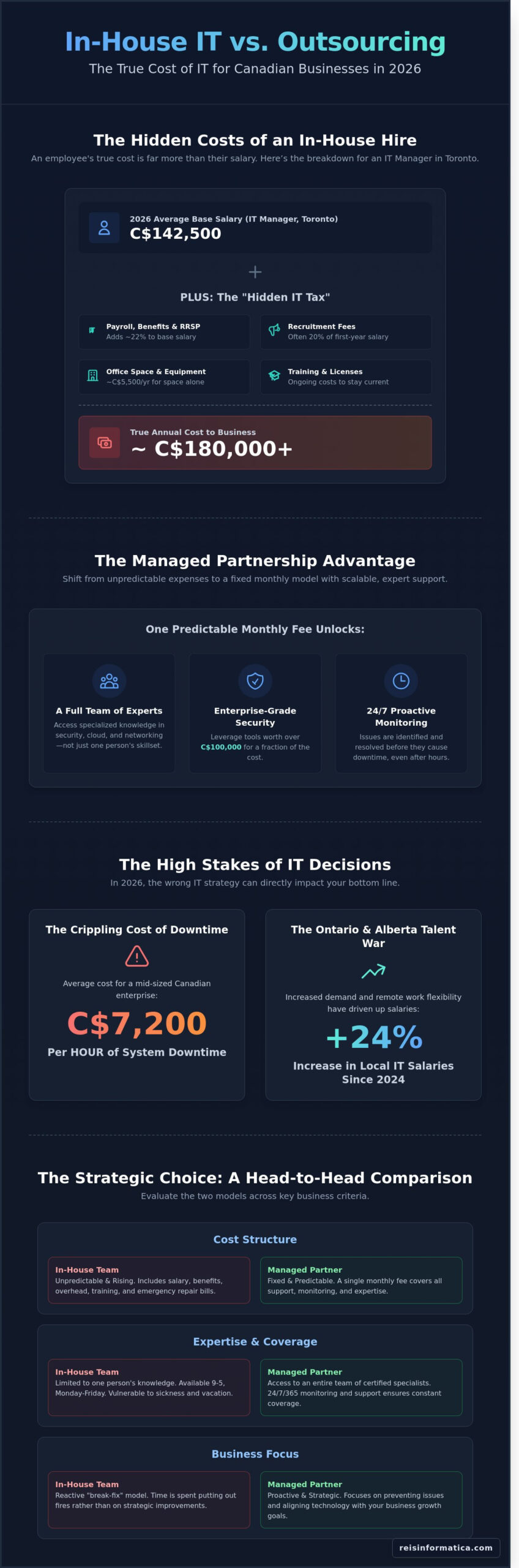
Small businesses in Calgary and Milton can’t easily compete with the aggressive hiring packages offered by global tech giants. In the 2026 job market, a talented developer or security analyst can demand remote-work flexibility and Toronto-level wages while living in London or Kingston. This trend has pushed local IT salaries up by 24% since 2024. For a Milton-based firm, hiring one person often costs more than a full team of outsourced experts. Understanding the cost of in-house IT vs outsourcing requires looking beyond the monthly invoice to see the hidden expenses of employee turnover and the constant need for retraining in a volatile market.
Why “Good Enough” IT is Now a Business Risk
In 2026, a single hour of system downtime costs a mid-sized Canadian enterprise an average of C$7,200 in lost productivity and missed opportunities. You can’t afford to wait for a technician to show up on Monday morning if your system crashes on Friday night. 24/7 monitoring is now a requirement, not a luxury, because cyber threats don’t sleep when your office closes at 5 PM. Forward-thinking companies in Ottawa and Halifax are already leveraging advanced automation and AI-driven support to stay ahead of competitors. They don’t just use technology to keep the lights on; they use it to drive efficiency and protect their bottom line from the rising tide of digital threats.
- Proactive Maintenance: Fixing vulnerabilities before they become outages.
- Predictable Budgeting: Moving from erratic repair bills to a fixed monthly investment.
- Specialized Expertise: Accessing a whole team of experts rather than relying on one person’s limited knowledge.
- Scalability: Adding or removing support capacity instantly as your business grows.
Breaking Down the True Cost of In-House IT Personnel
Most business owners in the Greater Toronto Area look at a salary figure and assume they understand their technology spend. This perspective is often incomplete. To find the real cost of in-house IT vs outsourcing, you have to look beyond the gross pay on a T4 slip. By 2026, an experienced IT Manager in Toronto or Mississauga will command an average base salary of C$142,500. This represents a 15% increase from 2023 levels, driven by the scarcity of talent capable of managing complex cloud environments and AI integrations.
The “Hidden IT Tax” adds a heavy layer to this base. Mandatory payroll taxes, including CPP and EI, combined with health benefits and RRSP matching, typically add 22% to the base salary. You also have to account for the physical space they occupy. In downtown Toronto, 100 square feet of office space costs roughly C$5,500 annually. When you add high-end workstations and ergonomic furniture, your C$142,500 employee actually costs your business closer to C$180,000 before they even fix a single server.
Retention is another expensive hurdle. The average IT professional in Ontario changes jobs every 2.1 years. Every time a staff member leaves, you face a recruitment cost of roughly 20% of their annual salary in agency fees or internal HR time. This cycle of hiring and onboarding creates a revolving door that drains your budget and disrupts your operational stability.
Salary Projections for 2026
Location significantly impacts your payroll. While a Toronto-based IT Manager expects C$142,500; a similar role in Kitchener-Waterloo averages C$134,000, and Calgary sits at C$128,000. However, the price gap between roles is even more stark. A Tier 1 Help Desk technician might cost C$65,000; yet they cannot perform the duties of a Senior Systems Administrator who earns C$120,000. One person rarely covers the full stack of modern needs. You cannot expect a hardware specialist to also be a master of 2026-era cybersecurity protocols and AI workflow automation. This gap often forces companies to hire multiple people, doubling their overhead instantly.
The Overhead of Management and Tools
An in-house hire requires an arsenal of professional tools to be effective. Professional-grade licenses for Remote Monitoring and Management (RMM) and Endpoint Detection and Response (EDR) tools can cost C$150 to C$300 per month per user. If you are not a technical founder, you also lose valuable hours managing this person. You have to evaluate their performance, approve their technical purchases, and vet their strategy without having the expertise to do so accurately. Evaluating these variables helps you secure a predictable IT budget that aligns with your growth.
Perhaps the most dangerous cost is the “Single Point of Failure.” When your only IT person takes a vacation or falls ill, your business is one glitch away from a total standstill. You are paying for a service that has a 0% availability rate during holidays or sick days. Training adds another C$4,500 to C$7,000 annually per person to keep them certified in the latest security standards. Without this investment, your in-house expert quickly becomes a liability as their knowledge of 2026 cyber threats becomes obsolete. The cost of in-house IT vs outsourcing is not just about the monthly cheque; it is about the price of the risks you are willing to carry.
The Outsourcing Model: Predictability and Scalable Expertise
Managing a corporate budget in competitive markets like Milton or Cambridge requires total financial visibility. When you rely on the traditional break-fix approach or a lone internal staffer, your IT expenses often look like a heart rate monitor, spiking unexpectedly when a server fails or a security patch breaks a legacy application. Transitioning to a Managed Service Provider (MSP) flattens this curve. You replace volatile repair bills with a fixed monthly fee that provides budget certainty. This shift from capital expenditure to operational expenditure allows you to allocate capital toward growth rather than putting out technical fires.
The financial advantage extends to the technology itself. Most small to mid-sized businesses can’t justify spending C$100,000 or more on a high-end enterprise tool stack. An MSP spreads the cost of premium remote monitoring, management software, and security platforms across its entire client base. You get the same protection and efficiency as a Fortune 500 company for a small fraction of the price. When you compare the cost of in-house IT vs outsourcing, you have to account for these hidden software costs that an MSP already includes in their service bundle.
Scalability is another area where the outsourced model shines for businesses in Mississauga or London. If your company grows by 20% in a single quarter, an in-house department might buckle under the increased ticket volume, leading to burnout and downtime. Hiring a new technician in Ontario takes an average of 42 days and involves significant recruitment costs. With an MSP, you simply add users to your plan. The support infrastructure is already there, ready to absorb the extra load without a single day of downtime or a lengthy hiring process.
Coverage is the final piece of the predictability puzzle. A single IT person needs sleep, vacations, and sick days. When they’re offline, your business is vulnerable. An MSP provides a team that offers 24/7/365 monitoring and support. You aren’t relying on a person; you’re relying on a system. This constant vigilance ensures that updates happen at 3:00 AM on a Sunday, so your team walks into a fully functional office on Monday morning.
Access to a Diverse Talent Pool
The “Jack of all trades” is a myth in modern technology. No single person can master cloud architecture, hardware maintenance, and complex cybersecurity services simultaneously. Outsourcing gives you a bench of specialists who each focus on a specific niche. This expertise is vital when calculating the cost of in-house IT vs outsourcing, as a specialist solves problems in minutes that might take a generalist hours to research. You also gain a vCIO (Virtual CIO) who provides high-level strategic roadmaps, giving you the leadership of a C-suite executive without the C$200,000 annual salary typical in the GTA.
Eliminating Tool Sprawl and Licensing Headaches
Many Ontario businesses suffer from “tool sprawl,” where they pay for overlapping software licenses they don’t actually use. We streamline this by utilizing cloud services to consolidate your infrastructure and reduce the need for expensive, power-hungry local hardware. Centralized management means you won’t see surprise C$600 invoices for forgotten software renewals. Instead, you get a clean, unified billing structure and enterprise-grade backup and disaster recovery. This ensures your data is safe and your invoices are predictable, removing the administrative burden from your finance team.
Calculating Your ROI: A Framework for Decision Makers
Understanding the true cost of in-house IT vs outsourcing requires looking beyond the monthly invoice. Many Toronto business owners overlook “Shadow IT,” which accounts for roughly 15% of total tech spending in 2024. This occurs when staff buy their own cloud storage or software subscriptions because the company’s official systems feel too slow or restrictive. These unmanaged costs leak capital and create massive security gaps that your insurance might not cover.
When you compare a single hire to a managed partnership, the math changes quickly. Hiring a qualified IT Manager in Ontario currently commands an average base salary of C$92,000. Once you factor in CPP, EI, health benefits, and office equipment, that total investment climbs to C$118,000 annually. For that price, you get one person who needs vacations and sleep. A comprehensive IT services agreement often costs 35% less than a full-time salary while providing a 24/7 security operations center and a team of diverse specialists.
Downtime: The Silent Profit Killer
You can calculate your specific hourly downtime cost using a simple formula: (Gross Annual Revenue / 2,000 hours) x % of workforce affected. For a Toronto firm generating C$5 million annually, a total system outage costs roughly C$2,500 per hour in lost productivity alone. If a server crash takes four hours to resolve, you’ve lost C$10,000 before even paying the “emergency” repair fees, which typically range from C$275 to C$450 per hour for on-site support in the GTA.
- Proactive Maintenance: Managed providers use remote monitoring to fix 85% of issues before they cause a crash.
- Predictable Budgeting: Fixed-fee models eliminate the C$2,000 surprise bills that follow a hardware failure.
- Staff Efficiency: Employees lose an average of 22 minutes per day to minor tech glitches; professional management recovers this time.
Maintaining a 99.9% uptime rate adds approximately 8.7 hours of profitable operation back to your annual calendar compared to the 99% availability common in unmanaged environments.
Strategic Growth through Technology
Modern businesses are moving IT from a “cost center” to a “revenue driver” by focusing on scalability. By leveraging AI business solutions, firms in Calgary and Toronto are projected to automate up to 45% of repetitive administrative tasks by late 2025. This isn’t about replacing people, but about freeing your team to focus on high-value client work that grows your bottom line.
The long-term value of a 3-year technology roadmap cannot be overstated. Instead of making panic purchases when a laptop dies, you follow a structured lifecycle management plan. This allows for predictable C$ budgeting and ensures your hardware always supports the latest security protocols. We help you build a foundation where technology works invisibly in the background so you can stay focused on your primary mission.
Ready to see how much your current setup is actually costing you? Request a professional IT audit to uncover hidden savings and secure your infrastructure.
Reis Informática: Your Strategic IT Partner Across Canada
Deciding between building an internal team or hiring an external partner isn’t just a technical choice. It’s a financial strategy that dictates your company’s growth trajectory for the next five years. At Reis Informática, we’ve spent over 20 years refining a service model specifically for the Canadian market. Our presence in the Kitchener-Waterloo-Cambridge tech triangle allows us to stay at the forefront of innovation, while our deep roots in Mississauga, Milton, and the Greater Toronto Area ensure we understand the local infrastructure challenges businesses face every day.
We don’t believe in the “break-fix” model where you only hear from your IT provider when your server is down and your staff is idle. That approach is expensive and outdated. Instead, we act as a Vigilant Partner. This means we use proactive monitoring tools to catch 98% of potential system failures before they impact your operations. When you analyze the cost of in-house IT vs outsourcing, you’ll find that the true value lies in this prevention. An internal employee might cost C$80,000 annually plus benefits, but they can’t monitor your systems 24/7/365 like an automated, expert-led team can.
Transparency sits at the heart of our philosophy. Many Canadian business owners feel frustrated by hidden fees or complex contracts that seem designed to confuse. We provide clear, predictable pricing models. You’ll know exactly what your monthly investment is, allowing you to forecast your budget with 100% accuracy. There are no surprise invoices for security patches or standard support calls. We prefer a partnership built on trust, where our success is directly tied to your uptime and productivity.
A Local Approach with National Reach
While our heart is in Ontario, our impact is felt across the country. We provide consistent, high-tier service to operations spanning from Halifax to Calgary. This national reach is vital for growing companies that need a unified IT strategy across multiple provinces. Whether you have a warehouse in London, a boutique firm in Kingston, or a satellite office in Ottawa, our team ensures your security protocols remain identical. This consistency eliminates the technical silos that often lead to security gaps and wasted spending. We act as your single point of contact, ensuring business continuity regardless of your geographic footprint.
Ready to Optimize Your IT Budget?
The journey toward a leaner, more secure infrastructure begins with a comprehensive IT and security audit. We examine your hardware lifecycle, cloud subscriptions, and data protection protocols to find immediate cost-saving opportunities. In your first 90 days with Reis Informática, we focus on stabilization. We clear out the backlog of ignored tickets, update aging firmware, and implement a robust backup solution. By the end of the third month, your team will see a measurable decrease in downtime and an increase in overall system speed. We move you from a reactive state to a strategic one.
Your business deserves a partner that treats your budget with respect. Get your custom IT strategy and quote today and see how we can transform your technology from a cost center into a competitive advantage. Let us handle the complexity so you can focus on your core mission.
Secure Your Competitive Edge for 2026
Choosing the right path for your technology isn’t just an administrative task; it’s a strategic move for your bottom line. By 2026, Canadian businesses will face higher talent costs and more complex digital threats. When you analyze the cost of in-house IT vs outsourcing, the difference often comes down to predictability. Hiring a single internal expert can cost over C$90,000 annually before benefits, yet a managed partnership provides an entire team of specialists for a fraction of that price.
Reis Informática serves as your vigilant partner from Toronto to Calgary, delivering specialized AI and cybersecurity integrations designed for the 2026 landscape. Our proactive vCIO strategy is included in every managed plan, meaning you get executive-level guidance without the executive-level salary. We handle the technical complexity so you can stay focused on your core business goals. You deserve a technology roadmap that offers stability instead of surprises.
Get a Predictable IT Budget for 2026 – Request a Quote
Your infrastructure is the backbone of your success, and we’re ready to help you strengthen it for the years ahead.
Frequently Asked Questions
How much does it cost to hire a full-time IT manager in Toronto in 2026?
Projections for 2026 indicate that a full-time IT manager in Toronto will command an average base salary of C$135,000. Once you factor in mandatory benefits, CPP, and EI contributions, the total cost to the employer rises to approximately C$162,000 annually. This figure excludes the 15% recruitment fee often required to find qualified candidates in the competitive Ontario tech market. You’ll also need to budget for annual performance bonuses to retain talent.
Is IT outsourcing reliable for businesses with multiple offices in Calgary and Mississauga?
Yes, outsourcing provides superior reliability for multi-office setups because Managed Service Providers use centralized cloud tools to monitor 100% of your endpoints simultaneously. Whether your staff is in Calgary or Mississauga, they access the same 24/7 help desk with guaranteed response times. This model ensures your security protocols stay identical across all locations. You won’t need to hire separate technicians for each city, which typically reduces operational overhead by 30%.
What are the hidden costs of hiring an in-house IT person?
Hidden costs generally add 25% to 40% on top of an employee’s base salary through training, software, and equipment. You’ll pay roughly C$3,000 per year for specialized certifications and provide professional tools that an MSP would otherwise supply. If your internal hire takes a 14-day vacation or falls ill, your business faces a total support vacuum. Evaluating the cost of in-house IT vs outsourcing requires looking at these gaps in coverage and the expense of constant recruitment.
Can managed IT services help my business stay compliant with Canadian data laws?
Managed IT services ensure your infrastructure meets PIPEDA and provincial requirements like Ontario’s PHIPA by implementing mandatory encryption and access logs. Most providers deliver the 24/7 monitoring required by 90% of cyber insurance policies in Canada. We handle the technical documentation and security audits so you don’t have to track legislative changes yourself. This proactive stance prevents regulatory fines that can reach C$100,000 for serious data handling violations.
How does an MSP handle emergency support compared to an in-house employee?
An MSP offers a 15-minute emergency response guarantee backed by a full team, while an in-house employee is limited by their physical presence and sleep schedule. If a server fails at 3:00 AM, our automated systems trigger a fix before your office opens at 9:00 AM. A single employee likely won’t notice the issue until they start their shift. This constant vigilance maintains 99.9% uptime and prevents the burnout often seen in solo IT roles.
What is the average monthly fee for managed IT services in Ontario?
Ontario businesses typically pay between C$150 and C$350 per user per month for fully managed IT support. For a firm with 25 employees, this equals a predictable investment of about C$5,000 monthly for total coverage. This flat rate includes cybersecurity, backups, and strategic consulting. It’s a clear financial advantage when considering the cost of in-house IT vs outsourcing, as a senior technician’s monthly salary often doubles this amount before adding software costs.
Is outsourcing cybersecurity better than managing it in-house?
Outsourcing is more effective because MSPs invest over C$60,000 annually in enterprise-grade security stacks that are too expensive for most small businesses to buy alone. You gain access to a Security Operations Center that monitors threats every second of the year. One person working 40 hours a week can’t compete with 24/7 automated threat hunting. Our layered defense approach reduces the risk of a successful ransomware attack by 85% compared to internal management.
How do I transition from an in-house person to an outsourced MSP?
The transition starts with a comprehensive 48-hour discovery audit to document every password, server, and network configuration in your office. We typically manage a 30-day handover period where we work with your current IT person to ensure no knowledge is lost. This process creates a secure “Technical Playbook” that your company owns forever. You’ll see a seamless shift in support as we take over the daily maintenance, letting your leadership focus on business growth.