
In a U.S. healthcare practice, every minute should be dedicated to patient well-being. Yet, behind the scenes, the constant threat of system downtime, the complexities of maintaining HIPAA compliance, and the growing risk of cyberattacks can divert critical focus and resources. When your EHR system lags or patient data feels vulnerable, the core mission of providing care is compromised. This is precisely where specialized managed it services for healthcare become a foundational component for a secure, efficient, and resilient practice.
This complete 2026 guide is designed to provide clarity and confidence. We will break down exactly how the right IT partner helps you navigate complex compliance requirements, fortify your defences against modern cyber threats, and ensure your clinical systems operate with maximum uptime. Our goal is to show you a clear path to offloading your technology burdens, allowing you to dedicate your full attention to what matters most: your patients.
Key Takeaways
- Discover why standard IT support is insufficient for medical practices and how a specialized approach directly impacts patient safety and operational continuity.
- See how proactive managed IT services for healthcare go beyond fixing problems to secure your practice against threats and prepare you for innovations like telehealth and AI.
- Learn how the right IT partner ensures robust data protection and simplifies compliance with Canadian privacy legislation like PIPEDA and provincial health acts.
- Access an actionable checklist of critical questions to ask potential IT providers, ensuring you select a partner who truly understands the Canadian healthcare sector.
Why Healthcare IT is Radically Different (And More Complex)
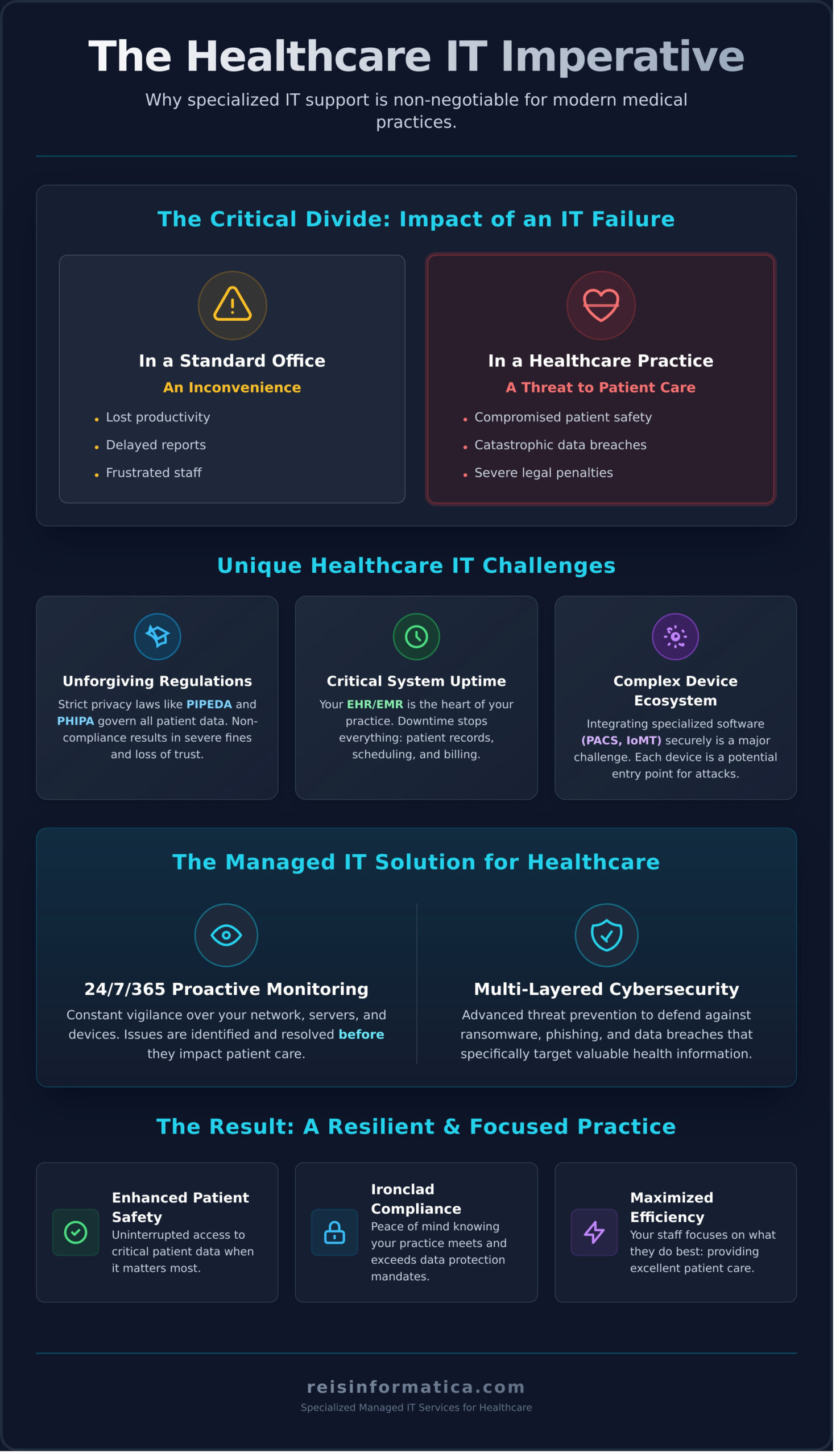
In a standard office, an IT issue is an inconvenience. In a healthcare setting, it’s a direct threat to patient care and operational integrity. The technology that powers a modern clinic or hospital is a complex ecosystem where uptime is non-negotiable, data security is paramount, and every component must work in perfect harmony. Generic IT support, designed for typical business environments, is dangerously insufficient for this high-stakes world.
Attempting to manage this environment with a generalist IT team is like asking a family doctor to perform specialized surgery. It requires a deep understanding of the unique intersection between technology, patient outcomes, and stringent regulations. A data breach isn’t just a financial cost; it’s a catastrophic event that can erode patient trust, trigger severe legal penalties, and permanently damage a practice’s reputation. This is why specialized managed it services for healthcare are not a luxury, but a fundamental requirement for modern medical practices.
The Unyielding Demands of Canadian Privacy Legislation
In Canada, protecting Patient Health Information (PHI) is governed by a strict legal framework, including the federal Personal Information Protection and Electronic Documents Act (PIPEDA) and robust provincial laws like Ontario’s PHIPA. These regulations mandate specific technical, physical, and administrative safeguards to ensure data confidentiality and integrity. Non-compliance can lead to severe penalties, with fines potentially reaching hundreds of thousands of dollars per violation. A knowledgeable Managed Service Provider (MSP) ensures you have the necessary safeguards and a signed Business Associate Agreement (BAA), contractually obligating them to protect your patients’ data.
The Criticality of EHR/EMR System Uptime
Your Electronic Health Record (EHR) or Electronic Medical Record (EMR) system is the digital heart of your practice. When it goes down, everything stops. Clinicians can’t access patient histories, appointments can’t be scheduled, prescriptions can’t be sent, and billing halts completely. This immediate paralysis of workflow directly impacts patient care. Your IT infrastructure demands 24/7 proactive monitoring and a rapid-response team that understands the urgency, ensuring your EHR performs seamlessly so your team can focus on patients, not error messages.
The Challenge of Specialized Software and Device Integration
A healthcare facility’s IT network is a complex web of interconnected, specialized systems. This includes:
- Picture Archiving and Communication Systems (PACS) for medical imaging.
- Diagnostic and lab equipment.
- Practice management and billing software.
- Telehealth and patient portal platforms.
Making these disparate systems communicate securely and efficiently is a major challenge. Furthermore, the rise of the Internet of Medical Things (IoMT) introduces countless connected devices that, if not properly secured, become potential entry points for cyberattacks. You need an IT partner who understands this specialized ecosystem and can manage it as a single, cohesive, and secure entity.
Core Components of Managed IT Services for Healthcare
In a healthcare setting, managed IT services for healthcare are not just about fixing computers; they represent a fundamental shift from a reactive ‘break-fix’ model to a proactive, strategic partnership. Instead of waiting for a critical system to fail during clinic hours, this model provides your practice or hospital with a comprehensive, outsourced IT department dedicated to preventing problems. The goal is to ensure your technology infrastructure is always secure, compliant, and available, allowing your clinical staff to focus entirely on patient care. This approach is built on several core components designed specifically to address healthcare’s unique operational and regulatory challenges.
Proactive 24/7/365 Network Monitoring and Management
The foundation of effective healthcare IT is uninterrupted system availability. We achieve this through constant, 24/7/365 monitoring of your entire network-from servers and workstations to medical devices. Our systems proactively perform essential maintenance like security patching, software updates, and performance tuning, often during off-hours to avoid disruption. This vigilance means potential issues are identified and resolved by our technicians before your staff even notices a problem, safeguarding patient data and clinical workflows. This proactive approach forms the foundation of all our managed IT services.
Advanced, Multi-Layered Cybersecurity and Threat Prevention
Healthcare organizations are prime targets for cyberattacks, with threats like ransomware and sophisticated phishing schemes posing a direct risk to patient safety and data integrity. A robust defence requires more than just antivirus software. We implement a multi-layered security stack that includes next-generation firewalls, advanced endpoint detection and response (EDR), and intelligent email filtering to block threats at every entry point. Crucially, technology is only part of the solution; we also provide ongoing security awareness training for your staff. Explore our dedicated cybersecurity services for complete protection.
This holistic view of practice preparedness extends beyond the digital realm. While we focus on securing your data and systems, it’s equally important that your team is equipped to handle in-person emergencies. Ensuring your staff has up-to-date certification from a recognized provider like Aspire First Aid Guide Training Corp complements your digital security measures, creating a truly resilient and safe environment for both patients and personnel.
PIPEDA-Compliant Data Backup and Disaster Recovery
A simple data backup is not enough. A comprehensive disaster recovery (DR) plan ensures your clinic can resume operations swiftly after any incident, from a server failure to a ransomware attack. In Canada, protecting patient data is governed by laws like PIPEDA, requiring robust safeguards. Our approach includes encrypted, geographically separate, and regularly tested backups to guarantee data integrity. While Canadian regulations are paramount, the standards outlined in the American HIPAA Security Rule provide an excellent global benchmark for securing electronic health information. A well-executed DR plan is your ultimate defence against downtime.
Responsive Help Desk Support for Clinical Staff
When an EMR system is down or a diagnostic machine cannot connect, clinical staff need immediate support from a team that understands the urgency. Our responsive, Canadian-based help desk is staffed by technicians familiar with healthcare workflows and applications. We provide expert assistance for everything from common IT issues to troubleshooting specialized clinical software. Through secure remote access, phone, or email, we deliver fast and effective solutions, minimizing downtime and allowing your team to maintain its focus on patient outcomes.
The Tangible Benefits of a Healthcare-Focused IT Partner
Choosing a technology partner is about more than just fixing computers; it’s an investment in your practice’s stability, security, and growth. The right provider of managed it services for healthcare moves beyond technical features to deliver direct outcomes that strengthen both patient care and your business’s bottom line. By entrusting your IT infrastructure to a specialist, you gain a vigilant partner dedicated to turning technology into a strategic asset rather than an operational burden.
Strengthen and Simplify Compliance
Navigating Canada’s complex privacy landscape, including PIPEDA and provincial laws, is a significant challenge. A specialized IT partner demystifies this process by conducting regular security risk assessments, implementing required technical safeguards, and providing the detailed documentation needed to prove due diligence during an audit. This gives you invaluable peace of mind, knowing a compliance expert is actively protecting your practice.
Enhance Patient Data Security and Trust
In healthcare, your reputation is built on trust. A single data breach can shatter that trust instantly. We protect your practice by implementing robust security measures, from advanced firewalls to strict access controls that ensure only authorized staff can view Protected Health Information (PHI). By demonstrating this commitment to data privacy, you build stronger, more lasting relationships with your patients.
Improve Clinical Efficiency and Productivity
Every minute your staff spends on IT issues is a minute taken away from patient care. Our proactive support minimizes technology-related disruptions, ensuring your team has fast, reliable access to EHRs and other critical applications. We let your clinicians focus on what they do best-treating patients-while also providing strategic guidance on leveraging the future of healthcare IT to optimize clinical workflows and improve outcomes.
Achieve Predictable, Scalable IT Budgeting
Move away from the financial uncertainty of unpredictable capital expenses. Our managed services model transitions your IT spending to a flat, predictable monthly fee (OPEX). This makes budgeting simple and eliminates the shock of emergency repair bills that can cost thousands in Canadian dollars. As your practice grows or your needs change, your services can easily scale, ensuring your IT investment always aligns with your operational reality.
How to Choose the Right Managed IT Provider for Your Practice
Selecting an IT partner is one of the most critical decisions your practice will make. In a field governed by strict privacy laws and zero tolerance for downtime, a generic IT provider is a significant liability. The right partner acts as a guardian for your data and a catalyst for your efficiency. To ensure you find a true specialist, use the following questions as your guide during the evaluation process.
Crucial Question 1: Do They Have Verifiable Healthcare Experience?
This is the non-negotiable starting point. A provider’s experience in other industries does not translate to the unique compliance and operational needs of a Canadian medical practice. True expertise in managed it services for healthcare is demonstrated through proven results and deep regulatory knowledge.
- Ask for references: Request to speak with other Canadian medical or dental practices they currently support.
- Verify software familiarity: Do they have experience supporting your specific EHR/EMR software, such as TELUS Health, Accuro, or OSCAR?
- Confirm compliance agreements: Ensure they will sign a comprehensive Privacy and Security Agreement that outlines their responsibilities under PIPEDA and relevant provincial health acts (like PHIPA in Ontario or PIPA in B.C.).
- Test their knowledge: Inquire about their protocols for data security, breach notifications, and ensuring patient data remains within Canada.
Crucial Question 2: What Does Their Onboarding Process Look Like?
A prospective partner’s onboarding plan reveals their level of organization and commitment to a seamless transition. A vague or rushed process is a major red flag that signals future disruptions to your practice.
- Request a detailed plan: A professional provider will present a clear, phased plan to minimize disruption to your daily operations.
- Clarify documentation: How will they audit and document your existing network, hardware, and critical systems?
- Define communication: Who will be your dedicated point of contact throughout the transition and beyond?
- Inquire about training: Does their process include training your staff on how to use their support system and any new tools effectively?
Crucial Question 3: How Are Service Level Agreements (SLAs) Defined?
The SLA is the contract that defines the promises they make. It moves beyond sales pitches to legally binding commitments on service quality and response times. Do not sign anything without thoroughly reviewing this document.
- Analyse response times: Look for guaranteed response and resolution times, especially for critical issues that could impact patient care.
- Understand priorities: How do they define an “emergency” ticket versus a “standard” request? This directly affects how quickly your problems are solved.
- Check support hours: Confirm their standard hours of operation and the exact procedure for accessing after-hours and emergency support.
Choosing the right partner for managed IT services for healthcare is about building a foundation of trust and reliability. By asking these critical questions, you empower your practice to select a provider who will truly protect and enhance your operations. For a deeper consultation on what to look for, our team is here to help.
The Future of Healthcare IT: Embracing Cloud, AI, and Telehealth
The landscape of Canadian healthcare is undergoing a profound transformation, driven by technological innovation. To remain competitive and deliver superior patient outcomes, clinics and hospitals must look beyond today’s needs and prepare for tomorrow’s standards. A forward-thinking IT strategy is no longer optional; it’s the foundation for a resilient, efficient, and patient-centric practice. As your strategic partner, we help you navigate and implement these advancements, ensuring your technology not only supports but accelerates your mission.
Leveraging Secure Cloud Services for Healthcare
Migrating electronic health records (EHR) and critical data to a PIPEDA-compliant cloud environment is a pivotal step towards modernization. Our specialized cloud services provide a scalable and reliable infrastructure that eliminates the need for costly on-premise servers. This enables secure remote access for providers, enhances data recovery capabilities, and ensures your practice can grow without technological constraints. By using a private or hybrid cloud model, we address security concerns head-on, giving you the control and protection your sensitive patient data requires.
The Growing Role of AI in Clinical and Administrative Tasks
Artificial Intelligence (AI) is moving from theory to practice, delivering tangible benefits for healthcare providers. In the clinical setting, AI assists with diagnostic imaging analysis, leading to faster and more accurate interpretations. On the administrative side, AI business solutions can automate routine tasks like billing, coding, and scheduling, freeing up your staff to focus on patient care. Harnessing these tools requires a robust IT foundation, and a specialist in managed it services for healthcare ensures your network and systems are prepared to support these data-intensive applications.
Ensuring a Reliable and Secure Telehealth Platform
Telehealth has become an essential component of modern care delivery. A successful virtual visit, however, depends entirely on the underlying technology. We ensure your practice has the necessary IT framework for stable, high-quality video consultations, including a high-bandwidth network and end-to-end encryption to protect patient privacy. Our proactive monitoring and management guarantee that your network can handle telehealth traffic without compromising the performance of other critical systems, providing a seamless and secure experience for both clinicians and patients.
Embracing these technologies is the key to building a future-ready practice. Partnering with a dedicated IT provider ensures you can implement these innovations securely and effectively, allowing you to focus on what matters most: delivering exceptional patient care. Discover how we can build your technological future at reisinformatica.com.
Elevating Patient Care Through Proactive IT Management
The landscape of healthcare technology is evolving at an unprecedented pace. As we’ve explored, success in 2025 hinges on a crucial understanding: healthcare IT is fundamentally different, driven by stringent Canadian compliance requirements and the non-negotiable need for system availability. A strategic partner doesn’t just fix what’s broken; they proactively secure patient data, ensure operational continuity, and prepare your practice for the future of medicine, from telehealth to AI.
Choosing a provider with proven expertise is the most important decision you can make for your practice’s technological health. The right managed it services for healthcare provide not just technical skill, but strategic guidance. At Reis Informática, we offer that specialized partnership, built on deep expertise in HIPAA technical safeguards and backed by a 24/7/365 US-based support team. Our proactive strategies are designed to ensure maximum uptime for your critical clinical systems, giving you the peace of mind to focus on what matters most.
Ready to build a more secure, efficient, and future-ready practice? Schedule a free consultation to discuss your practice’s IT security and compliance. Let us be your vigilant partner in technology, so you can remain focused on patient care.
Frequently Asked Questions About Managed IT Services for Healthcare
What is the difference between general managed IT and healthcare-specific IT services?
General IT services focus on operational efficiency and standard security. Healthcare-specific IT adds a critical layer of compliance and specialized knowledge. We go beyond basic support to ensure your practice adheres to Canadian privacy laws like PIPEDA and provincial regulations (e.g., Ontario’s PHIPA). This includes securing electronic health records (EHR), managing clinical application performance, and implementing safeguards to protect sensitive patient data from cyber threats, ensuring both operational continuity and legal compliance.
How much do managed IT services for a medical practice typically cost?
In Canada, the cost for comprehensive managed IT services for healthcare typically ranges from C$120 to C$250 per user, per month. The final investment depends on factors like the number of staff, the complexity of your network, and the level of cybersecurity required. This price reflects a proactive partnership that includes 24/7 monitoring, robust data protection, compliance management, and unlimited support, safeguarding your practice and ensuring technology accelerates patient care, not hinders it.
Our practice already has an IT person. How would you work with them?
We see ourselves as a strategic partner, not a replacement. Our role is to augment your internal IT staff by providing advanced security tools, 24/7 monitoring, and specialized compliance expertise they may not have access to. This collaboration frees your on-site person to focus on immediate user needs and practice-specific projects, while we manage the complex backend infrastructure, cybersecurity threats, and proactive maintenance, creating a more resilient and effective IT environment.
What EHR and practice management software do you have experience with?
Our team has extensive experience supporting the technology infrastructure that runs major Canadian EHR and practice management systems, including Telus Health (PS Suite, Med-Access), Accuro EMR, and OSCAR EMR. While we are not the software vendor, our expertise lies in ensuring these critical applications run with maximum uptime, performance, and security. We manage the networks, servers, and security protocols required for your software to function reliably and in compliance with privacy standards.
How long does it take to switch from our current IT provider to your service?
A seamless transition is our priority. For a typical medical practice, the onboarding process takes between two to four weeks. This involves a thorough discovery phase, strategic planning, and deploying our management and security tools behind the scenes without disrupting your daily operations. The final cutover is carefully scheduled outside of patient hours to ensure zero downtime, providing a smooth and secure handover of your critical IT systems.
What is a Business Associate Agreement (BAA) and why is it essential?
While the term “BAA” originates from US HIPAA law, the principle is vital in Canada. The Canadian equivalent is a comprehensive privacy and service level agreement. This legal contract outlines our responsibilities for protecting your patients’ health information according to PIPEDA and provincial laws. It is essential because it contractually binds us to maintain specific security safeguards, ensuring we are accountable for protecting your data and helping you meet your compliance obligations.