
Slow IT responses, unpredictable technology budgets, and the ever-present threat of cyberattacks can cripple a growing business. If your team spends more time troubleshooting tech issues than focusing on core objectives, you’re not alone. This constant state of reactive problem-solving drains productivity and leaves your valuable data vulnerable. For many companies, the strategic answer lies in understanding what is a managed service provider (MSP) and the stability they bring to your operations.
More than just an outsourced helpdesk, an MSP acts as your dedicated technology partner. This guide is designed to give you a clear, complete picture. We’ll break down exactly what an MSP does, explore the essential services they provide, and show you how this partnership can resolve your biggest IT challenges. By the end, you will understand how to turn technology from a daily headache into a true competitive advantage, allowing you to focus on what matters most: growing your business with confidence.
Key Takeaways
- An MSP is a strategic technology partner that proactively manages your IT infrastructure, allowing you to focus on core business growth instead of technical issues.
- Understanding what is a managed service provider is the first step to solving key business challenges like reducing unpredictable IT costs, improving cybersecurity, and scaling operations efficiently.
- Modern MSPs offer more than just IT support, providing comprehensive services including 24/7 network monitoring, cloud management, and data backup to ensure business continuity.
- Learn how to identify if your company is ready to move from a reactive “break-fix” IT model to a proactive partnership that drives productivity and security.
Defining the Managed Service Provider: Your Proactive IT Partner
At its core, a Managed Service Provider (MSP) is a company that proactively manages your business’s IT infrastructure and end-user systems, all for a predictable monthly fee. Think of an MSP as your dedicated, outsourced IT department, responsible for keeping your technology running smoothly so you can focus on your core business. This model is built on a long-term strategic partnership, not a one-time transaction. To truly understand what is a managed service provider, it’s best to contrast it with the traditional support model it replaced. For a comprehensive overview of the industry’s evolution, the formal definition of managed services provides excellent context.
An effective analogy is to view your MSP as a building superintendent. They are always on-site, performing preventative maintenance and ensuring everything is secure and operational. This is a stark contrast to simply calling a plumber after a major pipe has already burst and flooded your office.
The Old Way: The Break-Fix IT Support Model
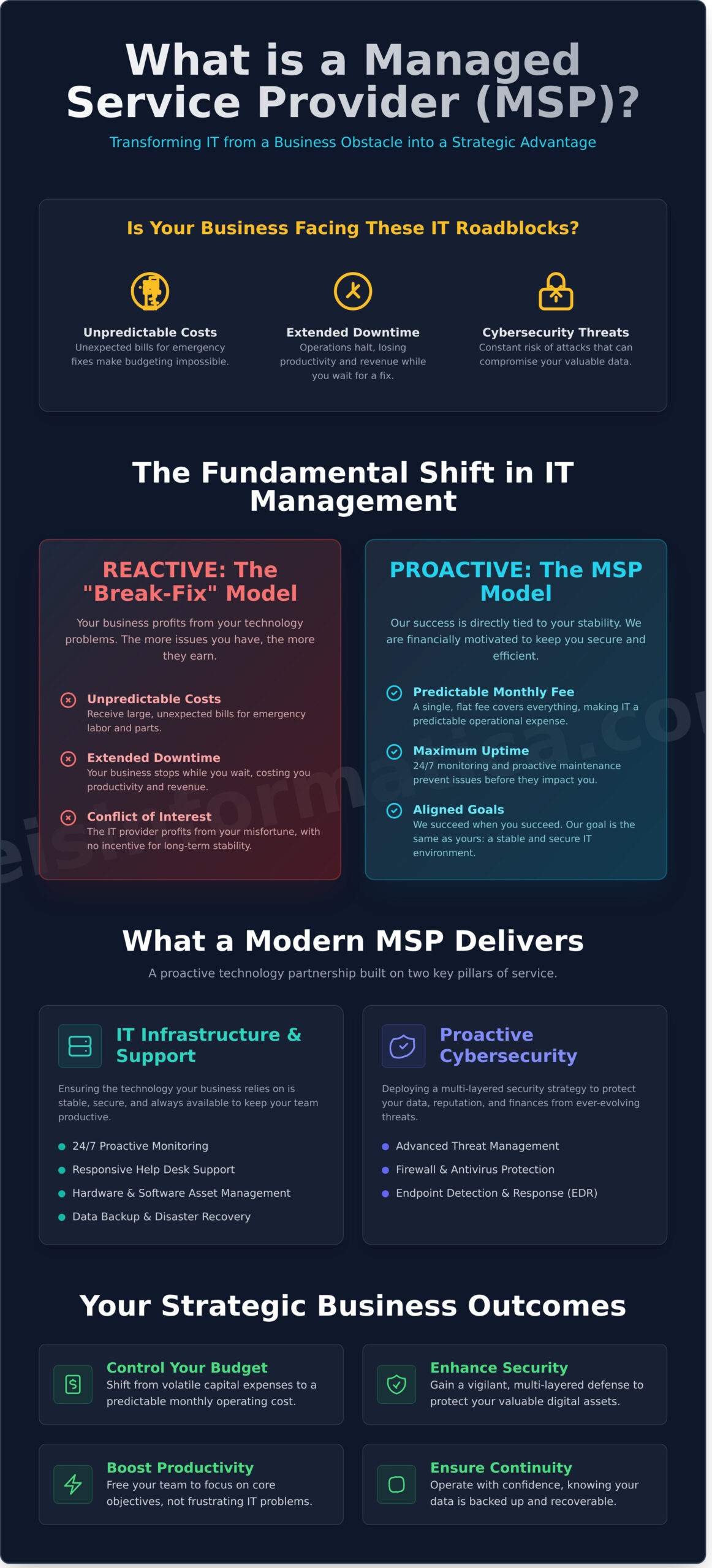
For decades, businesses relied on the reactive “break-fix” model. When a server crashed, a network failed, or a computer stopped working, you would call a technician for an emergency fix. This approach comes with significant downsides:
- Unpredictable Costs: You receive an unexpected, often large, bill for emergency labour and parts, making IT budgeting nearly impossible.
- Extended Downtime: Your business is at a standstill while you wait for a technician to arrive and resolve the issue, resulting in lost productivity and revenue.
- Conflict of Interest: A break-fix provider profits from your technology problems. The more issues you have, the more they earn, creating no incentive for them to provide a stable, long-term solution.
The New Way: The Proactive Managed Services Model
The managed services model flips this dynamic entirely. Instead of reacting to disasters, an MSP focuses on preventing them. Through continuous 24/7 monitoring, regular maintenance, and robust cybersecurity protocols, we identify and resolve potential issues before they can impact your operations. Our success is directly tied to your systems’ stability and uptime. Because you pay a flat monthly fee, our goals are perfectly aligned with yours: we are financially motivated to keep your technology secure and efficient. This transforms IT from an unpredictable expense into a strategic asset that fuels growth and provides complete peace of mind.
Core Services Offered by a Modern Managed Service Provider
When businesses ask, “what is a managed service provider?“, the answer lies in the comprehensive suite of services they deliver. A modern MSP moves beyond simple break-fix support to offer a complete, proactive technology partnership designed to manage your entire IT environment, allowing you to focus on your core business operations. While service packages can be customized to your specific needs in the Canadian market, a recent Forbes article on the Core Services of an MSP highlights that the objective is always to deliver consistent, predictable outcomes. These services are typically grouped into four key pillars.
IT Infrastructure Management and Support
This is the foundation of any MSP agreement. It’s about ensuring the technology your business relies on daily is stable, secure, and always available. This proactive management prevents minor issues from becoming major disruptions, keeping your team productive and your operations running smoothly.
- 24/7 Monitoring: Constant oversight of networks, servers, and workstations to detect and resolve issues before they impact your business.
- Help Desk Support: Responsive, expert assistance for your employees’ day-to-day technical problems.
- Asset Management: Complete management of your hardware, software, and licensing to ensure compliance and efficiency.
- Data Backup & Disaster Recovery: Robust planning and implementation to guarantee business continuity in the face of any event.
Proactive Cybersecurity Services
In today’s digital landscape, cybersecurity is not an optional add-on; it’s an integral component of IT management. An MSP acts as your vigilant guardian, deploying a multi-layered security strategy to protect your data, reputation, and finances from ever-evolving threats.
- Threat Management: Deployment and management of firewalls, advanced antivirus, and anti-malware software.
- Endpoint Detection and Response (EDR): Advanced tools to identify and neutralize sophisticated threats that bypass traditional defenses.
- Human Firewall: Employee security awareness training and phishing simulations to reduce human error.
- Learn about our comprehensive cybersecurity services to fully protect your business.
Cloud Management and Support
As more Canadian businesses leverage the power of the cloud, expert management is crucial for maximizing efficiency and controlling costs. An MSP ensures your cloud environment is not only functional but also secure, optimized, and aligned with your budget.
- Cloud Migration & Management: Seamless migration to and ongoing management of public or private cloud environments like Microsoft Azure and AWS.
- Software as a Service (SaaS) Administration: Expert administration of platforms like Microsoft 365 to maximize productivity and collaboration.
- Optimization & Cost Control: Continuous monitoring to ensure your cloud infrastructure is secure and cost-effective.
- Explore our expert cloud services for seamless operations.
Strategic IT Leadership (vCIO)
This service elevates an MSP from a technical vendor to a true strategic partner. A Virtual Chief Information Officer (vCIO) provides the executive-level guidance your business needs to make informed technology decisions that support long-term growth and innovation.
- Technology Roadmapping: Developing a long-term strategic plan for your IT infrastructure.
- IT Budgeting & Procurement: Providing expert guidance to maximize your return on technology investments.
- Business Goal Alignment: Ensuring your technology stack directly supports and enables your overarching business objectives.
- This includes developing strategies for emerging tech like our AI business solutions.
The Business Case for an MSP: 4 Key Problems Solved
Understanding what is a managed service provider goes beyond a technical definition; it’s about recognizing it as a strategic solution to core business challenges. An MSP doesn’t just fix computers; it aligns technology with your business goals to drive efficiency, security, and growth. By reframing IT from a reactive cost centre to a proactive business enabler, an MSP solves tangible problems that hold companies back.
Problem 1: Unpredictable and High IT Costs
Many businesses operate on a “break-fix” model, where IT support is only called when something fails. This leads to surprise invoices for emergency repairs, which can easily run into thousands of Canadian dollars, and unpredictable downtime that halts operations. An MSP replaces this volatility with a fixed, predictable monthly fee. This operational expense model simplifies budgeting and includes proactive maintenance, which prevents many costly issues from ever occurring, protecting your bottom line.
Problem 2: Growing Cybersecurity Risks
For Canadian businesses, the threat of ransomware, phishing, and data breaches is constant and evolving. Maintaining an effective in-house security posture is a full-time job requiring specialized expertise and expensive tools. An MSP provides access to an entire team of security specialists and enterprise-grade solutions, including 24/7 network monitoring and threat detection. This vigilant oversight acts as a powerful defence, safeguarding your critical data and reputation far more effectively than a small internal team ever could.
Problem 3: Low Employee Productivity Due to IT Issues
Every minute an employee spends wrestling with a slow computer, a network issue, or a software glitch is a minute lost from their core responsibilities. These small frustrations accumulate into significant productivity drains. With an MSP, your team gains immediate access to a professional help desk. Issues are resolved quickly and correctly, minimizing disruptions. Furthermore, proactive system management ensures the technology your team relies on is reliable and optimized, empowering them to work efficiently without technological roadblocks.
Problem 4: Technology That Can’t Keep Up with Business Growth
As your business scales, your technology needs to scale with it. An outdated or poorly planned infrastructure can create bottlenecks that stifle growth. A true MSP partner acts as your Virtual Chief Information Officer (vCIO), providing strategic guidance to ensure your IT infrastructure supports your long-term vision. This forward-thinking approach ensures you invest in the right technology at the right time. This level of strategic partnership is a critical differentiator, and understanding these qualities is essential when it comes to Choosing the Right MSP to guide your company’s future.
Who Needs an MSP? Identifying the Right Fit for Your Business
A common misconception is that managed IT services are exclusively for large corporations with massive infrastructures. The reality is quite different. The decision to partner with a Managed Service Provider (MSP) is less about company size and more about the need for strategic, reliable, and secure technology management. Understanding what is a managed service provider is the first step; the next is recognizing if your organization fits the profile of a business that stands to gain the most.
Ideal Company Profile
While an MSP can support businesses of any size, the sweet spot in the Canadian market is often small and medium-sized businesses (SMBs) with 10 to 200 employees—a demographic well-served by regional experts like Nanotek in the Greater Toronto Area. These organizations are large enough to depend heavily on technology but often lack the resources for a dedicated, multi-person internal IT department. If your business is growing rapidly and your current IT setup-or single “IT guy”-is struggling to keep up, you are a prime candidate for managed services.
Industries with Specific Needs
Certain sectors face stringent regulatory and operational demands, making an MSP an essential partner rather than a luxury.
- Healthcare: Clinics and medical facilities must ensure the security and privacy of patient data to comply with laws like Canada’s PIPEDA. An MSP enforces robust security protocols to protect sensitive information.
- Legal & Financial Services: These firms require high-level cybersecurity, encrypted communications, and secure data archiving to protect client confidentiality and meet strict compliance standards.
- Manufacturing: For manufacturers, downtime is not just an inconvenience-it’s a direct hit to the bottom line. MSPs ensure the uptime of both IT and operational technology (OT) systems that keep production lines running.
Key Signals That It’s Time for an MSP
If you find yourself nodding in agreement with any of the following points, it is a clear indicator that your business is ready for a strategic IT partner:
- You recently experienced a security breach, ransomware attack, or significant, costly downtime.
- Your designated IT person is overwhelmed with daily support tickets and has no time for strategic projects.
- You are planning a major technology shift, such as a cloud migration to Microsoft 365 or a server infrastructure upgrade, and need expert guidance.
- You and your team are spending too much time troubleshooting IT issues instead of focusing on core business activities like sales, service, and growth.
Ultimately, these trigger points lead business owners to seek out a proactive solution. An MSP delivers the expertise and structure needed to transform technology from a source of stress into a strategic asset, providing the peace of mind to focus on what matters most. If these challenges resonate with you, it may be time to explore a partnership.
How to Engage with an MSP: Understanding the Partnership
Choosing to work with an MSP is not about losing control of your IT; it’s about gaining a strategic partner dedicated to your success. A common concern for business owners is what this new relationship looks like in practice. A professional managed service provider demystifies this process with a structured framework built on transparency, clear expectations, and mutual goals. This ensures your technology aligns perfectly with your business objectives from day one.
The Service Level Agreement (SLA)
The foundation of your partnership is the Service Level Agreement (SLA). This is more than a contract; it’s a clear, written commitment that defines the standards of service you will receive. It ensures complete transparency and holds your provider accountable. Key metrics to look for include:
- Response Times: How quickly the MSP will acknowledge an issue.
- Resolution Times: The target timeframe for fixing a problem.
- Uptime Guarantees: The percentage of time your critical systems are guaranteed to be operational (e.g., 99.9%).
Understanding MSP Pricing Models
In Canada, MSPs typically offer flexible pricing to fit different business structures. Understanding these models helps you forecast costs and choose a plan that provides the best value. Common models include:
- Per-User Pricing: A flat monthly fee (e.g., C$80 – C$175) for each employee, covering all their devices and support needs. This is ideal for businesses where productivity is tied directly to the user.
- Per-Device Pricing: A fixed fee for each monitored device, such as a server, workstation, or network switch.
- Tiered Pricing: Bundled packages offering different levels of service, allowing you to choose the tier that best matches your needs and budget.
You can explore a full suite of managed IT services to see how they fit your budget and operational requirements.
The Onboarding Process
A seamless transition is the hallmark of an experienced MSP. The onboarding process is meticulously planned to integrate our services with your operations without causing disruption. This typically involves an initial assessment and audit of your current IT environment, followed by the quiet deployment of monitoring and security agents. We then document your systems and processes, creating a knowledge base that allows our support team to provide fast, effective, and context-aware assistance. This methodical approach ensures we are ready to act as your expert IT partner from the moment we begin.
Transform Your Technology into a Strategic Asset
Navigating the complexities of modern IT can feel overwhelming, but it doesn’t have to be. As we’ve explored, a managed service provider acts as your strategic partner, moving your business from a reactive “break-fix” cycle to a proactive model of continuous optimization. They are the guardians of your digital infrastructure, responsible for enhancing cybersecurity, ensuring operational uptime, and aligning technology with your core business goals.
Ultimately, answering the question of what is a managed service provider is about finding a partner who can provide technological peace of mind. This allows your team to stop worrying about system failures or security threats and focus entirely on innovation and growth. It’s about turning a necessary cost centre into a powerful competitive advantage for your Canadian business.
If you’re ready to unlock this potential, Reis Informática is here to help. With decades of experience, a dedicated team of certified technology experts, and a proactive, security-first approach, we build IT strategies that deliver real results. Schedule a free consultation to discuss your IT challenges. Let’s build a more resilient and efficient future for your business, together.
Frequently Asked Questions
What’s the difference between managed IT services and an in-house IT team?
An in-house IT team consists of direct employees, offering dedicated but limited expertise and availability. In contrast, a Managed Service Provider (MSP) provides access to a full team of specialists with diverse skills for a predictable monthly fee. This model shifts IT from a capital expense to an operational one, delivering proactive 24/7 monitoring, enhanced cybersecurity, and strategic guidance that a small internal team often cannot match, ensuring your business benefits from enterprise-level support.
How much do managed IT services typically cost?
In Canada, managed IT services are typically priced on a per-user or per-device basis, ensuring costs scale with your business. You can expect to invest between C$75 and C$200 per user per month, depending on the complexity of your infrastructure and the specific services included, such as cybersecurity, cloud management, and 24/7 helpdesk support. This predictable investment provides budget stability and often results in a lower total cost of ownership compared to hiring in-house staff.
Are MSP contracts long-term? What if I’m not satisfied?
Most MSP contracts are structured for terms of one to three years. This long-term approach allows the MSP to deeply understand your business, implement strategic improvements, and proactively manage your infrastructure for optimal performance. Reputable providers build satisfaction into the partnership through a clear Service Level Agreement (SLA) that defines performance metrics and response times. If standards aren’t met, the SLA provides a clear framework for resolution, ensuring accountability and peace of mind.
Will I lose control over my IT systems if I hire an MSP?
No, you gain strategic oversight while delegating the day-to-day technical management. A true MSP partnership is built on collaboration and transparency. You set the business goals, and the MSP executes the technical strategy to achieve them. Through regular reporting and strategy meetings, you remain in full control of your IT direction. This frees you from handling tactical issues like updates and troubleshooting, allowing you to focus on growing your business with a reliable technology foundation.
My business is very small. Is an MSP still a good fit for me?
Absolutely. For a small business, understanding what is a managed service provider is key to unlocking growth. An MSP provides access to enterprise-grade cybersecurity tools, strategic expertise, and proactive support that would be cost-prohibitive to build in-house. This levels the playing field, protects you from evolving cyber threats, and ensures your technology scales efficiently as your business expands. It’s a cost-effective way to secure a competitive advantage and professionalize your IT operations from day one.
How does an MSP handle data security and privacy?
A professional MSP places data security at the core of its services. This involves a multi-layered strategy, including 24/7 network monitoring, advanced endpoint protection, proactive patch management, and robust data backup and disaster recovery solutions. We ensure your operations comply with Canadian privacy regulations like PIPEDA. By acting as your vigilant partner, an MSP moves your security posture from reactive to proactive, constantly defending your critical business data against emerging threats.
What happens during the onboarding process when I switch to an MSP?
The onboarding process is a structured and transparent project designed for a seamless transition. It begins with a comprehensive discovery phase to audit your current IT environment and understand your business objectives. From there, we develop a strategic roadmap, deploy our monitoring and security tools with minimal disruption, and document your entire system. Our goal is to stabilize your infrastructure and establish clear communication channels, ensuring your team feels supported from day one.