
In today’s digital landscape, the pressure to secure your business network can feel overwhelming. The threat of a data breach, operational downtime, or significant financial loss is a constant concern for business owners. But what if you could replace that uncertainty with a clear, strategic plan? Implementing robust network security best practices is not about navigating complex technical jargon; it’s about creating a multi-layered defence that protects your most valuable assets and allows your team to focus on what they do best: driving your business forward.
As this technology becomes more central to enterprise security, resources such as Ethicrithm Explore offer a look into how AI consulting and operations partners can help implement these advanced systems.
This definitive guide is designed to provide that clarity. We will walk you through the essential strategies-from physical and technical safeguards to strengthening your human firewall-that form the foundation of a resilient operation. Consider this your actionable roadmap to understanding the biggest risks, building confidence in your defences, and achieving the peace of mind that comes from knowing your business is secure and prepared for modern cyber threats.
Key Takeaways
- Understand why network security is a core business strategy, protecting your operational continuity and preventing breach costs that average millions of dollars in Canada.
- A truly resilient network requires a multi-layered approach, securing your physical hardware, technical configurations, and most importantly, your people.
- Discover how to transform your team into your strongest defense by building a security-aware culture that neutralizes phishing and social engineering threats.
- Implement foundational network security best practices, from robust access controls to proactive monitoring, to ensure your infrastructure is prepared for modern cyber threats.
Why Network Security Is a Critical Business Function, Not Just an IT Problem
In today’s digital economy, viewing network security as a purely technical task for the IT department is a critical miscalculation. It is a fundamental pillar of business continuity and strategic risk management. A secure network is the bedrock that supports your operations, protects your data, and preserves your reputation. For a comprehensive overview of network security and its core components, it’s clear that its scope extends far beyond simple firewalls and antivirus software. Adopting robust network security best practices is not an expense; it is a direct investment in your company’s resilience and future.
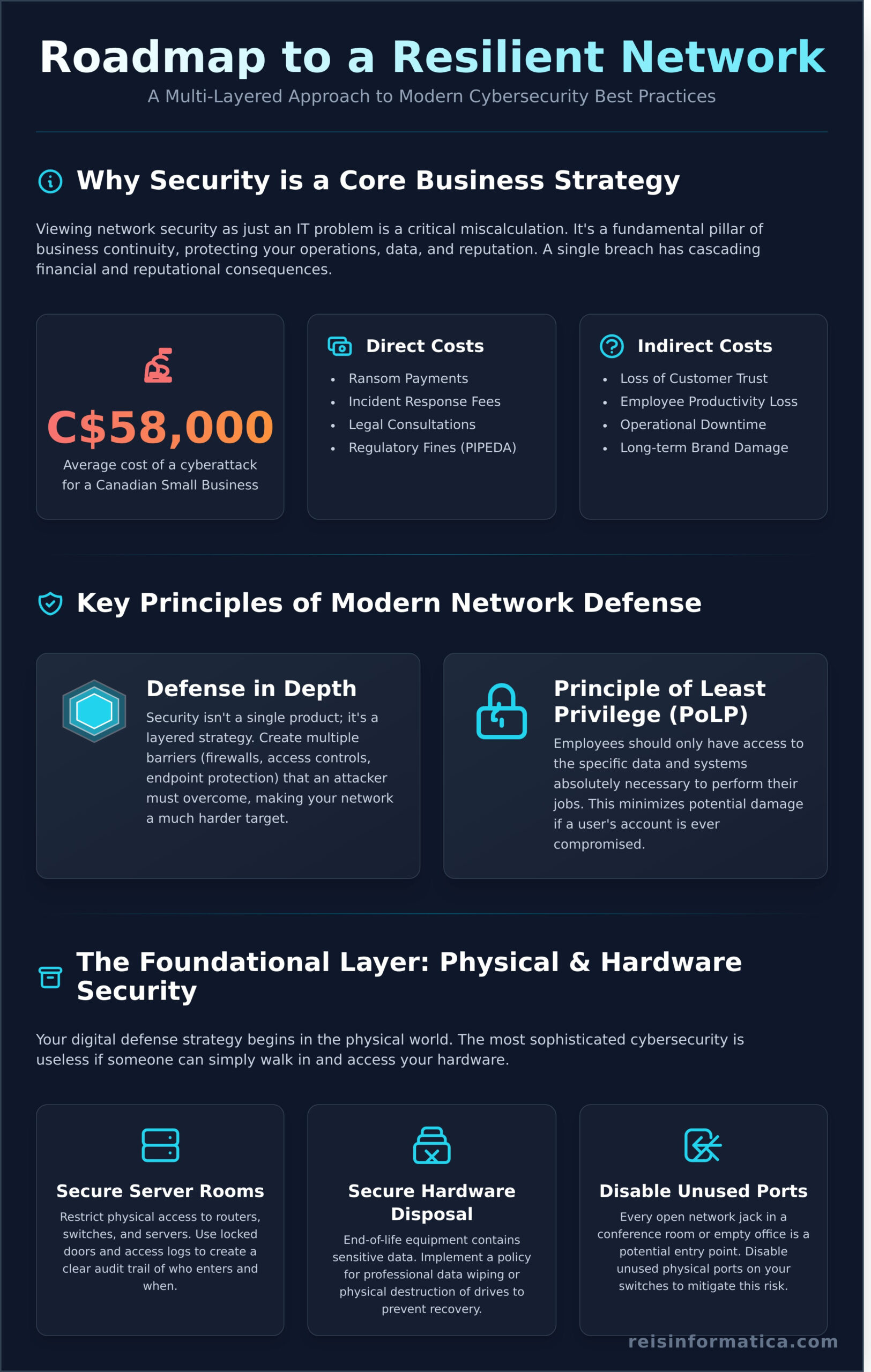
The mindset must shift from a reactive ‘fix when it breaks’ model to a proactive ‘always protected’ strategy. For Canadian small and medium-sized businesses, the stakes are incredibly high. A single successful cyberattack can cost a small business an average of C$58,000, a figure that doesn’t even account for the long-term brand damage. This financial threat alone elevates network security from an IT problem to a boardroom-level concern.
The Real-World Costs of a Network Breach
When a security breach occurs, the damage extends far beyond the initial incident. Consider a common ransomware scenario: a local accounting firm’s network is compromised, encrypting all client files and halting operations just before tax season. The consequences are immediate and layered:
- Direct Costs: These are the immediate cash-out expenses, including exorbitant ransom payments, fees for specialized incident response services, legal consultations, and potential regulatory fines under Canadian privacy laws like PIPEDA.
- Indirect Costs: Often more damaging in the long run, these include catastrophic loss of customer trust, decreased employee productivity during downtime, and the lasting stain on your brand’s reputation.
Key Principles of Modern Network Defense
A resilient security posture is built on foundational principles, not just on products. The goal is to create a security framework that makes your business a difficult and unattractive target. This involves embracing a proactive strategy guided by established concepts. Key among them are:
- Defense in Depth: This principle dictates that security should be layered. Instead of relying on a single point of defense, you create multiple barriers (e.g., firewalls, access controls, endpoint protection) that an attacker must overcome.
- Principle of Least Privilege (PoLP): In simple terms, employees should only have access to the data and systems absolutely necessary to perform their jobs. This minimizes the potential damage if a user’s account is ever compromised.
Ultimately, security is an ongoing process of vigilance and adaptation, not a one-time project. Consistent monitoring and refinement of your network security best practices are essential to staying ahead of evolving threats.
The Foundational Layer: Securing Your Physical and Hardware Infrastructure
Before implementing a single line of code or configuring a firewall, your digital defence strategy must begin in the physical world. The most sophisticated cybersecurity measures are rendered useless if an unauthorized individual can simply walk into your office and access a server or plug into an open network port. Establishing control over your physical and hardware infrastructure is one of the most fundamental network security best practices, creating a solid foundation upon which all other digital protections are built.
Controlling Access to Network Hardware
Your network’s core components-routers, switches, and servers-must be physically secured. This means more than just a locked door; it requires a comprehensive approach to asset management from deployment to disposal.
This principle extends beyond office IT to the operational technology (OT) on a factory floor; securing the supply chain for industrial automation components from trusted vendors like InstroDirect is a crucial, foundational step.
- Secure Server Rooms: Restrict access to server rooms and network closets to authorized personnel only. Implement access logs to track entry and exit, ensuring a clear audit trail.
- Hardware Disposal Policy: When equipment reaches its end-of-life, simply throwing it out can expose sensitive data. A secure disposal policy is essential, and working with certified ITAD vendors like Surplus Technology Solutions ensures professional data wiping or physical destruction of hard drives to prevent data recovery.
- Secure Unused Ports: Every open network jack in a conference room or empty office is a potential entry point. Disable unused physical ports on your network switches to mitigate the risk of unauthorized devices connecting to your network.
Securing Endpoints: Your First Line of Defense
In today’s hybrid work environment, your network perimeter extends to every laptop, smartphone, and tablet that connects to it. Securing these endpoints is critical, as they are often the primary targets for cyberattacks. Implementing robust endpoint controls aligns with foundational principles outlined in frameworks like the NIST Cybersecurity Framework, which emphasizes protecting organizational assets wherever they are. Mandate strong, unique passwords and enable multi-factor authentication (MFA) on all devices. For laptops containing sensitive business data, full-disk encryption (like BitLocker for Windows or FileVault for macOS) should be standard practice. For corporate smartphones and tablets, a Mobile Device Management (MDM) solution allows you to enforce security policies and remotely wipe a device if it is lost or stolen.
Wireless Network (Wi-Fi) Security Best Practices
Your business Wi-Fi is a direct gateway to your internal network and requires stringent security protocols to prevent unauthorized access.
- Use WPA3 Encryption: Ensure your wireless network is protected with WPA3, the current security standard, which offers superior protection against password-guessing attacks compared to older protocols like WPA2.
- Create a Separate Guest Network: Never allow visitors, clients, or personal employee devices onto your primary corporate network. A separate, isolated guest Wi-Fi network ensures their traffic is segregated from your critical business systems.
- Hide Your Primary SSID: While not a foolproof security measure, hiding the broadcast of your main network’s name (SSID) makes it invisible to casual snoops, adding a simple layer of obscurity.
The Technical Layer: Essential Digital Defenses and Controls
Beyond physical security and employee training lies the core of your digital defense: the technical controls. These are the software, hardware, and configuration settings that actively protect your data and systems. Implementing these technical network security best practices proactively creates a resilient digital perimeter designed to prevent threats before they can cause damage. This layer combines prevention with active monitoring and logging, giving you the visibility needed to detect and respond to suspicious activity swiftly.
Implementing Strong Firewalls and Network Segmentation
Think of a firewall as a digital gatekeeper for your network, inspecting all incoming and outgoing traffic and blocking anything that fails to meet your established security rules. For robust protection, a layered approach is best, using both a hardware firewall at your network’s perimeter and software firewalls on individual endpoints. We also recommend network segmentation-dividing your network into smaller, isolated zones. This critical tactic contains potential breaches, preventing an intruder from moving freely across your entire infrastructure.
Identity and Access Management (IAM)
A cornerstone of modern security is ensuring the right people have the right access-and nothing more. This is achieved by strictly enforcing the Principle of Least Privilege, where each user is granted only the minimum permissions necessary to perform their job. It is vital to regularly audit these permissions, especially when an employee changes roles or leaves the company. Centralized systems like Active Directory or Azure AD streamline this process, ensuring consistent and verifiable control over who can access your critical business data.
Proactive Patch and Vulnerability Management
Unpatched software is one of the most common entry points for cyberattacks. Every day, vendors release patches to fix security flaws in their operating systems and applications, and neglecting these updates leaves your business exposed to known threats. Implementing a systematic patch management process is one of the most fundamental CISA cybersecurity best practices. An automated system ensures updates are applied consistently and promptly, closing security gaps before they can be exploited. Effective patch management is a core component of professional cybersecurity services, providing peace of mind that your systems are always protected.
Data Encryption and Secure Backups
Your data must be protected everywhere it exists. Encryption makes data unreadable to unauthorized users, both ‘at rest’ (when stored on servers or hard drives) and ‘in transit’ (when moving across the internet). For any employee accessing the network remotely, mandating the use of a Virtual Private Network (VPN) is non-negotiable, as it creates a secure, encrypted tunnel for all communication. Finally, a resilient backup strategy is your ultimate safety net. We implement the proven 3-2-1 rule:
- Three separate copies of your data.
- On two different types of media (e.g., local server and cloud).
- With one copy stored securely off-site.
The Human Layer: Building a Security-Aware Culture
While firewalls, antivirus software, and encryption are essential, the most sophisticated technology can be bypassed by a single, unintentional human error. Cybercriminals know this, which is why they increasingly target your employees through social engineering tactics like phishing. Investing in your team’s security awareness is not just a recommendation; it is one of the most critical network security best practices for protecting your business. A security-aware culture transforms your staff from a potential vulnerability into your most vigilant line of defence.
Developing a Robust Security Awareness Program
A continuous training program is the foundation of a resilient human firewall. This involves more than a one-time onboarding session. We recommend implementing regular, mandatory training on identifying phishing emails, understanding social engineering threats, and practicing strong password hygiene. To make this training practical, use phishing simulations to safely test and educate employees on real-world attack methods. Crucially, foster a culture where staff feel safe to report suspected incidents immediately, without fear of blame, enabling your IT team to respond before a threat escalates.
Creating and Enforcing Key Security Policies
Clear, documented policies eliminate ambiguity and provide a consistent framework for secure behaviour. These are not just administrative documents; they are tools to manage risk and protect your operational integrity. Key policies include:
- Acceptable Use Policy (AUP): Clearly defines how employees can use company networks, devices, and software, reducing the risk of unauthorized or unsafe activity.
- Password Policy: Mandates strong password requirements, such as a minimum of 12 characters, complexity rules (using a mix of letters, numbers, and symbols), and the enforcement of Multi-Factor Authentication (MFA).
- Data Handling Policy: Classifies your business data (e.g., Public, Internal, Confidential) and outlines specific rules for how each type must be stored, transmitted, and protected.
Preparing an Incident Response Plan (IRP)
Even with the best defences, a breach can still occur. An Incident Response Plan (IRP) is a step-by-step guide that allows your organization to act swiftly and effectively to minimize damage. This plan identifies key roles and responsibilities within a response team, outlines procedures for containment and recovery, and establishes a clear communication strategy for notifying employees, customers, and, where necessary, Canadian regulators. A well-defined IRP is essential for ensuring business continuity and protecting your reputation in a crisis.
Building a security-first culture requires consistent effort and expertise. To fortify your human layer and implement these essential network security best practices, partner with a team that understands your business. Discover how Reis Informática can help you build a more secure and resilient organization.
Advanced Strategies and the Future of Network Security
While foundational security measures are vital, staying ahead of sophisticated cyber threats requires Canadian businesses to look toward the future. The modern work environment, defined by cloud adoption and remote teams, demands a more dynamic and intelligent defence. Implementing advanced network security best practices is no longer just an advantage-it is essential for long-term resilience and operational continuity.
These advanced measures are the standard for platforms handling high-value transactions, where trust and security are non-negotiable. For instance, institutional investors looking for a secure asset marketplace can discover SIMI, a platform built around these very principles of advanced digital defense.
Adopting a Zero Trust Architecture (ZTA)
The Zero Trust model operates on a simple but powerful principle: ‘Never trust, always verify.’ This modern framework abandons the outdated ‘castle-and-moat’ approach, where anyone inside the network perimeter was implicitly trusted. Instead, ZTA demands strict identity verification for every user, device, and application attempting to access resources, regardless of their location. This ensures that even if a threat penetrates one layer of defence, its ability to move laterally and access critical data is severely restricted.
Leveraging AI for Proactive Threat Detection
Instead of merely reacting to security incidents, what if you could anticipate and neutralize them? Artificial Intelligence makes this possible by analyzing vast amounts of network traffic to identify subtle anomalies and patterns that signal an impending attack. AI-powered Endpoint Detection and Response (EDR) tools and other AI business solutions act as a vigilant, 24/7 security analyst, transforming your cybersecurity from a reactive function to a proactive shield.
Securing Your Cloud and Hybrid Environments
The cloud offers incredible flexibility but also introduces unique security challenges where a single misconfiguration can expose sensitive data. Cloud Security Posture Management (CSPM) tools are critical for continuously monitoring these environments for risks. It is also vital to understand the shared responsibility model of cloud services-the provider secures the cloud infrastructure, but you are responsible for securing your data and applications within the cloud.
Integrating these advanced network security best practices is the cornerstone of a robust, modern security posture. This forward-thinking approach is central to effective, managed IT services, ensuring your business is not just protected today but prepared for the challenges of tomorrow. Let an expert partner build a security framework that gives you the peace of mind to focus on your core business.
Transforming Security from a Checklist to a Competitive Advantage
As we’ve explored, robust cybersecurity extends far beyond digital firewalls. It is a comprehensive strategy that integrates the physical, technical, and-most importantly-the human layers of your organization. Consistently applying these network security best practices is what transforms a vulnerable company into a resilient one, protecting your data, reputation, and bottom line.
Implementing and managing this framework requires constant vigilance, but you don’t have to do it alone. Reis Informática provides the strategic IT leadership your business needs, backed by proactive 24/7 network monitoring and deep expertise in compliance and risk management for the Canadian market. We handle the complexity so you can focus on your core objectives with confidence.
Don’t leave your business exposed. Request a professional cybersecurity assessment from Reis Informática today and take the definitive step towards lasting digital peace of mind.
Frequently Asked Questions About Network Security
What is the single most important network security practice for a small business?
While technical tools are vital, the most critical practice is comprehensive employee security awareness training. Your team is the first line of defence, and human error is a leading cause of breaches. Educating staff on identifying phishing scams, using strong password policies, and understanding data handling protocols transforms them from a potential vulnerability into a proactive security asset. This foundational step is crucial for protecting your business operations from common cyber threats.
How can a small business with no dedicated IT staff implement these practices?
For businesses without in-house IT, partnering with a Managed Service Provider (MSP) is the most effective and secure strategy. An MSP acts as your dedicated technology partner, proactively implementing and managing all network security best practices on your behalf. This includes firewall configuration, continuous monitoring, and software updates. For startups, working with a specialist like Connectics gmbh can be particularly beneficial. This approach delivers enterprise-grade security and peace of mind, allowing you to focus on your core business while experts ensure your infrastructure is protected.
How often should we conduct a professional network security audit?
We recommend a comprehensive, professional network security audit at least once per year. Additionally, an audit is essential after any significant infrastructure change, such as migrating to a new cloud service or deploying a new company-wide application. Regular audits act as a critical health check, proactively identifying vulnerabilities before they can be exploited by attackers. This ensures your security posture evolves with your business and the changing threat landscape, safeguarding your operational continuity.
Are cloud networks inherently more or less secure than on-premise networks?
Neither is inherently more secure; security effectiveness depends entirely on proper configuration and ongoing management. Major Canadian cloud providers offer robust physical security, but you remain responsible for securing your data and applications within the cloud. An on-premise network offers complete control but also places the entire security burden on you. For many small businesses, a professionally managed cloud environment often proves more secure than an under-resourced on-premise network.
What is the difference between a firewall and antivirus software?
Think of a firewall as the security checkpoint for your entire network. It inspects all incoming and outgoing traffic, blocking unauthorized access and malicious data packets from entering or leaving. Antivirus software works on individual devices (like computers and servers) within the network. It actively scans files and programs to detect, quarantine, and eliminate malware that might have already made its way inside. Both are essential for a layered, in-depth defence strategy.
How much should a business budget for network security?
There isn’t a single fixed cost, as your budget should be an investment proportional to your risk and data sensitivity. In Canada, a common guideline for small and medium-sized businesses is to allocate between 5% and 10% of their total IT budget specifically to cybersecurity. This can range from a few hundred to several thousand dollars (C$) per month. Viewing this as an investment in business continuity and client trust, rather than an expense, is key to building resilience.