
In 2024, a substantial number of US businesses faced cyberattacks, yet many owners still struggle to identify the specific threat that hit them. You’ve likely heard these terms used interchangeably, but understanding the real differences in ransomware vs malware is the first step toward securing your company’s future. It’s natural to feel overwhelmed by technical jargon while trying to maintain a competitive edge in fast-paced markets like New York or Los Angeles. You want your technology to be an invisible asset, not a source of constant anxiety or unexpected downtime.
We know your primary focus is growth, not decoding complex security manuals. You deserve a clear strategy that protects your data continuity without draining your 2026 budget on tools you don’t need. This guide provides a straightforward comparison of these digital threats and a practical roadmap to safeguard your US operations. We’ll show you how to transform your current infrastructure into a resilient shield, giving you the peace of mind to focus entirely on your business results.
Key Takeaways
- Identify the critical differences in ransomware vs malware to understand why one hides silently in your system while the other demands an immediate, high-stakes payout.
- Discover why mid-market businesses from Toronto to Calgary are prime targets for cybercriminals and how to align your security with Canadian PIPEDA compliance standards.
- Strengthen your digital perimeter with a “Defense in Depth” strategy and learn how immutable backups keep your critical data safely out of reach from hackers.
- Shift from reactive fixes to proactive protection by catching malicious activity before it scales into a costly business disruption or data breach.
- Gain the peace of mind to focus on your core business goals while a vigilant partner manages the complex technical layers of your security infrastructure.
Understanding the Basics: Malware vs. Ransomware in 2026
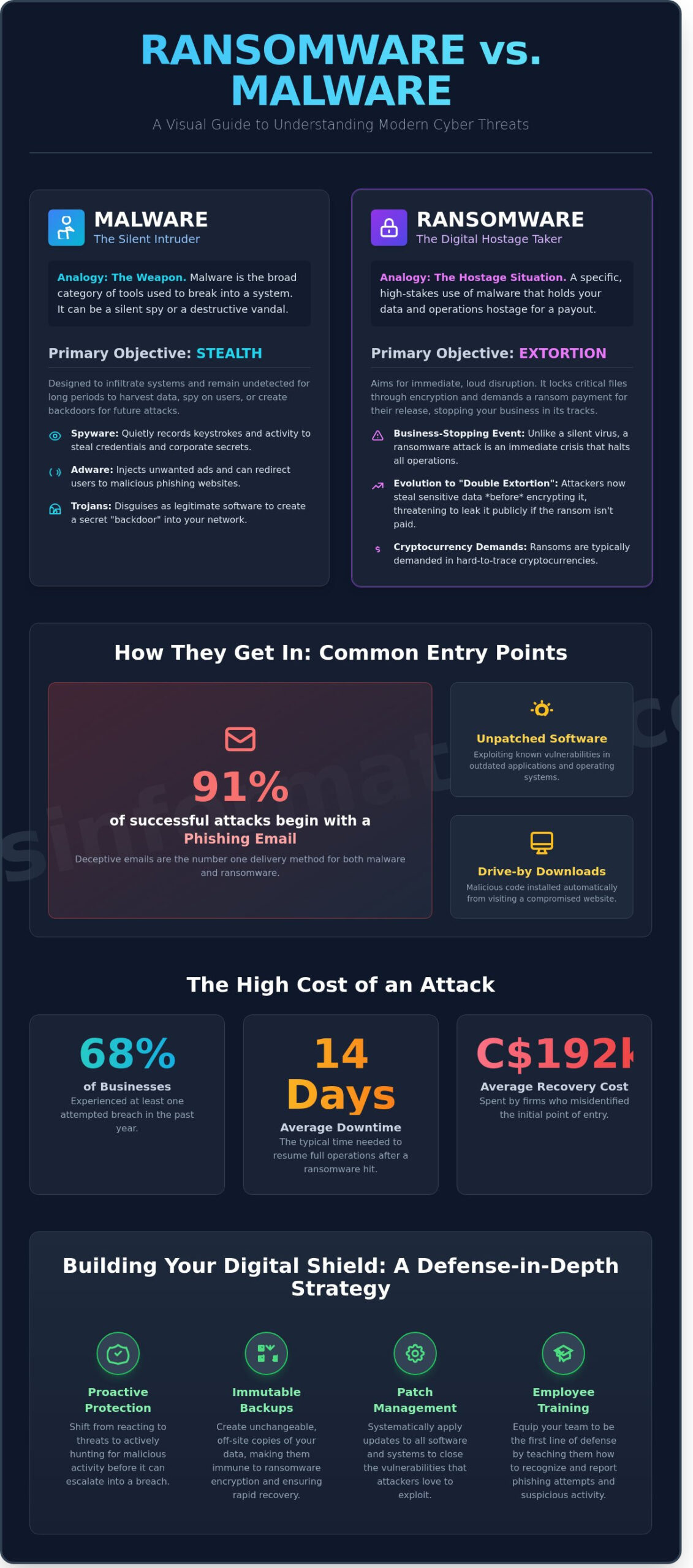
By early 2026, the digital threat environment in Canada has reached a sophisticated peak. Statistics from the Canadian Centre for Cyber Security in late 2025 indicated that 68 percent of businesses from Halifax to London, Ontario, experienced at least one attempted breach in the previous twelve months. For a business owner, these attacks often feel like a blur of technical jargon. However, distinguishing between ransomware vs malware is vital for your recovery strategy and insurance compliance. You can’t protect what you don’t define, and in 2026, the definitions carry heavy financial weight.
Think of the relationship between these two terms using the Weapon vs. Hostage analogy. Malware is the weapon itself; it’s the tool used to break into your system. It could be a silent spy or a destructive vandal. Ransomware is the hostage situation that follows. It’s a specific way of using that weapon to demand a payout. While all ransomware is malware, not all malware is ransomware. One is the category, while the other is a specialized, high-stakes method of digital extortion that can halt your operations in minutes.
The cost of confusion is high. In 2025, Ontario firms spent an average of C$192,000 on recovery efforts when they misidentified the entry point of an attack. Knowing the difference ensures you deploy the right defense at the right time. It’s about moving from a reactive state to a proactive posture where your infrastructure remains resilient against both broad and targeted threats.
What exactly is Malware?
Malware is short for malicious software designed to infiltrate or damage a computer system without the owner’s informed consent. It’s the broad umbrella term for every piece of “bad code” floating around the internet. In 2026, malware has become increasingly modular, often hiding in legitimate business software updates to bypass traditional firewalls. Malware is any code written to perform unauthorized actions on a device.
- Spyware: This software quietly watches your keystrokes to steal banking credentials or corporate secrets.
- Adware: While often seen as a nuisance, modern adware can redirect your employees to phishing sites.
- Trojans: These disguise themselves as useful programs to create a “backdoor” for future attacks.
The Ransomware Evolution
Ransomware specifically targets data availability through high-level encryption. It doesn’t just sit on your drive; it locks your files and demands a fee, usually in cryptocurrency, for the decryption key. Over the last few years, we’ve seen a shift from “locking the screen” to “Double Extortion.” In this scenario, hackers steal your sensitive data before encrypting it. They threaten to leak your client list or financial records on the dark web if you don’t pay. This evolution makes it a primary concern for business owners in Mississauga and Milton, where data privacy regulations have become much stricter as of January 2026.
If you’re looking for a foundational definition, What is Ransomware? provides a deep dive into how these attacks have scaled from simple viruses to multi-million dollar criminal enterprises. For local businesses, the risk isn’t just the “ransom” itself. It’s the downtime. A 2025 report showed that Milton-based companies took an average of 14 days to resume full operations after a hit. Understanding ransomware vs malware helps you realize that while a virus might be a headache, ransomware is a business-stopping event that requires specialized backups and a rapid response team to survive.
The Technical Divide: How Malware and Ransomware Operate
Understanding the distinction between ransomware vs malware starts with their primary objective. Most malware types, such as spyware or keyloggers, thrive on stealth. They want to live in your server for months without making a sound so they can harvest data. Ransomware is the opposite; it demands your attention immediately. It is the difference between a silent burglar who sneaks out with your jewelry and a loud kidnapper who holds your business operations for a price.
These threats often arrive through the same digital doors. Phishing emails account for roughly 91% of successful cyber attacks in Canada. Hackers also exploit unpatched software vulnerabilities or use drive-by downloads, where a compromised website installs malicious code without your consent. To understand the full scope of these risks, the Canadian Centre for Cyber Security guide provides a detailed breakdown of how these vectors evolve and how businesses can stay prepared.
Dwell time is a critical metric for business owners to track. In 2023, the average dwell time for non-ransomware intrusions was approximately 16 days, though some variants linger for over 200 days. During this period, the malware scans your network, steals credentials, and maps your backups. Only after the ground is prepared does the attacker deploy the ransomware payload. Detecting these early signals requires sophisticated cybersecurity services that monitor for anomalies long before the encryption process begins.
Proactive monitoring is the only way to catch a thief who has already moved into your house. If you wait for the ransom note to appear, the battle is already lost. The average cost of a ransomware attack for Canadian mid-sized businesses reached C$1.1 million in 2023 when accounting for downtime, recovery, and lost reputation. This makes the “quiet” phase of malware the most important time for your IT team to act.
Spread and Infection Mechanisms
Malware can self-replicate through your network like a digital flu, often categorized as a worm. Other times, hackers use “hands-on-keyboard” tactics where they manually navigate your systems after gaining initial access. We’ve seen local businesses in Waterloo and Kitchener targeted as test cases because of their high-value intellectual property and tech-heavy supply chains. Social engineering remains the biggest hurdle; it bypasses even the best firewalls by tricking an employee into clicking a “late invoice” link or a fake shipping notification.
Payload and Execution
When a payload triggers in a typical office, the results vary wildly. Standard malware might quietly copy your client list to a remote server in Eastern Europe. Ransomware, however, uses AES-256 encryption to lock your files, rendering them useless until a key is provided. While all ransomware is malware, not all malware has a ransom component. This distinction is vital for your recovery strategy. If you’re worried about your current setup, it’s worth having a professional security audit to identify hidden gaps before they are exploited.
Why Businesses from Toronto to Calgary are Targets
Canadian companies often find themselves trapped in a dangerous “security gap.” Whether you are operating out of the Toronto Financial District or managing high-value assets in Calgary’s energy sector, your business is a visible, lucrative target. Hackers specifically focus on the Canadian mid-market because these organizations are large enough to have significant cash flow, yet they often lack the C$350,000 annual budget required for a 24/7 in-house security operations center. This vulnerability makes understanding the nuance of ransomware vs malware a vital part of your risk management strategy.
While standard malware might quietly steal passwords or drain system resources, ransomware is an aggressive extortion tactic designed to halt your operations entirely. To see the technical complexity of these modern threats, CISA’s #StopRansomware Guide provides a deep dive into the operational tactics that attackers use to move through a network once they gain entry. For a local firm, trying to keep up with these global threats while running a business is nearly impossible. This is where managed IT services provide a critical advantage. They deliver the “big city” security infrastructure and proactive monitoring that local firms need to stay resilient without the overhead of a massive internal department.
The threat isn’t just about the digital files; it’s about the physical reality of running a business in Canada. Attackers know that Canadian firms are often part of tight-knit supply chains. If they can compromise one mid-sized supplier in Southern Ontario, they can potentially gain leverage over dozens of other companies. This interconnectedness is a strength for our economy, but it’s a primary target for cybercriminals who want to maximize the “ripple effect” of a single successful breach.
The Local Economic Impact of Downtime
Downtime is a silent profit killer that hits the bottom line immediately. For a Mississauga-based logistics firm moving C$4 million in freight monthly, a single hour of system failure costs roughly C$12,500 in lost productivity and missed delivery windows. In close-knit communities like Kingston or Milton, the damage is often social. When your systems go dark, you aren’t just losing money; you’re losing the trust of partners you’ve worked with for decades. Reputational damage in these local hubs is much harder to fix than the technology itself.
Regulatory Risks in Canada
Canadian business owners face a rapidly changing legal environment. While PIPEDA has long mandated reporting for breaches that cause “significant harm,” the upcoming Digital Charter Implementation Act (Bill C-27) will raise the stakes by 2026. Fines for non-compliance could reach 5% of global revenue or C$25 million. Business owners in Ottawa or Halifax can no longer use “I didn’t know” as a valid legal defense for data loss. Canadian regulations are becoming more punitive than many US-based counterparts, focusing heavily on individual privacy rights and mandatory disclosure.
Building a Defensive Shield: Prevention and Detection
Protecting your business requires more than a simple firewall or a free antivirus program. We call this strategy “Defense in Depth.” Think of it as a series of hurdles; if a hacker clears one, they hit another. Relying on one tool is like locking your front door but leaving the windows wide open. When discussing ransomware vs malware, many people focus on the virus itself, but the real solution lies in the layers of protection surrounding your data.
One of the most vital layers is the use of immutable backups. This technology ensures that once your data is saved, it cannot be altered or deleted by anyone, including a hacker with stolen administrative credentials. By integrating cloud services, you gain geographic redundancy. If your local office in London or Cambridge faces a hardware failure or a breach, your data stays safe in a secure, off-site environment. IBM’s 2023 report highlights that the average cost of a data breach for Canadian organizations is C$6.94 million, but companies with high levels of automation and modern cloud backups saved nearly C$2 million in recovery costs.
Technical Controls You Need Today
Multi-Factor Authentication (MFA) is your first line of defense. It’s the single most effective tool against credential theft, stopping 99% of bulk hacking attempts. While traditional antivirus programs look for known “bad files,” Endpoint Detection and Response (EDR) monitors behavior. If a computer suddenly starts encrypting thousands of files at 3:00 AM, EDR identifies the anomaly and shuts it down instantly. Regular patching is also non-negotiable. If you use specialized software for manufacturing or accounting, keep it updated. Hackers love exploiting vulnerabilities in outdated software because it’s an easy way to bypass security.
The Human Element of Security
Technology alone isn’t enough because 85% of breaches involve a human element. This is why we focus on building a “Human Firewall” within your team. A Human Firewall is a staff trained to recognize and report digital anomalies. For businesses in London and Cambridge, training your team to spot a suspicious email is just as important as installing a firewall. It turns your employees from a liability into your strongest defensive asset.
Running a phishing simulation is a great way to test your team without being the “bad guy.” Use these simulations as teaching moments rather than opportunities for discipline. You want to create a culture of security where employees feel safe reporting a mistake. If someone clicks a suspicious link, they should feel comfortable telling the IT team immediately. Rapid reporting can be the difference between a minor incident and a total system shutdown. Understanding the specific mechanics of ransomware vs malware allows you to build layers that protect both your hardware and your people.
Keep your business running smoothly with a proactive security plan. Contact our team today to strengthen your defenses.
Securing Your Future with Managed Cybersecurity
Understanding the technical nuances of ransomware vs malware is a great first step, but knowledge alone doesn’t stop a breach. Proactive monitoring acts as your digital early warning system. Most ransomware attacks don’t happen instantly. They usually begin as a silent malware infection that sits dormant for an average of 21 days while hackers scout your network. By identifying these initial intrusions early, we stop the encryption process before your files are held for a C$50,000 ransom or worse.
Relying on the old “Break-Fix” IT model is a financial trap for modern companies. Waiting for something to break means you’re already losing money through downtime and lost productivity. In 2023, Canadian businesses faced an average cost of C$6.94 million per data breach according to industry reports. A strategic partnership turns IT into a predictable utility. You pay a consistent monthly fee, and we ensure your systems stay up. It’s the difference between calling a plumber during a flood and having a modern sensor system that prevents the leak from ever happening.
The Reis Informatica Advantage
We operate directly across the Ontario corridor. From the growing tech hubs in Mississauga to the professional sectors in Ottawa, we understand the specific business landscape of our region. Our primary goal isn’t just “fixing computers” but providing what we call “Tranquility.” We assume the full responsibility of your technical infrastructure so your leadership team can focus on hitting growth targets. To achieve this, we integrate AI business solutions that monitor network patterns 24/7. These advanced tools predict anomalies that human eyes might miss, effectively blocking 99.9% of known threats before they ever reach an employee’s inbox.
Next Steps for Your Business
Your journey to total security starts with a cybersecurity baseline assessment. We don’t use generic checklists. We perform a deep dive into your specific network to find the gaps where ransomware vs malware could slip through. This assessment provides you with a clear, jargon-free report on your current risk level. From there, we build a customized roadmap to move your company toward a “Zero Trust” environment. By the start of 2026, this level of security will be the standard requirement for maintaining cyber insurance and client trust in Canada.
Ready to protect your organization? Here is how we get started:
- Initial Consultation: A brief call to understand your business size and specific industry regulations.
- Vulnerability Scan: We identify the “low-hanging fruit” that hackers exploit.
- Strategic Planning: We present a 12-month security plan tailored to your 2026 business goals.
- Active Protection: We deploy our monitoring tools to start guarding your perimeter immediately.
Don’t wait for a red ransom screen to appear on your workstation to realize your security is lacking. Reach out to our local experts today for a comprehensive audit. Let us handle the technical complexity and the constant vigilance required in today’s digital world so you can get back to what you do best: running your business.
Secure Your Growth by Outpacing Modern Cyber Threats
Understanding the critical differences in ransomware vs malware is the first step toward building a resilient 2026 business strategy. While standard malware might compromise your data integrity quietly, ransomware creates immediate operational paralysis that can cost Canadian firms thousands in lost productivity. With PIPEDA compliance standards becoming more stringent, the stakes for your data privacy have never been higher. You shouldn’t have to spend your day worrying about digital intruders when you’re trying to scale your company.
Reis Informatica acts as your dedicated security guardian, providing local support across 10+ Canadian cities. We implement proactive 24/7 monitoring and threat detection to identify vulnerabilities before they can be exploited. This hands-off approach for you means your technology stays invisible and efficient while we handle the technical heavy lifting. Our expertise ensures your business meets all Canadian data regulations while maintaining maximum uptime. Let’s work together to make your infrastructure a fortress that supports your long-term goals.
Your peace of mind is our priority, and we’re ready to help you navigate these challenges with confidence.
Frequently Asked Questions
Is ransomware considered a type of malware?
Yes, ransomware is a specific and dangerous category of malware designed to lock you out of your own data. While malware is a broad term for any malicious software, ransomware focuses on encrypting files and demanding payment for their release. Understanding the ransomware vs malware distinction is vital for business owners who need to build a layered defense strategy that protects both their hardware and their sensitive information.
Can I recover my files from ransomware without paying the ransom?
You can recover your files without paying if you have a verified, off-site backup system that remains untouched by the infection. Statistics from the Canadian Centre for Cyber Security show that 44% of organizations that pay the ransom still fail to get all their data back. We recommend a proactive backup strategy so you can restore your operations quickly and avoid funding criminal activities.
What is the most common way malware enters a business network in Canada?
Phishing emails remain the primary entry point, accounting for 80% of successful security breaches in Canadian small businesses in 2023. These emails often mimic legitimate invoices or shipping notices to trick employees into clicking a malicious link. Once someone clicks, the software bypasses your perimeter and begins its path of destruction across your entire office network.
Does a standard antivirus protect against modern ransomware attacks?
Standard antivirus isn’t enough anymore because it only recognizes threats it has seen before. Modern attacks use “fileless” techniques that 2024 security benchmarks show bypass 70% of traditional antivirus tools. To stay safe, you need Endpoint Detection and Response (EDR) that monitors behavior in real-time, allowing your IT partner to stop suspicious activity before it locks your files.
How much does a ransomware attack typically cost a small business in 2026?
By 2026, the average total cost of a ransomware attack for a Canadian small business is projected to reach C$250,000. This figure includes the ransom demand, the loss of billable hours, and the high price of rebuilding your digital infrastructure. Investing in managed security services costs a small fraction of this amount and provides the stability your business needs to grow without fear.
What should I do immediately if I suspect a malware infection at my office?
You must immediately disconnect the affected computer from the Wi-Fi and pull out any network cables. This physical isolation is the only way to stop the infection from jumping to your servers or other staff workstations. Once the device is isolated, call your technical support team to start the recovery process and ensure your clean backups are ready for restoration.
Are businesses in smaller cities like Milton or Kingston at less risk than those in Toronto?
Geography provides no protection in the digital world, as 62% of cyberattacks in Ontario now target small businesses outside the major Toronto hub. Hackers use automated scripts to scan for vulnerabilities in Milton, Kingston, and Burlington just as frequently as they do in large cities. Every business with an internet connection is a target, regardless of where your physical office is located.
How often should our business perform a cybersecurity audit?
Your business should conduct a full cybersecurity audit at least once every 12 months to identify new vulnerabilities. If you change your hardware or move to a cloud-based workflow, an immediate interim audit is necessary to keep your infrastructure secure. Regular checks ensure your ransomware vs malware defenses are strong enough to handle the 350,000 new threats discovered by researchers every single day.