
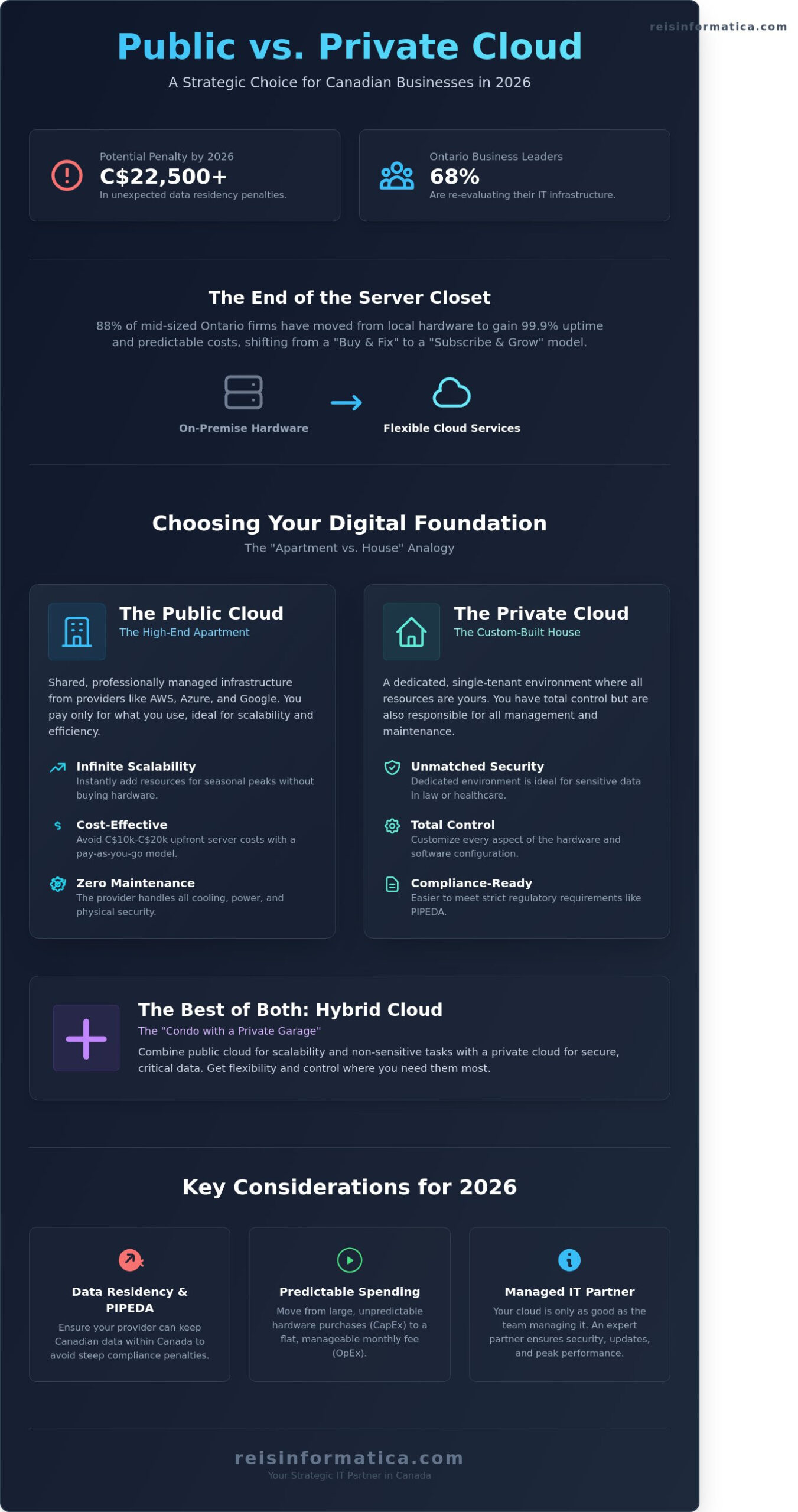
Could the ‘cheaper’ cloud option actually cost your Ontario business an extra C$22,500 in unexpected data residency penalties by the end of 2026? You aren’t alone if you feel like IT budgets are spiraling out of control while security threats grow more sophisticated. We know that 68% of business leaders in Toronto, Kitchener, and Waterloo are currently re-evaluating their infrastructure to avoid the sting of rising operational costs. Choosing between public vs private cloud for business isn’t just a technical checkbox. It’s a strategic decision that directly impacts your bottom line and your legal compliance under PIPEDA.
We believe your technology should be a silent, efficient partner rather than a source of constant stress. This guide cuts through the technical jargon to show you exactly how to achieve predictable IT spending and bulletproof security. You’ll discover the clear differences between these models so you can select the most secure, cost-effective fit for your Canadian operations. We’ll break down the latest 2026 pricing trends and local compliance standards you need to protect your company’s future and keep your focus on growth.
Key Takeaways
- Learn how to transition your infrastructure from costly physical hardware to flexible, high-performance services that scale alongside your business.
- Explore how public cloud platforms offer growing teams in the GTA and Waterloo Region massive efficiency without the burden of maintaining on-site servers.
- Understand why sensitive industries like law and healthcare prefer the dedicated security and total control provided by a private cloud environment.
- Use our direct comparison framework to weigh the public vs private cloud for business based on cost, security, and ease of use.
- Discover how a proactive migration strategy protects your Canadian data and ensures your technology remains an invisible, efficient engine for growth.
What is the Cloud? A Simple View for Businesses in Kitchener and Waterloo
The cloud isn’t a mysterious place in the sky or a technical abstraction. For a business owner in Waterloo or Kitchener, it represents a fundamental shift in how you consume technology. Instead of buying expensive hardware that sits in a dusty room, you’re renting computing power as a utility. Think of it like your office electricity. You don’t build a private power plant to run your lights; you simply plug into the grid and pay for what you use.
Local leaders in Canada’s tech triangle are leading this transition because it solves the constant headache of hardware replacement cycles. In 2026, waiting weeks for a physical server to arrive and be configured is a major competitive disadvantage. By shifting to a service model, companies gain immediate agility. You can scale your operations up on a Monday and back down on a Friday without wasting capital. This predictability is why 88% of mid-sized firms in Ontario have moved their primary operations away from local hardware to gain 99.9% uptime and flat monthly costs.
When weighing the public vs private cloud for business, you’re essentially deciding how much of that infrastructure you want to manage yourself. The core promise of any cloud model is to eliminate surprise repair bills and ensure your team can work from anywhere without interruption. It’s about moving from a “buy and fix” mentality to a “subscribe and grow” strategy.
The “Apartment vs. House” Metaphor
Understanding the difference between a public vs private cloud for business is easier with a simple analogy. Think of the public cloud as a high-end condo in downtown Toronto. You share the building’s foundation, elevators, and security with others, but your unit is private and professionally managed. A private cloud is a custom-built home. You have total control over every brick, but you’re also responsible for the roof and the plumbing. For many growing firms in Mississauga, a hybrid cloud offers a middle ground, providing the ease of a condo with the specialized storage of a private garage.
Why Infrastructure Matters in 2026
Your cloud environment is only as effective as the team watching over it. This is where Managed IT Services become vital. They act as the expert property manager for your digital space, ensuring everything stays secure and updated. With fiber connectivity reaching record speeds across Ontario and Nova Scotia in 2026, the “server in the closet” mentality has become a liability. Modern businesses now treat IT as a strategic asset. They focus on performance and security instead of hardware repairs, ensuring that technology remains an invisible engine for growth rather than a source of daily friction.
The Public Cloud: Efficiency and Scale for Growing Teams
Public cloud is often misunderstood as a “one size fits all” bucket, but it’s more like a utility, similar to how you use electricity or water. It operates on a multi-tenancy model. To put it simply, think of a modern office tower in downtown Toronto. Multiple businesses rent space in the same building. They share the foundation, the elevators, and the plumbing, but every office has its own secure door and private workspace. In the digital world, AWS, Microsoft Azure, and Google Cloud are the landlords providing that high-end infrastructure.
For a startup in Calgary, the pay-as-you-go model is a massive advantage. Instead of committing C$10,000 or C$20,000 to physical servers before you’ve even hired your tenth employee, you pay a small monthly fee for exactly what you use. This flexibility allows you to keep your capital focused on growth rather than hardware that depreciates the moment it’s unboxed. These providers also offer incredible reliability. They use massive redundancy, meaning your data is mirrored across multiple locations. If one server fails, another takes over instantly, so your staff never experiences the “system is down” frustration that kills productivity.
Top Benefits of Public Cloud Adoption
- Infinite scalability: If your Milton-based distribution company suddenly needs to add 50 users for a seasonal peak, you can scale up your resources overnight. You don’t have to wait weeks for new hardware to arrive and be configured.
- Zero hardware maintenance: The provider handles the heavy lifting of cooling, power, and physical security. Your internal team can stop acting as “repair techs” and focus on strategic projects that actually move the needle.
- Lower entry costs: Small businesses in Kingston and London can access the same enterprise-grade tools as global corporations without the massive upfront investment.
Potential Drawbacks to Consider
While the efficiency is high, the public cloud requires a specific strategy. One major hurdle is the shared security responsibility. When comparing public vs private cloud for business, remember that while the provider secures the “building,” you’re still responsible for locking your own “office door.” This is why most local firms integrate professional Cybersecurity Services to monitor access and prevent data leaks.
You also face limited customization. You’re playing by the provider’s rules and using their specific configurations. If your business uses legacy software that requires a very specific environment, the public cloud might not be the right fit. Finally, data residency is a concern for Canadian firms. You need to ensure your provider stores your data in Canadian data centers to meet local compliance and privacy standards. If you’re feeling overwhelmed by these choices, looking into managed cloud services can help you identify which platform aligns with your long-term goals.
The Private Cloud: Security and Control for Sensitive Industries
Think of the private cloud as a dedicated server environment reserved exclusively for your company. Unlike a shared apartment building, you own the entire floor. You don’t share hardware, storage, or networking with any other business. This isolation provides a level of control that’s often missing in shared environments. In 2026, the public vs private cloud for business debate has shifted because technology is now more accessible. You no longer need a massive data center in your basement to enjoy these benefits.
Law firms in Ottawa and medical clinics across the GTA frequently choose this model to maintain strict confidentiality. They need to know exactly which physical rack holds their client files. Customization is another major win. You can build an environment that fits your exact workflow, rather than forcing your team to adapt to a standardized platform. Since early 2024, specialized hardware costs have stabilized, allowing managed service providers to offer private setups that are surprisingly affordable. Many local leaders find that a private cloud starting at roughly C$600 per month provides better value than a fluctuating public bill.
Enhanced Security and Compliance
Privacy laws in Canada are becoming more rigorous. Meeting PIPEDA requirements is a baseline, not an option. A private cloud ensures total data sovereignty, meaning your information never leaves Canadian soil. This eliminates the risk of your data being subject to foreign laws. You also avoid the “noisy neighbor” effect. This happens when another company on a shared server runs a massive process that slows down your applications. In a private environment, 100% of the resources belong to you, ensuring 24/7 peak performance for your critical software.
When Private Cloud is the Right Investment
For engineering firms in Cambridge handling massive CAD files, speed is everything. Local private clouds offer lower latency than distant public data centers. The financial sector also relies on this model to satisfy strict regulatory audits that demand physical hardware separation. Cost predictability is the final piece of the puzzle. Public cloud bills often surprise owners with “egress fees” or unexpected usage spikes. A private cloud solution offers a flat, predictable monthly investment. This makes budgeting easier for mid-sized firms in Waterloo that want to avoid the 15% to 20% price fluctuations common in public platforms.
- Data Sovereignty: Guaranteed Canadian residency for all sensitive files.
- Performance: Zero interference from other businesses’ digital activities.
- Predictability: Fixed monthly costs with no hidden data transfer fees.
- Compliance: Ready-made environments for PIPEDA and SOC2 audits.
Public vs Private Cloud for Business: The Comparison Framework
Choosing between public and private cloud isn’t a one-time decision. It’s a strategic move that dictates your operational speed for the next five years. For leaders in Toronto and the Waterloo Region, the public vs private cloud for business debate usually centers on five specific pillars. Public cloud offers unmatched scalability and lower entry costs, while private cloud provides absolute data sovereignty and predictable long-term spending. You need to audit your current IT environment by documenting every software dependency and data touchpoint before committing to either path.
- Cost: Public cloud uses a monthly subscription model (OpEx), while private cloud involves upfront hardware or dedicated hosting costs (CapEx).
- Security: Private clouds offer physically isolated environments. Public clouds rely on a shared responsibility model where you’re responsible for data configuration.
- Scalability: Public cloud scales in minutes to meet demand. Private cloud requires hardware planning and procurement.
- Control: Private cloud gives you 100% authority over updates, legacy software compatibility, and hardware configurations.
- Ease of Use: Public cloud platforms are generally more “plug-and-play” for standard applications and remote workforces.
Many Toronto firms find that a Hybrid Cloud model is the most resilient choice. In fact, 82% of mid-sized enterprises now use a mix of both. This allows them to keep sensitive client data on a dedicated private server in Ontario while using the public cloud for high-intensity, non-sensitive computing tasks. When calculating Total Cost of Ownership (TCO), look at a 36-month window. While public cloud seems cheaper on day one, the cumulative costs often intersect with private cloud investments by month 14 or 18, especially as your data storage needs grow.
Cost vs. Control: Finding Your Balance
Hidden costs often derail cloud budgets. Public cloud egress fees, the charges for moving data out of the provider’s network, typically cost between C$0.10 and C$0.15 per GB. For a business moving terabytes of data, these costs bloat monthly invoices by 20%. A vCIO or IT Strategy session helps map these variables. Deciding on the right public vs private cloud for business model ensures your monthly costs remain flat regardless of how much data your team accesses.
Local Support: The Missing Link
When a server fails in Kitchener or Mississauga, a 1-800 number won’t put a technician in your office. Local partners provide on-site support that remote-only providers can’t match. This proximity is vital for Network Security Services in a hybrid world. Having a team that acts as a vigilant guardian of your infrastructure and can arrive at your facility within two hours ensures your business stays operational during critical outages.
Ready to see which model fits your growth plan? Explore our tailored cloud services to find your ideal balance of performance and price.
Making the Move: How Reis Informática Simplifies Your Cloud Journey
Choosing between public vs private cloud for business is a big decision, but it’s only the first step. The real value comes from how you execute that transition. At Reis Informática, we treat your migration as a strategic evolution rather than a simple data transfer. We’ve helped over 300 Canadian companies modernize their infrastructure since 2015, ensuring that security remains the foundation of every move. Whether you choose the massive scalability of a public provider or the isolated control of a private environment, our team implements a “security-first” architecture. This approach includes encrypted data paths and robust identity management that protects your assets from the moment you go live.
Your cloud environment should be more than just a storage locker. It needs to be an engine for growth. By integrating AI Business Solutions into your new infrastructure, we help you turn raw data into actionable insights. AI tools can analyze your operational workflows in real time. This often helps our clients reduce manual processing time by up to 22% within the first six months. We handle the technical complexity so your team can focus on what they do best.
Step-by-Step Migration Strategy
Our process starts with a deep-dive infrastructure audit. We look for every hidden dependency to ensure nothing breaks during the move. We understand that downtime is expensive; industry data shows that unplanned outages can cost Canadian firms upwards of C$8,000 per hour. To protect your revenue, we coordinate migrations for your staff in Halifax and London during low-impact windows. Our 99.9% uptime target during transitions means your employees stay productive. Once the move is finished, we provide ongoing optimization to ensure you aren’t overpaying for resources you don’t use.
Your Partner in Canadian IT Excellence
We pride ourselves on being more than just a vendor. We are your vigilant partner. Our expertise in Microsoft 365 Security ensures that your most common business tools are hardened against modern threats. Local leaders trust our Cloud Services because we provide a human connection in a digital world. We offer the tranquility of knowing your systems are monitored 24/7 by experts who understand the Canadian regulatory landscape. Stop worrying about server maintenance and start focusing on your next big project.
Ready to take the next step? Book your cloud strategy consultation today and let’s find the perfect fit for your business.
Future-Proof Your Ontario Business Strategy
Deciding between public vs private cloud for business determines how your team will scale through 2026. Public clouds offer the agility needed for the 85% of Waterloo Region startups looking to expand rapidly, while private infrastructure ensures your data remains under strict PIPEDA compliance. You don’t have to navigate these complex C$10,000+ infrastructure investments alone. Your choice impacts everything from daily productivity to long-term operational costs.
Reis Informática brings technical authority and local presence to your doorstep. With dedicated support teams across 11 Canadian cities, we provide the proactive 24/7 monitoring that keeps your operations running without a hitch. We’ve helped local leaders transition to secure environments that protect their bottom line and their clients’ trust. We handle the technical heavy lifting so you can focus on growing your company with total peace of mind.
Ready to build a roadmap that fits your specific goals? Get Your Custom Cloud Strategy from Reis Informática today. Your infrastructure is the backbone of your success, and we’re here to make sure it stays strong and secure.
Frequently Asked Questions
Is the public cloud less secure than the private cloud for my business?
Public cloud providers aren’t inherently less secure, but they operate on a shared responsibility model. Global leaders like Microsoft spend over C$1.3 billion annually on cybersecurity, which offers a level of protection most small businesses can’t afford alone. However, a private cloud gives you total control over the physical hardware and network perimeter. This setup reduces your attack surface because your company’s data isn’t stored on the same infrastructure as thousands of other organizations.
What is the most cost-effective cloud model for a small business in Ontario?
The public cloud is usually the most budget-friendly option for small teams in the Waterloo region. You avoid the C$10,000 to C$25,000 upfront cost of buying server hardware and cooling systems. Instead, you pay a predictable monthly fee based on your actual usage. This flexibility helps you manage cash flow while still accessing enterprise-grade tools. It’s a practical way to weigh the benefits of public vs private cloud for business without a massive initial investment.
Do I need to hire an IT person to manage a private cloud?
You don’t need a full-time internal hire if you partner with a managed service provider. Managing a private cloud requires about 10 to 15 hours of specialized maintenance every week to handle patches, backups, and hardware health. Outsourcing this responsibility to a Toronto-based expert costs significantly less than a C$70,000 annual salary. We act as your vigilant guardians, ensuring your infrastructure stays online while your team focuses on hitting your 2026 growth targets.
How does Canadian data residency (PIPEDA) affect my cloud choice?
PIPEDA requires businesses to ensure a “comparable level of protection” when personal data is processed by a third party. Since the 2023 updates to privacy regulations, many Ontario leaders prefer keeping data within Canadian borders. Choosing a provider with data centers in Toronto or Montreal simplifies your compliance audit. It protects you from the legal reach of foreign governments and ensures your customer information stays under the protection of Canadian law.
Can I switch from a public cloud to a private cloud later?
Yes, you can move your workloads, but it requires a structured migration plan to avoid downtime. Statistics show that 38% of mid-sized companies eventually move specific data to a private environment to gain better performance or lower long-term costs. We typically manage this transition in phases over a 6-week period. This approach ensures your applications stay stable and your employees don’t experience any service interruptions during the shift.
What is a hybrid cloud and is it right for my mid-sized company?
A hybrid cloud blends the scalability of public platforms with the ironclad security of private servers. It’s an excellent choice for Kitchener companies that handle sensitive financial data but need public apps for team collaboration. You keep your most critical files on private hardware and use the public cloud for less sensitive tasks. This model offers a balanced way to manage public vs private cloud for business by optimizing both cost and security.
How long does it typically take to migrate a business to the cloud?
A standard migration for a company with 20 to 40 employees takes between 4 and 10 weeks from start to finish. The first 20 days involve auditing your current software and preparing your team for the change. The final “cut-over” usually happens during a single weekend. This timeline ensures we can test every application thoroughly, which prevents the technical glitches that often frustrate staff during a major move.
What happens to my data if the cloud provider goes out of business?
Your data remains your property, but retrieving it quickly depends on your backup strategy. We always implement an independent backup solution that stores a copy of your data in a separate, secure Canadian location. Industry data indicates that 90% of businesses without a secondary backup fail within two years of a major data loss event. Having a proactive exit strategy ensures your business stays operational even if your primary vendor faces financial trouble.