Your in-house IT team is stretched thin, cybersecurity threats are becoming more complex, and unexpected tech issues are starting to hinder your growth instead of enabling it. If this sounds familiar, you’re not just patching systems; you’re patching a strategy that your company has outgrown. This is a common inflection point for ambitious businesses, and it’s precisely where a strategic shift to outsourced IT support for mid-sized companies becomes a powerful catalyst for growth, not just a line item on the budget.
This guide is designed to move your IT from a reactive cost centre to a proactive, strategic asset. We will explore how leveraging an external team of specialists can not only fortify your security and ensure compliance, but also stabilize your budget with predictable monthly costs. Prepare to discover how to reclaim your focus on core business objectives, confident that your technology infrastructure is not just managed, but optimized for scalability and success.
Key Takeaways
- Learn to identify the signs that your current IT support is hindering growth and how to calculate the true ROI of outsourcing in terms of productivity and risk reduction.
- Discover that IT support is not an all-or-nothing decision; explore flexible co-managed models that enhance your existing team’s capabilities.
- A strategic partnership for outsourced IT support for mid-sized companies delivers proactive cybersecurity and business alignment, not just reactive helpdesk fixes.
- Get a checklist of critical questions to ask potential IT providers, ensuring you choose a partner aligned with your specific Canadian business goals and compliance needs.
The IT Crossroads: Why Mid-Sized Companies Need a New Support Strategy
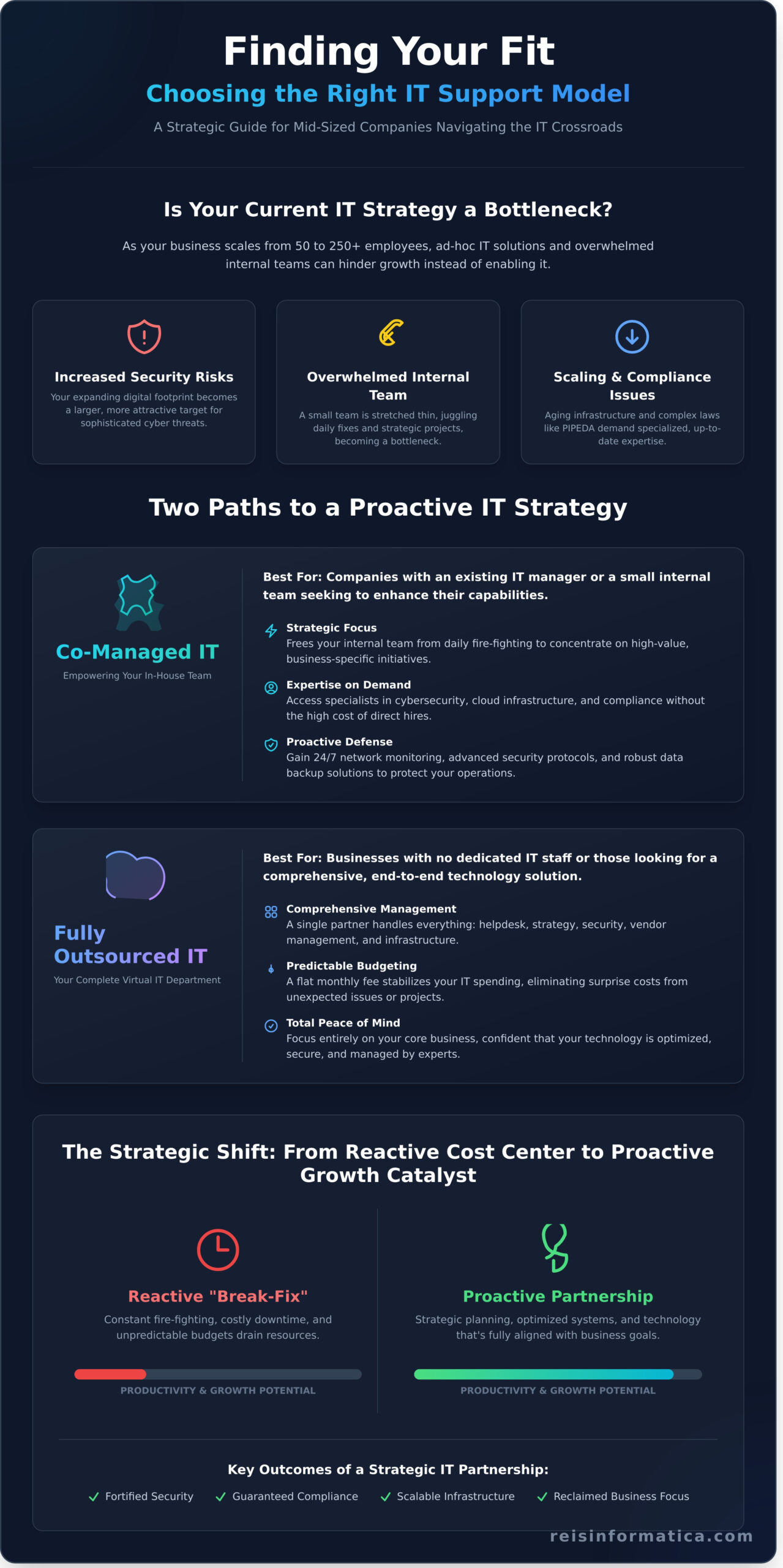
Your business has successfully navigated the startup phase and is now in a period of significant growth. As you scale from 50 to over 250 employees, the IT infrastructure that once supported you begins to show its limits. Simple file sharing evolves into complex data management, and a handful of software licenses multiplies into a sprawling digital ecosystem. This is the IT crossroads-a critical point where ad-hoc solutions and small internal teams are no longer sufficient to secure and power your operations.
At this stage, companies face a new class of challenges that demand a more robust strategy. These growing pains often manifest as:
- Increased Security Risks: Your expanding digital footprint becomes a larger target for sophisticated cyber threats, demanding enterprise-level protection.
- Complex Compliance Demands: Industry regulations and Canadian privacy laws like PIPEDA become non-negotiable, requiring specialized knowledge to ensure adherence.
- Pressing Scaling Issues: Your technology must not only keep up with but also enable business growth, a task that aging infrastructure and overburdened teams cannot handle.
The Overwhelmed Internal IT Team
A small, in-house IT department is often forced into a constant state of reaction. They are caught between managing day-to-day helpdesk tickets and attempting to plan long-term strategic projects. This dual role creates a specialist gap; they cannot be deep experts in every critical area, from cloud architecture to advanced cybersecurity. As a result, the IT team inadvertently becomes a bottleneck, slowing down innovation and hindering your company’s forward momentum.
The Rising Cost of Downtime and Inefficiency
The financial impact of IT failures at this scale is substantial. For a mid-sized Canadian company, even one hour of system-wide downtime can cost thousands of dollars in lost productivity and potential revenue. A reactive, “break-fix” support model drains efficiency company-wide, as employees wait for solutions. These issues are compounded by the hidden costs of managing multiple vendors, renewing disparate software licenses, and maintaining aging hardware that consumes more resources than it delivers.
Confronting these challenges requires a fundamental shift in perspective. The solution is not just about hiring another IT generalist; it’s about fundamentally redesigning your technology strategy. For many, this means exploring professional Outsourcing as a strategic business practice. Engaging a dedicated partner for outsourced IT support for mid-sized companies is no longer a simple cost-cutting tactic. It is a strategic investment in expertise, security, and scalability, allowing you to focus on your core business while your technology foundation is managed by specialists.
Finding Your Fit: Co-Managed vs. Fully Outsourced IT Models
Choosing to engage with outsourced IT support for mid-sized companies is a strategic decision, but it’s not a simple on-or-off switch. Many Canadian business leaders delay this crucial step because they mistakenly view it as a complete surrender of control. In reality, the best solution is a partnership designed to fit your unique operational needs and existing resources. The goal is to find a flexible model that enhances your capabilities, whether you have an in-house IT team or are starting from scratch. Recognizing the Signs it’s time to outsource IT is the first step; understanding your options is the next.
The Co-Managed IT Model: Empowering Your In-House Team
This collaborative model is the perfect fit for companies with an existing IT manager or a small internal team. It’s not about replacement; it’s about reinforcement. Your internal staff understands your business’s unique workflows and priorities. A co-managed partner complements their knowledge by handling the highly specialized, time-consuming tasks that often stretch small teams too thin. This allows your team to focus on high-value, strategic projects that drive business growth.
- Strategic Focus: Your team is freed from daily fire-fighting to concentrate on business-specific applications and initiatives.
- Expertise on Demand: Gain access to specialized skills in cybersecurity, cloud infrastructure, and compliance without the high cost of direct hires.
- Proactive Defence: We provide 24/7 network monitoring, advanced security protocols, and robust data backup solutions to protect your operations around the clock.
The Fully Outsourced Model: Your Complete Virtual IT Department
Ideal for mid-sized businesses with no dedicated IT staff or those looking to completely overhaul an underperforming technology strategy. This comprehensive approach provides you with an entire IT department for a predictable, fixed monthly fee. From day-to-day helpdesk support for your employees to high-level strategic planning with a virtual CIO (vCIO), every aspect of your technology is managed. This model delivers total peace of mind, ensuring your infrastructure is secure, efficient, and aligned with your business objectives, supported by a full team of managed IT services experts.
- All-Inclusive Support: A single point of contact for all technology issues, from user support and network administration to vendor management.
- Predictable Budgeting: A flat monthly fee covers all your IT needs, eliminating surprise costs and simplifying financial planning.
- Strategic Partnership: Benefit from proactive guidance on technology roadmaps, ensuring your IT investments deliver a clear return and support long-term growth.
What to Expect: Core Components of a Strong IT Outsourcing Partnership
Effective outsourced IT support for mid-sized companies moves beyond a reactive, break-fix model. It’s about forging a strategic partnership that delivers measurable business value and operational peace of mind. The difference between a simple contractor and a true technology partner lies in a comprehensive service framework designed for proactive stability and strategic growth. These core components should be the foundation of any Service Level Agreement (SLA), ensuring your technology infrastructure actively supports your business objectives.
Proactive Monitoring and Management
The foundation of a stable IT environment is constant vigilance. This means 24/7/365 monitoring of your critical systems, including networks, servers, and endpoints. By identifying potential issues before they escalate, your partner can perform automated patching and preventative maintenance behind the scenes. The direct business result is maximized system uptime and performance, empowering your team to remain productive without disruptive and costly downtime.
Comprehensive Cybersecurity and Compliance
In today’s digital landscape, a robust security posture is non-negotiable. A dedicated partner provides a multi-layered defence to protect your data and operations. This includes:
- Advanced Threat Protection: Implementing and managing enterprise-grade firewalls, endpoint detection and response (EDR), and sophisticated email filtering to block threats at every entry point.
- Human Firewall: Strengthening your team’s defences through ongoing security awareness training and simulated phishing attacks.
- Compliance Expertise: Providing guidance and support to help you meet industry and regulatory standards, such as Canada’s PIPEDA or CMMC for supply chain security.
Explore our dedicated cybersecurity services for a complete overview of how we protect your business.
Strategic IT Leadership (vCIO)
This is where IT outsourcing transforms from an operational expense into a strategic investment. A virtual Chief Information Officer (vCIO) works with your leadership to develop a technology roadmap that is fully aligned with your long-term business goals. This strategic guidance includes budgeting, technology planning, and vendor management. A vCIO helps you determine if managed IT is right for you by demonstrating how to leverage technologies like cloud services to gain a competitive edge and drive sustainable growth.
The principle of leveraging external executive talent extends beyond technology. In the same way a vCIO provides strategic IT leadership, businesses often require high-level financial guidance. For instance, when facing major growth events like mergers or acquisitions, engaging an expert for consulenza finanza straordinaria M&A becomes a vital strategic move.
The Business Case: Calculating the True ROI of Outsourced IT
Many business leaders see the monthly fee for a managed service provider (MSP) and immediately compare it to an employee’s salary, concluding it’s too expensive. This is a critical miscalculation. The true value of outsourced IT support for mid-sized companies isn’t found in a simple line-item comparison, but in a comprehensive analysis of risk, efficiency, and total cost of ownership.
The decision to outsource is an investment in stability. It transforms unpredictable IT costs-driven by emergencies, staff turnover, and surprise hardware failures-into a fixed, manageable operational expense that protects your bottom line.
Cost of Hiring vs. Cost of Outsourcing
Let’s analyze the real numbers in Canada. An internal IT generalist might have a salary of C$75,000, but their actual cost to your business is far higher. The fully-loaded cost of a single internal hire includes:
- Salary and Benefits: Base salary plus CPP, EI, and benefits packages can easily push the annual cost over C$95,000.
- Recruitment & Training: Agency fees, job postings, and continuous training to keep skills current add thousands more.
- Hidden Costs: Factor in sick leave, vacation coverage, and the significant disruption caused by employee turnover.
For a similar or even lower predictable monthly investment, you gain access not to one generalist, but to an entire team of certified specialists in cybersecurity, cloud infrastructure, and network management.
The Value of Increased Productivity and Uptime
Beyond direct costs, the most significant returns come from operational continuity. Consider the impact of a single major outage. For a mid-sized company, just a few hours of downtime can translate into tens of thousands of dollars in lost revenue, productivity, and client trust. Proactive 24/7 monitoring-a cornerstone of managed services-is designed to prevent these events before they disrupt your business.
Faster, expert-level ticket resolution gets your team back to their core tasks sooner, while strategic guidance helps you leverage technology for a true competitive advantage, unlocking efficiencies you didn’t know were possible. A proper analysis reveals that strategic outsourced IT support for mid-sized companies is not an expense, but a powerful driver of profitability and peace of mind.
How to Choose the Right IT Partner for Your Mid-Sized Business
Selecting a provider for outsourced IT support for mid-sized companies is a critical strategic decision. The right partner becomes an extension of your team, a catalyst for growth and efficiency. The wrong one can become a source of constant friction, hindering productivity and exposing your business to unnecessary risk. To ensure you find a partner who can scale with you, it’s essential to conduct a thorough evaluation.
Key Questions to Ask Potential Providers
A true technology partner will welcome detailed questions and provide transparent answers. Use this checklist to gauge their suitability and commitment to your success:
- Do you have experience with companies in our industry and of our size? A provider familiar with your sector’s specific compliance requirements and operational challenges in Canada can deliver more effective, relevant solutions.
- What are your guaranteed response times (SLAs)? Ask for a clear Service Level Agreement (SLA) that defines response and resolution times. This ensures you have a reliable framework for support when you need it most.
- Can you provide case studies or references? Proven success with clients similar to your business is the best indicator of future performance. Do not hesitate to ask for and contact references.
- How do you handle onboarding? A structured, well-defined onboarding process is a sign of an organized and professional provider. It should be designed to minimize disruption and integrate seamlessly with your operations.
Red Flags to Watch Out For
Equally important is knowing what to avoid. Be vigilant for these warning signs, as they often indicate a provider who is not aligned with a long-term partnership model:
- Vague or confusing pricing models. Your agreement should be clear and predictable, without hidden fees for “out-of-scope” work. Insist on transparency.
- A purely reactive, “break-fix” focus. A modern IT partner should be proactive, using monitoring and strategic planning to prevent issues before they impact your business.
- No clear process for communication. You should have a dedicated point of contact and receive regular, easy-to-understand reports on system health, security, and support activity.
- Inability to demonstrate deep cybersecurity expertise. In today’s threat landscape, a superficial understanding of security is a major liability. Your partner must be a cybersecurity specialist.
Ultimately, the goal is to find more than just a vendor; you need a strategic ally. The right outsourced IT partner acts as a vigilant guardian of your infrastructure, providing the stability and security necessary to focus on your core business. This partnership is the foundation for sustainable, technology-driven growth. To learn more about building a strategic IT partnership, explore our approach to managed services.
Your Strategic Next Step: Partnering for Growth and Security
Navigating the complexities of modern IT is a defining challenge for growing businesses in Canada. As we’ve explored, the decision to move beyond a reactive, break-fix model is about more than managing costs-it’s a strategic pivot toward enhanced security, efficiency, and scalability. Choosing between a co-managed or fully managed model allows you to tailor a solution that aligns perfectly with your operational needs and future goals. Ultimately, the right outsourced IT support for mid-sized companies transforms technology from a daily challenge into a powerful business asset.
At Reis Informática, we don’t just fix problems; we prevent them. With a dedicated team of strategic technology experts and a proactive, security-first approach refined over decades, we act as your vigilant technology partner. We take on the complexity of IT management so you can focus on what you do best: growing your business. Ready to build a technology foundation that supports your ambition? Schedule a consultation to build your strategic IT roadmap.
Frequently Asked Questions About Outsourced IT
What’s the difference between managed IT services and IT outsourcing?
IT outsourcing is a broad term for delegating any IT task, from a one-time project to full infrastructure management. Managed IT services is a specific, proactive form of outsourcing. Instead of reacting to problems, a Managed Services Provider (MSP) continuously monitors, manages, and optimizes your systems for a predictable monthly fee. This partnership model is designed to ensure stability and prevent issues before they impact your business operations, ensuring consistent uptime and performance.
Will we lose control of our IT infrastructure if we outsource?
Not at all. Outsourcing your IT is a strategic partnership, not a surrender of control. You retain full ownership of your infrastructure and data while setting the strategic direction. Your provider acts as your expert operational arm, managing the day-to-day complexities to meet your business goals. This collaboration provides you with enhanced visibility through regular reporting and strategic reviews, allowing you to focus on growth while we ensure your technology foundation is secure and efficient.
How do you ensure the security of our company’s sensitive data?
We implement a multi-layered security strategy, beginning with a robust framework that includes advanced endpoint protection, firewalls, and proactive threat monitoring. Our team adheres to strict data handling protocols and ensures your data is managed in compliance with Canadian regulations like PIPEDA. Regular security audits, vulnerability assessments, and employee training are standard practice to fortify your defences against evolving cyber threats, giving you confidence that your sensitive information is protected.
What is a Service Level Agreement (SLA) and why is it important?
A Service Level Agreement (SLA) is a critical component of our partnership. It is a formal contract that clearly defines the scope of services, performance metrics, and guaranteed response times for support requests. The SLA provides transparency and sets clear expectations for system uptime and issue resolution. It holds us accountable for delivering the high-quality, reliable service your business needs to operate without interruption, turning our promises of performance into a documented commitment.
How long does it take to onboard with a new outsourced IT provider?
The onboarding process for new outsourced IT support for mid-sized companies is typically completed within two to six weeks, depending on the complexity of your current environment. Our structured process begins with a thorough discovery and audit, followed by a detailed transition plan. We prioritize a seamless cutover with minimal disruption to your daily operations, ensuring your team is fully supported from day one of our partnership. Clear communication is maintained throughout each phase.
Can you work with our existing software and cloud applications?
Absolutely. Our expertise lies in integrating with and managing the technology you already use. We are vendor-agnostic and have extensive experience supporting a wide range of industry-specific software and major cloud platforms like Microsoft 365 and Google Workspace. Our goal is to optimize your current technology stack to improve efficiency and security, not force you into a new ecosystem. We work to enhance what you have, ensuring seamless operation across all your critical applications.