
What would happen to your Mississauga business if your entire digital operation vanished for 48 hours? While many leaders assume a basic cloud backup is enough, the reality is that simply having your data stored somewhere doesn’t mean you can get back to work quickly. When searching for disaster recovery services Mississauga, it’s vital to realize that true resilience isn’t just about saving files; it’s about how fast you can resume serving your clients.
We know the anxiety that comes with high downtime costs and the confusion of technical jargon. It’s difficult to feel secure when you aren’t sure if your current setup actually protects your bottom line. This guide provides a clear roadmap to digital resilience for 2026, helping you move from reactive fixes to a proactive strategy. You’ll learn the difference between simple backups and a full recovery plan, ensuring your technology supports your business goals. By the end, you’ll have the peace of mind that your operation is under competent management and ready for any challenge.
Key Takeaways
- Learn the crucial difference between simple data backups and a complete recovery strategy that ensures your business can actually resume operations after a crisis.
- Gain a clear understanding of RTO and RPO to help you decide exactly how much downtime and data loss your specific business model can realistically handle.
- Explore how modern cloud-based disaster recovery services Mississauga provide the digital resilience needed to failover instantly to secure, geographically dispersed data centers.
- Find out how to choose a consultative IT partner who treats your recovery plan as a “living document” through constant testing and strategic updates.
Digital Resilience: Why Mississauga Businesses Need More Than Just Backups
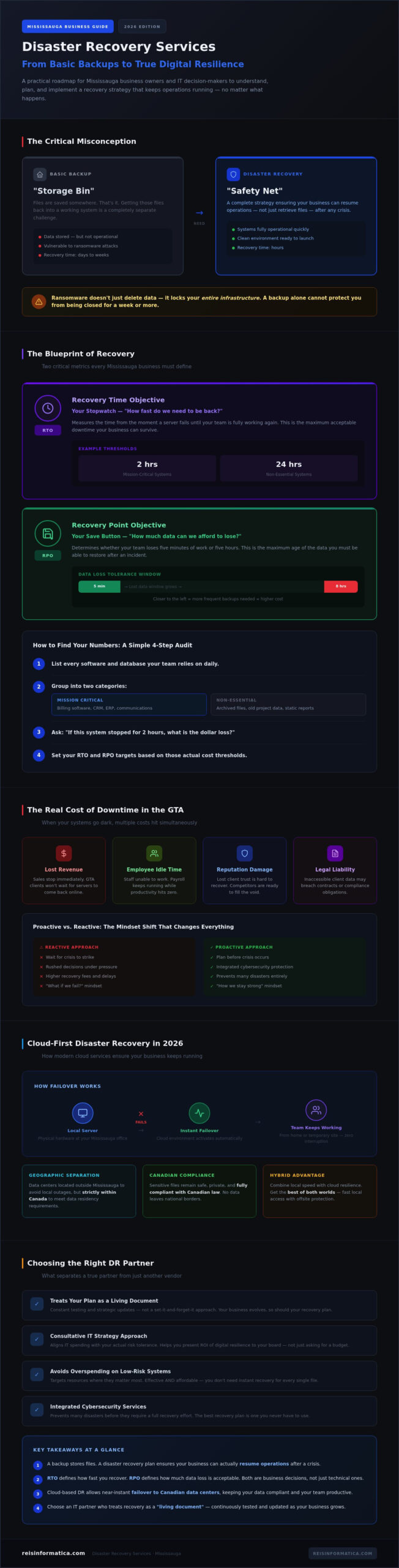
Many Mississauga business owners think a cloud backup is a safety net. It’s actually just a storage bin. If your office near Square One loses power or gets hit by a cyberattack, having a copy of your files is only half the battle. You need to know how fast those files can be turned back into a working system. This is where disaster recovery services Mississauga become a leadership strategy rather than just an IT task. In 2026, digital resilience means your business can absorb a shock and keep moving without missing a beat.
Traditional backups on tape or disk often fail when faced with modern ransomware. These attacks don’t just delete data; they lock your entire infrastructure. A strategic recovery plan ensures you have a clean environment ready to launch the moment an incident occurs. It’s the difference between being closed for a week or being back in business in hours.
The Real Cost of Downtime in the GTA
When your systems go dark, the clock starts ticking on your reputation. In a competitive market like the Greater Toronto Area, clients won’t wait for your servers to crawl back online. Beyond lost sales, you face hidden drains like employee idle time and potential legal liabilities if client data is inaccessible. High downtime costs can cripple a growing firm, making rapid restoration a non-negotiable requirement for survival.
Proactive vs. Reactive Recovery
Waiting for a crisis to strike is the most expensive way to manage technology. A reactive approach leads to rushed decisions and higher recovery fees. By integrating robust cybersecurity services, you build a shield that prevents many disasters before they require a full recovery effort. Being proactive means you’re acting as a guardian of your operational continuity, shifting from a mindset of “what if we fail” to “how we stay strong.”
The Blueprint of Recovery: Setting RTO and RPO Goals
Building a plan for disaster recovery services Mississauga starts with two simple questions: How fast do you need to be back, and how much data can you lose? These aren’t just technical metrics; they’re business decisions. We call these RTO (Recovery Time Objective) and RPO (Recovery Point Objective). Think of RTO as your stopwatch. It measures the time from the moment a server fails until your team is working again. RPO is like your save button. It determines if you lose five minutes of work or five hours.
To find your numbers, follow this simple audit:
- List every software and database your team uses.
- Group them into Mission Critical (billing, CRM) and Non-Essential (archived files).
- Ask: If this stopped for two hours, what’s the dollar loss?
- Set your RTO and RPO based on those costs.
Step-by-Step: Determining Your Recovery Needs
For a mid-market Mississauga firm, RTO and RPO mean defining the exact threshold where downtime turns from an annoyance into a financial crisis. You don’t need instant recovery for every single file. By separating mission-critical apps from non-essential data, you focus your resources where they matter most. This targeted approach ensures your recovery plan is both effective and affordable.
Aligning IT Spend with Risk Tolerance
Smart leaders don’t just buy the most expensive tech; they align their spending with their actual risk. Utilizing IT budget consulting in Mississauga helps you avoid overspending on low-risk systems while reinforcing the pillars of your business. When you present this to your board, you aren’t just asking for a budget. You’re showing the ROI of digital resilience. If you’re looking for a partner to guide this process, consider how a consultative IT strategy can protect your future.
Cloud-First Disaster Recovery: Ensuring Continuity in 2026
By 2026, relying solely on local hardware is a risk most Mississauga firms can’t afford. Modern cloud services provide a virtual “spare room” for your entire business. If your physical server fails, you can failover to the cloud almost instantly. This means your team keeps working from home or a temporary site while local issues are fixed. When evaluating disaster recovery services Mississauga, we ensure these data centers are outside the immediate region to avoid local power outages but strictly within Canada to meet data residency requirements. This keeps your sensitive files safe, private, and compliant with Canadian law.
Hybrid Cloud: The Best of Both Worlds
A hybrid approach gives you the best of both worlds. You get the lightning-fast speed of local access for daily tasks, but you have the rock-solid redundancy of the cloud for safety. It’s a balanced strategy that fits the pace of the GTA. Don’t fall for the myth of “set it and forget it” cloud backups. A real plan requires active management to ensure your cloud environment is always a mirror image of your local one. Without this constant synchronization, your recovery might fail when you need it most.
AI-Powered Resilience
The biggest shift in disaster recovery services Mississauga is the integration of artificial intelligence. Today’s AI-powered cybersecurity solutions don’t just wait for a crash. They predict vulnerabilities and mitigate threats before they cause a disaster. AI also handles the heavy lifting of automated testing. It constantly runs “fire drills” in the background to prove your plan actually works. This proactive stance provides the serenity you need to focus on your core business goals. Ready to modernize your setup? Explore our strategic cloud solutions to see how we can safeguard your operations and ensure your business never stops.
Implementing Your Plan: Choosing a Disaster Recovery Partner
Choosing a partner for disaster recovery services Mississauga isn’t just about hiring a tech vendor. It’s about finding a guardian for your business continuity. Large national firms might offer scale, but they often lack the local context needed when a regional crisis hits. A local partner understands the Mississauga business landscape and can provide on-site support when hardware failures require a physical presence. You want a team that acts as a support strategic partner, not just a help desk.
To ensure your plan is effective, look for a partner who treats documentation as a “living plan.” This means regular testing and updates rather than a binder that sits on a shelf. A fractional CIO or vCIO is essential here. They bridge the gap between technical recovery steps and your high-level business strategy, ensuring your IT spend always supports your growth. When vetting a provider, use this checklist:
- Do they have a physical presence in the GTA for emergency on-site support?
- How often do they perform full-scale recovery tests?
- Can they provide clear documentation that a non-technical manager can follow?
- Do they offer strategic leadership to align recovery goals with business ROI?
The Value of Local Support
In the event of a major regional issue, you don’t want to be just another ticket in a national queue. A local Mississauga partner can be on-site quickly to handle physical server issues or networking hardware failures. This proximity builds a consultative relationship where your partner truly understands your specific operational needs and regional risks. It provides a level of security that remote-only providers simply can’t match. Businesses across the broader 401 corridor share these same concerns, and a structured approach to business continuity planning Milton ON demonstrates how a locally-tailored strategy can turn complex technology challenges into operational resilience.
Next Steps for Your Business
If you aren’t sure where you stand, start by asking your current provider for your last recovery test result. If they can’t produce one, it’s time for a deeper look. You might also schedule cybersecurity services like a penetration test to find vulnerabilities before they become disasters. This proactive step helps you identify gaps in your current plan and builds a stronger foundation for your digital resilience in 2026.
Building Your Resilient Future in Mississauga
Building a resilient business in 2026 requires more than just hope; it requires a plan that turns technology into a silent, efficient facilitator of your success. We’ve explored how shifting from basic backups to a strategic recovery mindset protects your reputation and your bottom line. By setting clear RTO and RPO goals, you ensure your IT spend aligns perfectly with your actual risk tolerance. Each decision you make today acts as a safeguard for your operational continuity tomorrow.
Modern disaster recovery services Mississauga provide the peace of mind that comes from knowing your data stays within Canada and your systems are watched 24/7. With proactive monitoring and strategic vCIO leadership, you can stop worrying about technical vulnerabilities and focus on your central business goals. Your digital infrastructure should be a source of strength, not a cause of anxiety. Secure your business continuity with Reis Informatica’s expert DR services and build the digital resilience your organization deserves. You’ve got the vision; let’s ensure your technology is ready to support it every step of the way.
Frequently Asked Questions
What is the difference between data backup and disaster recovery?
Data backup is the act of copying your files to a safe location, while disaster recovery is the comprehensive plan to restore your entire IT environment after a failure. Think of backup as a spare tire in your trunk and disaster recovery as the roadside assistance service that gets you back on the highway. Backup saves the information, but recovery restores the systems so your team can actually work.
How much do disaster recovery services cost for a Mississauga business?
The cost of disaster recovery services Mississauga depends on your specific RTO and RPO requirements rather than a flat fee. Factors like the volume of data you store, the complexity of your network, and how quickly you need systems back online influence the investment. Most businesses find that a consultative assessment is the best way to determine a budget that aligns with their actual risk tolerance and operational goals.
How often should we test our disaster recovery plan?
You should test your disaster recovery plan at least twice a year, or whenever you make significant changes to your IT infrastructure. Regular testing ensures that your documentation is accurate and that your team knows exactly what to do during a real incident. These fire drills reveal gaps in your strategy before they become costly failures, providing the serenity that your business is truly prepared for any challenge.
Does my Mississauga business need a local DR provider or is the cloud enough?
While the cloud provides excellent redundancy, a local provider offers critical on-site support for hardware-related disasters. If a physical server fails or your local network hardware breaks, having a partner in the GTA means someone can be at your office quickly. A hybrid approach often works best, combining the instant failover of the cloud with the expert, hands-on assistance of local disaster recovery services Mississauga.
Can disaster recovery help protect us from ransomware?
Disaster recovery is your final line of defense against ransomware because it allows you to restore a clean version of your systems. Instead of paying a ransom, you can failover to an uninfected backup from a point in time before the attack occurred. When integrated with proactive cybersecurity, a recovery plan ensures that a security breach doesn’t turn into a permanent loss of your critical business data.