Is your IT budget a source of constant, unpredictable expenses? One month it’s an emergency server repair, the next it’s a critical software patch, all while the threat of a financially crippling cyberattack looms. When viewing technology purely as a cost centre, it’s easy to question whether managed IT is a necessary investment or a luxury. However, looking only at the monthly invoice means you’re missing the most important part of the financial story.
Calculating the true ROI of managed IT services requires a shift in perspective. It’s about moving beyond the fixed fee and quantifying the significant value found in boosted productivity, proactive risk mitigation, and the complete elimination of costly, reactive IT fixes. In this article, we provide a straightforward framework to help you calculate this real return. You will learn how to build a powerful business case, proving that the right IT partnership is not an expense, but a strategic investment that protects your operations and fuels your growth in the competitive market.
Key Takeaways
- Start by uncovering the hidden IT costs you’re already paying-like downtime and inefficient processes-to create a true baseline for comparison.
- Learn to measure both ‘Hard ROI’ from direct cost reductions and ‘Soft ROI’ from strategic gains like improved team productivity and focus.
- Understand how proactive risk mitigation dramatically increases the true ROI of managed IT services by preventing costly security incidents before they occur.
- Gain a practical, step-by-step framework to build a compelling business case and clearly demonstrate the financial value to your leadership team.
Beyond the Invoice: The Hidden Costs of Your Current IT
To accurately calculate the ROI of managed IT services, you must first look beyond the obvious line items in your budget. Most Canadian businesses track direct expenses like hardware purchases and software subscriptions, but this overlooks a far more significant financial drain: the hidden costs of inefficient or reactive IT. Understanding the true Total Cost of Ownership (TCO) of your current technology infrastructure is the foundational step in evaluating any strategic change.
Many organizations operate on a traditional “break-fix” model, where IT support is only called upon after a problem has already caused a disruption. This reactive stance carries unpredictable and often substantial costs that don’t appear on a standard invoice. In contrast, a proactive partnership seeks to prevent these issues from ever occurring. Understanding What are managed IT services? is understanding this fundamental shift from reaction to prevention, a move designed to protect your operational continuity and your bottom line.
The Financial Drain of Downtime
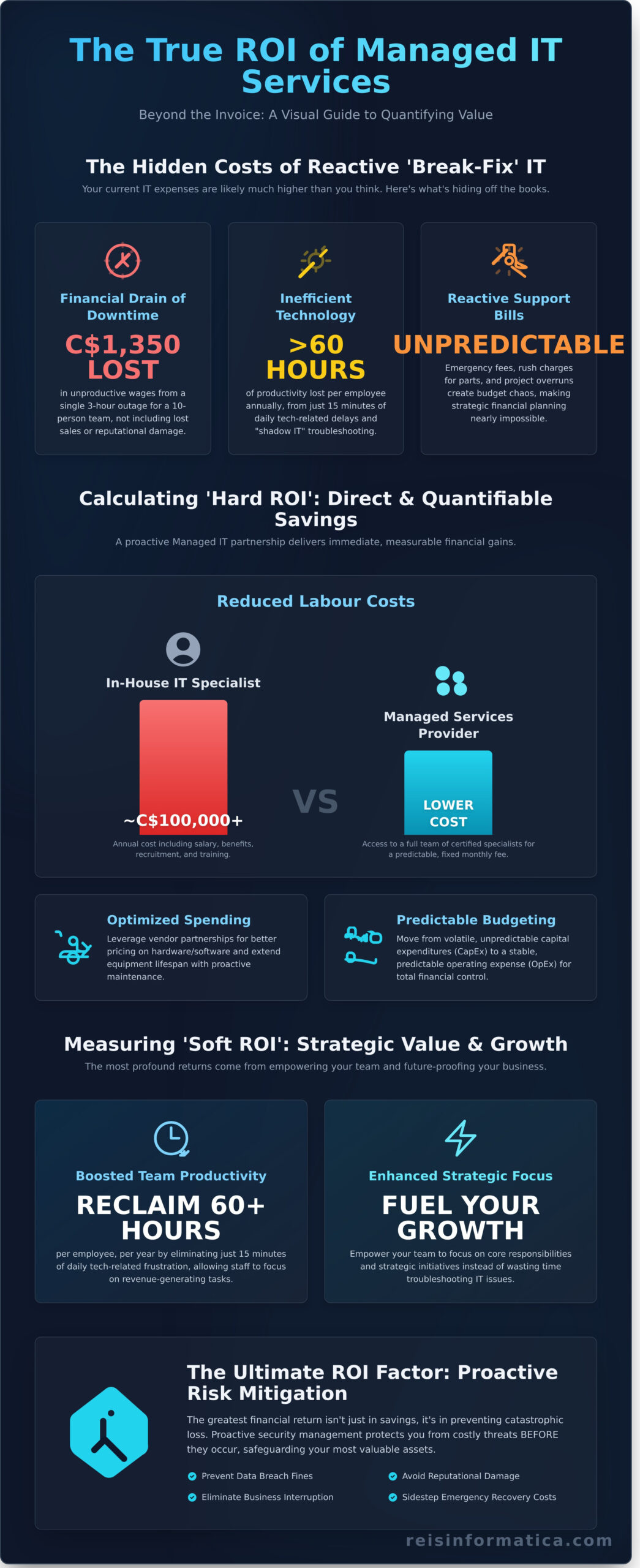
Every minute your systems are down, your business is losing money. This goes beyond just lost revenue. Consider a 10-person team with an average loaded salary of C$45 per hour. A single three-hour outage costs your business C$1,350 in unproductive wages alone. This figure doesn’t even account for missed sales opportunities, project delays, or the long-term reputational damage that can erode customer trust and confidence in your brand.
Lost Productivity from Inefficient Tech
Slow computers, network lag, and persistent software glitches create a constant drag on efficiency. If each employee loses just 15 minutes per day to tech-related frustrations, it amounts to over 60 hours of lost productivity per employee, per year. This also fuels “shadow IT,” where staff waste valuable time trying to troubleshoot their own issues instead of focusing on their core responsibilities. The opportunity cost is immense; what could your team achieve if their technology worked seamlessly?
The Unquantified Cost of Reactive IT Support
The break-fix model is defined by financial unpredictability. You pay for problems after they happen, often incurring expensive emergency call-out fees, rush charges for parts, and unforeseen project overruns. This budgeting chaos makes strategic planning difficult. A managed services model replaces this volatility with a predictable, fixed monthly cost, allowing you to budget effectively while a dedicated partner works proactively to prevent the very emergencies that inflate reactive support bills.
Calculating the ‘Hard ROI’: Direct and Quantifiable Savings
When presenting a case for any business investment, numbers speak loudest. The ‘Hard ROI’ of managed IT services is built on tangible, direct cost reductions that appear clearly on your balance sheet. These are the most straightforward benefits to demonstrate to a leadership team because they represent a clear shift from unpredictable capital expenditures (CapEx) to a stable, predictable operating expense (OpEx). This transition alone gives you greater control over your finances, but the savings go much deeper. Let’s break down the primary areas where you will see immediate financial gains.
Reduced Labour Costs vs. In-House IT
Hiring a single, full-time IT specialist in Canada can easily cost over C$80,000 annually in salary alone. When you factor in benefits, recruitment fees, training, and paid time off, the true expense often exceeds C$100,000. As publications like Forbes have detailed, there are many hidden costs of in-house IT that are easy to overlook. A Managed Services Provider (MSP) gives you access to an entire team of certified experts-specialists in cybersecurity, cloud computing, and network infrastructure-for a single, fixed monthly fee that is often less than the cost of one generalist employee.
Optimized Hardware and Software Spending
Strategic procurement is a critical component of a strong IT budget. An MSP acts as your dedicated technology consultant, preventing costly purchasing mistakes like overspending on unnecessary server capacity or under-spending on critical security software. Leveraging established vendor partnerships, we secure preferential pricing on hardware and software licenses that are unavailable to individual businesses. Furthermore, proactive maintenance and monitoring extend the lifespan of your existing equipment, deferring large replacement costs and maximizing the value of every technology investment.
Predictable Budgeting and Financial Control
One of the most significant challenges for businesses managing their own IT is financial unpredictability. An unexpected server failure or cybersecurity incident can result in emergency repair bills costing thousands of dollars, derailing your budget. Partnering with an MSP eliminates this volatility. Your IT support, maintenance, and monitoring are consolidated into one predictable monthly payment. This simplifies your budget to a single line item, providing the financial stability needed for accurate long-term planning and confident investment in core business growth. This predictability is a cornerstone of the positive ROI of managed IT services.
Measuring the ‘Soft ROI’: Value Generation and Strategic Growth
While direct cost savings are straightforward to calculate, the most significant long-term ROI of managed IT services often comes from less tangible benefits. These “soft ROI” factors are what transform your IT from a necessary expense into a proactive engine for growth, efficiency, and innovation. This is where market leaders create a sustainable competitive advantage, moving beyond simple maintenance to strategic value generation.
Boosting Employee Productivity and Morale
Constant tech glitches and slow systems are silent productivity killers. Consider a Canadian employee earning C$65,000 annually; just 30 minutes of daily IT-related downtime costs your business over C$4,000 per year in lost wages alone. A managed service provider delivers immediate, expert support, turning that frustration into focused work. When your team has reliable tools that empower their roles, you not only reclaim lost hours but also foster higher morale and improve employee retention.
Gaining a Strategic Advantage with a vCIO
How do you ensure your technology investments are directly fueling your business objectives? A virtual Chief Information Officer (vCIO) provides this executive-level guidance without the C$150,000+ salary of a full-time executive. A vCIO acts as your strategic partner, focusing on the strategic alignment of IT with your long-term goals. This forward-thinking guidance is crucial for leveraging emerging technologies, such as powerful AI business solutions, to gain a significant competitive edge.
Improving Business Agility and Scalability
Today’s business landscape demands flexibility. An MSP provides the agility to scale your IT infrastructure and support on demand, whether you are onboarding a new team or adjusting to seasonal market changes. This model allows your technology to adapt without the friction and massive capital expenditures of traditional IT. By leveraging enterprise-grade, scalable solutions like cloud services, you ensure your IT capabilities grow seamlessly alongside your business, providing a stable foundation for rapid expansion.
The Ultimate ROI Factor: Proactive Risk Mitigation
While operational efficiency and reduced overhead are significant benefits, the most crucial component in the ROI of managed IT services is one you hope you never have to calculate: the prevention of a catastrophic event. A single major security incident can instantly negate years of IT savings and, in some cases, threaten the very existence of your business. This is where managed services shift your posture from reactive damage control to proactive, strategic defense.
Investing in proactive security isn’t a cost; it’s an insurance policy with an unparalleled return. It’s about building a resilient organization capable of withstanding the sophisticated threats that define today’s digital landscape.
Calculating the Cost of a Data Breach
In Canada, the average cost of a data breach has soared to C$7.05 million. This staggering figure is not just about stolen data; it encompasses a cascade of financial consequences, including regulatory fines under legislation like PIPEDA, exorbitant legal fees, and the high cost of remediation. A robust security posture, managed by experts in cybersecurity services, is the most effective defense against these devastating expenses.
Ensuring Business Continuity and Disaster Recovery
Ask yourself: what is the financial impact if your business cannot operate for a day? A week? For most companies, the losses from halted sales, idle employees, and supply chain disruptions are immense. A managed IT partner implements and tests robust backup and disaster recovery plans, ensuring that if the worst happens, your operations can be restored in hours, not days. The ROI here is the direct revenue and operational costs you save by minimizing downtime.
Maintaining Compliance and Customer Trust
Navigating complex industry regulations is a significant challenge. An experienced Managed Services Provider (MSP) helps ensure your business remains compliant, avoiding costly penalties and legal entanglements. Beyond the fines, a security incident irrevocably damages your most valuable asset: your reputation. Demonstrating a commitment to security builds essential trust with clients and partners, safeguarding the brand equity you have worked so hard to build.
A Simple Framework to Calculate Your Managed IT Services ROI
Theory is valuable, but numbers build a business case. Let’s translate the benefits we’ve discussed into a practical, step-by-step framework. This simple calculation will help you quantify the value of switching to a managed services model, allowing you to make an informed, data-driven decision for your Canadian business.
Step 1: Tally Your Current IT Costs (The ‘Before’)
First, establish a baseline by calculating your total current IT expenditure. Be thorough and include both direct and indirect costs. This figure represents the costs you stand to reduce or eliminate.
- Hard Costs: Sum up all tangible expenses, including IT staff salaries (e.g., a C$75,000/year internal hire), software licensing fees, hardware purchases, and any ad-hoc support bills from third-party technicians.
- Downtime Costs: Estimate the annual hours of system downtime. Multiply this by your average hourly business revenue. Even four hours of downtime a year for a small business can easily cost thousands of dollars.
- Productivity Loss: Calculate the time your team wastes on IT issues. If 10 employees lose just 30 minutes a week to slow systems or glitches, that’s over 250 hours of lost productivity per year.
Step 2: Calculate the Investment (The ‘After’)
Next, determine the cost of a comprehensive managed IT services plan. This isn’t just a number; it’s a strategic investment in stability and efficiency. Request a detailed quote that covers all your operational needs-from cybersecurity and data backup to proactive monitoring and helpdesk support. This all-inclusive annual figure, paid in predictable monthly installments, will be your “Total Investment.”
Step 3: Apply the ROI Formula
With both figures in hand, you can now calculate the ROI of managed IT services. The “Total Gains” are your current IT costs (the ‘Before’ total from Step 1), as these are the expenses you will replace. The formula is straightforward:
ROI % = [(Total Gains – Total Investment) / Total Investment] x 100
For example, if your current annual IT costs total C$80,000 and a comprehensive managed services plan is C$60,000, the calculation is: [(C$80,000 – C$60,000) / C$60,000] x 100 = 33.3%. This gives you a clear, positive ROI to justify the transition and secure your technological future.
A detailed assessment can help you uncover all hidden costs and build a precise business case. To get a clear picture of your potential savings and operational gains, contact our specialists for a personalized consultation.
From Cost Centre to Strategic Asset: The Real ROI of Your IT
As we’ve explored, calculating the true ROI of managed IT services requires looking far beyond the monthly invoice. A holistic view is essential, one that accounts not only for direct cost savings but also for the powerful, indirect gains in team productivity and strategic agility. Ultimately, the most crucial component is proactive risk mitigation, which safeguards your critical data and operational continuity in an increasingly complex Canadian digital landscape. This comprehensive approach is what transforms your IT from a simple expense into a powerful driver for sustainable growth.
This is the difference between simple IT support and a true technology partnership. With Reis Informática, you gain a vigilant ally dedicated to your success, providing the peace of mind that comes with proactive 24/7 monitoring, the foresight of strategic vCIO guidance, and the resilience of comprehensive cybersecurity protection.
Ready to discover the ROI for your business? Contact us for a custom assessment. Take the first step towards transforming your technology into your greatest competitive advantage.
Frequently Asked Questions About the ROI of Managed IT Services
Is it always cheaper to outsource IT than to hire an in-house team?
Often, yes. An in-house technician’s salary in Canada, which can range from C$60,000 to C$90,000+, is only part of the cost. You must also account for benefits, training, specialized tools, and coverage during absences. Outsourcing provides access to a diverse team of certified experts-in cybersecurity, cloud, and networking-for a predictable monthly fee. This model eliminates recruitment overhead and ensures you have comprehensive expertise on demand, making it a highly cost-effective and strategic choice.
What is a typical ROI percentage for managed IT services?
While specific figures depend on your industry and initial operational state, many Canadian businesses see a return on investment between 50% and 200%. This value is driven by more than just direct cost savings; it stems from significant gains in employee productivity, minimized costly downtime, and enhanced security that prevents devastating data breaches. A complete analysis of the ROI of managed IT services must factor in these crucial operational and risk-mitigation benefits.
How long does it take to see a return on investment after switching to an MSP?
Immediate benefits, such as improved system stability and faster support responses, are often noticeable within the first one to three months. The more substantial financial returns-derived from increased productivity, proactive problem prevention, and strategic technology alignment-typically become clear and measurable within six to twelve months. Our process focuses on stabilizing your environment first, then optimizing it for long-term growth, ensuring a steady and compounding return on your investment.
Can managed IT services really help a small business with only 10-20 employees?
Absolutely. In fact, businesses of this size are often the most vulnerable to cyber threats and operational disruptions due to a lack of dedicated IT resources. Managed services provide access to enterprise-grade security, strategy, and support at a predictable, small-business-friendly cost. This levels the playing field, allowing your team to focus on core business goals with the confidence that your technology infrastructure is secure, efficient, and professionally managed.
How do I account for intangible benefits like ‘peace of mind’ in an ROI calculation?
While “peace of mind” doesn’t appear on a balance sheet, its components can be quantified. Consider the value of “recovered leadership hours” no longer spent on IT fires. You can also estimate the cost savings from improved employee morale and retention due to frustration-free technology. By translating these intangibles into measurable business metrics, you can incorporate their significant financial impact into a more holistic and accurate ROI calculation.
Does a fixed monthly fee cover everything, or are there hidden costs?
Transparency is key to a successful partnership. A reputable MSP provides a service agreement that clearly defines all included services-such as proactive monitoring, helpdesk support, security management, and reporting-for one predictable monthly fee. Costs for out-of-scope projects, like an office move or major hardware purchases, are typically quoted separately and approved by you in advance. Our goal is to ensure your IT budget is predictable, with no surprises.