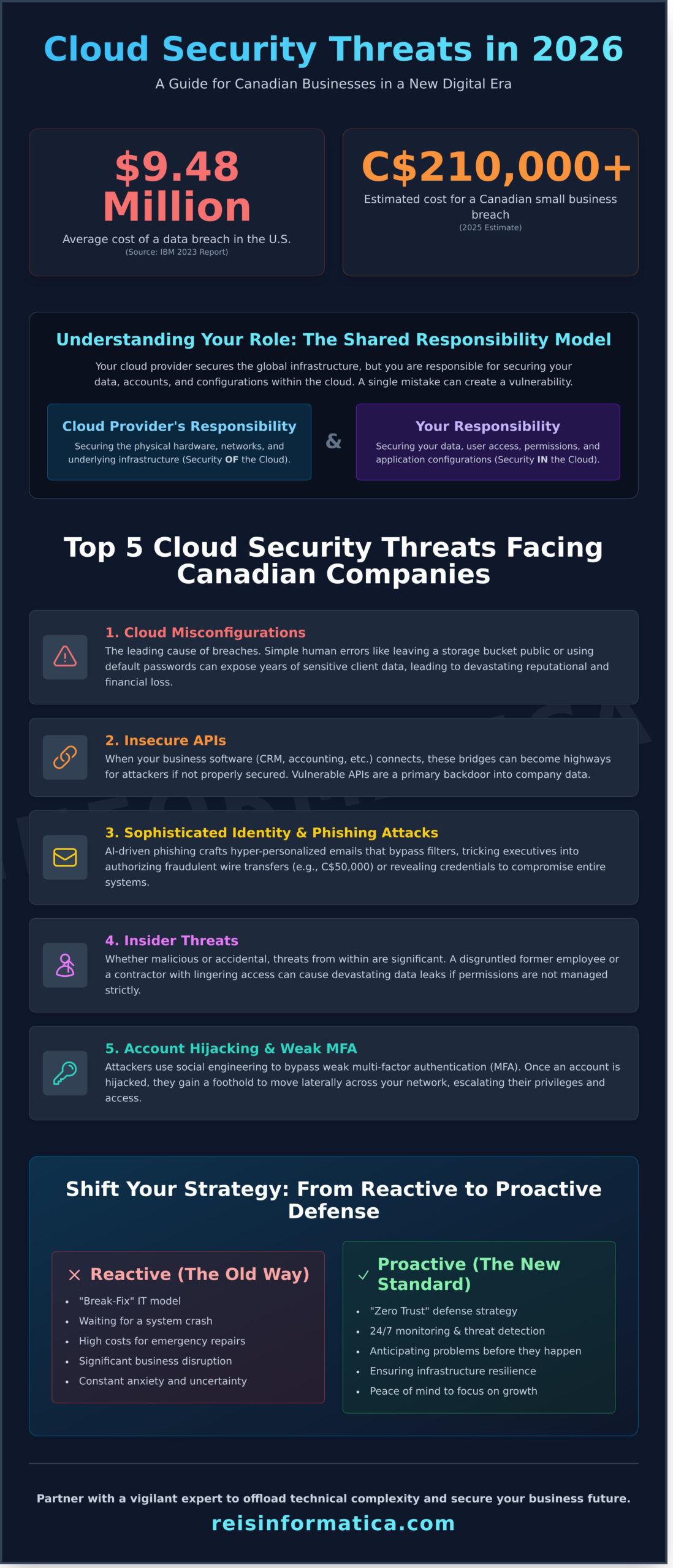
On October 14, 2024, a business owner in a growing tech hub realized that a single misconfigured setting had leaked five years of private client data onto the dark web. It’s a devastating scenario that contributes to the average $9.48 million cost per U.S. data breach reported in the 2023 IBM Cost of a Data Breach Report. You likely already feel that moving to the cloud was the right move for your growth; however, the constant headlines about evolving cloud security threats probably leave you feeling more anxious than agile. It’s exhausting trying to decode complex jargon while worrying if your business is truly meeting state and federal privacy regulations.
You deserve to focus on your core operations without the nagging fear of a digital disaster hitting your local reputation. We promise to help you understand exactly where your vulnerabilities lie and how to build a proactive defense that ensures your peace of mind. We’ll break down the specific risks coming in 2026 and provide a clear, actionable roadmap to keep your infrastructure resilient and secure.
Key Takeaways
Understand how modern cloud security threats have evolved for 2026 and why tech hubs like Waterloo and Kitchener are now primary targets for digital risks.
Identify the top vulnerabilities-from simple setup mistakes to insecure software connections-that could inadvertently open a back door to your private company data.
Learn why local Canadian businesses are being targeted through identity spoofing and how to protect your firm from the steep costs of PIPEDA compliance breaches.
Discover how to move from a reactive setup to a proactive “Zero Trust” defense strategy that ensures your infrastructure remains resilient and secure.
Find out how partnering with a vigilant expert allows you to offload technical complexity, giving you the freedom to focus on growing your business with total confidence.
What Are Cloud Security Threats in 2026? A Simple Overview
Cloud security threats are any vulnerability that allows unauthorized access to business-critical cloud environments. As we move through 2026, the technological landscape for companies in Ontario tech hubs like Kitchener and Waterloo has reached a critical turning point. Local firms have moved beyond simple off-site backups into complex, multi-cloud ecosystems that power everything from inventory to client communications. This deep integration means that a single point of failure can now halt an entire operation in minutes.
Security isn’t just about hackers in far-off locations anymore. It involves a mix of external attacks and internal oversights that put your data at risk. Understanding Cloud computing security is the first step toward building a resilient business. Most providers operate under a Shared Responsibility Model. In this framework, the provider secures the physical hardware and the underlying infrastructure, while you remain responsible for the data, user permissions, and configurations. If you leave a digital door unlocked, the provider isn’t liable for what happens inside your environment.
The stakes for local businesses are both financial and emotional. In 2025, the average cost of a data breach for a Canadian small business was estimated to be over C$210,000 when considering recovery costs, legal fees, and lost revenue. Beyond the C$ symbol, there’s the devastating loss of reputation. When a client in Southern Ontario trusts you with their sensitive information, a breach feels like a personal betrayal. Rebuilding that trust takes years, and many businesses don’t survive the first 12 months following a major data loss event.
The Evolution of Cloud Risks for Small Businesses
Hackers have traded simple password guessing for sophisticated identity-based attacks. They now use social engineering to bypass multi-factor authentication, making cloud security threats harder to detect with basic software. Businesses in Cambridge and Milton are no longer considered too small for these criminals. In fact, smaller firms are often preferred targets because attackers assume their defenses are weaker. The shift toward permanent remote work in Ontario has also expanded the attack surface. Every home office in the province is now a potential gateway into your corporate network, requiring a much more robust defense strategy than the traditional office firewall provided.
Why Proactive Management is the New Standard
The days of the break-fix IT model are over. Waiting for a system to crash before calling for help is an expensive way to run a business in 2026. Modern infrastructure demands a vigilant partner who anticipates problems before they disrupt your workflow. This is where Managed IT services provide a critical safety net. By implementing 24/7 monitoring and automated threat detection, we remove the burden of technical anxiety from your shoulders. We act as your dedicated technological guardian, ensuring that your cloud environment remains a tool for growth rather than a source of risk. This proactive approach allows you to focus on your core business goals while we handle the complexities of digital defense.
The Top 5 Cloud Security Threats Facing Canadian Companies
Cloud adoption is a necessity for Canadian firms looking to scale, but it brings a specific set of challenges. As we move through 2026, the nature of these cloud security threats has shifted from simple viruses to complex, multi-stage attacks. Understanding cloud security risks and vulnerabilities is the first step toward building a resilient digital infrastructure that protects your bottom line. Hackers are no longer just knocking on the front door; they’re looking for any crack in your digital armor.
Insecure APIs are currently a major back door for connected business software. When your CRM connects to your accounting platform, that bridge can become a highway for attackers if not properly secured. Additionally, AI-driven phishing is surging in business hubs like Toronto and Mississauga. These attacks use deep-learning models to craft highly personalized emails that bypass traditional filters, often tricking executives into authorizing fraudulent C$50,000 wire transfers. Insider threats also remain a persistent issue. Whether it’s a disgruntled former employee or a contractor who still has active credentials, failing to revoke access immediately can lead to devastating data leaks. Finally, account hijacking via weak multi-factor authentication (MFA) continues to plague businesses. If your team relies on simple SMS codes, you’re vulnerable to SIM-swapping attacks that can bypass these basic protections in minutes.
The Hidden Danger of Misconfigurations
Misconfiguration is the primary reason for accidental data exposure in 2026. Common mistakes when setting up AWS, Azure, or Google Cloud include leaving storage buckets open to the public or failing to restrict outbound traffic. These “invisible” security holes are difficult to spot manually. Local businesses in Calgary and Halifax must implement automated auditing tools to scan their environments daily. A single error in a cloud setup can cost a mid-sized firm upwards of C$4.2 million in recovery fees and regulatory fines, making proactive monitoring a business requirement rather than a luxury.
For those looking into such solutions, you can check out Penetrify, an AI-powered platform that automates security testing for web applications to find these kinds of vulnerabilities.
Identity and Access Management (IAM) Failures
Managing who has access to what is the cornerstone of a safe cloud environment. Many organizations fail by granting broad permissions, but the “least privilege” principle dictates that nobody should have more access than they need for their specific role. Utilizing professional Cybersecurity services allows you to monitor user behavior and identify anomalies before they escalate. Consider a real-world example: in early 2025, a Vancouver-based logistics company suffered a total cloud takeover because a single manager’s compromised password had administrative rights. If that account had been restricted to only necessary functions, the damage would have been contained to a single department instead of the entire corporate network. If you’re unsure about your current access levels, a quick security assessment can help you regain control and ensure your team stays focused on growth rather than crisis management.
Addressing these cloud security threats requires a shift from a reactive mindset to a proactive partnership. By securing your APIs, training staff against AI phishing, and tightening your IAM protocols, you create a stable environment where technology serves your business goals without creating unnecessary risk. This strategic approach ensures your infrastructure remains a competitive advantage rather than a liability.
Why Local Businesses in Calgary, Halifax, and Ontario are Key Targets
Cybercriminals no longer focus exclusively on global giants. Small and medium businesses across Canada, from the energy sector in Calgary to the growing tech hubs in Halifax, are increasingly in the crosshairs. These attackers leverage a concept known as the “Local Trust” factor. By spoofing the identities of known Canadian businesses or using local area codes, hackers trick employees into lowering their guard. A phishing email that appears to come from a reputable supplier in Mississauga or a local bank in Toronto carries a level of authenticity that generic global scams lack. This localized approach makes cloud security threats particularly dangerous for companies that assume their geographical location provides a safety net.
The regional landscape also dictates the type of risks your business faces. In the Waterloo tech corridor, the primary target is often intellectual property and proprietary code. In contrast, the financial hub of Toronto sees a higher volume of attacks aimed at intercepting sensitive transaction data. Hackers recognize that Canadian SMBs often serve as entry points into larger supply chains. If your cloud infrastructure isn’t properly hardened, you aren’t just risking your own data; you’re risking the trust of every partner you work with. Security isn’t just a technical requirement. It’s a fundamental pillar of your brand’s reputation in the Canadian market.
The financial consequences of a breach are staggering. According to the 2023 Cost of a Data Breach Report by IBM, the average cost of a data breach for a Canadian organization is approximately C$6.94 million. This figure includes legal fees, forensic investigations, and the loss of customer business. For a business in London or Milton, a single incident involving top cloud security threats like misconfigured storage or compromised credentials can be catastrophic. You need a strategy that moves beyond basic firewalls and addresses the specific ways Canadian businesses are being targeted today.
Navigating Canadian Data Privacy Laws
Compliance is a major driver for robust security. You must manage data according to the Personal Information Protection and Electronic Documents Act (PIPEDA), along with provincial regulations like Alberta’s PIPA. Failing to secure your cloud environment can lead to regulatory fines reaching C$100,000 for specific violations. Canadian businesses must ensure their cloud providers store data in a way that aligns with national privacy standards to avoid legal liability. This means knowing exactly where your data resides and ensuring your cloud security threats mitigation strategy accounts for Canadian residency requirements.
The Advantage of a Regional Security Partner
Proximity matters when a crisis hits. If a security event occurs in Ottawa or Kingston, having a partner who operates in your time zone and understands the local business environment is invaluable. Unlike generic global providers, Cloud services tailored for Canadian SMBs prioritize data sovereignty and low-latency connections. This local expertise allows you to focus on growth while your IT partner acts as a vigilant guardian. By choosing a regional specialist, you ensure that your technology remains an invisible, efficient engine for your business rather than a source of constant worry.
Building a Proactive Defense Strategy for Your Cloud Infrastructure
You shouldn’t wait for a breach to happen before you take action. A proactive defense starts with a comprehensive cloud security audit that looks at every corner of your digital environment. By identifying weak points in your current setup, you can stop cloud security threats before they disrupt your operations. In 2024, IBM reported that the average cost of a data breach for Canadian organizations reached C$6.32 million. That’s a financial hit most small to medium businesses can’t recover from easily. We focus on finding hidden gaps in your permissions and configurations so your team can work without the constant fear of a shutdown.
The Zero Trust Approach
By 2026, security experts predict that Zero Trust will be the non-negotiable standard for every secure organization. The mantra is simple: never trust, always verify. This doesn’t mean you’re slowing your team down with endless hurdles. We implement identity verification that happens seamlessly in the background, keeping productivity high while ensuring only the right people access your sensitive data. Encryption plays a vital role here as well. It protects your files whether they’re sitting in storage or moving between offices. It’s about building a digital perimeter that stays strong regardless of where your employees log in from.
Leveraging AI for Cloud Defense
Traditional antivirus software isn’t enough to handle modern risks. Modern AI business solutions monitor your network 24/7 to spot anomalous login patterns that a human might miss. If someone tries to log in from a location they’ve never visited at 3:00 AM, the system flags it instantly. This is the difference between reactive fixes and proactive server maintenance. We ensure your cloud stability by catching these cloud security threats early. It’s like having a digital security guard who never sleeps and learns from every interaction.
Your team in Mississauga is your first line of defense. We turn them into a human firewall through regular, clear training sessions that explain risks without using confusing jargon. When employees know how to spot a phishing attempt or a suspicious link, your overall risk drops by up to 70%. It’s about empowering your staff to be part of the solution rather than a vulnerability. We provide the tools and the knowledge so they feel confident navigating their daily tasks safely.
Beyond training, you need a reliable safety net. Regular backup and disaster recovery planning ensure business continuity even if the worst happens. If a server fails or a file is accidentally deleted, you can recover in minutes rather than days. This keeps your revenue flowing and your reputation intact. We handle the technical complexity of these backups so you can focus on growing your business. It’s time to move away from “fixing what’s broken” and start preventing the break in the first place.
Securing Your Business Future with Reis Informática
Protecting your company shouldn’t be a source of daily stress for you. We act as your Vigilant Partner across Ontario and the rest of Canada, taking the heavy technical lifting off your shoulders. Our team manages the complex landscape of cloud security threats so you can stay focused on what really matters; growing your business and serving your customers. According to IBM’s 2023 Cost of a Data Breach Report, the average cost of a breach for Canadian organizations reached C$6.94 million. You shouldn’t have to face those risks alone. We provide a technical shield that keeps your data safe and your budget predictable.
Our commitment goes beyond just installing software. We build customized security roadmaps for businesses in Ottawa, Kingston, and London. These plans aren’t generic templates. They’re strategic documents designed to address your specific vulnerabilities and local market requirements. By shifting the technical burden to us, you gain the freedom to innovate without fear. We believe technology should be a silent engine of growth, not a constant hurdle for your leadership team to jump over.
The Reis Informática Method: Security, Stability, and Support
We don’t believe in reactive fixes that only address problems after they’ve caused damage. Our method relies on proactive monitoring and rapid incident response. Statistics from the National Cyber Security Alliance show that 60% of small businesses close their doors within six months of a cyber attack. We’re here to ensure you aren’t part of that number. Our team watches your infrastructure 24/7, catching anomalies before they turn into full-blown crises.
Our GTA clients trust our consultative style because we prioritize clarity over jargon. We explain your security posture in terms of business outcomes like uptime and ROI. You can get started today by booking a comprehensive security audit. We’ll examine your current setup, identify every gap, and provide a clear path forward. This isn’t just about fixing a computer; it’s about stabilizing your entire business foundation for the years ahead.
Tranquility Through Technology
True security comes from a long-term strategic partnership rather than a one-time patch. Business owners in Calgary and Halifax deserve the same high-level protection and local support as those in our largest urban centers. We provide the peace of mind that allows you to sleep better at night. A single hour of system downtime can cost a mid-sized Canadian firm over C$10,000 in lost productivity and missed opportunities. Our proactive approach aims to eliminate that risk entirely.
We encourage you to take the next step in securing your cloud assets against evolving cloud security threats. Don’t wait for a warning sign that might come too late. Our experts are ready to help you transition from a state of worry to a state of total operational confidence. Contact the Reis Informática team today for a consultation. Let’s work together to make your technology invisible, efficient, and above all, secure.
Secure Your Business Future Against Tomorrow’s Risks
As we move toward 2026, the landscape of cloud security threats is shifting from simple password breaches to complex, AI-driven attacks. Protecting your operations in hubs like Toronto, Calgary, or Halifax isn’t just about installing software; it’s about constant vigilance. Recent industry data suggests that proactive threat detection can save Canadian firms from the average C$6.94 million cost of a single data breach. You need a strategy that meets strict Canadian privacy standards while keeping your team focused and your data locked down.
Reis Informática acts as your vigilant partner across Ontario, Alberta, and Nova Scotia. We take the technical weight off your shoulders with 24/7 monitoring and specialized support for local compliance regulations. We’ll ensure your infrastructure stays invisible and efficient so you can lead your company with total confidence. Take the first step toward a worry-free digital environment today.
We’re ready to help you build a resilient foundation for your continued success.
Frequently Asked Questions
What are the most common cloud security threats for small businesses?
The most common cloud security threats for small businesses include data breaches, insecure APIs, and account hijacking via phishing. These vulnerabilities often stem from a lack of multi-factor authentication or weak password policies. IBM’s 2023 Cost of a Data Breach Report shows that Canadian companies pay an average of C$6.94 million per incident. We focus on proactive monitoring to stop these threats before they impact your daily operations.
Is the cloud safer than an on-premise server for my Kitchener business?
Yes, the cloud is generally safer because major providers invest over C$1.3 billion annually in security infrastructure and physical protection. Your Kitchener business likely can’t match that level of specialized defense on a local server. While on-premise hardware requires manual patches, cloud environments receive automatic updates. This ensures your data stays protected against the latest 2024 exploits without your team lifting a finger.
How does PIPEDA affect how I store data in the cloud?
PIPEDA requires you to ensure a comparable level of protection for personal data regardless of where it’s stored. If your cloud server is outside Canada, you remain responsible for how that provider handles information. Since 2001, this federal law has mandated that businesses obtain clear consent and use strong encryption. We help you select Canadian-based data centers to simplify your compliance roadmap and protect client privacy.
What is a cloud misconfiguration and why is it so dangerous?
A cloud misconfiguration is a setup error, like leaving a database public, that exposes your private information to the internet. It’s dangerous because it provides an open door for hackers without requiring any complex skills. Research from Gartner indicates that through 2025, 99% of cloud security failures will be the customer’s fault. These simple mistakes are the leading cause of cloud security threats today.
Can AI help protect my business from cloud security threats?
AI protects your business by identifying unusual patterns that human monitors might miss. It acts as a 24/7 digital guard that blocks suspicious login attempts from unknown locations instantly. According to IBM, companies using AI and automation in their security saved C$1.76 million compared to those that didn’t. This technology turns a reactive strategy into a proactive defense against evolving cloud security threats.
How often should my Mississauga company perform a cloud security audit?
Your Mississauga company should perform a comprehensive cloud security audit at least every 90 days. Quarterly reviews allow you to catch unauthorized access points or outdated permissions before they become liabilities. With 45% of all data breaches now occurring in the cloud, waiting for an annual checkup is too risky. Regular audits ensure your infrastructure remains lean, secure, and fully optimized for your current staff count.
What should I do if I suspect a cloud data breach?
You should immediately isolate the suspected accounts and change all administrative passwords to prevent further access. Contact your IT partner to begin a forensic analysis and determine exactly what data was compromised. Under Canadian law, you must report certain breaches to the Privacy Commissioner if there’s a real risk of significant harm. Taking these steps within the first 24 hours significantly reduces the long-term financial impact on your business.
Why do I need a managed service provider if I already use a major cloud provider?
You need a managed service provider because major platforms like AWS or Azure only secure the underlying infrastructure, not your specific data. This is known as the Shared Responsibility Model. While they keep the data center safe, you’re responsible for locking the doors and windows of your specific environment. We act as your expert caretakers, managing those daily security tasks so you can focus on your core business goals.