
For three consecutive years, manufacturing has been the most-attacked industry sector globally. For local plant managers, this threat hits close to home when a single ransomware infection can freeze CNC machinery, PLC controllers, and entire assembly lines. Balancing daily production with robust cybersecurity for manufacturing SMBs Cambridge ON is increasingly difficult, especially when Tier 1 automotive and aerospace partners demand complex security questionnaires. It’s stressful to manage aging shop-floor hardware running legacy software that cannot accept standard patches, particularly when you lack the technical staff to handle complex network segmentation.
You deserve clear visibility and operational serenity on the shop floor. Discover how Cambridge manufacturers can protect plant operations, prevent downtime, and satisfy supply chain security audits. This 2026 guide outlines practical, proactive steps to separate your office networks from production automation, ensuring your business passes vendor-risk assessments and stays continuously running.
Key Takeaways
- Understand why local manufacturing plants along the 401 corridor are prime targets for supply chain breaches and how to protect your status as a trusted partner.
- Learn to bridge the gap between office systems and factory floor machinery by implementing tailored cybersecurity for manufacturing SMBs Cambridge ON without risking production crashes.
- Follow a practical checklist to map your connected industrial assets and build secure network barriers that keep malware away from your assembly lines.
- Discover the value of proactive managed IT support that understands industrial operational schedules and prevents downtime before it starts.
Why Cambridge Manufacturing SMBs Face Escalating Cyber Threats in 2026
Cambridge sits at a strategic crossroads along Highway 401. This location makes local shops vital to the Southwestern Ontario economy, but it also places them in the crosshairs of global cybercrime. Threat actors recognize that cybersecurity for manufacturing SMBs Cambridge ON is often the weakest link in a massive supply chain. Instead of attacking a multi-billion dollar OEM directly, they target the tier-two supplier to gain leverage. It’s a “path of least resistance” strategy that works all too often.
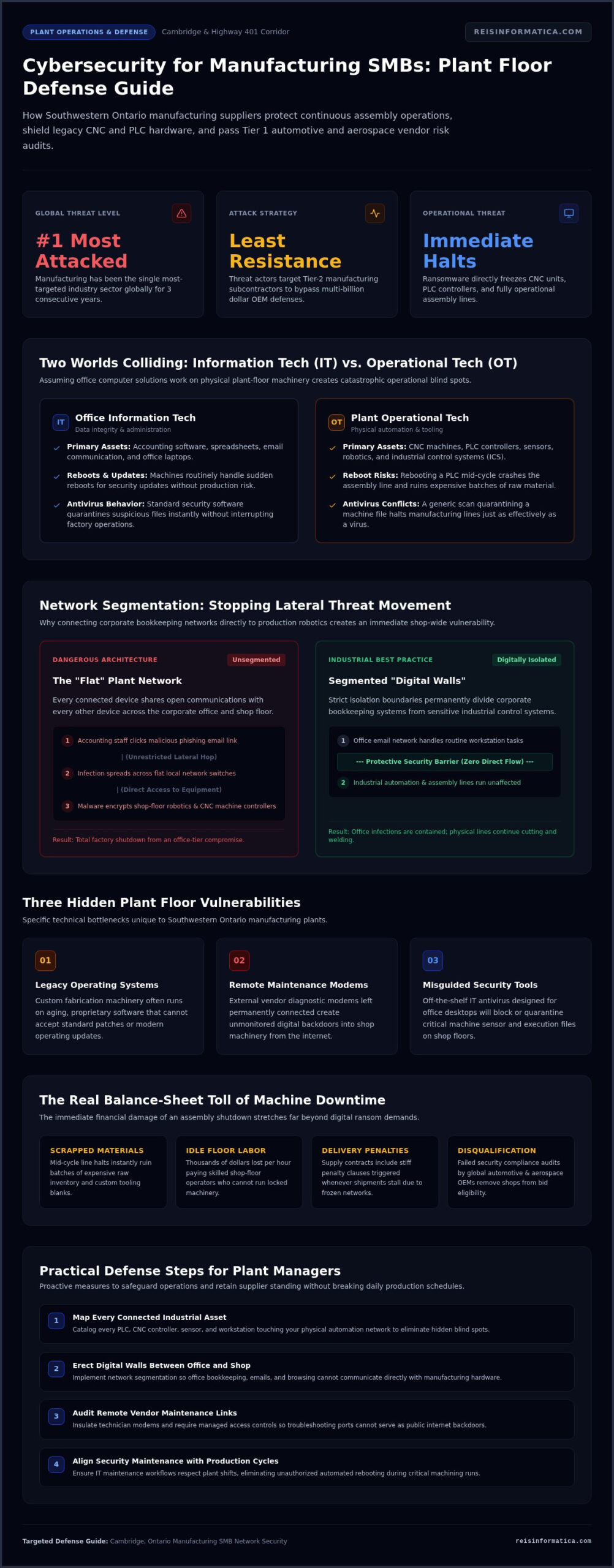
Standard antivirus software is designed for office laptops, not the shop floor. It cannot protect an industrial control system (ICS) cybersecurity framework or the programmable logic controllers (PLCs) that run your lines. If a generic security scan accidentally quarantines a critical machine file, the line stops just as surely as if a virus hit it. You need solutions that understand the difference between a spreadsheet and a sensor.
The Reality of Modern Industrial Supply Chain Attacks
Global OEMs now demand rigorous digital security compliance from every subcontractor. They’ve seen how a single compromised vendor email account leads to fraudulent wire transfers or redirected invoices. Implementing professional cybersecurity services is no longer optional; it’s a requirement to meet supplier contract mandates and keep your business eligible for major projects.
The Financial Toll of Shop-Floor Production Stoppages
The true cost of a breach isn’t just the ransom. It’s the thousands of dollars lost every hour in wasted raw materials, idle labor, and missed deadlines. Many contracts now include stiff penalty clauses triggered if your factory shipments stall because your network is encrypted. When your machinery stops, the financial impact ripples through your entire balance sheet immediately. Investing in robust cybersecurity for manufacturing SMBs Cambridge ON ensures these costly stoppages don’t happen.
IT vs. OT Security: Identifying Vulnerabilities on Your Plant Floor
In manufacturing, your network lives in two different worlds. Information Technology (IT) manages your emails and accounting. Operational Technology (OT) controls the physical machinery on your shop floor. The Critical Manufacturing Sector faces unique risks because these two worlds are now colliding. For business owners, the biggest danger is assuming that what works for an office laptop works for a CNC machine.
Applying traditional security patches to production machinery is risky. An office computer handles a quick reboot easily. However, doing the same to a PLC mid-cycle can crash your assembly line or ruin expensive raw materials. This is a core challenge in cybersecurity for manufacturing SMBs Cambridge ON. You need a strategy that protects the hardware without interrupting the flow of work.
Legacy Machinery and Unsupported Industrial Operating Systems
Many shops use custom fabrication gear running on older software that cannot receive modern updates. These legacy systems are often left wide open when external technicians use remote maintenance modems to troubleshoot. These modems act as unmonitored backdoors into your facility. It’s vital to review professional it services to ensure these sensitive endpoints are insulated from the public internet.
The Risk of Flat, Unsegmented Plant Networks
A “flat” network is one where every device can talk to every other device. If an employee in accounting accidentally clicks a malicious link, that infection can travel directly to your shop-floor robotics. Separating your corporate bookkeeping data from your industrial control systems is the only way to prevent lateral movement. Effective cybersecurity for manufacturing SMBs Cambridge ON relies on building digital walls between your office and your plant. If you’re worried about your current setup, consulting with a specialist can help you identify these hidden access points.
A Practical 4-Step Cybersecurity Checklist for Local Plant Managers
Managing a plant floor is complicated enough without worrying about digital intruders. You don’t need a multi-million dollar budget to start securing your facility. A practical approach to cybersecurity for manufacturing SMBs Cambridge ON begins with visibility and control. By following these four steps, you can build a resilient foundation for your operations.
- Step one: Map every connected device. You can’t protect what you don’t know exists. This includes industrial sensors, shop-floor laptops, and office servers. The Canadian Centre for Cyber Security recommends this as a baseline for all organizations.
- Step two: Establish strict network segmentation. Use dedicated firewalls and virtual local area networks (VLANs) to keep your assembly floor separate from your office Wi-Fi.
- Step three: Enforce mandatory multi-factor authentication (MFA). This should be active across all external remote desktop access channels used by staff or vendors.
- Step four: Deploy immutable offline data backups. These ensure you can restore operations rapidly without ever paying a ransom to criminals.
Implementing Pragmatic Network Segmentation and Access Controls
Isolating your assembly floor ensures that a virus on an office laptop won’t halt your machinery. It’s also vital to restrict vendor access. Don’t leave remote diagnostic portals open 24/7. Instead, only permit access during pre-scheduled, supervised maintenance windows. Modernizing your network through professional it services makes this process seamless and sustainable for long-term growth.
Building Human Defenses Through Frontline Staff Awareness
Your employees are your best defense. Train shipping clerks, quality inspectors, and floor supervisors to spot sophisticated phishing attempts. Even the best technical barriers can fail if someone inadvertently gives away credentials. Investing in cybersecurity services that include staff education builds a human firewall around your business. If you’re ready to secure your plant, start with a professional network assessment today.
Partnering for Protection: Choosing Managed IT Support in Cambridge
Effective cybersecurity for manufacturing SMBs Cambridge ON isn’t just about software. It’s about having a partner who understands that your assembly line doesn’t run on a standard 9-to-5 schedule. When a network glitch threatens a midnight production run, a remote helpdesk located hours away isn’t enough. You need proactive management that prevents the glitch from happening in the first place.
Standard “break-fix” IT is reactive. It waits for something to stop before acting. For a manufacturer, that pause represents lost revenue and missed shipping targets. In contrast, proactive managed IT services provide continuous monitoring and infrastructure management. This approach identifies failing hardware or unauthorized intrusions before they can trigger a shutdown. It also ensures you have the documentation ready when Tier 1 partners send over their rigorous security compliance questionnaires.
Key Criteria for Selecting a Local Cambridge Technology Partner
Localized dispatch is critical. If a physical failure occurs, you need a technician who can arrive at your facility in Boxwood or the North Dumfries industrial areas quickly. Verify that your partner has experience handling industrial network configurations, not just office workstations. They must understand how to secure cloud accounts alongside legacy shop-floor machinery without causing operational friction.
Maintaining Continuous Operational Serenity and Resilience
Ongoing system monitoring allows leadership to concentrate entirely on output quality and shipping targets. You shouldn’t have to worry about whether your backups are working or if a firewall is outdated. Regular disaster recovery simulations ensure that if the worst happens, you can resume operations without paying a ransom. Booking a comprehensive vulnerability review is the first step to uncovering hidden industrial gaps. This proactive stance is what separates successful local suppliers from those struggling to keep up with modern digital demands.
Securing Your Plant’s Future in Southwestern Ontario
Protecting your facility’s operations requires moving beyond reactive repairs and embracing a strategy that bridges the gap between your office and the assembly line. We’ve detailed how proper network segmentation and proactive monitoring prevent unauthorized intrusions from freezing your machinery. By following a clear checklist, your business can satisfy rigorous supply chain audits and maintain its competitive edge along the 401 corridor.
Reis Informatica offers dedicated technical expertise serving Cambridge, Waterloo Region, and Southwestern Ontario. Our comprehensive cybersecurity services are specifically tailored to bridge enterprise networks and operational plant floors. This proactive IT leadership ensures zero disruption to your critical manufacturing production schedules. Don’t let hidden vulnerabilities stall your growth. You can protect your plant’s uptime with a manufacturing cybersecurity assessment from Reis Informatica. Strengthening your cybersecurity for manufacturing SMBs Cambridge ON is a strategic investment in long-term operational serenity. Your facility deserves a partner that stays vigilant so you don’t have to.
Frequently Asked Questions
Why are small manufacturing plants in Cambridge targets for global cyber attacks?
Cambridge manufacturers are prime targets because they act as vital nodes in the Highway 401 supply chain. Attackers target these SMBs to gain access to larger enterprise partners like automotive OEMs. Since smaller shops often have leaner security than global corporations, they represent the path of least resistance for hackers looking to disrupt critical infrastructure or commit financial fraud. Being local doesn’t protect you from global threats.
Can standard business antivirus software protect computer-controlled factory machinery?
No, standard antivirus isn’t sufficient for shop-floor hardware. Traditional software is built for office environments and can accidentally flag or quarantine files essential to machine operation, causing unplanned downtime. Effective cybersecurity for manufacturing SMBs Cambridge ON requires specialized tools that understand industrial protocols and programmable logic controllers without crashing the assembly line during a scan or update. You need a solution that recognizes the difference between a spreadsheet and a sensor.
What is network segmentation, and why is it essential for production plants?
Network segmentation is the practice of creating digital barriers between different parts of your network. In a manufacturing setting, this means separating your office Wi-Fi and accounting systems from the production machinery. It’s essential because it stops an infection from a simple office email from spreading to your robotics. This ensures a breach in one area doesn’t halt your entire operation or compromise sensitive industrial control systems.
Will implementing cybersecurity controls slow down our daily manufacturing output?
Properly implemented security controls actually improve uptime by preventing malware-related shutdowns. While some initial setup is required, modern cybersecurity for manufacturing SMBs Cambridge ON is designed to work silently in the background. Strategic segmentation and managed monitoring ensure that security protocols don’t interfere with machine cycle times or operator access. This leads to more consistent production schedules rather than creating friction on the factory floor.
How often should an industrial facility test its emergency data backups?
You should test your emergency data backups at least quarterly, or whenever significant changes are made to your industrial hardware. Simply having a backup isn’t enough. You must verify that the data is recoverable and that your team can restore it within an acceptable timeframe. Regular disaster recovery simulations ensure that your business continuity plan works as intended when every minute of downtime costs your business money.