
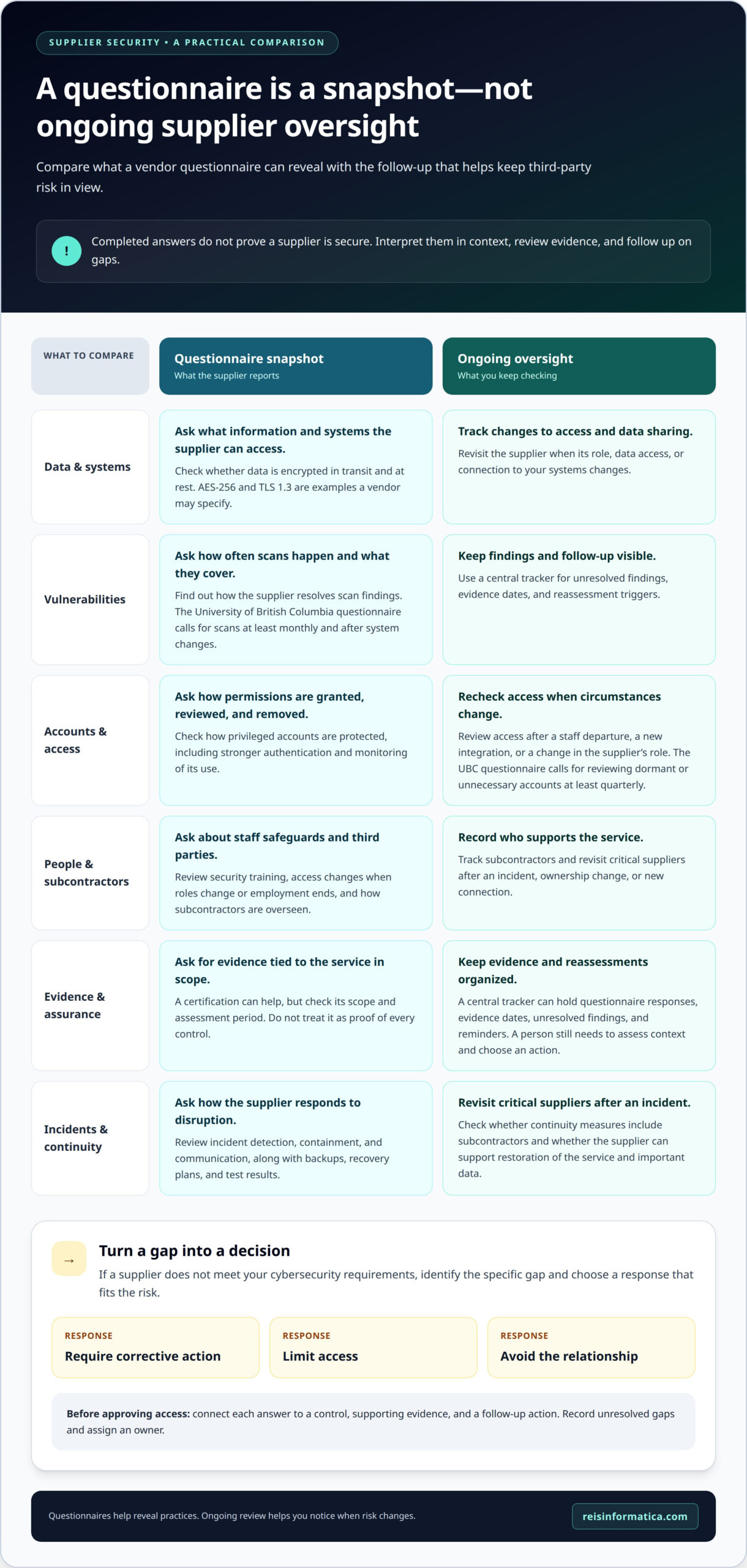
A completed questionnaire does not prove that a supplier is secure. Use a cybersecurity questionnaire for vendors to understand how a supplier protects your data, controls access, responds to incidents and oversees subcontractors. Then weigh the answers alongside ongoing risk monitoring.
A clear, consistent way to assess suppliers is especially useful when your business relies on outside providers to store information or support daily operations. A questionnaire can reveal important practices, but it is only a snapshot, so interpret the answers in context and follow up on gaps.
This guide explains how to prepare useful questions, assess responses in proportion to each supplier’s access and risk, and turn the process into a practical security self-assessment for a small business. It also covers how to keep third-party risk in view as supplier relationships and business needs change.
Key Takeaways
- Match each supplier assessment to the data and systems the supplier can access, then focus on controls such as encryption and vulnerability management.
- Look beyond completed answers by reviewing access practices, security incidents, subcontractors and changes that could affect supplier risk.
- Include backup, recovery and incident-response planning to understand how a supplier would support business continuity.
- Use the questionnaire as a practical starting point for your own security self-assessment, then build follow-up into your ongoing risk process.
What are best practices for vendor risk assessment questionnaire usage?
A supplier that does not meet your cybersecurity requirements may expose your organization to unauthorized access, data loss or service interruptions. Use the assessment to identify specific gaps, then decide whether to require corrective action, limit access or avoid the relationship.
Start with controls that protect information and systems. Ask whether the vendor encrypts data both in transit and at rest; AES-256 and TLS 1.3 are examples vendors may specify. Ask how often external and internal vulnerability scans occur, what systems they cover, and how findings are resolved. The University of British Columbia questionnaire calls for vulnerability scanning at least monthly and after system changes. A certification can provide useful evidence, but review its scope and assessment period rather than treating its presence as proof of every control.
- Confirm access is limited to authorized people. Ask how the supplier grants, reviews and removes user permissions, including when employees leave.
- Ask how privileged accounts are protected. Request details on stronger authentication for administrative access and how its use is monitored.
- Review personnel safeguards. Ask how staff receive security training and how access is restricted when a role changes or employment ends.
These checks can reveal insider risks, whether accidental or deliberate. For example, a former employee’s account could retain access to shared customer files if the vendor does not disable it promptly.
Put supplier security requirements in contracts, not only in questionnaire responses. Define expected safeguards, incident notification and cooperation, subcontractor oversight, and secure data return or deletion when the work ends. Clear terms give both parties a reference if practices change or an incident occurs.
For government contractors handling Controlled Unclassified Information, NIST SP 800-171 defines how nonfederal organizations should protect that information. Ask whether the vendor’s security posture addresses relevant requirements and request evidence tied to the services in scope. A focused vendor security questionnaire connects each answer to a control, supporting evidence and a follow-up action. Record unresolved gaps and assign an owner before approving access.
Can vendor risk questionnaires keep you informed about your third-party risk?
A vendor questionnaire provides a point-in-time view, not a live picture of security. Keep risk management current with follow-up reviews, account changes and incident updates. For example, the University of British Columbia questionnaire calls for reviewing dormant or unnecessary accounts at least quarterly.
Ask how the supplier creates, changes and removes accounts, and who approves privileged access. Confirm that sensitive systems are restricted to authorized users and that stronger authentication protects administrator accounts. As a practical follow-up, review access after a staff departure, new integration or change in the supplier’s role. This helps show whether controls remain effective when circumstances change.
Track the supplier relationship as well as questionnaire responses. Record what information each vendor can access, which subcontractors support the service, and whether access or data sharing changes. Revisit critical suppliers after an incident, ownership change or new connection. This helps your organization respond before a small change expands its attack surface.
NIST SP 800-161 outlines cybersecurity supply-chain risk management practices, including control families in Appendix A.2. Use its structure to connect supplier risks with specific controls, responsible parties and follow-up actions. This makes an enterprise process easier to apply consistently, even when a smaller organization has limited review capacity.
ISO 27001 is an international information security management system standard. A supplier’s certification can support a compliance review, but examine its scope and assessment period. Confirm that it covers the service and information your organization relies on, rather than assuming certification addresses every shared risk.
Automation can make recurring oversight easier to manage. Use a central tracker for questionnaire responses, evidence dates, unresolved findings and reassessment triggers. Set review reminders and flag changes such as new data access or subcontractors. Automation organizes the work, but a person still needs to assess the context and choose the right action.
When supplier oversight connects to your wider IT environment, managed IT services can support a more coordinated approach to operational risk.
Can a small business use this as a third party risk assessment template?
Yes. A small business can use a vendor questionnaire as a reusable template and tailor it to each supplier’s role. A software provider handling customer records needs questions about recovery and data restoration; a supplier with no system access may need a narrower review.
Use these checks to assess continuity and disaster recovery:
- Confirm backups cover the service and its important data. Ask how the vendor protects backup copies and controls access to them.
- Review recovery plans and test results. A written plan matters most when the supplier has practised restoring service after an outage.
- Understand incident communication. Confirm how the vendor detects, contains and communicates a breach affecting your information.
- Track subcontractors. Ask how continuity measures apply when another party supports the service.
These answers help establish whether a supplier can keep essential work moving after a disruption. The University of British Columbia questionnaire calls for disaster-recovery plans and emergency procedures for its services to be reviewed and updated at least annually. Treat this as an example for shaping your own review, not as a universal Canadian rule.
In Canada, a third-party risk assessment should consider PIPEDA and applicable provincial privacy laws when suppliers handle personal information. The requirements that apply depend on the organization, its activities and the information involved. Include privacy responsibilities in onboarding and contract reviews.
Review frequency should reflect risk. The recommendations provided call for reviewing Tier 1 vendors every 12 months and Tier 2 vendors every 24 months; standard Tier 3 vendors may be assessed triennially or after a triggering event. Reassess sooner after an incident, ownership change, new integration or change in shared data.
For ongoing monitoring, keep a simple record of supplier security posture, evidence dates, open issues and review triggers. A spreadsheet or risk-management tool can automate reminders and flag changes, while a person evaluates their significance. Update questionnaire prompts when your security standards, software or supplier relationship changes, so the template remains useful after onboarding.
Cybersecurity questionnaires and security self-assessment
A supplier questionnaire can also expose gaps in your own security practices. Use the same topics to assess internal policies, network protection, incident response and monitoring. For example, if you ask vendors how they handle a breach, confirm that your own plan covers detection, containment, remediation and communication with affected parties.
Start with a straightforward inventory of information and systems. Note where sensitive data is stored, which people and software can access it, and where external connections reach your network. Then assess controls that reduce exposure, such as access restrictions, endpoint protection and vulnerability management. This turns a long questionnaire into a practical view of your organization’s security posture.
Use established standards to organize the review, not as a reason to copy every control. The NIST Framework for Improving Critical Infrastructure Cybersecurity brings cybersecurity standards and best practices together. The SANS Top 20 Critical Security Controls offers a short list of controls developed by security experts based on practices known to reduce cyber risks.
- Check whether policies match daily practice. Compare written rules with how staff actually handle access, updates and sensitive files.
- Test incident response readiness. Confirm that people know their roles and can communicate clearly during an incident.
- Record gaps and owners. Assign each improvement to a responsible person, then track progress through internal reviews.
For cloud services, the Cloud Security Alliance’s CAIQ focuses on provider controls across 17 domains and contains more than 280 questions. Use its subject areas to identify relevant topics, then keep your own assessment proportionate to the service and data involved. A small business does not need to adopt every question to create a useful baseline.
A repeatable self-assessment helps prepare clear, evidence-based responses when customers ask about your security. To turn identified gaps into practical improvements, get support with your cybersecurity assessment.
Reisinformatica.com: Cybersecurity services
Reis Informatica provides cybersecurity services for businesses that need help turning assessment findings into practical security improvements. This support can be useful when customer questionnaires reveal gaps, your team needs clearer evidence for its responses, or supplier reviews compete with internal security priorities.
A focused review can connect questionnaire requirements with your existing controls, policies and technology. It can also identify security practices that need attention, helping you prioritize improvements that support your business and customer commitments.
If you’d like help strengthening your cybersecurity approach, contact reisinformatica.com about cybersecurity services.
Make supplier security part of everyday decisions
Use each customer questionnaire to keep supplier oversight aligned with business changes. When your organization adds software, shares new information or changes vendors, revisit whether your assessment still reflects the relationship. A cybersecurity questionnaire for vendors is most useful when its answers guide decisions, ownership and follow-up, rather than sitting unused after submission. This also helps leadership connect security work with operational priorities.
When the process reveals broader IT needs, Reis Informatica offers cybersecurity and Managed IT services, alongside private and public cloud services and products. These offerings can help businesses align supplier reviews with the systems and services they rely on. Start by identifying the gap that matters most to your business, then decide whether focused support or a broader review is needed.
Contact reisinformatica.com about vendor security to discuss your priorities. A clear, repeatable process can help your team approach future assessments with greater confidence and keep security decisions connected to day-to-day operations.
Frequently Asked Questions
Bonus tip: What do I do if a vendor’s responses to these questions are unsatisfactory?
Discuss specific answers with the vendor and request clarification or evidence to address concerns. For example, if a response describes backups but not restoration, ask how recovery is demonstrated. Document the gap, its impact on your business and any agreed corrective steps. If the answers remain unsatisfactory, consider whether the vendor can meet your needs or another option would be more appropriate.
How do organizations tier vendors for cybersecurity assessment purposes?
Organizations group vendors by the potential impact of a compromise or service disruption. Consider the sensitivity and volume of information involved, system access, operational importance and reliance on subcontractors. A supplier hosting a business-critical application or handling customer records may warrant closer scrutiny than one providing a service with no access to internal systems. Record the reasons for each tier so the review effort reflects business risk.
Is a vendor with a SOC 2 report automatically approved?
No. A SOC 2 report can inform a decision, but it doesn’t automatically establish that a vendor meets your requirements. A SOC 2 Type II report provides evidence about how controls operated over time. Review the report’s scope, assessment period, results and customer control responsibilities matrix. For example, a report may cover a vendor’s hosting platform but exclude the specific service your organization plans to use.
What is a cybersecurity vendor due diligence questionnaire?
A vendor security questionnaire is a set of written questions used to understand a supplier’s security practices before or during a business relationship. A useful questionnaire connects each answer to your organization’s actual exposure. For example, ask a payment processor about handling payment-card information and a software provider about access to business data. This makes the assessment more relevant than sending every supplier the same broad checklist.
What evidence should you request, and how do you read it?
Request evidence that supports answers about the service in scope, such as a relevant assessment summary, policy excerpt or incident-response overview. For Tier 1 and Tier 2 vendors, the recommended approach is to request a penetration-test summary or attestation letter dated within the prior 12 months. Check the document’s scope, date, findings and exceptions, then note whether it covers the systems and service your organization will rely on.
What frameworks govern third-party cybersecurity assessment?
No single framework governs every supplier assessment. NIST SP 800-161 addresses cybersecurity supply-chain risk management, while the NIST Cybersecurity Framework organizes cybersecurity standards and practices. ISO 27001 is an international information security management system standard; SOC 2 and PCI DSS may also be relevant to particular services. Organizations in Kitchener, Waterloo, Cambridge, Mississauga, Milton, Calgary, Halifax and London can use frameworks to structure reviews, then tailor questions to their data and operations.