
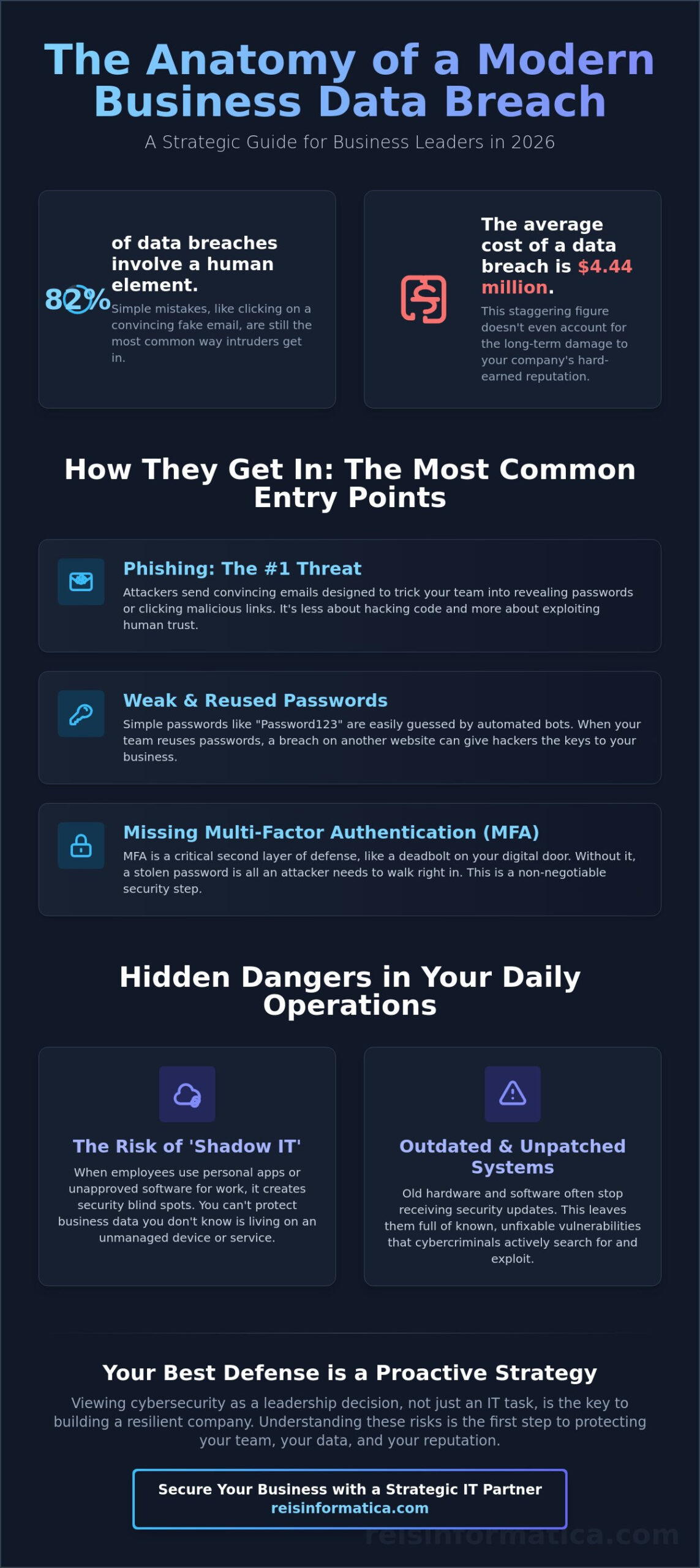
Did you know that 82% of data breaches still involve a human element like a simple phishing email or a small mistake? Even with the global average cost of a breach sitting at $4.44 million in 2025, many leaders still view business data breach prevention as a purely technical chore for the IT department. In reality, staying secure in 2026 is a strategic leadership decision that protects your company’s hard-earned reputation and long-term assets.
You’re likely worried about the damage a single leak could do to your brand, or perhaps you’re feeling overwhelmed by the complex patchwork of new privacy laws like PIPEDA. It’s completely normal to feel a bit lost when security experts start throwing around jargon you don’t use in your daily operations. This guide is designed to cut through that noise and show you how to protect your business using practical, non-technical strategies. We’ll explore the current risk landscape, break down actionable prevention steps, and help you gain the peace of mind needed to focus on your core business goals.
Key Takeaways
- Learn why high-profile security incidents serve as a vital wake-up call for Canadian leaders to redefine how they protect sensitive information.
- Identify your company’s biggest vulnerabilities, focusing on why phishing and credential theft remain the most common entry points for hackers.
- Master the essential steps for business data breach prevention, starting with the non-negotiable implementation of Multi-Factor Authentication.
- Discover how to build a “Human Firewall” by transforming your team into a proactive line of defense through regular, engaging security awareness.
- Understand how a strategic IT partnership provides the vigilance and leadership needed to navigate complex compliance and ensure business continuity.
What is a Business Data Breach? Lessons from the Blue Jays Hack
At its core, what is a data breach? It’s more than just a technical error; it’s a fundamental violation of the trust your clients place in you when they share their sensitive information. While many leaders associate these events with massive global corporations, the reality of business data breach prevention starts with understanding that no operation is truly under the radar in 2026.
Take the “Blue Jays Today” incident from early 2025 as a prime example. While it wasn’t a breach of the baseball organization’s corporate servers, the hacking of their popular fan-run YouTube channel served as a loud wake-up call for Canadian businesses. It proved that even community-focused entities can have their digital presence hijacked in an instant. If you have a digital footprint, you have something worth stealing.
The long-term cost of a breach goes far beyond the immediate financial hit. While the global average cost of a breach reached $4.44 million in 2025, the permanent stain on your reputation is often what halts a company’s growth. This is especially true for SMEs in growing hubs like Kitchener and Waterloo, where local trust is the foundation of every successful contract.
The Reality of Modern Cyber Threats in Canada
A data breach occurs when sensitive business or customer information is accessed without permission, effectively shattering the relationship of trust you’ve built with your audience. As local companies embrace digital transformation, they unintentionally expand their “attack surface.” Every new cloud tool or digital process is a potential entry point that requires professional cybersecurity services to monitor and protect.
Why ‘It Won’t Happen to Us’ is a Dangerous Strategy
It’s a common myth that hackers only target the giants. In reality, modern cybercriminals use automated bots that scan the internet for weaknesses 24 hours a day. These bots don’t care about your annual revenue or your company size; they only care about finding an unlocked door. Relying on being “too small to notice” isn’t a strategy, it’s a vulnerability. Effective business data breach prevention requires accepting that your business is a target and acting before the bots find a way in.
How Data Breaches Happen: Identifying Your Vulnerabilities
To build an effective strategy for business data breach prevention, you first need to see your company through a hacker’s eyes. They aren’t always looking for a complex technical back door; they usually look for the easiest path. This often involves exploiting human psychology or simple oversight rather than sophisticated code. Understanding these weak spots is the first step toward a secure, stable operation.
Common Entry Points for Cybercriminals
Phishing remains the primary way attackers gain access. Think of it as “digital social engineering.” Instead of picking a lock, a hacker sends a convincing email that tricks an employee into handing over the keys. This is why investing in cybersecurity awareness is just as vital as any software. When your team can spot a fake, the attack stops before it starts. Beyond phishing, hackers frequently exploit:
- Weak Passwords: Using simple phrases like “Password123” or reusing the same password across multiple accounts.
- Lack of MFA: Failing to use Multi-Factor Authentication, which provides a critical second layer of defense.
- Stolen Credentials: Using logins leaked from other breaches to try and access your corporate network.
The Risk of Shadow IT and Unmanaged Devices
In our remote-work era, “Shadow IT” has become a silent threat. This happens when staff use personal apps or unmanaged devices to handle business data without your knowledge. While they often do this to be more efficient, it creates gaps in your security perimeter. Without a clear policy and professional cybersecurity services, you lose visibility into where your data is actually living. Even an accidental file share by a well-meaning employee can lead to a crisis.
Many businesses also fall into the trap of thinking “if it ain’t broke, don’t fix it” with their legacy hardware. Using outdated systems is a recipe for disaster since they lack modern security patches. If you find yourself facing a vulnerability, the FTC’s Data Breach Response Guide provides a solid framework for response. However, the ultimate goal for business data breach prevention is always to stop the leak before it happens. This requires keeping your systems updated, your devices managed, and your team informed about the risks they face every day.
5 Proactive Strategies for Business Data Breach Prevention
Moving from understanding risks to taking action is where your leadership truly counts. Effective business data breach prevention isn’t about buying every piece of software on the market; it’s about building a layered defense that makes your company an unattractive target for hackers. Here are five practical steps you can take right now to secure your operations.
- Step 1: Mandate Multi-Factor Authentication (MFA). This is your most powerful tool. By requiring a second form of verification, you block the vast majority of automated attacks even if a password is stolen.
- Step 2: Cultivate a “Human Firewall.” Since 82% of breaches involve human error, regular training turns your staff from a vulnerability into a proactive defense force.
- Step 3: Secure Your Perimeter. Professional network security services act like a high-tech fence around your digital property, filtering out threats before they reach your internal systems.
- Step 4: Practice Least Privilege. Don’t give everyone the “master key.” Employees should only have access to the specific data and tools required for their daily tasks.
- Step 5: Conduct Regular IT Audits. You don’t know what you don’t see. Regular check-ups help you find and patch security holes before they can be exploited by outsiders.
Strengthening Your Identity and Access Management
Think of MFA as the deadbolt on your digital front door; a password alone is just a simple latch that’s too easy to bypass. It’s the single most effective deterrent against account takeovers because it adds a layer of verification that stolen passwords simply cannot satisfy. For many businesses, this starts with securing your core productivity tools through expert Microsoft 365 Security configurations that protect your email and files around the clock.
Proactive Monitoring: The Role of EDR and MDR
Traditional antivirus software is reactive; it only looks for known “bad” files. Modern Endpoint Detection and Response (EDR) is “always-on” threat detection that watches for suspicious behavior in real-time. This proactive approach saves significant money by isolating a threat the moment it appears, preventing it from spreading across your entire network. While you hope to never need it, having a plan like the Data Breach Response: A Guide for Business is essential for overall resilience. Ready to harden your defenses? Our team can help you implement these cybersecurity services to ensure your business stays ahead of evolving threats.
Building a Resilient Future with a Strategic IT Partner
Cybersecurity isn’t a one-time destination; it’s a continuous journey. Whether you’re operating a firm in Calgary or a growing business in Halifax, the threat landscape evolves every single day. This makes business data breach prevention an ongoing operational priority rather than a simple checkbox on a yearly to-do list. As hackers refine their methods, your defenses must adapt in kind to keep your assets safe.
The value of a Managed IT Service Provider lies in their ability to provide the constant vigilance required to spot anomalies before they turn into crises. Beyond just monitoring your network, a Virtual CIO (vCIO) works with you to ensure your security budget actually supports your long-term business goals. This strategic leadership helps you stay on the right side of Canadian regulations like PIPEDA and various provincial privacy laws without getting bogged down in complex legal jargon.
The Reis Informatica Approach to Peace of Mind
We focus on building local relationships that matter. With our presence in Kitchener, Waterloo, and surrounding areas, we offer rapid support that feels like an extension of your own team. We specialize in helping non-technical leaders make confident, informed decisions about their cybersecurity services. You don’t need to be an IT expert to maintain a secure operation; you just need a partner who speaks the language of business results and operational stability.
Your Next Steps: The Cybersecurity Audit
Don’t start your security journey by making random software purchases. The most effective business data breach prevention starts with a comprehensive assessment of where your company stands today. This audit identifies your specific gaps and helps us build a tailored Incident Response Plan. Having a clear roadmap ensures that if an issue does arise, your team knows exactly how to react to maintain business continuity and protect your professional reputation.
Taking Charge of Your Business Security Journey
Protecting your company in 2026 requires more than just a piece of software; it’s about a consistent commitment to operational stability. We’ve explored how identifying vulnerabilities like phishing and implementing layered defenses like MFA can significantly reduce your risk. By shifting from a reactive mindset to one of proactive business data breach prevention, you ensure that your team, your data, and your reputation remain secure against evolving threats.
Reis Informatica is here to act as your strategic partner and vigilant guardian. We serve businesses across Canada, from Kitchener to Calgary, offering the vCIO leadership and proactive threat monitoring needed to keep your operations running smoothly. You don’t need to be a technical expert to make confident decisions about your company’s safety. When you have a clear roadmap and professional support, you can stop worrying about “what if” and start focusing on your core goals.
Ready to harden your defenses? Secure your business future—Book a Cybersecurity Audit with Reis Informatica today. It’s the first step toward the peace of mind you deserve.
Frequently Asked Questions
What is the most common cause of a business data breach in 2026?
The human element remains the leading cause of security incidents, accounting for 82% of all breaches according to industry data from May 2026. This typically includes phishing attacks where employees are tricked into clicking malicious links or social engineering where they’re manipulated into sharing sensitive credentials. Effective business data breach prevention starts with addressing these human vulnerabilities through education and better internal processes.
How much does it cost a small business to recover from a data breach?
Recovery costs depend on the volume and type of data lost, with the global average cost of a breach sitting at $4.44 million in 2025. On a more granular level, industry reports from early 2026 show that remediating a single compromised customer record costs approximately $160. These figures include legal fees, notification costs, and the technical work required to secure the environment after an incident has occurred.
Does my business insurance cover data breaches and cyberattacks?
Standard commercial general liability policies rarely provide the comprehensive coverage needed to handle a modern cyberattack. You’ll likely need a dedicated cyber insurance policy to cover costs like forensic investigations, ransom payments, and regulatory fines. It’s best to review your current policy with your provider to see if it specifically addresses data theft and the high costs of business interruption.
How often should our employees undergo cybersecurity awareness training?
Cybersecurity training should be an ongoing part of your company culture rather than a yearly checkbox. Most experts recommend quarterly sessions or monthly micro-learning modules to keep security top of mind for your staff. Regular training ensures that your team can recognize new, sophisticated phishing tactics that automated filters might miss, reinforcing your business data breach prevention efforts.
What are the legal requirements for Canadian businesses after a data breach?
Under the Personal Information Protection and Electronic Documents Act (PIPEDA), Canadian businesses must report breaches to the Privacy Commissioner if they pose a real risk of significant harm to individuals. You’re also required to notify affected customers and keep records of all security incidents for at least 24 months. Some provinces have additional requirements, so it’s vital to consult with a professional who understands the specific privacy laws in your region.