
Imagine it’s 9:00 AM on a Monday in Calgary, and your entire network suddenly goes dark. For many Canadian businesses, every hour of downtime costs an average of C$137,000 according to industry data from 2024. You know that waiting on hold for an automated system or a slow email ticket isn’t just frustrating; it’s a direct hit to your bottom line. You need fast response IT support that puts a human technician on the line immediately to protect your revenue and your reputation.
We understand that you’re tired of unpredictable repair bills and tech issues that seem to pop up at the worst possible moments. You deserve a partner who acts as a vigilant guardian for your infrastructure, catching vulnerabilities before they turn into full scale emergencies. In this article, you’ll learn how rapid response times and proactive monitoring minimize downtime while keeping your data safe. We’ll explore how shifting to a managed service model provides predictable monthly costs and the peace of mind you need to focus on your core business goals in Kitchener and across Canada.
Key Takeaways
- Calculate the hidden cost of technical delays and learn how to protect your Canadian business from the “Downtime Tax.”
- Discover how proactive monitoring and AI-driven triage resolve most infrastructure issues before your team even encounters a problem.
- Learn why fast response IT support is your most vital defense for neutralizing cybersecurity threats and ransomware in real-time.
- Master the essentials of Service Level Agreements (SLAs) to ensure your technology partner is held to the highest standards of accountability.
- Explore why localized expertise in hubs like Kitchener and Calgary provides the strategic proximity needed for seamless business continuity.
What is Fast Response IT Support and Why Does It Matter?
When your server goes down or a critical software error blocks your sales team, every minute feels like an hour. True fast response IT support isn’t just about getting an automated “ticket received” email. It’s about immediate human intervention from experts who understand that your business continuity is on the line. To understand the tiers of help available, it’s helpful to look at what is technical support? and how structured levels of expertise ensure your problems reach the right person quickly.
Most Canadian SMEs are moving away from the outdated “break-fix” model. In that old system, you only called a technician when something stopped working, leading to unpredictable bills and long wait times. The foundation of fast response IT support is the shift toward a proactive partnership. By choosing professional IT services, you’re opting for a team that monitors your systems 24/7 to catch ripples before they become waves. This approach ensures that when a glitch does occur, the resolution is rapid because the provider already knows your infrastructure inside and out.
Employee morale takes a direct hit when technology fails. If your staff in Calgary or Kitchener spends hours fighting with a printer or a frozen cloud application, they feel unsupported and frustrated. This technical friction erodes the trust your clients have in your brand. If a customer calls and your team can’t access their data because the system is “lagging,” that customer might look for a more reliable competitor by the end of the day.
The Hidden Costs of Slow IT
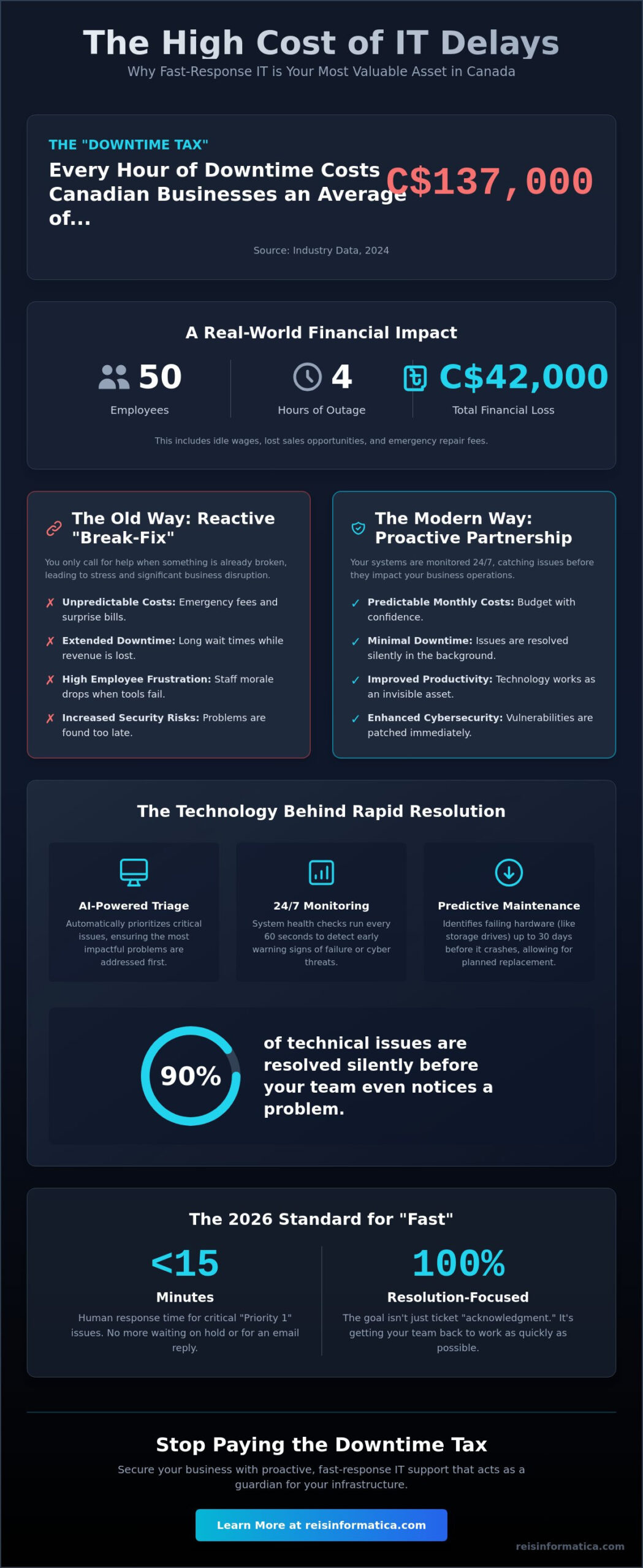
The “Downtime Tax” is a very real financial burden for businesses in the Kitchener-Waterloo tech corridor. Beyond the obvious loss of sales, you have to account for the “recovery tail,” which is the time it takes for employees to regain their focus once systems are back online. For a mid-sized Canadian firm with 50 employees, a 4-hour total system outage results in an average financial loss of C$42,000 when you calculate idle wages, lost opportunities, and emergency repair fees. These numbers show that waiting for a slow technician is often more expensive than the repair itself.
Defining “Fast” in 2026
By 2026 standards, the definition of speed has changed. It’s vital to distinguish between “acknowledgment time” and “resolution time.” An acknowledgment is just a notification, but resolution is when your team is back to work. Industry benchmarks now demand that critical “Priority 1” issues receive a human response within 15 minutes. 24/7 monitoring is now a requirement for any firm handling sensitive data, as it allows for “silent fixes” that happen while your team is asleep. If your current provider takes more than an hour to start working on a critical ticket, your business is operating at a competitive disadvantage in the Canadian market.
How Modern IT Teams Achieve Rapid Resolution
Achieving fast response IT support requires more than just a large team of technicians. It demands a sophisticated blend of automated systems and strategic local placement. Modern IT providers have moved away from the outdated break-fix model. Instead, they utilize a monitor-resolve approach that keeps business operations running without interruption. This shift ensures that technology remains an invisible asset rather than a source of daily frustration.
Speed is often the byproduct of preparation. By the time a user realizes a system is slow, an optimized IT team has likely already received an alert and begun the remediation process. This transition from reactive to proactive support is what separates standard help desks from high-performance technology partners.
AI and Automation in Support
Artificial intelligence now serves as the first line of defense for modern businesses. These AI business solutions automatically categorize and prioritize support tickets based on their potential impact. For example, a server failure at a Calgary distribution hub is instantly flagged as a critical priority, while a minor software update request is queued for standard processing. This automated triage ensures that resources are always directed where they are needed most.
System health checks run in the background every 60 seconds. These checks look for early warning signs of hardware fatigue or software conflicts. Predictive maintenance can identify a failing storage drive up to 30 days before it actually crashes. By catching these issues early, IT teams resolve approximately 90% of technical glitches before an employee even notices a problem. This level of vigilance is your strongest cybersecurity defense, as it prevents vulnerabilities from being exploited by external threats.
The Human Element of Speed
While automation handles the routine, the human element determines the outcome of complex issues. Speed depends heavily on who answers the phone. We provide clients with direct access to Tier 2 and Tier 3 technicians. You won’t spend 20 minutes explaining a problem to a gatekeeper who is simply reading from a basic script. You speak directly to specialists who have the authority and knowledge to make immediate changes.
Continuous education is a non-negotiable standard for our team. Support staff undergoes rigorous training every 90 days to master the latest business applications and security protocols. This expertise is a core component of our managed IT services. When a technician understands the specific workflow of a Mississauga law firm or a Kitchener manufacturing plant, they can solve problems in minutes rather than hours.
Remote support tools allow for instant over-the-shoulder assistance. A technician can see exactly what is happening on a user’s screen and take control to fix the issue immediately. This eliminates the need for travel time for software-related hurdles. However, physical hardware failures still require a boots-on-the-ground approach. Maintaining a local presence in cities like Calgary and Mississauga ensures that if a router or switch fails physically, a technician can be on-site with replacement hardware in record time. If you want to see how a more proactive approach can stabilize your network, you might consider looking into strategic IT consulting for your next project.
Fast Response as Your Best Cybersecurity Defense
Cybersecurity is a race against the clock. If a breach starts at 2:00 PM, a response at 2:15 PM might save your sensitive data, while waiting until 4:00 PM could result in total system loss. In 2026, hackers use automated scripts that scan for vulnerabilities thousands of times per second. This means your defense must be just as agile. Rapid patch management is your first line of protection, closing security holes before attackers can exploit them. Waiting even 24 hours to apply a critical update is a risk most Canadian businesses can’t afford.
Effective fast response IT support relies on strict incident response protocols. Within the first 15 minutes of a detected threat, the goal is to isolate the affected segment of your network. This containment strategy minimizes the “blast radius,” ensuring a single infected device doesn’t lead to a company-wide shutdown. These timelines aren’t just goals; they’re often defined in professional IT Support SLAs that hold your provider accountable for your digital safety.
Stopping Ransomware in Its Tracks
Ransomware thrives on hesitation. Once it enters a network, it begins encrypting files immediately to maximize leverage. We use constant network monitoring to spot these patterns the moment they start. Slow response times are a gift to cybercriminals, giving them the hours they need to exfiltrate data. By isolating threats instantly, we protect your backups and your reputation. You can learn more about our specific cybersecurity services to see how we stay ahead of these evolving threats.
Compliance and Reporting
Meeting Canadian data protection standards, such as PIPEDA, requires more than just good firewalls. It requires rapid incident logging and reporting. When you respond quickly, you create a clear audit trail that demonstrates due diligence to regulators. Fast response also supports your cyber insurance requirements. Many Canadian insurers now demand proof of active monitoring and 24/7 response capabilities before they’ll approve a claim or renew a policy. For a deeper look at the human side of this defense, refer to our guide on Cybersecurity Awareness in 2026.
Evaluating IT Support SLAs: What to Look For
A Service Level Agreement (SLA) acts as your operational safety net. It’s a formal commitment that defines exactly what you can expect from your technology partner. Without one, you’re essentially relying on “best efforts,” which doesn’t protect your bottom line during a crisis. For businesses in Kitchener or Calgary, having fast response IT support backed by a legal guarantee ensures that technical glitches don’t turn into day-long outages. In 2026, where downtime costs for Canadian mid-sized businesses can reach upwards of C$5,600 per minute according to recent industry benchmarks, an SLA is your primary insurance policy.
Providers categorize issues by severity to manage their workflow. A “Critical” ticket usually involves a total system failure, a ransomware attack, or a security breach affecting the whole office. “Non-critical” issues might involve a single user needing a software update. You need to ensure your contract defines these levels clearly. If your definition of a crisis doesn’t match your provider’s, you’ll find yourself waiting while your revenue disappears. Most software issues are solved remotely within minutes, but physical hardware failures require boots on the ground. A strong SLA specifies different timelines for both remote and on-site assistance.
The Components of a Strong SLA
Look for a 15-minute response time for critical issues. This doesn’t mean the fix is finished in 15 minutes; it means a qualified technician has actively started working on your ticket. Your agreement should also include 99.9% uptime guarantees for cloud services. This ensures your data remains accessible to your team. Finally, check for clear escalation paths. If the first technician can’t solve the problem within an hour, who is the senior specialist next in line? A transparent process prevents your ticket from sitting in a queue.
Questions to Ask Your Potential IT Partner
Don’t sign a contract until you’ve asked about their local track record. Ask: “What is your average resolution time for Kitchener-based clients?” A reputable provider should have performance data from the last 12 months ready for review. Also, confirm if they provide 24/7 support or just standard business hours. Since many Canadian firms operate across multiple time zones, a “9 to 5” support model is often insufficient. Use our Managed IT Guide to vet providers effectively before you commit to a long-term partnership.
Watch out for the “fine print” in IT contracts. Some providers include exclusions for “user-induced damage” or “legacy hardware” that might let them ignore certain tickets. Ensure the contract doesn’t hide extra fees for after-hours work if you’ve already paid for a premium support package. You want a partner who takes full responsibility for your infrastructure, not one who looks for excuses to bill you extra when things go wrong.
View our IT support packages to see how we guarantee your business uptime.
Localized IT Support from Mississauga to Halifax
Choosing between a massive national firm and a tiny local shop used to be a compromise. You either got scale without personal service or personal service without the resources to handle a crisis. In 2026, we’ve bridged that gap. Reis Informática provides fast response IT support that scales from the tech-heavy corridors of Kitchener, Waterloo, and Cambridge to the bustling energy sector in Calgary. We know that a business in Milton has different compliance needs than one in Halifax, and our team is built to respect those nuances. Our commitment is about proactivity. We don’t just wait for a server to fail; we monitor your systems to ensure they don’t. This approach gives you the tranquility to focus on your quarterly targets instead of worrying about network uptime.
Our Local Footprint Across Canada
Our presence in Mississauga and the GTA allows us to reach local offices within 60 to 90 minutes when on-site help is required. We’ve also strengthened our operations in London and Halifax to ensure operational continuity for clients with multi-province footprints. Having technicians who understand the local business landscape means we aren’t just reading from a script. We know the local ISPs, we understand regional weather risks to infrastructure, and we’re familiar with the specific talent markets in these hubs. For Calgary businesses, our rapid response teams handle the unique connectivity challenges of the Western Canadian market, ensuring your remote sites and main offices stay synchronized 24/7/365.
The Reis Informática Difference
We believe technology should be a silent partner in your success. Our team handles the technical complexity so you can prioritize business growth. By creating custom technology roadmaps aligned with your 2026 goals, we ensure your IT spend is an investment, not just an expense. We’ve helped partners build a resilient foundation with infrastructure services that adapt as they scale. This strategic oversight ensures you aren’t just reacting to the market; you’re leading it. With our fast response IT support, your team stays productive, your data stays secure, and your business stays ready for whatever comes next. We act as your vigilant partner, assuming full responsibility for your digital health so you can lead with confidence.
Secure Your Business Growth with Proactive Technology Management
Technology should empower your business, not hold it back with unexpected downtime or security gaps. Choosing fast response IT support means you’re prioritizing operational continuity and protecting your bottom line from the high costs of technical delays. By partnering with experts who understand the Canadian landscape, you gain a vigilant ally dedicated to your success. Waiting hours for a fix isn’t just frustrating; it’s a risk to your reputation and productivity that modern businesses can’t afford.
Reis Informatica delivers peace of mind through local technicians stationed in 8 major Canadian cities, ensuring help is always nearby when you need it most. Our team maintains an average 15-minute response time for critical issues, so your operations stay fluid. We’re so confident in our ability to stabilize your infrastructure that we offer a 90-day money-back satisfaction guarantee. It’s time to stop worrying about your server health and start focusing on your core business goals.
Request a Fast Response IT Audit for Your Business and see how a strategic partnership transforms your daily operations. Your path to a more stable and secure digital future starts today.
Frequently Asked Questions
What is the average response time for IT support in Kitchener?
Our standard for fast response IT support in Kitchener targets a 15 minute initial reply for all critical system failures. Industry benchmarks from the Canadian Federation of Independent Business suggest downtime costs small firms an average of C$427 per hour. We prioritize immediate triage to keep your local operations running without these expensive interruptions. Our team focuses on restoring your workflow so you can stay productive.
Can IT support be handled remotely for my Calgary office?
Yes, we resolve approximately 94% of technical issues for Calgary businesses through secure remote access tools. This approach eliminates travel time and ensures your staff returns to work much faster. Our team uses encrypted connections to troubleshoot server errors or software glitches instantly. It’s a reliable way to manage your infrastructure without needing a technician physically present in your office every day.
Does fast response IT support include 24/7 monitoring?
Comprehensive fast response IT support includes 24/7 proactive monitoring to catch vulnerabilities before they cause a full system crash. We track your network health every 60 seconds to identify hardware failures or unusual traffic patterns. This vigilant approach ensures that most problems are identified and fixed at 3:00 AM. You’ll enjoy peace of mind knowing your systems are ready when your team starts their day.
How does rapid IT support help with cybersecurity?
Rapid response is your best defense against data breaches because the average cost of a Canadian data breach reached C$6.94 million in 2024. When a threat is detected, every second matters to isolate infected machines and stop the spread. Our team acts within minutes to contain incidents, protecting your intellectual property and reputation. We act as a vigilant guardian for your digital assets.
What happens if my IT issue requires an on-site visit in Mississauga?
If a hardware failure prevents remote access, we dispatch a technician to your Mississauga location within 4 hours for emergency repairs. We maintain a local presence to ensure physical issues, like a failed router or server component, don’t stall your business for days. This hybrid model guarantees that your infrastructure stays robust through both digital and physical interventions when you need them most.
Are there different response times for cloud vs. on-premise issues?
Cloud issues often see faster resolution because they don’t depend on physical hardware availability or technician travel. While on-premise repairs might require a 2 hour window for parts delivery, cloud configurations can often be adjusted in under 10 minutes. We maintain strict Service Level Agreements for both environments. This ensures your productivity remains high across all platforms regardless of where your data lives.
How much does fast response IT support cost for a small business?
Canadian small businesses typically invest between C$100 and C$250 per user, per month for managed IT services, based on 2025 market analysis. This flat fee covers proactive maintenance and emergency support, making IT costs predictable for your budget. Investing in a fixed-rate plan prevents the financial shock of unexpected emergency repair bills. It’s a strategic way to ensure your technology remains an asset rather than a liability.