
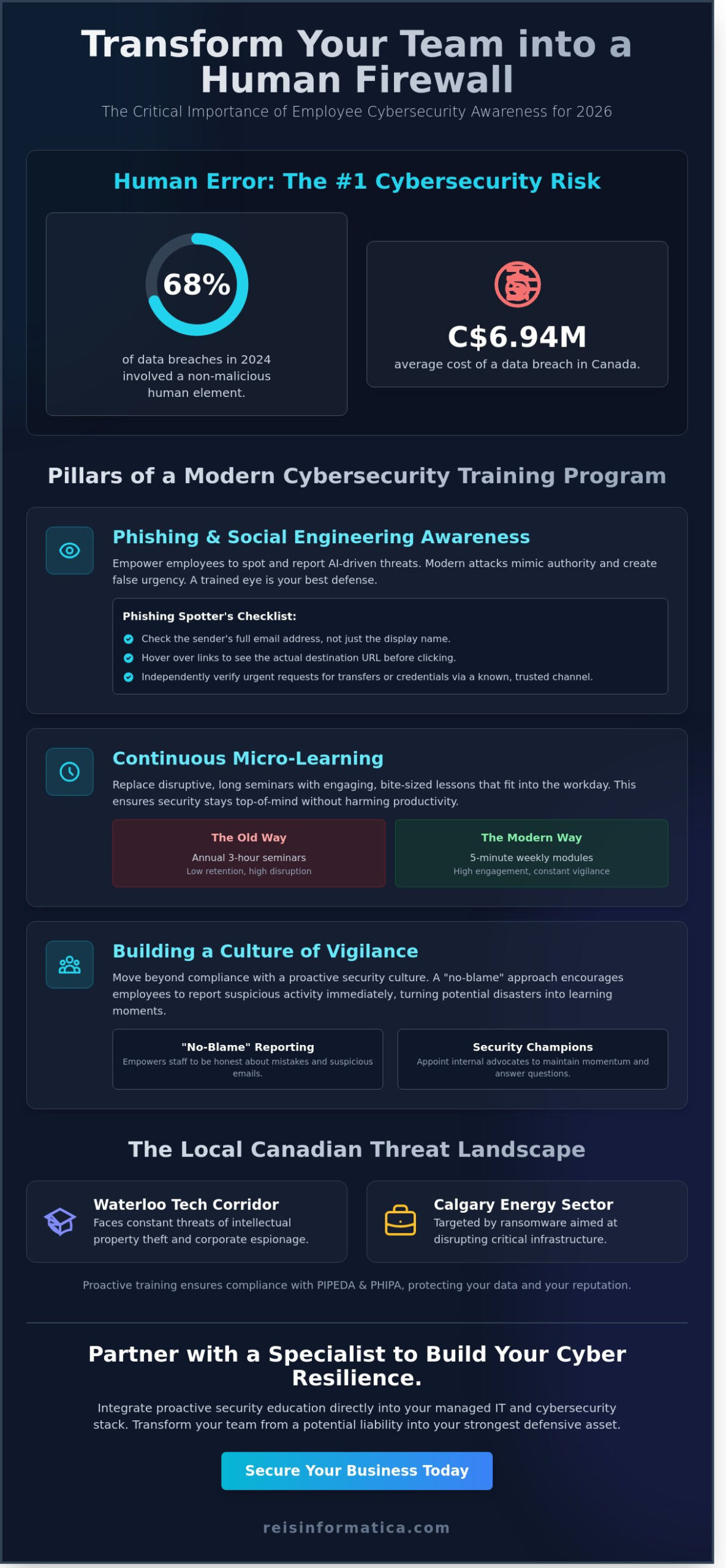
Did you know that 68% of data breaches in 2024 involved a non-malicious human element, such as an employee accidentally clicking a phishing link? You’ve likely felt that familiar knot in your stomach when an unverified attachment arrives in your inbox. It’s frustrating to watch team members ignore security protocols while the threat of ransomware looms over your operations. This is why employee cybersecurity awareness training has become the most critical investment for American firms looking to secure their future.
We’ll show you how to transform your team into a proactive human firewall to protect your US business from the evolving digital threats of 2026. You don’t need to be a technical expert to build a culture of security that actually works. We’re going to examine the most reliable training platforms available and provide a clear strategy to ensure your technology remains a quiet, efficient engine for your growth rather than a source of constant worry.
Key Takeaways
- Understand why businesses in Kitchener and Mississauga are prime targets in 2026 and how to transform your staff into a resilient human firewall.
- Discover the essential pillars of a modern employee cybersecurity awareness training program designed to be accessible for non-technical team members.
- Learn how interactive phishing simulations and a “no-blame” culture empower your employees to recognize and report digital threats in real-time.
- Identify strategies for moving beyond annual compliance by appointing internal Security Champions to maintain a culture of constant vigilance.
- Explore the benefits of partnering with a local specialist to integrate proactive security education directly into your managed IT and cybersecurity stack.
The Growing Need for Employee Cybersecurity Awareness Training in Canada
Employee cybersecurity awareness training isn’t just a technical checkbox for IT departments. It’s a strategic business investment that safeguards your company’s financial future. As we approach 2026, Canadian businesses in Kitchener and Mississauga have become prime targets for international threat actors. These regions host high concentrations of manufacturing, tech innovation, and professional services, making them lucrative marks for data theft and extortion. Modern attackers have pivoted away from trying to break through firewalls with brute force. They prefer social engineering, which exploits human trust rather than software vulnerabilities. Integrating Security awareness into your corporate culture creates a defensive layer that technical tools alone cannot provide. Data from the 2023 IBM Cost of a Data Breach Report shows the average cost of a data breach in Canada reached C$6.94 million. Proactive education represents a small fraction of that potential loss, offering a clear return on investment through immediate risk mitigation.
Why Human Error is the #1 Security Risk
Industry research frequently confirms that up to 90% of successful breaches start with a human mistake. Hackers don’t always look for a back door in your code; they look for a front door held open by an unsuspecting employee. They use psychological tactics, such as creating artificial urgency or mimicking authority figures, to bypass even the most expensive security software. Our approach fosters a Vigilant Specialist mindset within your team. We teach your staff to recognize these emotional triggers before they click a malicious link or share credentials. This proactive stance ensures your cybersecurity services are supported by people who act as a human firewall. When your team knows what to look for, they stop being a liability and become your strongest asset.
The Local Threat Landscape: Ontario to Alberta
Regional threats in Canada are becoming increasingly specialized. Waterloo’s tech corridor faces constant intellectual property theft attempts, while Calgary’s energy sector deals with ransomware targeted at critical infrastructure. Beyond the immediate financial hits, Canadian regulations like PIPEDA and Ontario’s PHIPA mandate strict data protection measures for any business handling personal or health information. Non-compliance leads to heavy fines and a total loss of client trust. Cyber resilience is the capacity of a Canadian organization to maintain its core purpose and data integrity while under the stress of an active cyber attack. By prioritizing employee cybersecurity awareness training, you ensure your business remains compliant with federal laws while protecting the local reputation you’ve worked hard to build.
Essential Pillars of a Modern Cybersecurity Training Program
Modern employee cybersecurity awareness training isn’t a once-a-year event anymore. By 2026, the most effective programs will focus on continuous, bite-sized modules that respect your team’s time. We see productivity drop significantly when staff are forced into three-hour technical seminars. Micro-learning fixes this by delivering five-minute lessons that actually stick. This approach ensures that security stays at the front of the mind without becoming a burden on daily operations. It’s about building a culture where safety is intuitive, not a chore.
Your training content must be accessible to everyone, from the accounting department to the sales team on the road. Technical jargon often creates a barrier that leads to disengagement. Instead, we focus on clear, actionable advice that empowers your staff to act as the first line of defense. As AI-driven threats become more sophisticated, your training must evolve to address how attackers use automation to scale their efforts. Investing in your people is just as vital as investing in your IT services infrastructure.
Phishing Awareness and Social Engineering
AI has changed the game for scammers. Hackers now use deepfake audio to mimic a manager’s voice in a quick phone call or generate highly personalized spear-phishing emails that contain no spelling errors. Your team needs to know that an “urgent” request for a wire transfer might be a trap, even if it sounds legitimate. Following a step-by-step guide to phishing simulation helps build a “human firewall” that catches what software might miss. We recommend a simple checklist for every employee:
- Check the sender’s actual email address, not just the display name.
- Be wary of unusual urgency or requests for sensitive data.
- Hover over links to see the real destination before clicking.
If you’re looking to strengthen these defenses, our cybersecurity services provide the tools needed to stay ahead of these evolving tactics.
Password Hygiene and Multi-Factor Authentication (MFA)
The era of simply adding a capital letter and a number to a password is over. We’re moving toward the use of passkeys and hardware tokens that provide physical proof of identity. It’s vital to explain the “why” behind MFA to your team. When staff understand that MFA stops 99.9% of bulk automated attacks, resistance usually turns into cooperation. This layer of protection acts as a safety net for your business data, ensuring that a single leaked password doesn’t lead to a total breach.
Safe Remote Work and Mobile Security
Whether your team is working from a local cafe in Milton or a home office in Halifax, the risks are constant. Public Wi-Fi is a common playground for data interception, making secure connections a non-negotiable requirement. We also advocate for “clean desk” policies in the modern home office. This means ensuring sensitive Canadian client information isn’t visible during video calls or left out where guests can see it. Securing corporate data on personal devices requires a clear strategy that protects company assets without overstepping into employee privacy. For a smooth transition to these secure environments, consider how cloud services can help centralize and protect your data regardless of where your team is located.
Phishing Simulations: Testing Your Human Firewall
Phishing simulations aren’t about tricking your staff. They’re about “learning by doing.” Reading a manual is one thing, but spotting a deceptive email in a crowded inbox is a different skill entirely. These simulations turn passive listeners into active defenders. This hands-on approach is a cornerstone of effective employee cybersecurity awareness training because it builds muscle memory for security.
A “no-blame” culture is vital for these tests to work. If an employee clicks a simulated link and feels shamed or punished, they’ll stop reporting suspicious activity. That’s a disaster for your security. Instead, use a “click” as a teachable moment. When someone “fails,” provide immediate feedback. A quick, friendly pop-up explaining the red flags they missed helps the lesson stick without creating resentment. This approach fosters a partnership between your team and your IT experts.
The data you gather from these simulations is gold. It helps you identify high-risk departments that might need extra support. If your sales team is clicking at a 20% rate while accounting is at 2%, you know exactly where to focus your resources. This targeted strategy ensures you aren’t wasting time on generic training that doesn’t address your specific vulnerabilities.
How to Run Effective Phishing Simulations
Consistency keeps your team alert without making them paranoid. Aim for a monthly schedule. For a Canadian accounting or HR department, use scenarios that feel real. A fake email regarding a C$1,200 payroll discrepancy or a fraudulent CRA tax document is highly effective. Don’t limit yourself to email. Test for “smishing” (SMS phishing) and malicious QR codes. These vectors are becoming common in the Canadian market, and your team needs to recognize them on their mobile devices too.
Measuring Success and ROI
You can’t manage what you don’t measure. Track these three key metrics to see your progress:
- Click Rates: The percentage of staff who fall for the simulation.
- Reporting Rates: How many employees used the “Report Phishing” button. This is your most important metric.
- Time-to-Detection: How quickly your team identifies and reports the threat.
High reporting rates give business owners real tranquility. You’ll see your risk level drop as your “human firewall” strengthens. For long-term planning, link these results to your IT Strategy and Leadership. This ensures your employee cybersecurity awareness training evolves as your business grows and as new threats emerge in the digital landscape.
Building a Culture of Vigilance in Your Local Office
Treating employee cybersecurity awareness training as a yearly compliance chore is a recipe for disaster. According to the 2023 Verizon Data Breach Investigations Report, 74% of all breaches include a human element. This means your team is your biggest vulnerability, but they can also be your strongest shield. Real security happens when vigilance becomes a daily habit rather than a slide deck viewed once every 12 months.
One effective strategy involves appointing “Security Champions” within each department. These aren’t IT staff; they’re influential team members in Finance, HR, or Sales who receive extra training. They act as the first point of contact for colleagues’ questions, making security feel like a peer-to-peer conversation and less like a mandate from the basement. When a manager in Sales models secure behavior, the rest of the team follows suit. Leadership must set the tone by participating in every drill and openly discussing the importance of data protection during quarterly meetings.
Positive reinforcement works better than fear. Instead of just punishing those who fail phishing tests, implement a reward system. Small incentives, like a C$25 gift card for the first person to report a simulated attack, can transform a passive workforce into an active defense line. This gamification keeps the team engaged and makes the threat landscape feel tangible.
Integrating Security into Onboarding
The first 90 days of an employee’s tenure are critical for setting expectations. During this window, habits are formed. Training should be role-specific; a Finance employee needs deep dives into wire transfer fraud, while Sales teams should focus on social engineering. Robust Infrastructure Services provide the foundation for this culture, ensuring that security protocols are integrated into every workflow from the moment an employee receives their credentials.
Addressing the Remote and Hybrid Workforce
Whether your team is working from an office in Cambridge, a home in Mississauga, or a shared space in London, the security culture must remain unified. Distance shouldn’t mean a drop in standards. Utilizing secure Cloud Services ensures that your team has safe, centralized access to data, regardless of their physical location. This consistency helps maintain a “security-first” mindset across the entire organization, keeping your Canadian business resilient against evolving threats.
Ready to strengthen your frontline and protect your business? Explore our cybersecurity services to build a custom training plan today.
Partnering with Reis Informatica for Local Cyber Resilience
Building a resilient business requires more than just software updates and firewalls. It demands a culture of constant vigilance. At Reis Informatica, we act as your “Vigilant Partner,” ensuring that your team isn’t just a group of users, but a robust human firewall. We integrate employee cybersecurity awareness training directly into our Managed IT and Cybersecurity stacks. This means security isn’t treated as a side project; it’s a core component of your daily operations.
Our approach focuses on eliminating technological worries so you can concentrate on your primary business goals. We don’t just provide tools; we provide a strategic partnership that prioritizes uptime and data integrity. By choosing a partner that understands the specific threats targeting Canadian infrastructure, you gain a level of protection that generic solutions simply can’t match.
Why a Managed Approach Beats DIY Training
Many business owners try the DIY route by using generic online videos or static PDF guides. These often fail because they lack the local context needed to recognize sophisticated threats. For instance, a generic course might not cover the specific phishing tactics used against Canadian tax filers or regional businesses. We handle all the technical complexity through our AI Business Solutions, which allows you to grow your company while we monitor the perimeter.
Having experts on the ground in Kitchener, Calgary, and Halifax makes a significant difference in response time and relevance. When a critical issue arises, you aren’t calling a generic call center in a different time zone. You’re talking to a partner who understands the Canadian business environment and the regulatory requirements your company must meet. We move away from the reactive “break-fix” model and toward a proactive stance that stops threats before they enter your network.
Your Next Steps to a Secure Workforce
Strengthening your defense starts with a clear understanding of your current vulnerabilities. We recommend starting with a formal audit of your existing protocols to identify where your team is most at risk. You can start a conversation with your staff today by asking how they would handle an urgent, unexpected request for a wire transfer from a senior executive. If their answer involves any hesitation or lack of a verification process, your business is at risk.
Don’t wait for a security breach to realize that your staff needed better employee cybersecurity awareness training. A proactive posture is the only way to maintain operational continuity and protect your reputation. Our team is ready to help you build a culture of safety that lasts. To get started, book a consultation with our experts and let’s secure your business together.
Empowering Your Team for a Resilient 2026
Securing your business in Kitchener or Waterloo starts with recognizing that your staff is your strongest asset against digital threats. By 2026, cyberattacks in Canada are projected to grow in complexity, making proactive measures essential for survival. Modern programs focus on more than just basic rules; they use phishing simulations to build a human firewall that identifies risks before they reach your network. This shift from a reactive stance to a culture of constant vigilance ensures your operations remain uninterrupted and compliant with evolving Canadian data standards.
Reis Informatica provides the local expertise needed to navigate these challenges. With support across 8 or more Canadian cities, our team delivers vigilant, proactive monitoring that keeps your infrastructure stable. We specialize in Canadian compliance standards, ensuring your business meets every regulatory requirement while your team stays sharp. Investing in comprehensive employee cybersecurity awareness training isn’t just about protection; it’s about giving yourself the peace of mind to focus on growth.
Secure your business with expert Cybersecurity Awareness Training from Reis Informatica
You’ve built a great business, and we’re here to help you keep it safe.
Frequently Asked Questions
What is employee cybersecurity awareness training and why is it important?
Employee cybersecurity awareness training is a structured educational program that helps your staff recognize and avoid digital threats like phishing and social engineering. It’s a critical investment because 82% of data breaches involve a human element according to the 2022 Verizon Data Breach Investigations Report. This proactive approach gives business owners the peace of mind that their digital assets are protected by a vigilant team.
Without this knowledge, your staff might accidentally grant hackers access to your entire network through a simple mistake. Training transforms your employees from a potential vulnerability into your strongest line of defense. It builds a culture of security where every team member feels responsible for protecting the company’s sensitive information and operational continuity.
How often should Canadian businesses conduct cybersecurity training?
Canadian businesses should conduct training sessions at least every 90 days to ensure security protocols stay fresh in everyone’s minds. A study by USENIX demonstrated that an employee’s ability to identify phishing attempts declines significantly just four months after their last training session. Consistent reinforcement ensures that security protocols become a natural part of the daily workflow for every team member.
Annual training is no longer sufficient to keep up with the rapidly evolving tactics used by cybercriminals. By implementing quarterly updates, you provide your team with the latest information on emerging threats. This regular cadence helps maintain a high level of alertness and ensures that your business remains resilient against new types of digital attacks.
Is phishing simulation training effective for small teams?
Phishing simulations are incredibly effective for small teams because they provide safe, hands-on practice with real-world scenarios. Statistics show that regular testing can drop the click rate on malicious links from 30% down to 2% within the first 12 months of implementation. This practical approach builds muscle memory that simple reading materials or videos can’t replicate on their own.
Small teams often have employees who handle multiple roles, making them prime targets for targeted attacks. Simulations allow you to identify specific knowledge gaps without risking actual data loss. These exercises provide personalized feedback, allowing for targeted improvements where they are needed most to keep your entire organization secure and focused on growth.
What are the most common cyber threats for businesses in Ontario and Alberta?
Ransomware and Business Email Compromise (BEC) are the most persistent threats facing businesses across Ontario and Alberta. The Canadian Centre for Cyber Security reported that the average cost of a data breach in Canada reached C$7.05 million in 2023. Energy firms in Alberta and financial services in Ontario are often specifically targeted due to the high value of their data.
Hackers frequently use localized lures, such as fake invoices or provincial tax documents, to trick employees into clicking malicious links. These threats can disrupt your operations and cause significant financial damage if your team isn’t prepared. Understanding these specific regional risks allows you to tailor your defense strategies and protect your company’s long-term stability.
How much does cybersecurity training cost for a mid-sized company?
For a mid-sized company, the cost for employee cybersecurity awareness training typically ranges from C$25 to C$100 per user annually. These figures come from industry benchmarks for comprehensive cloud-based platforms that include automated simulations and detailed reporting. Investing in these tools is a proactive way to avoid the much higher costs associated with a successful cyberattack or data breach.
The total investment depends on the depth of the curriculum and the frequency of the simulations you choose to run. Most modern platforms offer tiered pricing based on the number of employees, making it easier to scale the program as your business grows. This predictable cost structure helps you manage your IT budget while ensuring your infrastructure remains protected.
Can cybersecurity training help with PIPEDA or PHIPA compliance?
Yes, this training is a fundamental requirement for complying with PIPEDA and Ontario’s PHIPA regulations. Both laws mandate that organizations implement administrative safeguards to protect personal and health information. Regular training sessions provide the documented proof you need to show regulators that your team is prepared to handle sensitive data in a secure and legal manner.
Maintaining these standards protects your business from legal liabilities and potential fines that can arise from non-compliance. It also builds trust with your Canadian clients and partners who expect their data to be handled with the highest level of care. By prioritizing compliance, you demonstrate your commitment to professional integrity and the protection of client privacy.
What happens if an employee fails a phishing simulation?
If an employee fails a simulation, they should receive immediate remedial training instead of a formal reprimand. This “just-in-time” learning approach uses the mistake as a teaching tool while the experience is still fresh in the employee’s mind. It helps foster a supportive environment where staff feel confident reporting real threats rather than hiding their errors out of fear.
Turning a failure into a positive learning moment is much more effective for long-term retention than punishment. You can track these results to see which individuals or departments might need extra support in future sessions. This data-driven approach allows you to refine your strategy and ensure that everyone eventually reaches the same high standard of cybersecurity proficiency.
How do we train remote employees who work from multiple locations like Mississauga and Calgary?
You can effectively deliver employee cybersecurity awareness training to remote teams in Mississauga and Calgary using a centralized cloud-based platform. These systems allow your management team to deploy lessons and track progress across different provinces simultaneously. This ensures your security standards remain consistent regardless of where your team members are logging in from each day.
By using digital modules, you eliminate the logistical challenges of on-site workshops and ensure every employee receives the same high-quality instruction. Remote workers often face unique risks, such as using home networks or public Wi-Fi, which these programs can address specifically. This modern approach to training keeps your distributed workforce connected, informed, and ready to defend your business from any location.