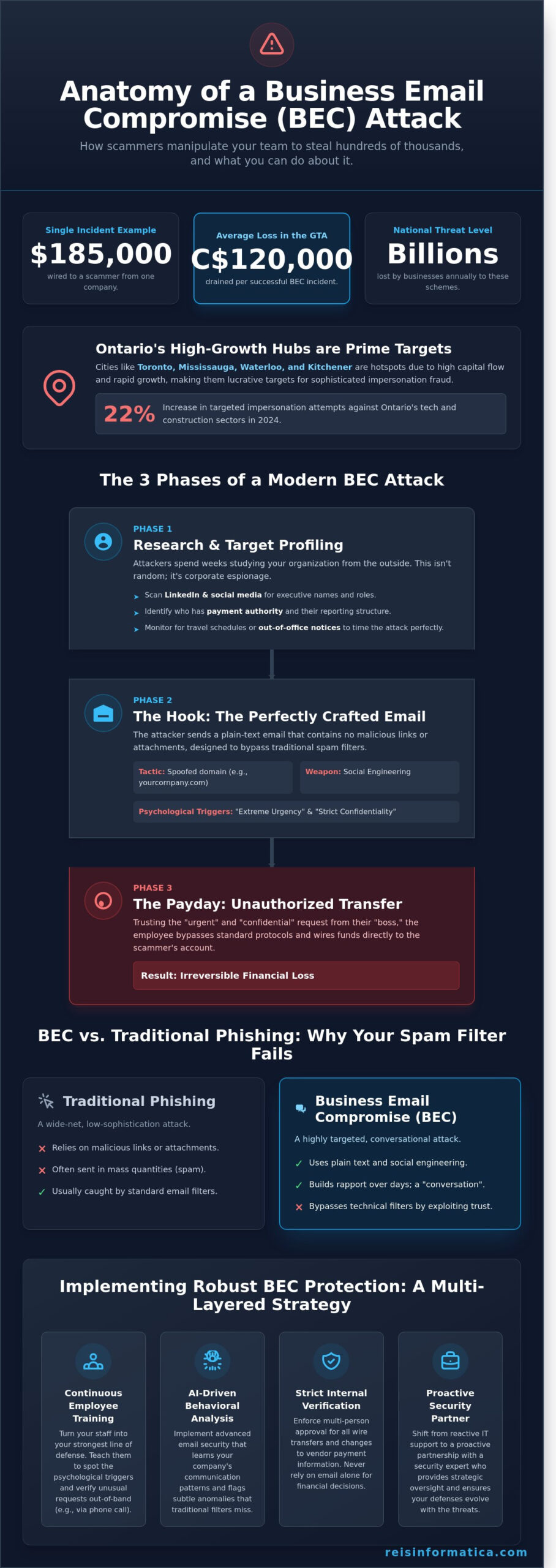
Imagine arriving at your office on a Tuesday morning to discover your controller accidentally wired $185,000 to a scammer posing as a long-term vendor. In 2023, the FBI’s Internet Crime Complaint Center (IC3) reported that businesses lost billions to these exact schemes, and that figure is only rising as we head into 2026. You likely feel that your current systems should catch these threats, yet the fear of one sophisticated email slipping through is a heavy burden. Implementing effective business email compromise protection shouldn’t feel like learning a second language or waiting for the next disaster to strike.
It’s understandable to feel overwhelmed by technical jargon or uncertain if your IT support is truly ahead of the curve. You deserve a clear path to security that doesn’t require a computer science degree. This guide will show you how to shield your company with a multi-layered strategy, ensuring your business enjoys predictable costs and total peace of mind. We’ll outline a practical roadmap for employee training and technical safeguards that turns your staff into your strongest line of defense.
Key Takeaways
Learn why high-growth Ontario hubs like Kitchener and Mississauga are prime targets for impersonation fraud and how to spot these sophisticated attacks before they start.
Understand the two-phase anatomy of a breach, from the deep research of your leadership team to the high-pressure “hook” that leads to financial loss.
Discover how implementing robust business email compromise protection through AI-driven behavioral analysis can catch subtle red flags that traditional filters miss.
Identify why partnering with a local security expert in the Toronto area provides the accountability and strategic oversight needed to safeguard your organization’s future.
Shift your mindset from reactive tech support to a proactive partnership model that ensures your business continuity remains uninterrupted and secure.
What is Business Email Compromise (BEC) and Why is it Targeting Ontario Businesses?
Business Email Compromise isn’t a virus that breaks your computer or encrypts your files. It’s a digital con game. Scammers pretend to be someone you trust, like a CEO or a long-term vendor, to trick you into sending money or sensitive data. According to the Canadian Centre for Cyber Security, 2023 saw a sharp rise in these attacks because they’re incredibly lucrative. To understand the basics, you can review the community-vetted definition of What is Business Email Compromise (BEC). Unlike a standard hack, this is a targeted strike on your business processes.
Fraudsters focus on high-growth hubs like Waterloo and Mississauga because that’s where the capital flows. In 2024, the tech and construction sectors in Ontario saw a 22% increase in targeted impersonation attempts. These companies often have enough cash flow to be targets but lack the robust cybersecurity services needed to catch a sophisticated 2026-era “Whaling” attack. In this landscape, scammers use AI to mimic an executive’s writing style perfectly, making “CEO Fraud” harder to detect than ever before.
The financial hit is massive. While a simple malware infection might cost C$5,000 to remediate, a single successful BEC wire transfer redirection in the GTA now averages C$120,000 per incident. It’s a direct drain on your liquidity that can’t always be recovered by banks.
The Local Threat: Why Toronto and Calgary are Hotspots
Scammers spend weeks researching local corporate hierarchies using public data and LinkedIn profiles. Toronto and Calgary are primary targets due to the high volume of B2B transactions in finance and energy. Common tactics include:
Invoice Redirection: A fraudster intercepts a conversation between a Calgary oil firm and its supplier, then sends a fake C$90,000 invoice with “new” banking details.
Psychological Triggers: Attackers use “extreme urgency” or “confidentiality” to pressure an employee into bypassing standard office protocols.
Executive Impersonation: Using a spoofed email to ask a junior accountant for an urgent gift card purchase or wire transfer.
BEC vs. Phishing: Understanding the Difference
Your current spam filter likely misses these attacks. Standard phishing relies on malicious links or attachments, but BEC is a “conversation.” The attacker might spend three days building rapport through plain-text emails that contain no red-flag code. Social engineering is the weapon here. Effective business email compromise protection requires monitoring for behavioral shifts and unusual communication patterns. It’s about securing the human element and the workflow, not just the inbox. Since BEC bypasses technical barriers by exploiting trust, business email compromise protection must include both advanced AI filtering and strict internal verification steps.
How Modern BEC Attacks Work: The Anatomy of a Breach
Modern cybercrime isn’t a random event. It’s a calculated, multi-stage operation that targets the weakest link in any organization: the human element. Unlike traditional spam, these attacks don’t rely on malicious links or attachments that your antivirus might catch. Instead, they use social engineering to trick employees into handing over money or sensitive data willingly.
Phase 1 involves deep research and target profiling. Attackers spend weeks studying your leadership team using public data from LinkedIn, social media, and your corporate website. They identify who has the authority to sign off on payments and who they report to. They also look for travel schedules or out-of-office notices to time their strike perfectly. This level of preparation makes modern scams incredibly convincing.
Phase 2 is the “Hook.” The criminal sends a perfectly timed email that mimics a legitimate request, often using a spoofed domain that looks nearly identical to your own. Effective business email compromise protection is critical here, as these emails often bypass traditional filters by using high-reputation domains. Understanding how to protect against BEC attacks is vital for your staff, especially when faced with a message that demands immediate action.
Phase 3 is the “Payday.” Once a staff member initiates a transfer, the funds are routed through a series of “mule” accounts. By the time the fraud is discovered, the money has often left Canada and landed in offshore accounts where recovery is nearly impossible. In 2026, these threats have evolved to a point where specialized cybersecurity services are necessary to detect the subtle anomalies that the human eye simply misses.
The Three Most Common Scenarios
CEO Fraud: An employee in the finance department receives an “urgent” request from the CEO, who claims to be at a conference and needs a C$35,000 wire transfer handled immediately for a “confidential deal.”
The Fake Invoice: Criminals intercept an email thread with a regular vendor and send an “updated” invoice with new banking details, redirecting a scheduled payment to a fraudulent account.
Payroll Divergence: An attacker emails HR pretending to be a senior manager, asking to update their direct deposit information just before a large bonus cycle or monthly pay date.
The Role of AI in 2026 Scams
AI tools now allow hackers to analyze thousands of past emails to perfectly replicate an executive’s tone, vocabulary, and even their common typos. Vishing has also surged; this is where deep-fake audio makes a phone call sound exactly like your CFO confirming a fraudulent email request. Experts define AI-driven BEC as the most significant threat to Canadian mid-market firms in 2026. Implementing robust business email compromise protection isn’t just about software; it’s about creating a culture of verification. If you’re concerned about your current vulnerabilities, a quick review of your IT services strategy can provide much-needed clarity.
Key Features of Robust Business Email Compromise Protection
Securing your Toronto enterprise requires more than a simple password. Modern attackers use social engineering to mimic your voice, making business email compromise protection a multi-layered necessity. AI doesn’t just look for viruses; it looks for intent. By utilizing AI business solutions, your system can analyze historical communication data to identify shifts in syntax or tone. If a controller usually signs off with “Regards” but suddenly sends an urgent request ending in “Thanks!”, the system flags it. It’s about spotting the anomaly before a wire transfer happens.
Multi-Factor Authentication (MFA) is your non-negotiable baseline. Microsoft’s 2023 data indicates that MFA blocks 99.9% of account compromise attacks. Beyond MFA, your domain needs its own technical “ID cards.” We implement SPF, DKIM, and DMARC protocols to verify your identity. These records tell receiving servers exactly who is authorized to send mail on your behalf. DMARC specifically instructs servers to reject fraudulent mail, ensuring your brand reputation stays intact across Ontario.
Technical Safety Nets
Zero Trust architecture ensures that every access request is verified, regardless of where it originates. We also deploy automated warning banners. When an email arrives from an external source but uses a name identical to your CEO, a bright alert reminds the recipient to stay cautious. Every attachment and link undergoes real-time scanning. This process strips away hidden payloads before they reach your inbox, providing a proactive shield for your team.
The Human Firewall: Awareness Training
Technology is only half the battle. Your team in London or Ottawa needs to be ready. Annual training sessions are outdated because tactics evolve too fast. We recommend monthly simulations that mirror real-world threats. Effective business email compromise protection relies on a “verify before you wire” policy. You must foster a culture where a junior employee feels safe calling the CEO to confirm a C$25,000 invoice request. This psychological safety prevents costly mistakes and builds long-term organizational resilience.
Monthly Simulations: Keeps security top-of-mind for all staff.
Verification Protocols: Mandatory second-channel confirmation for all financial changes.
Real-time Reporting: Easy “one-click” buttons for employees to report suspicious emails.
Choosing the Right Security Partner in Your City
Selecting a local security partner in Kitchener or Milton provides a level of accountability that offshore help desks simply cannot provide. When your business faces a potential breach, you need a team that understands the Ontario business environment and the specific threats targeting the GTA. A local partner is a neighbor who shares your regulatory concerns and time zone, ensuring that your business email compromise protection is managed by people who are personally invested in your success.
A tech vendor sells you a software license and leaves the configuration to you. In contrast, a strategic IT partner takes ownership of your digital safety. They integrate managed IT services to provide 24/7 vigilance, acting as a watchful guardian over your network. This proactive approach means they are hunting for threats while your team sleeps, stopping unauthorized access before a single cent leaves your Canadian bank account.
Speed is the most critical factor when an employee flags a suspicious request. If a fraudulent email asks for a C$25,000 wire transfer, you cannot afford to wait 24 hours for a ticket response. A reliable partner provides immediate feedback, analyzing headers and metadata to confirm the email’s legitimacy. This rapid intervention prevents the “human error” that leads to most financial losses in Toronto businesses today.
Questions to Ask Your Potential Provider
Do you provide local support for businesses in the GTA and beyond? You need to know if they can be on-site if a critical incident occurs.
How do you integrate email security with our overall cloud services? Security should never be a standalone silo; it must be part of your entire digital infrastructure.
Can you provide references from other Canadian businesses in our industry? Hearing from peers in Kitchener or Milton confirms the provider understands your specific operational challenges.
Red Flags in Cybersecurity Providers
Be wary of any provider promising 100% protection through a single software tool. Technology is only one part of the solution. If a provider ignores employee training or doesn’t help you improve your internal financial processes, they are leaving the door wide open. Avoid the reactive “break-fix” model; if they only show up after the money is gone, they aren’t a partner, they are a witness to your loss. True security requires a proactive stance that prioritizes prevention over recovery.
At Reis Informática, we operate as your Vigilant Partner. We don’t just install software; we take full responsibility for your digital safety. Our team understands that Canadian business owners need more than just a help desk. You need a guard who watches the perimeter while you focus on growth. Whether you’re managing a boutique firm in Halifax or a large manufacturing plant in Calgary, we build customized protection plans that reflect your specific operational risks. According to the 2023 Canadian Centre for Cyber Security report, the average cost of a data breach in Canada has climbed to over C$6.9 million. We’re here to ensure your company stays on the right side of those statistics.
Our style is consultative and straightforward. We avoid the confusing jargon that often clutters the IT industry. Instead, we explain your risks and solutions in plain language that makes sense for your bottom line. You’ll gain the peace of mind that comes from knowing your infrastructure is guarded by experts who prioritize your business continuity above all else. We treat your security with the same urgency you do.
Our Local Commitment
We have deep roots in the Kitchener, Waterloo, and Cambridge tech corridors, which gives us a unique perspective on the challenges facing Ontario businesses. Our team provides fast, on-the-ground support for operations in Mississauga, Toronto, and London. We don’t believe in one-size-fits-all solutions. Our strategic IT leadership scales alongside your business, providing the high-level guidance you need as your team grows from five employees to five hundred. We’re your neighbors, and we’re invested in your success.
Take the First Step Toward Total Email Security
Waiting for a breach to happen is a strategy that costs Canadian businesses millions every year. A proactive cybersecurity audit is the most effective way to identify vulnerabilities before they can be exploited. We specialize in robust business email compromise protection that stops attackers before they reach your inbox. Our team simplifies the entire transition process, ensuring that moving to a more secure environment doesn’t disrupt your daily workflow. We handle the technical complexity so you can enjoy a seamless, protected experience.
Identify hidden vulnerabilities in your current email setup.
Implement multi-layered authentication that stops 99% of automated attacks.
Train your staff to recognize sophisticated phishing attempts.
Establish clear protocols for wire transfers and sensitive data handling.
Secure Your Organization’s Future in an Evolving Threat Landscape
Safeguarding your revenue means moving beyond basic passwords. By 2026, cybercriminals will use sophisticated deepfake audio and AI-generated phishing to bypass traditional filters. You’ve learned that effective business email compromise protection requires a multi-layered strategy that combines 24/7 monitoring with proactive employee awareness. This approach ensures that your operations remain uninterrupted by the rising tide of digital fraud targeting Ontario businesses.
At Reis Informática, we provide strategic IT leadership designed for owners who want to focus on growth rather than technical jargon. We offer 100% Canadian-based support and leverage AI-driven security tools to block threats before they reach your inbox. Our team acts as your vigilant partner, ensuring your infrastructure stays resilient against both local and global attacks. We handle the technical complexity so you can lead with total confidence.
You don’t have to navigate these complexities alone. Let’s build a safer, more productive environment for your team to thrive in.
Frequently Asked Questions
Is standard office email security enough to stop BEC?
No, standard filters often fail because business email compromise attacks don’t always use malicious links or attachments. They rely on social engineering and impersonation tactics that bypass traditional spam detection. To ensure effective business email compromise protection, you need advanced AI-driven behavioral analysis that flags unusual communication patterns. These sophisticated attacks cost businesses over C$3.9 billion globally in 2023, proving that basic security isn’t enough to protect your bottom line.
How much does business email compromise protection cost in 2026?
In 2026, comprehensive protection typically costs between C$8 and C$15 per user every month. This investment covers advanced threat detection, automated response tools, and continuous monitoring. For a Toronto business with 25 employees, your annual budget would sit around C$2,400 to C$4,500. This is a small fraction of the C$150,000 average loss reported by Canadian small businesses after a successful breach. We provide a clear cost structure to help you plan effectively.
What should I do if an employee already clicked a suspicious link?
You must disconnect the device from the network immediately to prevent any potential malware from spreading. Change the employee’s credentials from a known secure device and enable a forced logout of all active sessions. Our team at Reis Informática recommends performing a full forensic audit of the account activity within 30 minutes of the click. This speed prevents hackers from establishing a permanent foothold in your infrastructure and protects your sensitive corporate data.
Can MFA (Multi-Factor Authentication) completely stop BEC attacks?
MFA is a critical layer that stops 99.9 percent of automated account takeover attempts, but it isn’t a silver bullet. Sophisticated hackers use session hijacking or “MFA fatigue” attacks where they spam your phone with approval requests until you click “yes” by mistake. You still need business email compromise protection that monitors for weird login locations and unusual account activity. Relying on MFA alone leaves you vulnerable to social engineering where an employee is tricked into approving a fake login.
How often should we conduct employee cybersecurity training?
You should conduct training sessions at least once every quarter to keep security top of mind. Research from 2024 shows that employee security awareness begins to drop significantly after just 4 months without a refresher. We recommend running simulated phishing tests monthly to keep your team vigilant. This consistent schedule ensures they can identify the latest tactics used by cybercriminals to target Canadian firms. Regular education turns your employees into a strong first line of defense.
Does Reis Informática support businesses outside of Ontario, like in Calgary or Halifax?
Yes, we provide full support to businesses in Calgary, Halifax, and across all Canadian provinces. Our remote monitoring and management tools allow us to secure your infrastructure regardless of your physical location. We currently manage systems for over 200 clients across Canada, ensuring their operations stay online and protected. Our team handles the technical complexity so you can focus on growing your business in any Canadian market with total peace of mind.
What is the most common sign of a BEC attack?
The most frequent red flag is a request for an urgent wire transfer or a sudden change in vendor payment details. About 70 percent of BEC incidents involve fraudulent invoices or payroll redirection requests. Look for slight misspellings in email addresses, such as “rnicrosoft.com” instead of “microsoft.com”. If a high-level executive asks for an unusual task with extreme urgency, always verify it through a separate phone call. Trusting your gut can save your company thousands of dollars.
Can AI really help detect fake emails from my boss?
Yes, modern AI tools analyze years of communication data to understand your boss’s unique writing style and typical request patterns. If an email arrives that uses different phrasing or asks for something outside of their normal behavior, the AI flags it instantly. These systems have a 95 percent success rate in identifying anomalies that a human eye would likely miss. It acts as a silent guardian for your inbox, providing an essential layer of security for your business.